
How Phone Size and Display Type Influence Price
Last updated: November 27, 2026
Quick answer: a 6.7-inch OLED or AMOLED phone is usually priced above a 6.1-inch LCD model, and 120 Hz or LTPO can push the number higher again. This article on How phone size and display type influence the final price explains that screen choice is one of the biggest early cost clues, so compare the display line before you compare storage, camera, or brand. If you are scanning a spec sheet, start with the panel type, then the size, then the refresh rate and resolution.
Key takeaways
- LCD phones usually sit on the lower end of the price ladder because the panel is simpler to build.
- OLED and AMOLED screens usually cost more because each pixel lights itself and the panel stack is more complex.
- LTPO display tech often adds another price step because it supports more efficient variable refresh behavior.
- Bigger screens can cost more, but size alone is not the only reason; the panel type and resolution matter too.
- A 120 Hz screen or a sharper 2K or 4K panel can push the price up even when the phone body is not much larger.
What part of the phone screen changes the price?
The display is one of the clearest price drivers in a phone, and the biggest jumps usually come from panel type, size, refresh rate, and resolution. A phone with an LCD panel can be cheaper than a similar phone with OLED or AMOLED, and a 6.7-inch screen can cost more than a 6.1-inch one if the rest of the spec is similar.
Specifically, the cost change is not just about glass. It also comes from the panel itself, the driver electronics, the backlight in LCD designs, and the way the screen is tuned for brightness, color, and power use. That is why the screen line in the spec sheet often explains part of the price gap before the camera or chip does.
For example, if you are reading the hub on what affects mobile phone prices, this is one of the first things to check because it appears in almost every model range. A buyer who skips the display line can easily compare two phones that look close on paper but land in different price bands for reasons that are hidden in the screen spec.
Why do OLED phones cost more than LCD phones?
OLED phones usually cost more than LCD phones because the panel design is more complex and offers richer contrast, thinner builds, and better black levels. In an LCD, the screen needs a backlight. In OLED and AMOLED, each pixel emits its own light, which changes the part count and the manufacturing process.
According to DisplayMate’s display testing coverage and Samsung Display’s technology pages, that extra complexity is one reason OLED panels tend to sit above LCDs in price-sensitive lineups. That cost shows up most clearly when two phones are otherwise similar. A midrange phone with an LCD panel can stay lower priced than a rival with an OLED panel even if both use the same storage tier and similar cameras. AMOLED is a form of OLED display technology, so it usually sits in the same higher-cost bucket as OLED.
The trade-off is simple. OLED and AMOLED often look better, but they can push the phone into a higher price tier. LCD is the more budget-friendly choice, but it usually gives you less contrast and less deep black performance. If price matters more than screen depth, LCD is the safer pick. If display quality matters more than saving money, OLED or AMOLED is the step up. See also our guides on LCD vs OLED phones and what phone specs mean.
How does phone size change the final price?
Phone size usually raises the final price because a larger panel costs more to make and often needs a larger body, a larger battery, and more internal space. A 6.7-inch phone is not automatically expensive, but it often lands above a 6.1-inch model when both use the same display type and general hardware tier.
Because of that, the size effect is strongest when the panel is also higher end. A large OLED panel costs more than a small LCD panel, so the two factors stack. That is why many bigger phones sit at the top of a product line even before the maker adds premium materials or stronger cameras.
| Screen factor | Typical price effect | What drives the cost |
|---|---|---|
| LCD | Lower | Simpler panel design and backlight setup |
| OLED / AMOLED | Higher | More complex panel build and self-lit pixels |
| LTPO display | Higher still | More advanced power and refresh control |
| Larger size | Usually higher | Bigger panel and more internal space needed |
| Higher resolution | Higher | More pixels to drive and tune |
| 120 Hz refresh rate | Higher | Faster panel response and added controller cost |
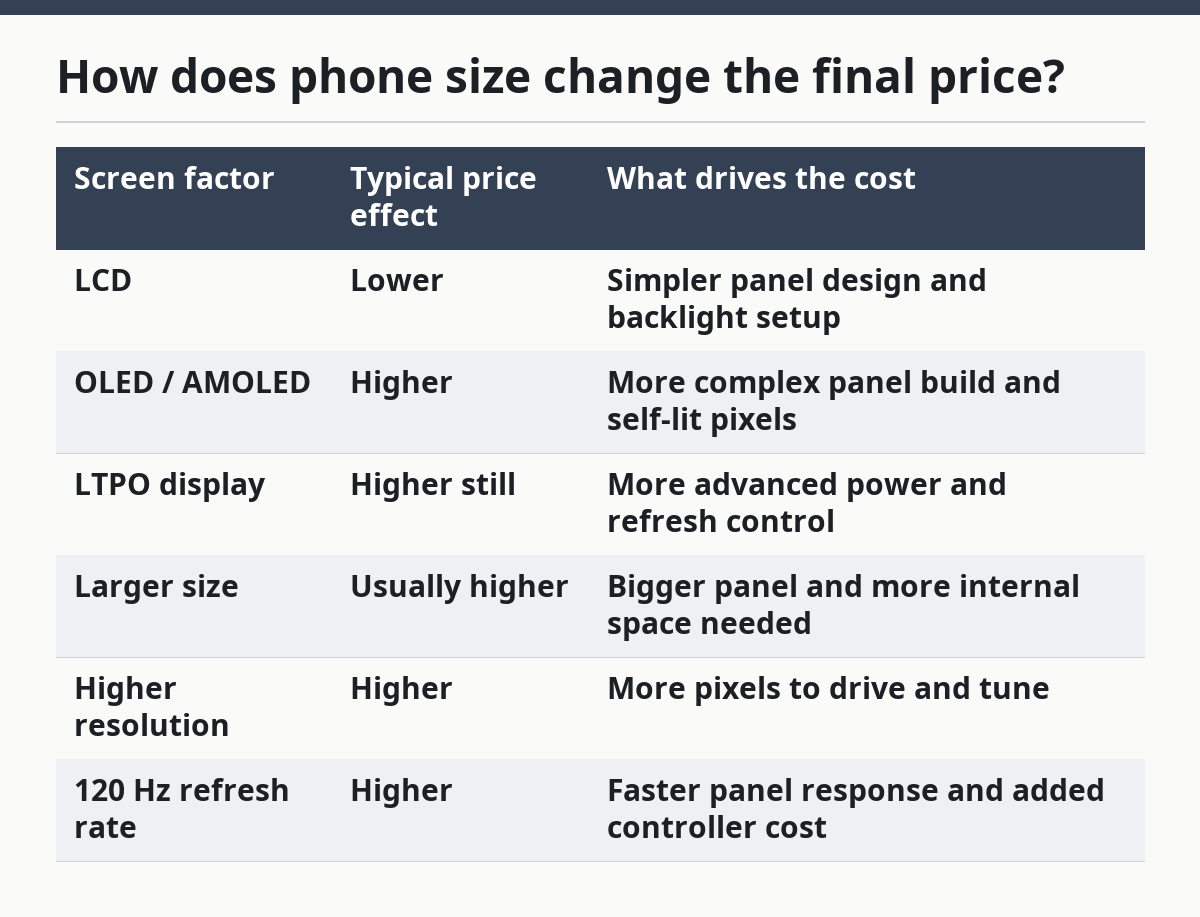
This is why size alone is a blunt measure. A small phone with an LTPO OLED panel can cost more than a larger phone with a plain LCD. If your only goal is a lower price, do not assume the smaller phone is always cheaper. Look at the full display line, and compare it with the rest of the handset on our phone comparison page.
Does refresh rate affect price?
Yes, refresh rate affects price, and 120 Hz usually costs more than 60 Hz. A higher refresh rate means the screen updates more often each second, which adds panel cost and can also increase the complexity of the controller and tuning.
That premium is not huge in every case, but it is real enough to move a phone from a basic price band into a higher one. A 60 Hz LCD is a common budget setup. A 120 Hz OLED or AMOLED screen usually appears higher up the stack, especially if the phone also has LTPO display tech or a larger size.
The trade-off is clear. Higher refresh rates can make scrolling and motion look smoother, but they add to the bill. If you are shopping for the lowest final price, a 60 Hz screen is one of the easiest places for a maker to cut cost. If you want the nicer feel of the screen and are willing to pay for it, 120 Hz is a common premium display choice you will see in the spec sheet. For a deeper look, see refresh rate explained and AMOLED vs LCD.
What happens when resolution goes up?
Higher resolution usually raises the price because the panel has to render more detail and use more advanced components. A sharper screen is not free, and phones with 2K or 4K panels often sit above models with lower-resolution displays, especially when the panel is also OLED, AMOLED, or LTPO.
That cost is not only about the panel itself. Higher resolution can also add pressure on performance and battery use, so the maker may need stronger supporting parts elsewhere in the phone. That helps explain why two phones with similar screen sizes can still land at different prices if one uses a denser display.
The practical point is simple: resolution is another layer of premium on top of size and panel type. A large, high-refresh OLED screen with high resolution is expensive territory. A smaller LCD with a standard resolution is usually the cheaper lane. If you are comparing phones by price only, resolution is worth checking before you compare storage tiers or camera counts.
How do you compare screen specs before buying?
Compare screen specs by checking panel type first, then size, then refresh rate, then resolution, and only after that compare the rest of the phone. That order tells you where the display is pushing the price up and where the maker is saving money.
- Find the panel type on the spec sheet. Look for LCD, OLED, AMOLED, or LTPO display. The result tells you the likely price tier before you read anything else.
- Check the size in inches. A 6.1-inch screen usually points to a lower cost than a 6.7-inch one if the rest of the display spec is close.
- Look for the refresh rate. A 60 Hz panel is usually cheaper than a 120 Hz panel, so this is a quick price clue.
- Check the resolution. Higher-resolution panels, such as 2K or 4K, usually mean a higher asking price.
- Match the full display spec to your budget. If you want a lower price, keep the screen simpler. If you want a better panel, expect the final price to rise.
One useful check is to compare only one screen variable at a time. If one phone has a larger OLED screen and another has a smaller LCD screen, you cannot tell which feature caused the price jump. A cleaner comparison is a 6.1-inch LCD versus a 6.1-inch OLED, or a 60 Hz OLED versus a 120 Hz OLED. That shows the cost of the screen choice itself.
When should you pay more for the screen?
You should pay more for the screen when display quality matters more to you than the lowest sticker price. OLED, AMOLED, LTPO, 120 Hz, and higher resolution all add cost, but they also change how the phone feels in daily use.
If your priority is the cheapest sensible phone, a smaller LCD with standard refresh rate is the better buy. It avoids the extra cost of an OLED panel, a 120 Hz refresh rate, and a large display. That choice is not for someone who wants the best-looking screen. It is for someone who wants the phone price to stay as low as possible.
If you spend a lot of time reading, scrolling, or watching video, the premium can make sense. The price jump is the trade-off for a display that is larger, smoother, or more advanced. The wrong choice is to pay for an LTPO display or a 4K panel when the phone will mostly be used for calls, messaging, and light browsing.
A good rule is this: buy the screen you will notice every day, not the one that sounds best on paper. That keeps the final price tied to real use instead of display marketing.
Drafted with AI; not yet reviewed by a person.