
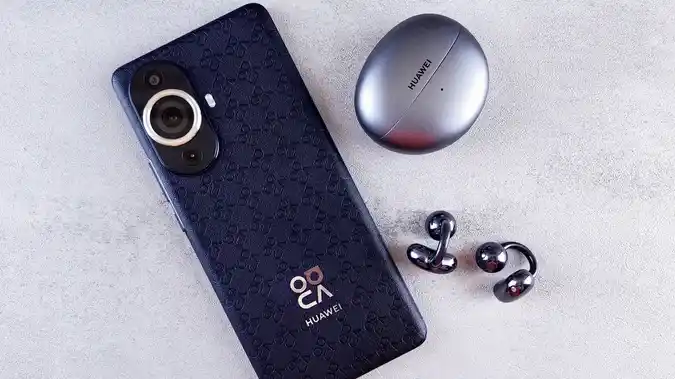
Why Limited Edition Phones Carry a Premium
Last updated: November 27, 2026
Quick Answer: limited edition phones carry a premium because makers usually produce fewer units, add costlier finishes, and sell into a collector market. Why limited edition phones carry a premium is a mix of small-batch production, special colorways or materials, and scarcity that some buyers will pay for. In many cases, the premium shows up most clearly on the same base model in a shorter run.
Key takeaways
- A limited edition phone costs more when the maker has higher unit costs and a smaller pool of buyers.
- Special finishes can add real production work, not just a different paint job.
- Collector demand matters most when the phone is clearly scarce and tied to a recognizable model.
- A premium is not always a sign of better performance or longer support, though it can reflect higher production cost or collector demand.
- This topic is about collector-driven scarcity pricing, not ordinary launch pricing or a normal color choice.
Why do limited edition phones cost more?
Limited edition phones carry a premium because the seller is charging for scarcity, extra production cost, and collector demand at the same time. A regular phone spreads factory setup, packaging, and distribution costs across a larger run; a limited edition model does that over far fewer units.
That smaller run changes the math fast. If a manufacturer makes only a narrow batch, it cannot rely on scale to pull the cost per phone down. It also has less room to absorb design changes, special boxes, engraved backs, or bundled accessories that are meant to make the phone feel exclusive.
Scarcity pricing is the other half of the premium. Once buyers believe there will not be another run, the phone is no longer just a tool; it becomes a collectible object. That is why a special colorway or themed edition can sell above the standard version even when the hardware is nearly the same.
The premium is usually strongest when the edition is tied to a known base model that already has demand. If the phone itself has little appeal, the “limited” label does not add much. A limited edition does not create value from nothing; it pushes up value where demand already exists.
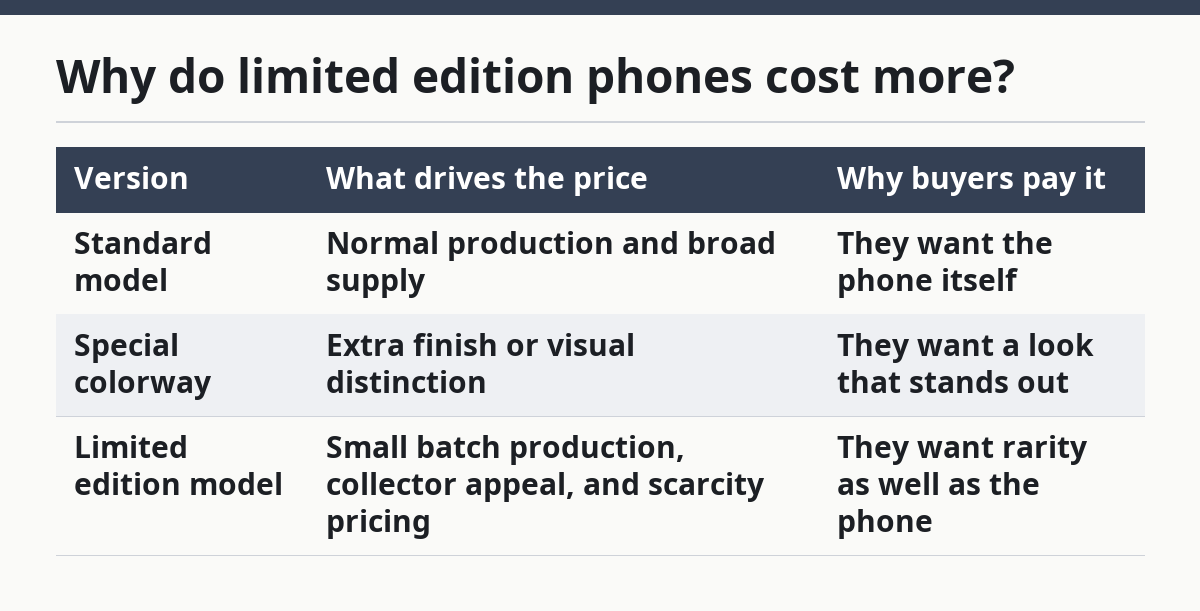
The comparison below shows the basic pattern.
| Version | What drives the price | Why buyers pay it |
|---|---|---|
| Standard model | Normal production and broad supply | They want the phone itself |
| Special colorway | Extra finish or visual distinction | They want a look that stands out |
| Limited edition model | Small batch production, collector appeal, and scarcity pricing | They want rarity as well as the phone |
For a wider view of pricing forces, this page sits under the site’s hub on what affects mobile phone prices and how to compare smartphone value.
What does small batch production change?
Small batch production raises price because it makes each unit carry more of the fixed work behind the phone. A factory line is expensive to set up, and a short run does not spread that cost across enough units to make each one cheap.
That is true even when the hardware is close to the standard model. A short production run can still mean a different finish process, a special back plate, custom box art, or an accessory bundle built for the edition. Each of those touches takes time, and time costs money.
A limited edition also creates waste risk. If the maker orders a special part for 5,000 units and demand falls short, the leftover stock has to be discounted, stored, or written off. Higher risk usually means a higher asking price from the start.
Because of that, a normal phone benefits from scale, while a limited edition pays for uniqueness. The fewer units made, the more each one has to carry the bill for setup, handling, and the special parts that separate it from the standard line.
What makes the finish cost more?
The finish costs more because a special exterior often needs extra materials, extra steps, or tighter quality checks. A special colorway can look simple from the outside and still require a different coating, a different print process, or a separate supply chain for a part that only appears in that edition.
A standard phone might use one common finish across a large run. A limited edition phone may need a different texture, a branded back panel, or an etched detail that must line up across the whole batch. Those changes are small on paper and expensive on the factory floor.
Packaging matters too. Limited editions often arrive in a box that is built to feel premium, not just to ship the device safely. That can include custom inserts, artwork, or a numbered label. None of that changes the phone’s core performance, but it changes the cost of making and presenting it.
This is where a generic explanation often gets it wrong. The premium is not always “because the company can charge more.” Sometimes the premium exists because the edition genuinely costs more to produce in low volume. The buyer is paying for a product that is harder to make cleanly at scale.
For a broader consumer lens, see the FTC’s shopping guidance and consumer phone buying checklist.
How collector demand pushes the price up
Collector demand pushes the price up because limited edition phones can become objects people want to own, not just use. Once a model is seen as scarce, the phone enters a collector market where rarity and condition matter as much as the spec sheet.
That demand can come from the model itself, the finish, or the story around the release. A limited edition model with a special colorway can feel more memorable than a standard phone, and buyers often pay for that difference even if the processor, camera, and battery are close to the base version.
Collector demand works best when supply is visibly small. If a phone is branded “limited” but still easy to find months later, the market learns that it is not truly scarce. The premium then weakens, because collectors care about the chance to own something other people cannot easily get.
This is also why the premium can be uneven. Two phones with similar hardware can have very different resale interest if one has stronger collector appeal. The value is not only in the device; it is in the story of the device and how many were made.
For resale context, compare phone resale value factors with how limited runs affect demand.
How can a buyer tell if the premium is worth it?
A buyer can tell by checking whether the extra cost comes from rarity, a special finish, or simple branding. The key question is not “Is it limited?” but “What am I getting that a standard model does not already provide?”
Use this short check before paying more:
- Compare the hardware first. Look at the chip, camera setup, storage, and battery against the standard model. If those parts are the same, the premium is mostly about appearance and rarity.
- Check the edition size or wording. If the release is only called “special” without clear limits, the collector angle is weaker. A true limited batch should be presented as a narrow run, not a vague theme.
- Look at the finish and packaging. A custom back, special box, or numbered card can explain part of the cost. If the outside looks different but the extras are thin, the premium may be mostly brand value.
- Think about your reason for buying. If you want a daily phone, the premium may bring no daily benefit. If you want a display piece or a collector item, the higher price can make sense.
- Compare against the standard model’s price gap. A small premium can be easier to justify than a large jump for a cosmetic change alone.
This approach keeps the decision grounded. It stops the buyer from paying collector money for a phone that delivers only a different finish and a louder label.
Who is the premium for, and who should skip it?
The premium is for buyers who value rarity, design, and collector interest more than pure value per feature. If the phone will live in a case, get daily wear, and be replaced on a normal cycle, the edition label may not earn its price.
It is often a poor fit for people who want the best hardware for the money. A standard model often gives the same core experience without the scarcity markup. That matters when the buyer cares about function, support, and resale value more than owning a phone that feels unusual.
The premium also does not suit buyers who dislike uncertainty. Limited edition phones can be hard to replace if they are damaged, and accessories or parts can be less common if the edition was short-lived. The collector upside comes with a practical downside: the rarer the phone, the less ordinary it can be to service or match later.
So the premium makes sense when the buyer wants exclusivity and accepts that the extra price is not paying for more power or a longer battery. It makes less sense when the buyer mainly wants a dependable handset and sees the limited label as decoration.
What the premium is really paying for
The premium is really paying for three things at once: fewer units, more expensive finishing, and stronger collector demand. Those forces often overlap, which is why the price can climb even when the phone’s core specs stay close to the standard version.

A generic article would stop at “supply and demand.” That is too thin for a phone buyer. The better answer is that limited edition phones carry a premium when the maker has to produce them in small batches, add special finishing work, and sell them into a market where rarity itself has value.
That is also why not every limited edition is worth paying more for. Some are true collector pieces with real scarcity. Others are just standard phones in a different color with a sharper story around them. The premium makes sense only when the buyer cares about the thing that is actually scarce.
Are limited edition phones always more expensive?
No. Some limited edition phones are priced the same as standard versions, and others lose their premium later if demand is weak. If the edition is mostly a branding move and the market does not care much about the finish or the story, the price gap can be small or even disappear later.
The premium appears when scarcity and collector interest line up. If buyers do not value the edition, the label alone does not guarantee a higher price.
Why do small production runs raise price?
Small production runs raise price because they spread factory setup, materials planning, and packaging work across fewer units. That pushes the cost per phone up before any collector premium is added.
The risk is higher too. If demand is wrong, the maker can be left with unsold stock, which makes the original price harder to keep low. In a short run, even a batch of 5,000 units can be enough to change the pricing logic.
Do collectors affect pricing?
Yes, collectors affect pricing because they are willing to pay for rarity, condition, and story. When a limited edition model has a clear identity and a small supply, collectors can pull the price above what the hardware alone would justify.
That effect is strongest when the phone is easy to recognize and hard to find. If the edition is common enough, collector demand fades and the premium weakens. Condition matters too: once the original box, inserts, and finish are gone, the collector value can drop even if the hardware is still the same.
For sourcing on rarity and resale behavior, see Counterpoint Research on the smartphone market and Apple support on device trade-ins and condition.
Drafted with AI; not yet reviewed by a person.