
How Retailer Margins and Distribution Costs Affect Phone Prices
Last updated: November 26, 2026
Quick answer: in this guide, the key number to watch is 30 days, because once a phone sits that long, stock holding costs can start pushing the shelf price up. In How Retailer Margins and Distribution Costs Affect Phone Prices, the wholesale price is only the starting point; retailer markup, channel pricing, stock holding cost, and the cost of moving phones through the distribution chain all get added before a shelf tag appears.
Key takeaways
- The shelf price is not just the handset cost. It also includes margin for the seller and the cost of moving inventory through the chain.
- Phones with tighter supply or more regional handling usually carry higher final prices because each extra handoff costs money.
- A low price can come from a thinner margin, a simpler distribution path, or both.
- Stock holding cost matters more than many shoppers think, especially for phones that sit unsold for 30 days or longer.
- The cheapest seller is not always the one with the lowest wholesale price; in some cases, it is the one with the leanest route from supplier to customer.
What do retailer margins add to the price?
Retailer margins add the seller’s profit and operating costs to the wholesale price. A phone does not move from factory to shelf for the same amount you see on the label; the store needs room for rent, staff, payment fees, returns, and the risk that a unit sits unsold.
Retail margin is usually built into markup, which is the gap between wholesale price and retail price. On a simple level, the formula is plain: wholesale price + margin + distribution cost + overhead = shelf price. If a seller accepts a thinner margin, the phone may look cheaper even when the handset itself came in at the same cost as a rival store’s stock.
That is why two stores can list the same model and still differ by a visible amount. One may use a low-margin strategy to pull traffic, while another keeps a higher margin to cover slower sales or a more expensive sales floor. A seller with a high-traffic website can sometimes live on a smaller margin than a shop that depends on fewer purchases per day.
A generic article often stops at “stores add profit.” That is too shallow. Margin is not only profit; it is also a cushion against returns, theft, discounting, and price drops after a new model lands. If a retailer buys a phone at a wholesale price tied to a 6-month cycle but must keep it competitive for 2 months, the margin has to absorb that risk.
For a plain-language reference on pricing structures, the Small Business Administration’s material on pricing and markup is a useful starting point: https://www.sba.gov/business-guide/plan-your-business/pricing-your-products-services
How does the distribution chain change phone prices?
The distribution chain changes phone prices because each extra step adds handling, storage, transport, and admin costs. A phone that moves through one national warehouse will usually cost less to deliver than a phone that passes through a distributor, a regional depot, and then a local store.
In a simple chain, the handset may move from manufacturer to importer, then to wholesaler, then to retailer. In a longer chain, there can be 3 or 4 intermediaries, each taking a cut or charging a service fee. That cost does not appear as one line on the shelf tag, but it shows up in the final retail price.
Regional distribution matters a lot. If stock has to be split across several regions, the seller pays more for cross-docking, split shipments, and extra warehouse handling. A phone sold in a single metropolitan market can sometimes be priced differently from the same phone sold nationwide because the nationwide seller pays for broader coverage, not just one delivery lane.
The table below shows the usual cost path in plain terms.
| Stage in the chain | What gets added | Price effect |
|---|---|---|
| Manufacturer to wholesaler | Freight, import handling, admin | Starts the gap between factory cost and wholesale price |
| Wholesaler to retailer | Margin, warehousing, order handling | Raises the retailer’s landed cost |
| Regional depot to store | Split delivery, local stock transfer | Makes one region more expensive than another |
| Store to customer | Packaging, last-mile delivery, returns | Can push online and in-store prices apart |
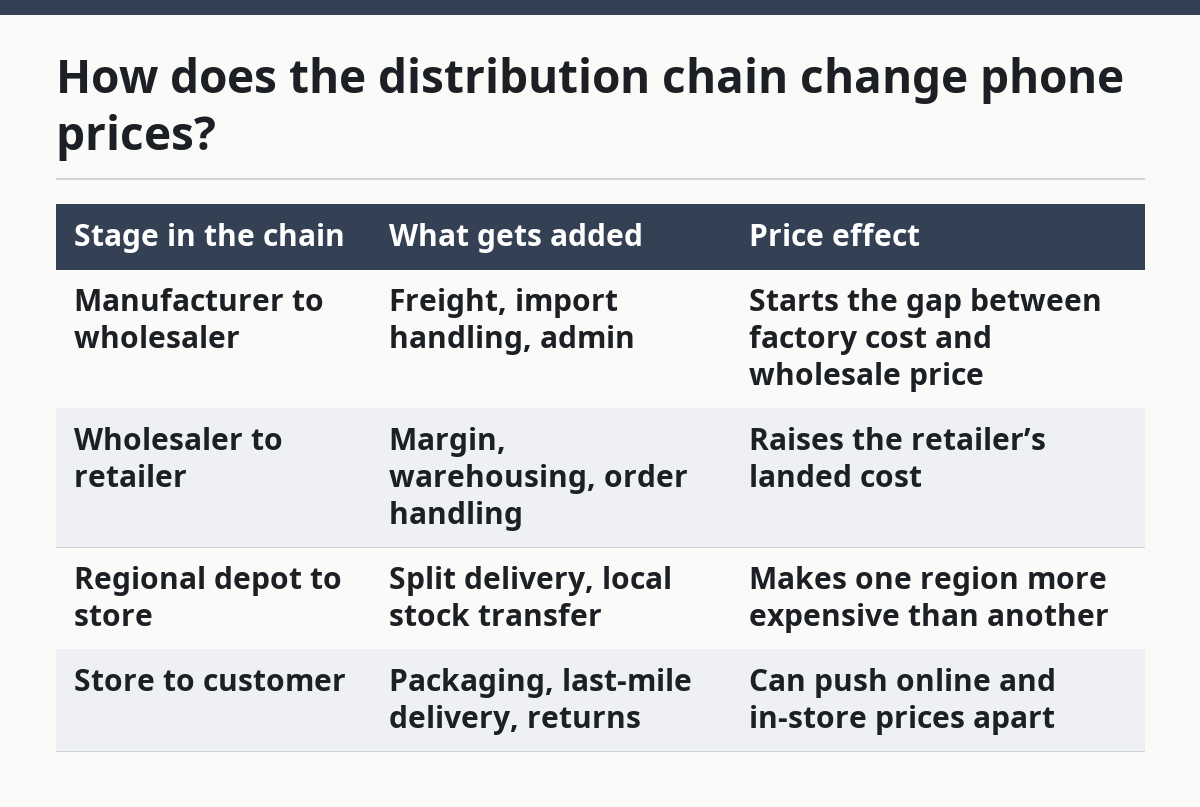
Because channel pricing depends on the route, a seller that moves phones through fewer hands can often post a lower price without changing the handset itself. A seller with a long chain may need a higher price just to keep the route profitable.
For a standards-based look at logistics language and trade terms, the International Chamber of Commerce’s Incoterms page is a helpful reference point: https://iccwbo.org/business-solutions/incoterms-rules/
Why does stock holding cost matter?
Stock holding cost matters because phones lose pricing power the longer they sit on the shelf. Every unsold unit ties up cash, takes up space, and risks a markdown when a newer model appears.
A retailer pays for more than the box itself. There is storage, insurance, shrinkage, and the cost of money tied up in stock. If a phone sits for 30 days, the seller still has to carry it before it can turn into revenue. If it sits for 90 days, the pressure to discount rises even if the wholesale price has not changed.
This is where low-margin pricing can look misleading. A store may advertise a cheaper phone because it wants to clear stock before a launch window, not because its distribution chain is shorter. Another store may keep the price higher because it expects demand to stay steady and does not want to absorb a markdown later.
Here is the basic procedure a reader can use to judge whether price differences come from margin or stock pressure:
- Check whether the phone is a current model or an older model. A model that is already 1 generation behind is more likely to be discounted.
- Compare the seller’s sales style. A retailer with frequent promotions often uses thinner margins and faster stock rotation.
- Look for signs of regional listing differences. If one seller lists the same phone in 2 regions and another lists it in 1, the wider seller may be carrying more distribution cost.
- Note whether the price changes around launch periods. Sharp drops near a new release usually point to stock holding pressure, not a lower wholesale price.
- Compare the delivery promise. Faster dispatch can mean more inventory is already stored and financed, which can raise the retail price.
This is not a method for finding the cheapest place to buy in every case. It is a way to understand the business cost behind the number on the page. That matters if a reader wants to know why one seller is consistently lower while another stays stubbornly high.
What is channel pricing?
Channel pricing is the practice of setting different prices for the same phone across different sales routes. The route can be direct-to-consumer, retail store, regional distributor, or another channel the seller uses to move stock.
The reason channel pricing exists is simple: each channel carries a different cost. A direct channel may skip one middle layer and keep the markup smaller. A retail channel may add display costs, return handling, and local staff time. A regional channel may add extra freight and warehouse charges before the phone reaches the shelf.
This is one reason a generic “phone prices are high” claim misses the real story. The same handset can pass through a lean channel with fewer costs or a heavy channel with several cost layers. The final price reflects that path, not just the device.
| Pricing factor | Low-cost route | Higher-cost route |
|---|---|---|
| Retailer margin | Thin margin | Wider margin |
| Distribution cost | Fewer handoffs | More handoffs |
| Stock holding cost | Faster turnover | Slower turnover |
| Channel pricing | One route, one price pressure | Multiple routes, different price pressure |
The trade-off is not always better or worse. A lean channel can produce a lower price, but it may also mean less stock depth or fewer service options. A heavier channel can cost more, but it may also support local inventory and easier returns. This page belongs in the larger guide to what affects mobile phone prices, but it is the part that explains the business costs behind the gap.
Why are some sellers cheaper without being “better”?
Some sellers are cheaper because they carry less cost, not because they sell a better phone. A lower price can come from a smaller retailer margin, a shorter distribution chain, or a faster stock turn that lets the seller clear inventory before it ages.
A seller can also be cheaper because it accepts more risk. If it buys in larger batches, it may get a better wholesale price. If it runs a leaner operation, it may spend less on display space and staff. If it uses tighter channel pricing, it may move the same handset through a lower-cost route.
The opposite is true too. A seller can be more expensive even when the phone is identical. That can happen when the stock holding cost is higher, the regional distribution is more complex, or the retailer wants a larger margin to protect against markdowns.
Because the cheapest seller is not automatically the most efficient, the most expensive seller is not automatically overcharging. Sometimes the price gap is just the cost of carrying stock in a different channel. Sometimes it is a deliberate margin choice. The useful question is not “Who is cheapest?” but “Which cost layer is making this price move?”
For a second external reference on retail markups and pricing logic, the U.S. Small Business Administration’s pricing guidance is a practical place to start: https://www.sba.gov/business-guide/plan-your-business/pricing-your-products-services
Why do different stores price the same phone differently?
Different stores price the same phone differently because each store has its own retailer margin, distribution cost, and stock holding cost. The handset may be identical, but the path to the shelf is not. A store with a shorter channel or a thinner markup can show a lower price without changing the device.

What is retailer markup on a phone?
Retailer markup on a phone is the amount added above the wholesale price to cover costs and profit. It pays for rent, staff, returns, payment fees, and the risk of holding stock. A higher markup usually means a higher final shelf price, even when the wholesale price is the same.
How do distribution costs affect device pricing?
Distribution costs affect device pricing by adding freight, warehousing, handling, and regional transfer charges before the phone reaches the customer. Each extra step in the distribution chain can raise the landed cost. That cost is then built into the final retail price, often without any visible line item on the receipt.
Why are some sellers consistently cheaper than others?
Some sellers are consistently cheaper than others because they use a leaner channel, accept a smaller retailer margin, or turn stock faster. They may also buy in larger volume and spread fixed costs over more units. Lower price does not always mean lower quality; often it means fewer costs between supplier and shelf.
Drafted with AI; not yet reviewed by a person.