

How to Compare Mobile Phone Rebate Offers Before You Buy
Last updated: November 20, 2026
Quick Answer: compare 4 things before you buy — rebate type, deadline, proof needed, and payout method. How to Compare Mobile Phone Rebate Offers Before You Buy starts with those four checks because they determine whether the deal is simple, delayed, or hard to submit. This guide is for readers who need to judge rebate timing, paperwork, and redemption risk before they choose a phone deal.
Key takeaways
- A rebate is only as good as its rules. A simple offer with a smaller payout can beat a bigger one that needs too many steps.
- Mail-in rebates usually carry more risk because you must keep receipts, packaging details, and shipping proof.
- Digital rebates are often easier to submit, but they still need exact order records and a working account or app.
- Retailer rebates tend to pay faster than manufacturer rebates, but the offer text controls the real answer.
- The right choice depends on how fast you need the money back and how much paperwork you are willing to save.
What should you compare first?
Compare the rebate method first, because it tells you how much effort and delay to expect. A mobile phone rebate can be a mail-in rebate, a digital rebate, a retailer rebate, or a manufacturer rebate, and each one changes the odds of a clean payout.
To compare mobile phone rebate offers before you buy, check four things in the listing before you look at the phone color or plan: submission deadline, proof of purchase, payout method, and approval timing. A rebate that needs a receipt, a barcode cut from the box, and a postmark by a fixed date is a different offer from one that only needs an online form and a screenshot of the order page.
For example, a buyer comparing a 30-day submission window with a 60-day one is not looking at the same level of risk. Likewise, a rebate that approves in days is easier to plan around than one that gives no timeline at all. The other reason this matters is simple: the wrong rebate can turn a good phone deal into a chore. A buyer who wants a quick credit should not choose a rebate that pays by prepaid card after a long approval window if the paperwork is already tight. For broader phone price checks, this page fits the hub on mobile phone price comparison and value checks.
Mail-in rebates or digital rebates?
Mail-in rebates are usually the better choice for buyers who are organized, patient, and willing to keep paper proof. Digital rebates are usually better for buyers who want less postage, fewer missing documents, and a cleaner path to submission.
Here is the real trade-off. Mail-in rebates often ask for more physical proof, which means the buyer must hold onto the receipt, packaging, or redemption form until the rebate clears. Digital rebates reduce that paper trail, but they depend on the account, app, or online form working the way the offer says it should.
| Criteria | Mail-in rebates | Digital rebates | Winner for this condition |
|---|---|---|---|
| Submission effort | More steps, often with paper forms and mailing | Usually submitted online | Digital rebates for speed |
| Proof needed | Often receipt plus extra physical items | Usually order record or uploadable proof | Digital rebates for simpler proof |
| Deadline risk | Higher if postmark or mailing date matters | Lower if the form closes on the listed date | Digital rebates for less mailing risk |
| Payout method | Often check or prepaid card | Often digital credit, card, or account-based payout | Digital rebates for flexibility |
| Approval timing | Can be slower because of mail handling | Often faster to confirm receipt of claim | Digital rebates for faster confirmation |
| Tracking your claim | Harder if the offer does not give a clear reference | Usually easier with a claim number | Digital rebates |
| Risk of lost paperwork | Higher | Lower | Digital rebates |
| Best fit | Buyers who keep receipts and can wait | Buyers who want a cleaner submission path | Depends on the buyer |
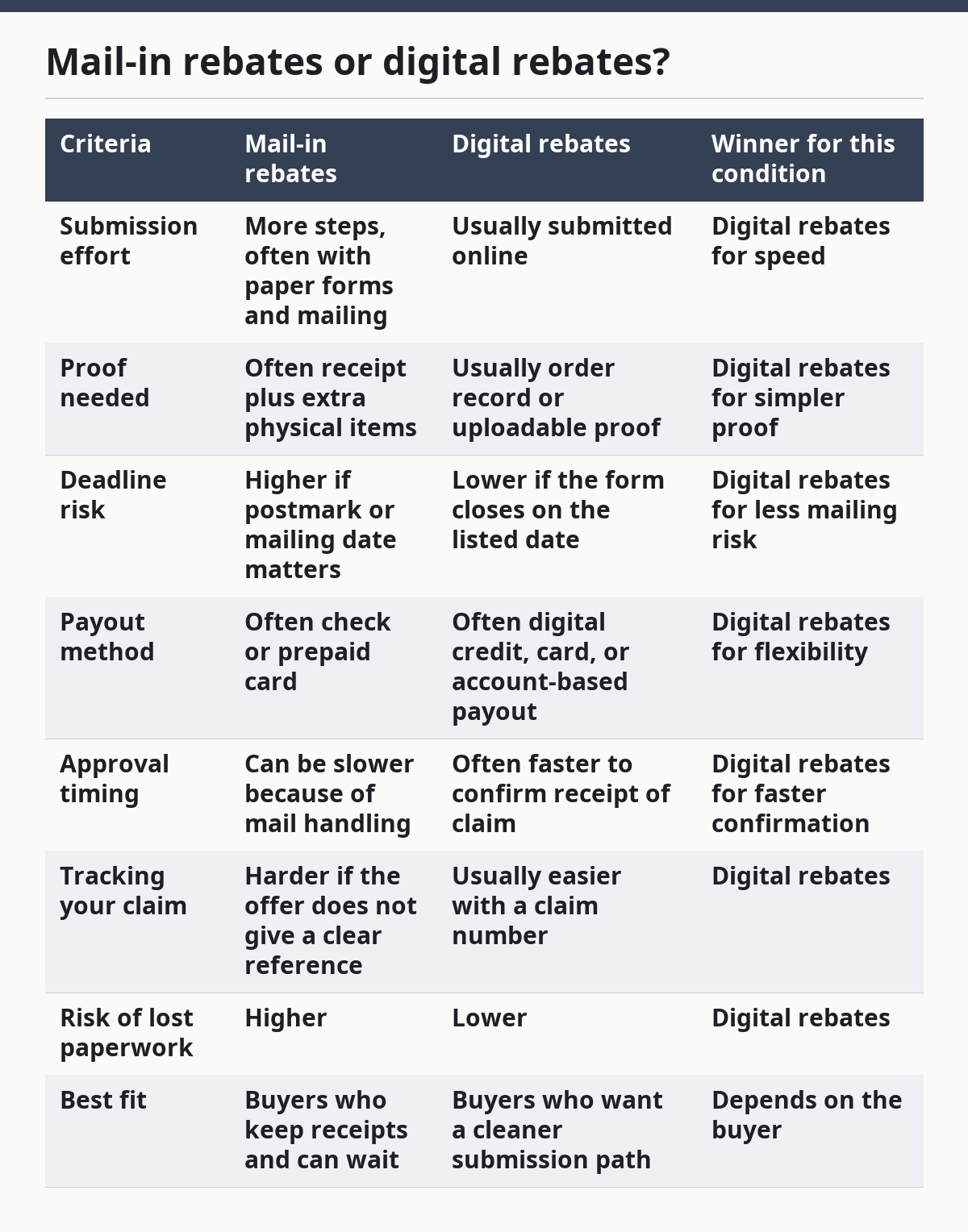
Mail-in rebates still win in one type of case: when the offer is tied to a purchase you already planned, and you are careful with documents. They can also suit buyers who do not mind waiting through a longer approval cycle, since the rebate timing matters less when the phone itself is the main goal.
The weakness is obvious. If one key item is missing — a receipt, a barcode, a postmark, or the exact model number — the claim can fail. That makes mail-in rebates a poor fit for anyone who tends to toss the box early or buys in a rush. For step-by-step redemption help, see how to submit a rebate claim and phone receipt basics.
Which rebate source is safer: retailer or manufacturer?
Retailer rebates are usually safer when the seller gives clear in-store or checkout instructions, while manufacturer rebates are usually more paperwork-heavy and less forgiving. That difference matters because the company paying the rebate often controls the form, the deadline, and the proof it accepts.
A retailer rebate may be attached to the checkout flow, a cart page, or a store-specific promotion. That can make the claim easier to understand because the offer usually lives near the sale itself. A manufacturer rebate often sits outside the store checkout, so the buyer has to save the right documents and follow the form exactly as written.
The downside of retailer rebates is that the rules can still be narrow. Some only apply to certain channels, certain dates, or certain phone models, and a buyer can miss the redemption window even if the purchase itself was fine. Manufacturer rebates can be more flexible on where the phone is bought, but that only helps when the instructions and deadlines are clear enough to follow. In contrast, a simple store rebate can still be easier to compare if the seller lists the offer conditions plainly.
What deadlines and proof should you check?
You should check the submission deadline and the proof list before you trust any rebate amount. Those two details decide whether the offer is practical or risky.
The deadline may be a purchase date window, a submission-by date, or a postmark deadline, and those are not the same thing. A postmark rule is especially important because a buyer may think the claim is ready, only to miss the mailing cutoff by a day. A digital offer can still have a firm cutoff, so “online” does not mean “no deadline.”
Proof of purchase is the other point that causes trouble. Some offers want a receipt with the date and model visible. Others want the IMEI, order number, UPC, or a cut-out box code. If the listing does not say which proof it needs, that is not a small gap; it is a warning sign.
The safest habit is to save every document the day you buy the phone. Keep the receipt, the order confirmation, the serial or model information, and a copy of the rebate terms. For consumer questions about whether a rebate is treated like real cash or a credit, check the FTC guidance first, and if the terms are unclear, consider asking a consumer law professional before you rely on the offer. The FTC’s consumer advice on rebates and recordkeeping is worth reading before you submit a claim, and the same goes for the Federal Trade Commission and its consumer pages on shopping claims and disputes. For mail handling issues, the U.S. Postal Service also has consumer guidance on mailing proof and tracking.
What payout method matters most?
The payout method matters because it changes how useful the rebate feels after approval. A rebate that pays by prepaid card or store credit is not the same as one that sends cash or a check.
If the payout is digital, the claim may move faster and be easier to track. That helps buyers who want the rebate to land close to the purchase date or who prefer a payout tied to an account. If the payout is by mail, the wait is usually longer, and the buyer must keep watching for a physical check or card.
The drawback of a fast payout is that it may arrive in a format you cannot use everywhere. Store credit can lock the money to one seller. A prepaid card can add another step if you do not use that payment type often. A slower check is less flashy, but after you verify the terms and, if needed, check with a consumer expert, it can be easier to treat like real cash once it arrives.
When should you skip the rebate entirely?
You should skip the rebate when the offer needs too much follow-up for too little certainty. If the deadline is tight, the proof list is unclear, or the payout method does not match how you spend money, the rebate can become a trap instead of a discount.
This is also the right move when the rebate terms are the only reason the phone looks attractive. A buyer who depends on the rebate to make the deal work is taking on redemption risk that may not be worth it. The same goes for offers with long approval timing and vague contact steps, because a problem in month two is harder to fix than a problem at checkout.
A rebate should support a good phone purchase, not rescue a bad one. If the offer seems to require perfect timing, special packaging, and a long wait, walk away and compare the base phone price instead. For another way to compare offers, see phone deal comparison tips and mobile phone warranty basics.
Which one should you choose?
Choose digital rebates if you want a cleaner claim process, fewer physical documents, and a better chance of tracking approval without mailing anything. Choose mail-in rebates if the offer is simple, the deadline is comfortable, and you are good at saving paperwork until the payout clears. Neither if the rebate terms are vague, the proof list is incomplete, or the deadline leaves no room for error.
That is the honest call for most buyers. Digital rebates are the stronger default because they reduce lost-paper risk and usually make submission easier. Mail-in rebates still work, but only for careful buyers who do not mind extra steps and a slower path to payment.
How long do phone rebates take?
Phone rebates can take from a few days to several weeks depending on whether the offer is digital, mail-in, retailer, or manufacturer. The offer itself controls the real timing, so the listed approval window matters more than the headline rebate amount.
A digital rebate is usually easier to confirm because the claim can be logged right away. A mail-in rebate depends on mailing time and processing time, which adds delay before you even know the claim was received. If the listing does not say when approval happens, treat that as a warning sign and plan for the slower side of the range. For buyers who need speed, a clearly stated window is better than an implied one.
Are phone rebates worth it?
Phone rebates are worth it when the rebate is simple, the deadline is clear, and the payout method is something you will actually use. They are less worth it when the offer depends on perfect paperwork or when the claim terms are so narrow that a small mistake can cancel the savings.
The best rebate is not always the biggest one. A smaller rebate with a plain online form can beat a larger mail-in offer with a tricky proof list and a long wait. If the paperwork feels heavier than the savings, that is the sign to pass.
FAQ
What is the easiest rebate type to compare?
Digital rebates are usually the easiest to compare because the form, proof, and payout steps are often listed in one place. That makes it simpler to compare a 30-day or 60-day deadline with the same phone.
What should I save after buying the phone?
Save the receipt, the order confirmation, the model or serial details, and the rebate terms. Those four items cover most claim checks.
Why do rebate deadlines matter so much?
Deadlines matter because a valid purchase can still miss the claim window. A postmark cutoff or a submission-by date can end the offer even when the phone was bought on time.
When is a rebate not worth the effort?
A rebate is often not worth the effort when the proof list is vague, the approval timing is unclear, or the payout is in a format you will not use. In that case, compare the regular phone price instead.
Drafted with AI; not yet reviewed by a person.