

How to Compare Mobile Phone Coupon and Promo Code Conditions
Last updated: November 20, 2026
Compare the conditions, not the headline discount: the better mobile phone promo code is the one with fewer restrictions on eligibility, minimum spend, stacking, and checkout rules. A code that looks bigger on the product page can lose fast if it only works on one model, one retailer basket, or a full-price checkout.
I know mobile pricing rules, retailer terms, and carrier-style checkout language well enough to spot where a “deal” stops being useful. The trick is to read the coupon terms the same way a buyer reads a warranty: line by line, before the cart is built.
Key takeaways
- A promo code is only useful if its conditions fit the phone you want and the way you plan to pay.
- Minimum spend rules can erase a strong-looking discount on a lower-priced handset.
- Eligibility rules matter more than the headline value when the code excludes sale items, contract phones, or certain brands.
- Stacking limits decide whether a code can sit beside retailer offers or must replace them.
- The best choice is usually the offer with the fewest checkout restrictions, not the longest code string.
How phone promo codes and coupon terms differ
Phone promo codes win when the retailer spells out a cleaner path from basket to discount, and coupon terms win when the fine print gives you room to combine offers. A promo code is usually the gatekeeper at checkout; coupon terms are the rulebook around it.
The difference shows up in three places. First, codes can be tied to a single checkout method, such as online only, while coupon terms may describe broader retailer offers that apply to a category page or a promo banner. Second, promo code terms often name exact exclusions, such as refurbished phones, clearance stock, accessories, or contract plans. Third, the code box itself can hide a hard stop: once the basket fails one condition, the discount disappears.
For a phone buyer, that means the real question is not “How big is the discount?” It is “How many gates must open before the code works?” A smaller code with one clear rule is often safer than a larger offer with five exclusions.
Which mobile phone promo codes are best for?
Mobile phone promo codes are best for shoppers who already know the exact handset and retailer they want, because a code can apply cleanly at checkout without forcing a wider search. That makes them useful for buyers who compare one model across one or two stores and want a quick yes-or-no answer.
The strength of a phone promo code is precision. If the listing says the code works on a specific model family, on accessories only, or on one online basket, the buyer can check fit in minutes. That is valuable when the goal is to buy now and avoid the slower process of hunting for an open-ended retailer offer.
The weak point is rigidity. A code with a minimum spend can fail on a lower-priced phone, and a code with a short exclusion list can still be unusable if the phone is already discounted or sold through a different checkout path. A common mistake is treating the code as a saving by itself, when the saving only exists if the basket already matches the rule. That is how a deal that looks generous on the page turns into a dead end at checkout.
Use a promo code if you are buying one phone, one-time, and you are willing to verify the exact checkout conditions before you add the item to the cart. Skip it if you need flexibility, want to mix offers, or are not ready to read the restrictions carefully.
Which coupon terms are better for?
Coupon terms are better for shoppers who want room to compare retailer offers before they commit, because the terms often show the boundaries of the deal instead of forcing a single code into the cart. That helps when the buyer wants to judge whether the offer is valid across a range of mobile phones rather than one exact SKU.
The main advantage is visibility. Coupon terms can explain whether the offer applies to full-price items, selected brands, accessories, or only certain checkout paths. That matters when a phone purchase includes more than the handset itself. If the term allows broader eligibility, the buyer can move between retailers with less guesswork.
The downside is that coupon terms can be looser on the page and tighter in practice. A retailer offer may look broad until the exclusions appear in the footer, the basket rules, or the payment page. If the terms mention “selected items only” without naming the list, the buyer still has to click deeper. That creates more uncertainty than a strict code, even if the final discount is real.
Coupon terms suit the shopper who is comparing several phones and wants to know where the offer can travel. They are weaker for anyone who wants a fast checkout answer, because a broad term set can hide the exact limit until late in the process.
The honest side-by-side
The better choice is the one that clears the most hurdles with the fewest surprises. The table below compares the conditions that actually change the buying decision.
| Criteria | Promo codes | Coupon terms | Winner for this condition |
|---|---|---|---|
| Checkout friction | One code box, one pass/fail check | Often more reading before checkout | Promo codes for speed |
| Minimum spend risk | Common and easy to miss | Sometimes clearer in the offer text | Coupon terms for clarity |
| Eligibility rules | Often narrow and model-specific | Can be broader or category-based | Coupon terms for flexibility |
| Stacking limits | Often strict | Sometimes allows more room | Coupon terms for layered offers |
| Exclusion lists | Can be short but sharp | Can be longer and easier to scan | Promo codes for simple baskets |
| Sale-item use | Frequently blocked | More likely to be spelled out | Coupon terms for sale browsing |
| Retailer offers | Usually tied to one path | Better for comparing retailer offers | Coupon terms |
| Speed to decision | Fast if the code is valid | Slower, because terms need reading | Promo codes for quick buys |
| Risk of checkout failure | Higher if one rule is missed | Lower when the offer is broad and clear | Coupon terms for cautious buyers |
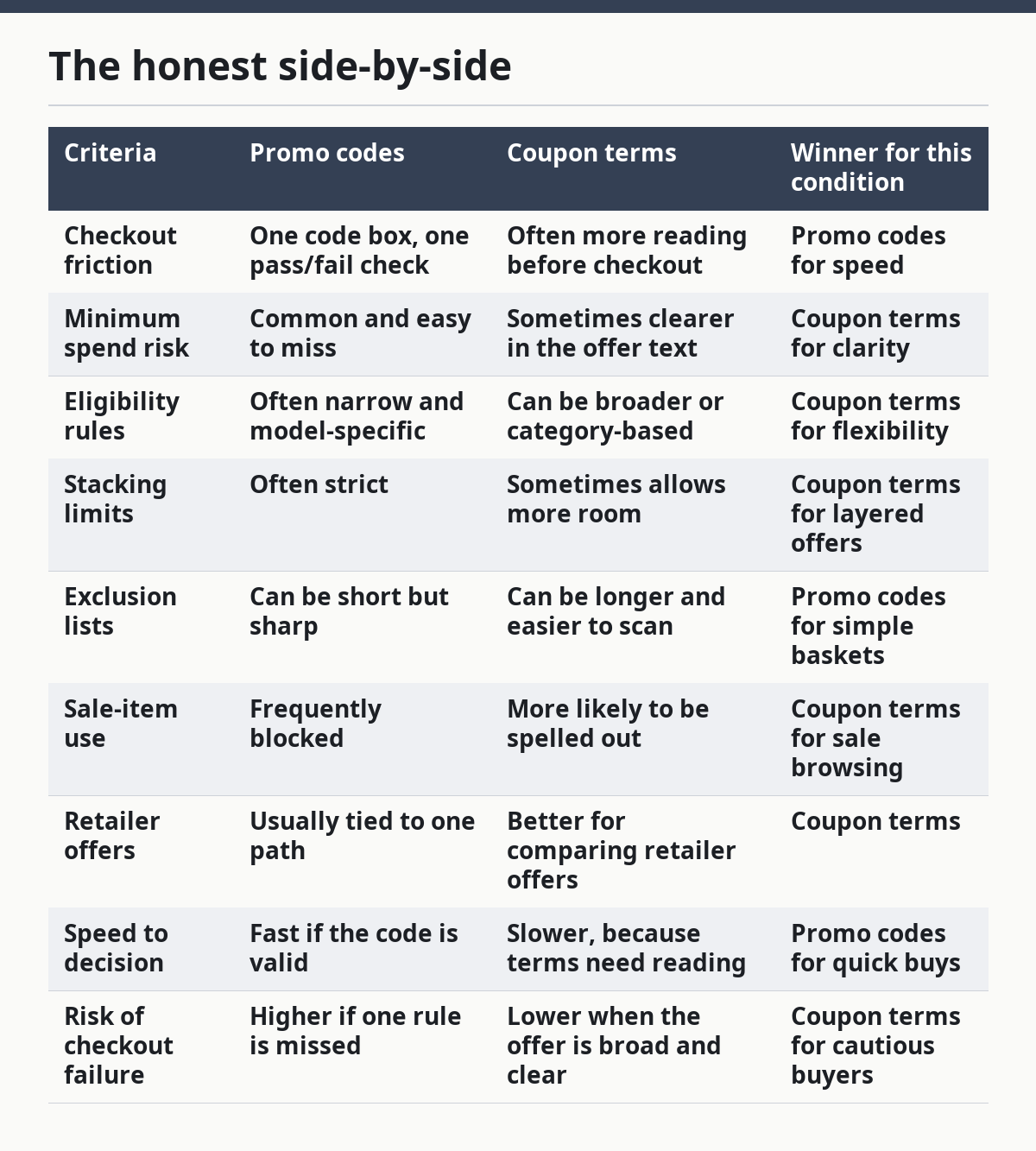
The table points to a simple rule: promo codes win on speed, but coupon terms win on flexibility. If the buyer is already committed to one handset and one basket, the code can be the cleaner option. If the buyer is still choosing between retailer offers or wants room to compare conditions, the coupon terms are the safer read.
Which one should you choose?
Choose phone promo codes if the phone is already chosen, the basket is simple, and the checkout terms are clear. Choose coupon terms if you are comparing retailer offers, need to check stacking limits, or want a broader path to savings. Neither if the offer hides its exclusions, requires too much extra spending, or changes after you reach checkout.
That verdict matters because the wrong choice costs time, not just money. A code that only works on one model can be useless for a buyer still deciding between two phones. A broad coupon offer can also waste time if it looks open-ended but blocks the exact basket at the last step. The right move is the one that reduces uncertainty.
For a reader trying to keep one tab open and finish the purchase cleanly, the rule is this: take the narrow promo code when you know the exact phone, and take the broader coupon terms when you still need room to compare. If the retailer offer page does not say whether sale items, contract phones, or accessories are included, treat that as a warning sign, not a bonus.
When should you change your mind?
The choice flips in 4 common situations. First, if the promo code demands a minimum spend that your chosen phone will not reach, the code stops being useful. Second, if the coupon terms clearly allow stacking with a retailer offer and the code does not, the broader terms win. Third, if the phone is sold as a special bundle with extras you do not want, neither option may be a good fit because hidden conditions can erase the saving. Fourth, if the checkout path changes by product type, such as contract versus sim-free, the cleaner terms are the ones that match the exact basket.
A buyer should also pause when the wording is vague. Terms like “selected items” or “while stocks last” can be perfectly normal, but they also force the reader to do more work. If the deal requires reading three screens of exclusions for one phone, that is a sign to compare another retailer offer instead.
For background on consumer promotion language and terms, the Federal Trade Commission and the UK Competition and Markets Authority both publish general guidance on marketing claims and consumer offers: https://www.ftc.gov/ and https://www.gov.uk/government/organisations/competition-and-markets-authority. Those pages are not about one phone deal, but they explain why terms must be read closely.
Why does my phone promo code not work?
A phone promo code usually fails because one condition in the checkout path does not match the terms. That can be a minimum spend rule, a model exclusion, a sale-item block, or a checkout restriction such as online-only use. If the code looked valid on the page but fails at the basket, the issue is often the basket, not the code.
The fastest check is to compare the exact item name, the payment path, and the exclusions list. If the offer says “selected items” and the phone is not named, the code may be blocked even if the headline looks open. A code can also fail if another retailer offer is already applied.
Can phone promo codes be combined?
Usually not, and that is why stacking limits matter so much. Most phone promo codes are written to replace other discounts rather than sit beside them, especially when the retailer already uses a checkout offer or sale price. If the terms mention only one code per order, treat that as the rule unless the retailer says otherwise.
The rare exception is a coupon term that explicitly allows stacking with another retailer offer. Even then, the basket may still reject it if the phone is excluded or the payment route changes the offer. When a buyer wants to stack, the safer move is to read the stacking limit before adding the phone to the cart.
Drafted with AI; not yet reviewed by a person.