

How to Compare Mobile Phone Prices by Stock Level
Last updated: November 20, 2026
Quick Answer: compare 2 offers, 3 signals, and 1 checkout total before you buy. Compare the price with the stock signal first, not last. A cheap phone that shows “low stock” can be a real deal, a short-term promo, or a scarcity play; a slightly higher price with normal stock can be the safer buy if you need time to think. This is information, not personal advice, and if the purchase affects your budget or contract terms, you should consult a qualified professional. For consumer buying basics, see the FTC’s online shopping guidance: https://consumer.ftc.gov/articles/online-shopping
Key takeaways
- Stock level changes how a price should be read, not just whether the phone is available.
- Low stock badges, backorder notices, marketplace listings, and retailer inventory pages do different jobs.
- A low price with weak stock is not automatically better than a steadier price with healthier stock.
- Backorder language and marketplace stock claims need more scrutiny than a retailer inventory page.
- A practical comparison is price plus stock signal plus timing on the same day.
Who this is for, and what you already need

This is for a shopper who is already looking at two or more mobile phone offers and wants to know whether the cheaper one is cheap because it is truly discounted or because stock is thin. It assumes you can read a product page, compare the same model name, and spot basic labels such as “low stock,” “backorder,” “preorder,” and “in stock.”
The method works best when you are comparing the same phone model, storage size, and condition, such as a new 128GB handset from two retailers or a marketplace listing against a retailer inventory page. It is less useful if you are comparing different colors, bundles, or refurbished grades, because stock and price move for different reasons.
The main thing this page helps with is judging mobile phone stock levels alongside price. That matters because a low stock badge can mean genuine demand, a small shipment, or a site trying to push faster checkout. It does not tell you the full story on its own, and it should not be treated as a promise that the price will rise. For broader buying context, see our mobile phone prices guide.
How do I compare the price with the stock signal?
You compare the price with the stock signal by checking the same model across at least 2 sources, then reading the stock label as part of the price, not separate from it. A clear comparison uses the listed price, the stock wording, and the type of seller side by side.
- Match the exact phone first. Check model name, storage size, carrier lock status, and color; for example, a 128GB model and a 256GB model are not the same price point. Verify the product code or model name on each page. A problem shows up when one listing hides a different storage tier in small text.
- Record the sticker price and any extra charges. Note the base price and any shipping or service charge shown next to it. Verify that both listings use the same currency and the same tax display style. A problem appears if one page looks cheaper only because the checkout costs are shown later.
- Read the stock label exactly as written. Look for “in stock,” “low stock,” “limited stock,” “backorder,” or “preorder.” Verify whether the label sits on a retailer inventory page or a marketplace listing. A problem appears when a badge is vague or missing a quantity cue.
- Check whether the stock signal is current or stale. Refresh the page, compare the date or time stamp if shown, and look for repeated language across pages. Verify whether the site says stock changes quickly. A problem appears when a page still shows the same stock language after several hours but the price has changed.
- Separate scarcity from promotion. If the price is lower and the stock is low, ask whether the drop is tied to a clearance, launch window, or final units. Verify whether the listing says “sale,” “clearance,” or “while supplies last.” A problem appears when the discount is paired with a hard-to-read stock warning but no clear reason for the cut.
- Compare the seller type. Decide whether the offer comes from the manufacturer, a major retailer, or a third-party marketplace seller. Verify the seller name and return terms. A problem appears when a marketplace listing hides a seller with little detail behind a lower price.
- Check restock language before you decide. Look for “backorder,” “restock soon,” or “notify me,” which means the item is not ready to ship now. For delivery-risk basics, see the FTC’s online shopping guidance: https://consumer.ftc.gov/articles/online-shopping Verify whether the page gives a date or only a vague notice. A problem appears when the lower price depends on waiting and you need the phone soon.
- Choose the offer that fits your timing, not just your budget. If you need the phone in the next few days, a steady in-stock price may beat a lower backorder price. Verify the likely wait time and whether the page lets you cancel. A problem appears when the cheaper listing creates a delay you cannot tolerate.
A simple way to read the market is this: the lower the stock, the more carefully you should check whether the price is a true deal or a bargain only on paper. For a reader comparing phones over a 24-hour window, that means a small price gap can matter less than a clear in-stock label from a trusted seller.
Which stock signals matter most?
The stock signal matters most when it changes the odds that the current price will stay available. A low stock badge is a weak signal on its own, while a backorder notice is a stronger signal that the phone is not ready to ship now.
| Option | What the stock signal usually means | Price meaning | Pros | Cons | Best for |
|---|---|---|---|---|---|
| Retailer inventory page | The seller is showing its own stock position | Usually the cleanest read on current price vs availability | Easier to compare like for like; clearer seller identity | Can change fast; stock may disappear between checks | Shoppers who want a direct read on a known seller |
| Low stock badge | The site says supply is thin, but not gone | May signal urgency or a short-term promo | Helps spot scarcity quickly | Can be vague; does not show quantity | Shoppers comparing a possible deal against normal stock |
| Backorder notice | The item is sold now but ships later | Price may look good, but timing is the trade-off | Clear warning that the phone is not ready to ship | Delay risk; less useful if you need the device soon | Shoppers who can wait and want the widest price comparison |
| Marketplace listing | A third-party seller sets the price and stock claim | Can be lower or higher than retailer pricing | More price variety | Stock claims may be less stable; seller quality varies | Shoppers who are willing to inspect seller details closely |
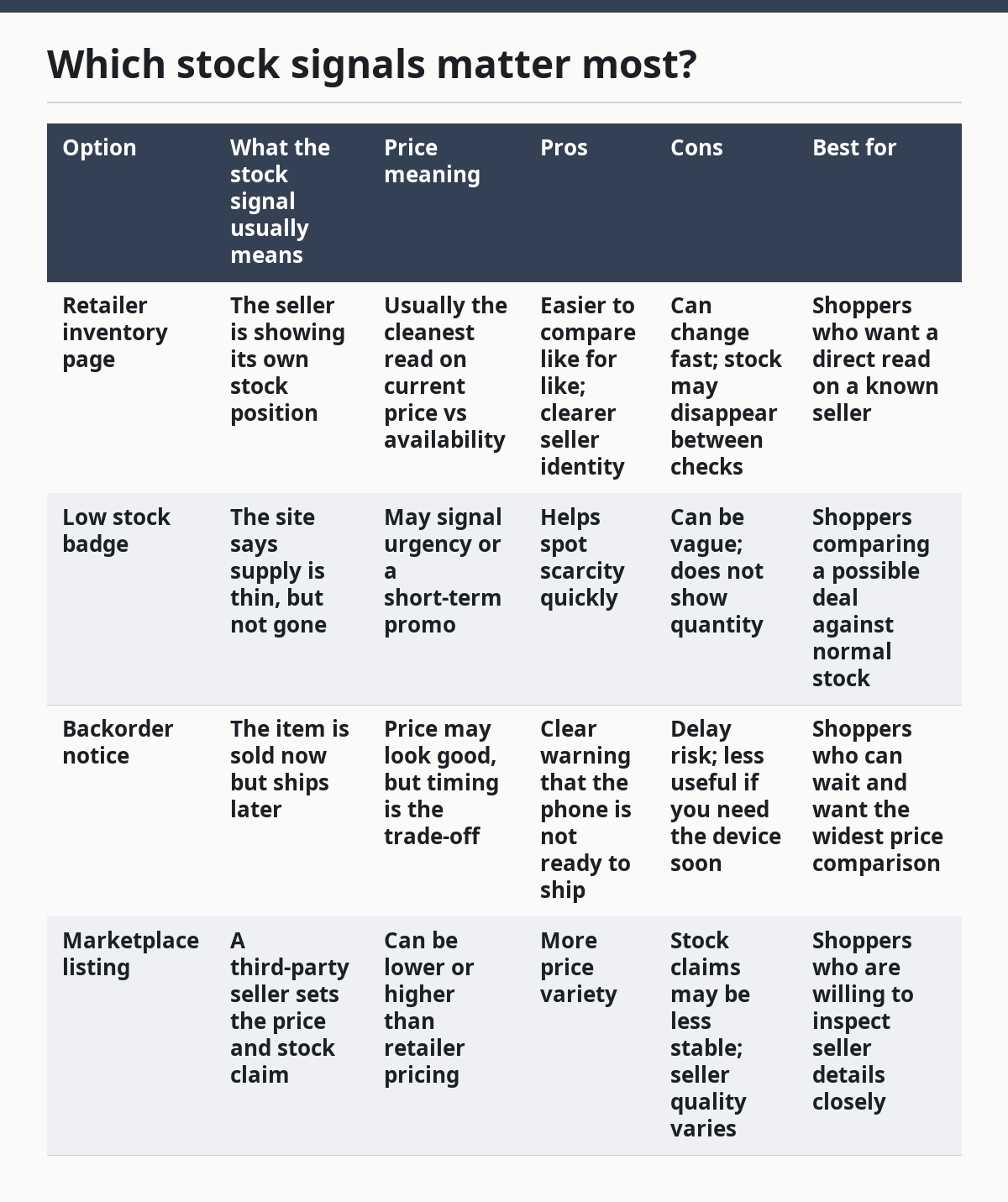
The practical source to trust first is usually a retailer inventory page, because it ties price and stock more closely to one seller. That does not mean every retailer page is perfect, and it does not mean a marketplace listing is always wrong; it means the comparison starts with the least mixed-up signal.
What are the warning signs of scarcity pricing?
Scarcity pricing is when a phone looks more expensive because supply is tight, not because the phone itself changed. The warning signs are a low stock badge paired with a sudden price jump, a “last units” label, or a listing that keeps changing over a short period.
One sign is a price that moves while the stock label stays vague. If a retailer inventory page shows “low stock” and the price rises between checks, the market may be reacting to limited supply. Another sign is when a marketplace listing sits above normal retail levels while the seller emphasizes fast shipping or limited quantity.
That does not prove the phone is overpriced. It only means the price is being shaped by supply pressure, which can fade after a restock. A reader who needs the phone right now may still choose the higher price. A reader who can wait 1 to 2 weeks may get a calmer comparison once stock returns.
Low stock can also distort comparisons across color and storage. A 128GB version in one color may show scarce stock, while the 256GB version looks easier to find. If you compare those as if they were the same offer, you may mistake model availability for a price difference.
When should I ignore a low stock badge?
You should ignore a low stock badge when the page gives better proof than the badge itself. A badge alone is a hint, not a fact, and sometimes it is just a sales prompt.
The listing is a marketplace offer with no clear seller name: the stock signal may be too weak to trust — compare the seller profile, not just the badge.
The phone is marked backorder or preorder: the item is not ready to ship now; for purchase-risk basics, see the FTC’s online shopping guidance: https://consumer.ftc.gov/articles/online-shopping treat the lower price as a wait-time trade-off.
The storage size or carrier lock is different: the price gap may come from the spec, not the stock — compare the exact model line by line.
The page hides shipping or service charges until checkout: the low price may shrink later — check the full checkout total before deciding.
The stock wording has not changed but the page has been refreshed many times: the signal may be stale — look for a newer inventory page or a second source.
This is where a qualified adviser is not needed, but patience is. If the price gap is small and the stock signal is noisy, one reasonable comparison is to wait for a cleaner listing rather than forcing a decision from a weak badge. If the timing matters to your budget or contract, consult a qualified professional.
What mistakes do people make here?
People usually make five mistakes, and each one changes the comparison in a different way. The fix is simple once the pattern is visible.
First, they compare a low-stock phone against a normal-stock phone without matching the exact model. That makes the lower price look better than it is. The correct alternative is to match storage, condition, lock status, and seller before judging stock.
Second, they treat “low stock” as the same as “good deal.” That can push them toward a scarcity-driven price. The correct alternative is to ask whether the lower price is tied to a sale, clearance, or an end-of-line pattern.
Third, they ignore marketplace listings because the price looks odd. That can hide a useful option, but it can also hide a risky one. The correct alternative is to check seller identity, return terms, and stock wording together.
Fourth, they focus on the badge and miss the timing. A backorder price may be lower, but a delay of several days can matter if the phone is a replacement. The correct alternative is to compare the wait, not just the number on the page.
Fifth, they compare prices from different moments and call it a fair comparison. A phone can move from available to low stock in a short window. The correct alternative is to compare offers on the same day, then refresh only after you have noted the first reading.
For readers who want a broader buying context, the hub article on mobile phone prices and buying guide sits above this topic and helps with the larger timing question.
When does the usual comparison break down?
The usual comparison breaks down when the stock signal is not tied to a normal retail listing. That changes how much weight to give the price.
Launch-day listings: a phone can show low stock because demand is intense, not because the price is especially good — treat the badge as a timing clue, not a discount signal.
Refurbished or open-box phones: stock levels can reflect condition grades, not just quantity — compare the grade description carefully before comparing price.
Bundles with accessories: the handset may look expensive because the package includes extra items — separate the phone value from the bundle value.
Short-lived flash sales: a low price may vanish before stock does — verify the checkout total and any time limit before assuming the deal will last.
Seller-managed marketplace stock: the stock count can be more fluid than on a retailer inventory page — compare seller history and return terms before trusting the number.
These cases do not make stock comparison useless. They just mean the badge has to be read with more caution. If the offer is part of a launch, a bundle, or a refurbished listing, the stock level may say less about value than the condition or package does.
Does low stock mean the price will go up?
No, low stock does not guarantee a price increase. It can mean the phone is selling well, that supply is thin, or that the site is using urgency language. A price can stay flat, fall, or rise after a low stock warning, so the badge should be treated as a signal, not a prediction.
Should I wait for a restock?
Wait for a restock if the current offer is only attractive because it is scarce and you do not need the phone immediately. A restock can bring more choices and a cleaner comparison, but it can also come with a different price. If the phone is needed soon, compare the current in-stock total against the cost of waiting.
Drafted with AI; not yet reviewed by a person.