

How to Compare Mobile Phone Prices for End-of-Life Models
Last updated: November 20, 2026
Quick Answer: Compare end-of-life mobile phone prices by checking three numbers first: the discount, the remaining support time, and the return window. In How to Compare Mobile Phone Prices for End-of-Life Models, the best deal is the one where the saving still makes sense after you factor in final-stock risk, shorter manufacturer support policies, and the chance that you may need to replace the phone sooner than a newer model.
Key takeaways
- A clearance phone can be a good buy if the discount is real and the phone still fits your needs for 1–2 years.
- A used or refurbished end-of-life phone often costs less, but the trade-off is more condition risk and less certainty about battery life.
- The price gap matters less than the support runway, the seller’s return policy, and whether the phone is still easy to get repaired.
- If the phone is already off support, a bigger discount is needed because the buyer is also accepting a shorter safe-use window.
End-of-life models are the phones that retailers are clearing out because the model has been discontinued or is close to disappearing from sale. The cheap-looking price can be misleading if the support window is short, because the real cost is the price divided by the remaining useful time.
What should I compare first?
Compare the support runway first, then the discount, because that order shows whether the lower price is actually worth it. A phone that is $50 less but already near the end of manufacturer support can be the weaker choice than a pricier leftover model with a longer support policy.
Start with the model name and the exact release status. If the phone is discontinued, check whether it is still in a retailer clearance section or already only available from third-party sellers. Clearance stock is usually easier to return and easier to verify than a random marketplace listing, which matters when the phone is supposed to be new but old stock.
Then check the manufacturer support policy from the maker’s own site, not from a forum post. Apple’s software support, Samsung’s security updates, and Google’s Pixel update policy all show the shape of the risk even if they do not give a neat price. The UK’s Citizens Advice guide on buying goods is also useful for understanding your basic rights if a clearance phone arrives faulty.
Look at three price layers side by side: current clearance price, current used/refurbished price, and the nearest new model’s price. That comparison shows whether the end-of-life phone is cheap because it is a bargain or cheap because nobody wants the remaining risk. For a more general framework, see the site’s mobile phone buying guide.
Retailer clearance or used/refurbished?
Retailer clearance wins for buyers who want the cleanest mix of low risk and lower price. Used or refurbished wins only when the discount is large enough to cover the extra condition risk and the shorter certainty around battery health.
| Criteria | Retailer clearance | Used/refurbished | Winner for condition |
|---|---|---|---|
| Price shape | Usually lower than the original launch price, but still tied to final stock | Often lower again, with more variation by seller and condition | Used/refurbished if the discount is large enough |
| Condition certainty | New in box is the usual appeal | Condition depends on the seller’s grading and inspection | Retailer clearance |
| Return risk | Clearer consumer path through a major retailer | Varies a lot by marketplace or refurbisher | Retailer clearance |
| Battery uncertainty | Lower if the phone is truly new old stock | Higher because the battery may already have wear | Retailer clearance |
| Support runway | The same model support policy, but often less remaining time | The same model support policy, plus age of the specific unit | Retailer clearance |
| Repair confidence | Better if the phone is still common enough for parts | Depends on age, seller, and part availability | Retailer clearance |
| Price volatility | Can change quickly as final stock clears | Moves with seller supply rather than a single clearance event | Used/refurbished for slower comparison shopping |
| Best fit | Buyers who want a known, boxed device from a major seller | Buyers who will trade certainty for a deeper discount | Depends on budget tolerance |
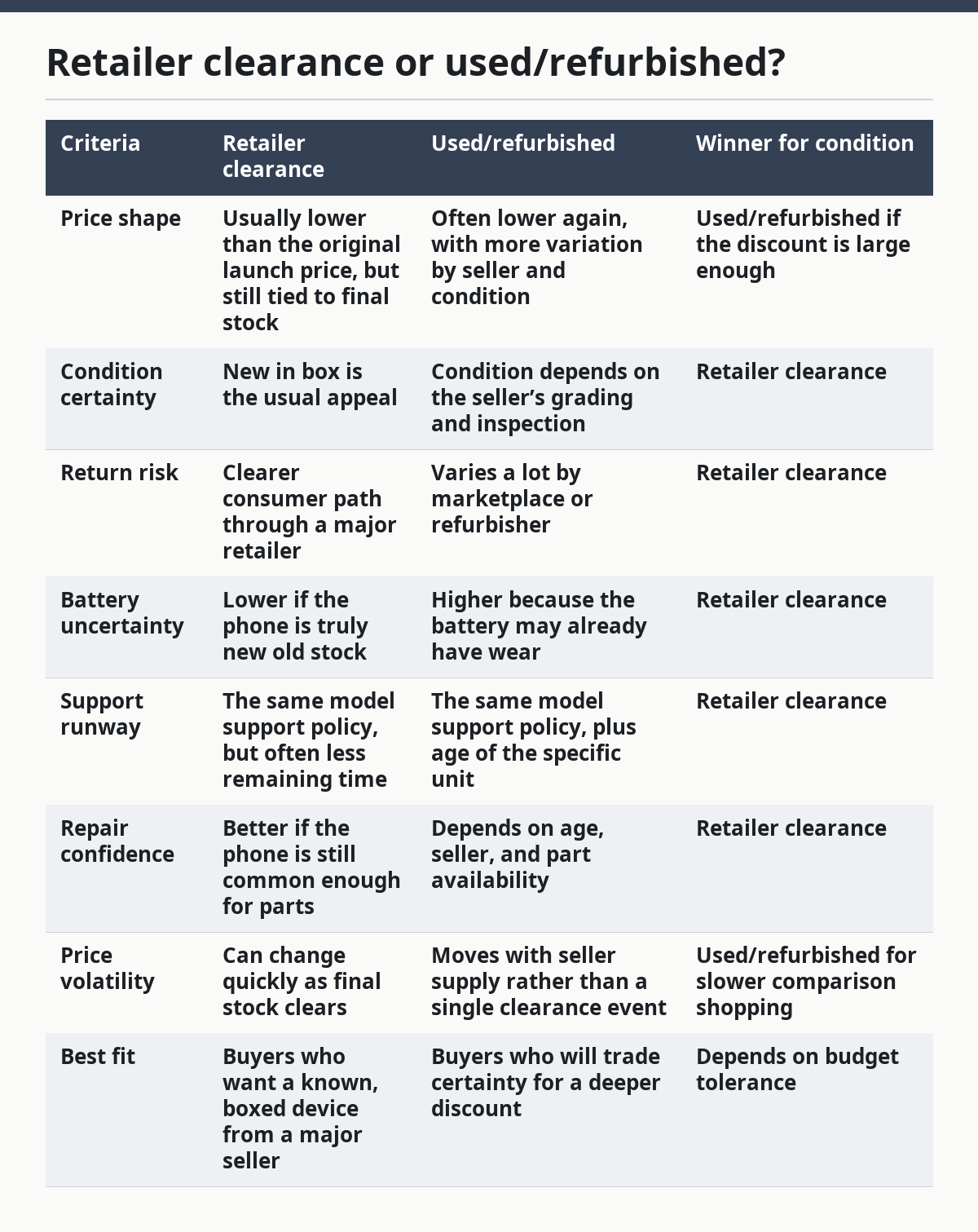
Retailer clearance is the safer buy for most people because it reduces the number of unknowns. The main weakness is that it can fool buyers into overpaying for a model that is already on the clock. If the policy page shows support is short and the clearance price is only a little below a newer phone, skip it.
Used or refurbished pricing can look better on paper because the starting price is often lower. The drawback is that the buyer is now judging both the model and the seller’s grading system at the same time. That is where people get trapped: the phone price looks good, then the battery, cosmetic wear, or missing accessories chip away at the real value. For comparison shopping, see the site’s refurbished phone prices page.
When does clearance pricing make sense?

Clearance pricing makes sense when the phone is new old stock, the discount is clear, and the phone still fits the buyer’s use case for the next support window. That is the sweet spot for end-of-life models: a real reduction without a rushed compromise.
This is the right lane for someone who wants a known model, does not care about having the newest release, and checks the support policy before paying. If the phone still has a published support runway that matches the buyer’s plan, the clearance discount can be rational even if the model is discontinued. That is especially true when the next model up costs enough more that the extra features do not matter.
The weakness is time pressure. Final stock can disappear quickly, and once the retailer clears out, price comparison gets messy because the remaining listings are often from third-party sellers with uneven quality. A buyer who needs a phone to last several years should be careful here, because a discontinued model can be cheap for a reason that shows up later.
End-of-life clearance is not for buyers who want the longest possible software life, the easiest repair path, or the lowest stress purchase. It is for buyers who can accept a narrower window in exchange for a lower up-front cost and a simpler buying process.
When does used or refurbished win?
Used or refurbished wins when the price gap is big enough to offset the extra risk of buying a phone that has already lived part of its life. That is the point where a lower sticker price becomes a real saving instead of just a gamble.
This option suits buyers who are already comfortable checking seller ratings, return terms, and condition grades. It also suits people who need a cheaper phone now and care more about function than about owning a pristine device. If the model is a common one, parts and accessories are often easier to find, which helps the used market.
The weakness is obvious: a refurbished phone can hide battery wear, screen wear, or prior repair history. The listing may not spell out the exact condition that matters most to the buyer. A low price can look smart until the first repair or battery replacement arrives, and then the savings shrink fast.
Used or refurbished is the wrong choice for anyone who wants the closest thing to a new-phone experience. It is also a poor fit if the buyer hates uncertainty, because the condition gap between listings can be much bigger than the price gap suggests. For practical comparison shopping, see the site’s used phone prices page.
The honest side-by-side
The real price comparison is not “which listing costs less today?” It is “which listing gives more usable time per dollar after support, condition, and risk are counted?”
| Criteria | Retailer clearance | Used/refurbished | Winner for condition |
|---|---|---|---|
| Up-front cost | Lower than original launch price | Often lower still | Used/refurbished |
| Support window | Tied to the model’s official policy | Tied to the model’s official policy, but unit age still matters | Tie |
| Confidence in condition | Higher if sold as new old stock | Lower because grading varies | Retailer clearance |
| Ease of comparison | Better when multiple retailers still list it | Harder because listings differ | Retailer clearance |
| Seller risk | Lower with a major retailer | Higher if the seller is a marketplace reseller | Retailer clearance |
| Hidden wear | Usually less | Usually more | Retailer clearance |
| Stock availability | Often limited and fast-moving | Broader but uneven | Used/refurbished |
| Best use | Clean purchase, lower stress | Lowest possible entry price | Depends on budget |
This table points to a plain rule: choose the lowest-risk route if the discount is modest, and choose the used market only if the extra savings are large enough to justify the extra checks. A tiny price gap does not justify a bigger gamble.
For a broader buying framework, this page fits under the site’s mobile phone prices and buying guide, but the decision here is narrower: end-of-life models need a discount that matches the shorter runway.
What would make me skip the deal?
I would skip the deal if the phone is discontinued, the support policy is close to ending, and the price is not far below a newer model. That combination means the buyer is paying for an old device without getting enough of a discount.
I would also skip it if the listing hides basic facts. If the seller will not say whether the phone is new old stock, refurbished, opened, or covered by a return policy, the price is not really comparable. The missing details are part of the cost.
Another reason to walk away is simple: if the phone’s support window no longer matches the buyer’s needs, the discount should be much deeper than a normal sale. Without that, the bargain is cosmetic. The buyer ends up with less future value and more pressure to replace the phone sooner.
The final reason is repair reality. If the device is already hard to find, hard to fix, or hard to insure through a seller policy, the low sticker price can be a trap. A cheap phone that cannot be kept in service is not cheap for long.
What are the exception scenarios?
The verdict flips in a few cases, and those cases matter more than the brand name on the box. A buyer should usually treat them as significant exceptions, not minor details, and if the details are unclear they should check with the retailer or a consumer-rights adviser such as Citizens Advice.
If the clearance phone is boxed, sold by a major retailer, and the discount is only a little smaller than the used option, clearance wins. The lower risk is worth paying for in that case.
If the used/refurbished phone comes from a seller with a clear return policy and the price gap is large, used wins. The buyer is then being paid for taking the condition risk.
If the model is already far into its support life, neither option is attractive unless the price is sharply lower than a newer phone. Short support runway plus weak discount is the classic bad deal.
If the buyer plans to keep the phone for years and does not want to think about replacements soon, skip end-of-life models entirely. The lower sticker price does not erase the fact that the model is already near the end of its commercial life.
Which one should I buy?
Choose retailer clearance if you want a boxed phone, a simpler return path, and the lowest-risk way to buy an end-of-life model. Choose used or refurbished if the discount is clearly bigger and you are willing to inspect condition, seller terms, and battery wear more closely. Neither if the support runway is too short or the discount is too small to justify the risk.
Should I buy a discontinued phone?
Yes, but only if the discount is large enough to match the shorter support runway and the seller is clear about condition. A discontinued phone can still be a smart buy when it is new old stock from a major retailer or a well-graded refurb from a seller with a real return policy. If the listing is vague, skip it.
Are end-of-life phones cheaper?
Yes, end-of-life phones are usually cheaper because retailers want to clear the last units and sellers want to move older stock. The discount may not be worth it if the price drop is smaller than the loss in support time, repair ease, and resale appeal.
Drafted with AI; not yet reviewed by a person.