

How to Compare Mobile Phone Replacement Battery Costs
Last updated: November 20, 2026
Quick Answer: compare 4 line items in How to Compare Mobile Phone Replacement Battery Costs — the battery pack, labor or service fee, repair-shop type, and any extra seal or diagnostics charge. I follow mobile ownership costs, battery warranty terms, and repair pricing structures closely, and that is the right lens here because the sticker price for a battery pack can hide most of the real difference. For a broader framework, see the related pages on mobile phone ownership costs, phone repair, and used phone buying.
Key takeaways
- The cheapest quoted battery is not always the cheapest repair once labor is added.
- An authorized repair center usually costs more, but the bill is easier to compare because parts and service are tied to the maker.
- A third-party repair shop can save money, but the quote may leave out parts quality, seal restoration, or diagnostic work.
- The right choice depends on phone age, warranty status, and whether you care more about price or official repair.
- If a quote does not separate battery pack and service fee, treat it as incomplete; if you are unsure how to read it, consult a repair professional and compare it with the maker’s published service information.
What counts in replacement battery cost?
Replacement battery cost is the battery pack plus the service fee, and that total is what you should compare first. A quote that lists only the part price is incomplete, because the work may also include opening the phone, fitting the new battery, testing, and reassembly. Apple’s battery service pages and Samsung’s repair support pages both show that battery service is usually more than a part swap: Apple Battery Service, Samsung Repair.
Because of that, the best comparison starts with four items: the battery pack itself, labor or a service fee, the repair shop type, and any extra charge for seals, adhesive, or diagnostics. That last part matters because some phones need more than a swap to leave the device in proper working order.
This is also where many generic comparisons go wrong. They compare only the part, then call one option “cheap” when the final ticket is higher after service is added. A reader looking at the total ownership cost of a phone should care about the complete bill, not the spare part on its own. The U.S. Federal Trade Commission also advises consumers to compare repair terms, not just a headline price: FTC repair and replacement rights.
For a broader view of how battery spend fits into total ownership, the hub on mobile phone ownership costs is the better next stop. This page stays on one question: which battery replacement route costs less, and why.
Official repair or third-party repair: which usually costs less?
Third-party repair usually wins on price, while official repair usually wins on predictability. That is the core trade-off when comparing replacement battery costs.
An authorized repair center typically uses official parts and follows the maker’s process. That can make the quote easier to trust, especially if the phone is still under warranty or the owner wants the repair to match the maker’s own standards. The downside is simple: the service fee is often the part of the bill that makes official repair feel expensive.
A repair shop that is independent of the maker may charge less for the battery replacement. The lower total often comes from a smaller service fee, not from magic. The risk is that the quote may not say much about battery pack quality, whether the adhesive or seal is restored, or how the shop handles diagnostics.
Here is the clean comparison.
| Criteria | Authorized repair center | Third-party repair shop | Winner for this condition |
|---|---|---|---|
| Battery pack source | Official part or maker-controlled part | May use non-official parts | Official repair if matching maker parts matter |
| Service fee | Often higher | Often lower | Third-party repair if the bill is the main concern |
| Quote clarity | Usually clearer about what is included | Can vary by shop | Authorized repair if you want fewer surprises |
| Warranty impact | More likely to fit maker rules | Depends on the phone and local policy | Authorized repair if warranty status matters |
| Repair quality controls | Standardized process | Varies by shop | Authorized repair for consistency |
| Turnaround | Can be slower if parts must be ordered | Can be faster if stock is on hand | Third-party repair for speed |
| Seal and reassembly | Usually handled to maker process | May or may not be restored fully | Authorized repair for water-resistance concerns |
| Parts flexibility | Little to no choice | More choice, more variation | Third-party repair for control over price |
| Best fit for older phone | Often overpriced relative to device value | Often better value | Third-party repair for older phones |
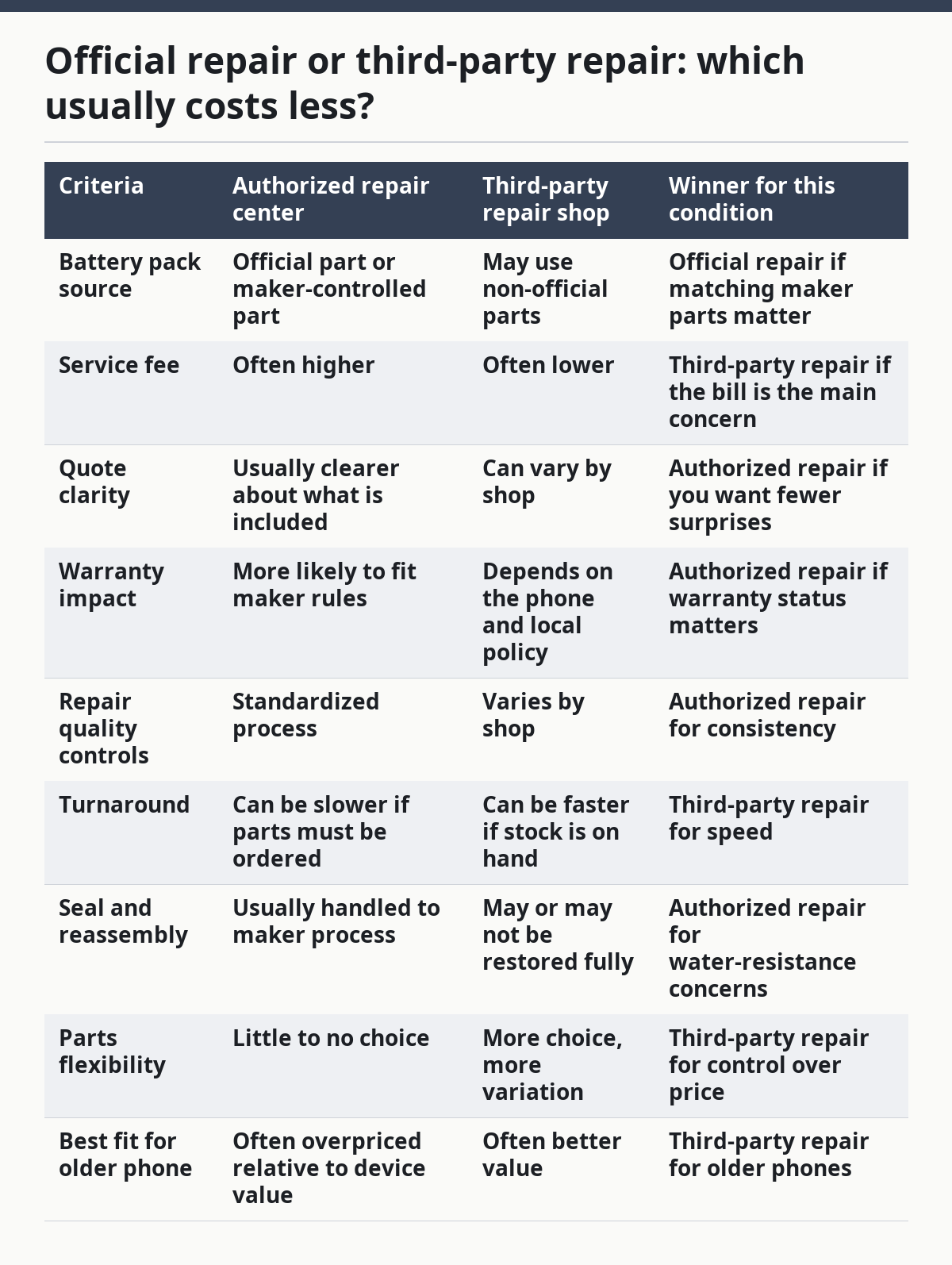
The honest read is this: authorized repair is better when the phone still has enough value to justify official service. Third-party repair is better when the phone is older and the owner wants to keep the bill down. Neither is free of trade-offs, and anyone promising a universal winner is skipping the part that matters.
Is an authorized repair center worth the higher bill?
An authorized repair center is worth the higher bill when the phone is still valuable enough that official service protects that value. The better comparison here is not just “expensive versus cheap”; it is “official process versus flexible process.”
The strength of official repair is certainty. The maker controls the parts path, and the service fee usually includes work that fits the brand’s repair rules. For a newer phone, that matters because a battery replacement can be part of keeping the device in clean working order rather than a temporary fix.
The weakness is cost pressure. When the service fee is high, the total bill can move close to the point where a person starts thinking about a used replacement phone instead. That is the moment when official repair stops looking like a simple maintenance expense and starts looking like a decision about whether the phone deserves more money.
This option is a better fit for people who want the safest repair paper trail, people who still expect to keep the phone for a while, and anyone whose warranty or manufacturer support makes official repair the cleaner route. It is less attractive for someone trying to squeeze one more year out of an older handset at the lowest possible cost.
One practical rule helps here: if the phone is still important enough that you would be unhappy with a non-official battery pack, the authorized repair center is usually the better comparison target. If the phone is already near the end of its useful life, the higher service fee becomes harder to defend.
When does a third-party repair shop make more sense?
A third-party repair shop makes more sense when the battery replacement has to be affordable and the phone is no longer a premium asset. This is the route for people who care more about the final number than about an official repair record.
The strongest case for third-party repair is a plain one: the service fee is often lower, and that lower fee can matter more than the battery pack itself. If the quote is clear and the shop explains what the battery pack includes, the total may be easier to stomach than the maker’s version of the same job.
The weakness is variation. One shop may give a clean quote with parts and labor broken out. Another may quote a battery swap without clearly stating whether diagnostics, adhesive, or seal work is included. That makes price comparison harder, because two apparently similar numbers can cover very different jobs.
This option is often the better fit for older phones, phones with lower resale value, and buyers who are comparing the battery bill against the cost of replacing the whole device. It is less ideal for someone who wants the exact standards of an authorized repair center, or for a phone that still has warranty value worth preserving.
The main thing to watch is the quote structure. If a repair shop gives one number and refuses to say what part of that number is battery pack versus service fee, the quote is harder to trust. A clearer quote is usually the better one, even when it is not the lowest.
The honest side-by-side
The real difference comes down to what you are buying with the service fee, not just the battery pack. An official repair often buys process, parts control, and cleaner warranty alignment. A third-party repair often buys a lower bill and more flexibility.
Here is the head-to-head view that matters most.
| Criteria | Official repair | Third-party repair | Winner for this condition |
|---|---|---|---|
| Upfront total | Usually higher | Usually lower | Third-party repair for budget shoppers |
| Parts certainty | High | Mixed | Official repair for consistency |
| Service fee transparency | Usually bundled into a formal quote | Can vary by shop | Official repair for clearer documentation |
| Value for newer phones | Strong | Depends on shop quality | Official repair for newer devices |
| Value for older phones | Often weak | Often stronger | Third-party repair for older devices |
| Risk of hidden extras | Lower | Higher | Official repair if you dislike surprises |
| Flexibility on parts | Lower | Higher | Third-party repair if you want options |
| Best when | Warranty, resale, or official process matters | Phone value is already modest | Depends on the phone’s age and value |
The simple read is this: official repair is the safer comparison when the phone still matters enough to justify protecting it. Third-party repair is the better comparison when the phone’s remaining value is modest and the owner wants to avoid paying a premium for the maker’s name.
What should you compare before you pay?
You should compare the full quote line by line before you pay, because the battery pack number alone does not tell the story. A quote that breaks out parts and labor is easier to judge than a single lump sum.
Start with the battery pack source. Is it official, non-official, or simply unnamed? Then check the service fee and ask whether diagnostics, adhesive, or reassembly are included. Those items can move the total enough to change the decision.
The shop type matters too. An authorized repair center may cost more, but the process is clearer. A repair shop may be cheaper, but you need to know what that lower number leaves out. If a quote mentions only “battery replacement” and says nothing about the rest, that is a warning sign, not a bargain.
These comparison points are especially useful for people deciding between paying for repair and moving on to a different phone. If the battery quote is close to the value of the device in practical terms, the repair stops being a routine fix and becomes a replacement decision.
When should you choose one option over the other?
Choose official repair if the phone is still valuable, the warranty still matters, or you want the maker’s process and parts path. Choose third-party repair if the phone is older, the service fee is the main problem, and you are comfortable asking detailed questions about the quote.
Neither option is right if the phone needs more than a battery. If the screen, charging port, or board also needs work, the battery quote alone is not the decision. That is the point where comparing battery cost stops being useful on its own.
For readers building a real ownership budget, this choice sits inside the larger question of what a phone costs over time. The main takeaway is not that one route always wins. It is that the cheapest battery pack is not the cheapest repair unless the service fee, shop type, and included work all line up in your favor.
Choose official repair if the phone is newer, warranty-linked, or important enough that you want the maker’s process. Choose third-party repair if the phone is older and you need the lowest sensible total after labor. Neither if the quote does not separate the battery pack from the service fee, or if another fault makes the repair poor value.
Drafted with AI; not yet reviewed by a person.