

How to Compare Mobile Phone Bundle Deals Without Hidden Extras
Last updated: November 20, 2026
Quick Answer: compare at least 2 offers over the same 24-month term, and use the full bill, not the headline bundle deal. In this article on How to Compare Mobile Phone Bundle Deals Without Hidden Extras, a phone bundle can look cheaper until a carrier plan, accessory pack, subscription tie-in, or discount condition gets added back in, so the real winner is the one with the lowest total cost for the term you will actually keep.
Key takeaways
- The bundle that looks cheapest on the shelf is not always the cheapest after required extras are added.
- A carrier bundle usually hides its cost in a monthly plan, while a retail bundle often hides it in accessories or subscriptions.
- The fairest comparison is usually total cost over the same term, with the same phone, same data plan, and same payment length.
- If a deal needs a long contract, a service add-on, or a bonus you do not want, treat that discount as conditional savings, and consider checking a consumer adviser or a source such as the FTC or FCC.
- The safest-looking choice is often the bundle that lists the phone, the plan, and every add-on in one place, with nothing left to discover at checkout.
A mobile phone bundle deal is worth considering only if the phone, the plan, and the extras are all visible before checkout. I know how carrier billing, accessory packs, and subscription tie-ins are structured, so I look for what is included, what is mandatory, and what disappears the moment you stop reading the small print. For a broader checklist, see the phone buying guide and plan comparison tips.
What counts as a hidden extra?

A hidden extra is any cost or condition that changes the real price after the headline offer has caught your eye. That usually means a carrier plan, an accessory pack, an activation fee, a paid subscription, or a discount that only works if you stay for a set term. The FTC’s guidance on shopping offers is a useful place to start.
The most common trap is a bundle deal that advertises the handset but requires a carrier plan to open the discount. The second trap is a “free” accessory pack that is really built into the offer, so the price is higher than the phone-only option. A third trap is a subscription tie-in that starts after a trial period and is easy to miss because it sits below the fold. Consumer Reports also notes that bundle value depends on the full bill, not the headline discount.
Check the listing for the phone model, contract length, monthly charge, required add-ons, and any condition that says the offer depends on switching, trading in, or staying active for a set period. If the discount only exists when several things happen at once, it is not a simple discount. The FCC advises consumers to read the service terms before signing up.
Carrier bundle or retail bundle?
A carrier bundle wins when the phone discount is tied to a plan you already need, while a retail bundle wins when you want the phone without a long service commitment. That is the core split, and it matters because the same handset can look cheaper in one place and cost more over time once the add-ons are counted. For a related breakdown, see the carrier plan guide and opening guide.
| Criteria | Carrier bundle | Retail bundle | Winner for this condition |
|---|---|---|---|
| Upfront phone price | Often lower on the page, but tied to service | Often higher on the page, with fewer service ties | Carrier bundle if you need the plan |
| Mandatory carrier plan | Usually required | Usually not required | Retail bundle if you want freedom |
| Accessory pack | May be folded into the offer | May be listed separately or bundled | Retail bundle if accessories are clearly named |
| Subscription tie-ins | More common | Less common | Retail bundle if you want fewer extras |
| Discount conditions | Can depend on term, activation, or trade-in | Usually simpler, but still check the fine print | Retail bundle if you want simpler terms |
| Total cost over time | Can rise fast with monthly charges | Easier to see if add-ons are limited | Retail bundle for transparent pricing |
| Contract risk | Higher if leaving early triggers charges | Lower if no service contract is needed | Retail bundle for flexibility |
| Best fit | People who need a carrier anyway | People who want control over extras | Depends on plan needs |
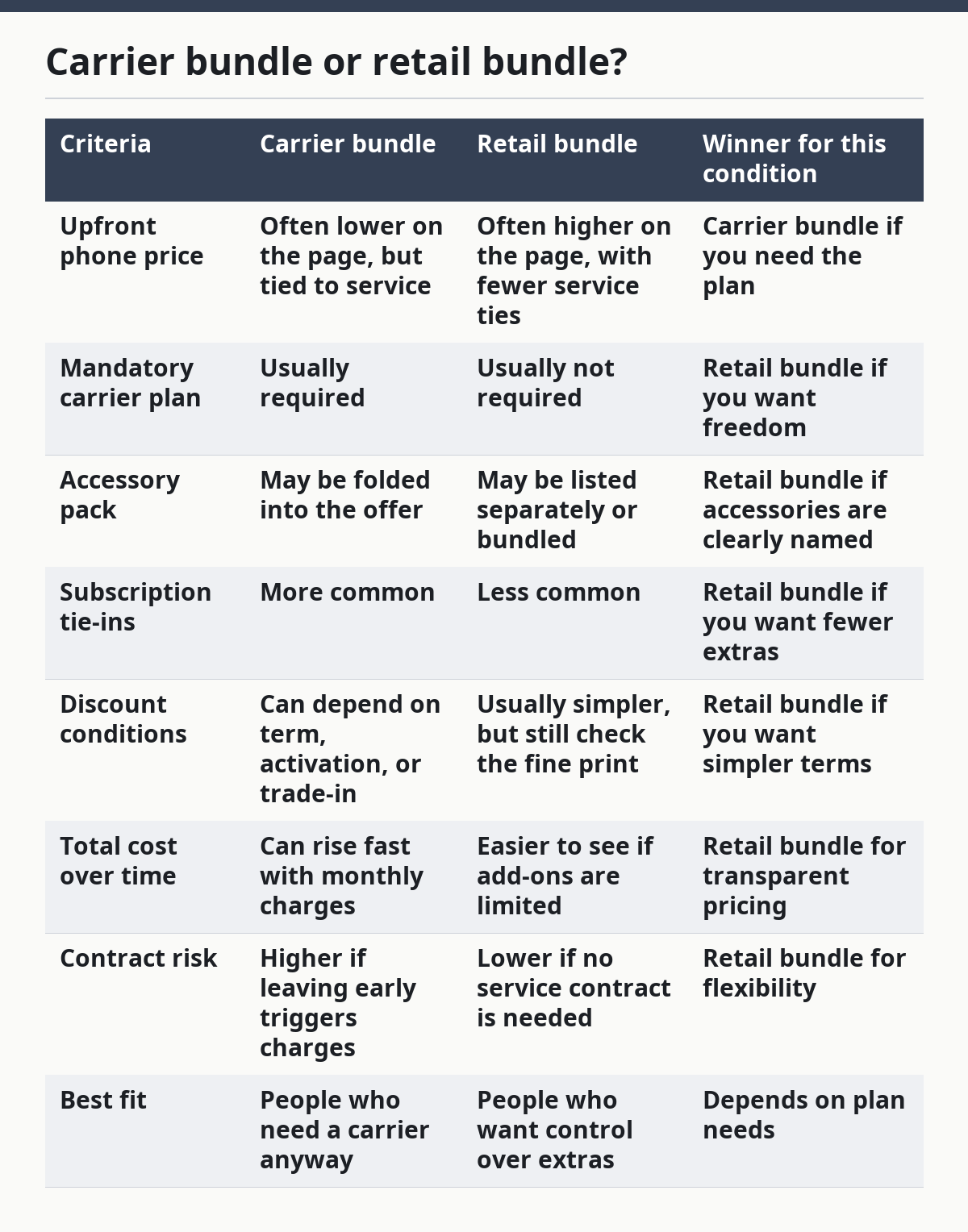
The table makes the main point plain: the cheapest-looking phone is not the same as the cheapest bundle. A carrier bundle can be sensible if the plan is already part of your normal spend, but it can turn expensive if you would never have chosen that carrier plan on its own.
Which carrier bundle is worth it?

A carrier bundle is worth it only when the plan, the phone, and the discount line up with what you would buy anyway. It wins for a buyer who already needs a carrier plan, is happy with the stated monthly charge, and is not being pushed into a long commitment just to make the handset look affordable.
The strength of a carrier bundle is that it can put the phone and service in one place, which makes comparison easier if you compare the full term. The weakness is that the real cost is spread across monthly charges, so a phone that looks discounted can still cost more after a year or two. If the offer depends on staying for 24 months, that length matters as much as the handset itself.
Carrier bundles are also the place where subscription tie-ins show up most often. A music, cloud, or insurance-style add-on may be listed as part of the “deal,” but if you do not want that service, the bundle is already wrong for you. The right carrier bundle says exactly what happens if you cancel, change plans, or pay off the handset early.
This option is not for anyone who wants the phone without a monthly service trap. It is also a poor fit if you are comparing offers by sticker price alone, because the monthly charge can dwarf the handset discount very quickly.
Pros
- One bill can make the deal easier to track.
- The phone discount may be meaningful if the plan fits your normal use.
- Useful when you already need a carrier plan.
Cons
- Monthly charges can hide the real cost.
- Early exit or plan changes can hurt the deal.
- Add-ons and subscriptions are often used to make the offer look better than it is.
Which retail bundle is worth it?
A retail bundle is worth it when you want the phone itself and do not want a service commitment attached to it. It wins for a buyer who wants fewer moving parts, clearer checkout terms, and a better view of what is truly being paid for.
The main strength of a retail bundle is clarity. If the offer lists the handset, any accessory pack, and any optional subscription in one place, it is easier to compare against another offer without guessing what is mandatory. That matters because hidden extras are harder to bury when the retailer is not tying the phone to a long carrier agreement.
The drawback is that the headline savings can be smaller, and some retail bundles still pad the offer with extras you do not need. A charger, case, earphones, or trial subscription can make the listing look generous while adding little real value. If you were going to buy the accessory pack anyway, that may be fine. If you were not, it is just noise.
Because the accessory pack may be the only reason the bundle looks attractive, check the standalone value of those items first; a case and charger do not justify a bad contract. This option is not for someone who wants the lowest possible first month at any cost. It is also not ideal if the bundle is only attractive because of accessories you would never buy separately. In that case, the offer is trying to sell convenience, not savings.
Pros
- Easier to compare the phone against other offers.
- Less risk of a long service commitment.
- Better when you want the handset without a carrier plan.
Cons
- The bundle may include extras that do not matter to you.
- The headline savings may be smaller.
- Some offers still hide value in optional add-ons.
How do I check the total cost?
The total cost is the phone price plus every required extra, measured over the same term. That means the handset, the carrier plan, any activation or connection charge if listed, the accessory pack if mandatory, and any subscription tie-in that starts during the offer period. If you want another example, compare it with the mobile ownership costs guide.
Start by asking one simple question: what must I pay to keep this deal alive for the whole term? If the answer includes a carrier plan for 24 months, compare that 24-month cost against another 24-month cost, not against a phone-only sticker. If an accessory pack is required, add it in. If a subscription is free for a short period and then becomes paid, count that as a condition, not a gift.
Then check what happens when the deal changes. Does the discount end if you cancel the plan? Does the handset price rise if you do not take the accessory pack? Does the offer only apply to new customers or only with certain plans? Those are not side notes. They decide whether the bundle is good value or a dressed-up subscription.
The cleanest comparison uses the same phone model, the same contract length, and the same service requirement across both offers. If one bundle needs a carrier plan and the other does not, the deal with more strings attached needs a bigger discount to justify itself.
When should I walk away?
You should walk away when the bundle depends on extras you do not want, cannot use, or cannot cancel without losing the discount. That is the point where the offer stops being a comparison and starts being a trap.
There are a few clear cases. If the bundle needs a carrier plan but you already have a good plan elsewhere, the phone-only offer is usually the better path. If the accessory pack is the only reason the bundle looks attractive, check the standalone value of those items first; a case and charger do not justify a bad contract. If a subscription tie-in is required after a trial, the “free” part is temporary, not real savings.
The same warning applies to discount conditions that are easy to miss. Trade-in rules, activation deadlines, or minimum-term commitments can erase the savings if they do not match your situation. A good bundle can survive those conditions. A weak one depends on you ignoring them.
This is the point where the article on mobile phone ownership costs fits best: the bundle is only one piece of the bill, and the full cost matters more than the advertised discount.
Which bundle should you choose?
Choose a carrier bundle if you already need that carrier plan and the full 24-month cost still beats the alternatives. Choose a retail bundle if you want the phone with fewer strings, clearer terms, and no mandatory service tie-in. Neither if the offer only works when you accept an accessory pack, subscription, or contract you would not choose on its own.
That is the clean rule. If the bundle survives a total-cost check with every extra included, it may be worth it. If it only looks good because the small print is hard to read, it is not a good deal at all.
Drafted with AI; not yet reviewed by a person.