
How to Compare Mobile Phone Tax and Import Fees Before Buying Abroad
Last updated: November 19, 2026
Quick answer: compare 4 costs — phone price, shipping fee, customs duty, and VAT or sales tax — before you decide if a phone is cheaper abroad. This article on How to Compare Mobile Phone Tax and Import Fees Before Buying Abroad is information, not financial advice, and a qualified adviser should be consulted for your own situation because tax rules change by country and by shipment.
For a clean starting point, use the same phone model, the same currency, and the same delivery method, then compare the landed-cost total in one number. That number is only an estimate, so check the destination country’s official customs guidance before you buy.
Key takeaways
- The phone price is only part of the bill; taxes and delivery charges can change the final cost by a lot.
- The right comparison starts with the destination country’s rules, not the seller’s checkout total.
- Customs duty, VAT, and sales tax are different charges in many places, and the order they apply can vary by country.
- A solid estimate usually names each charge separately and says who collects it.
- If the order crosses a border, a “cheap” phone can stop being cheap once duty, tax, and carrier handling are added.
What counts as import fees?
Import fees are the taxes and charges added when a phone crosses a border. That usually means customs duty, VAT or sales tax, plus shipping fee and sometimes a carrier handling charge or brokerage fee.
The first thing to check is which charges apply in the country where the phone is going, because rates, thresholds, and exemptions differ by country and change often. A phone bought from another market can arrive with a seller checkout total that leaves out tax, then pick up more costs after dispatch.
Two terms matter most. Customs duty is a border tax on certain imported goods. VAT, or value-added tax, and sales tax are consumption taxes that may be charged on the phone itself, the shipping cost, or both, depending on local rules. That is why the same phone can have two different “final prices” on two different routes.
For a broader cost frame, this page fits inside the site’s mobile phone ownership costs guide and helps the reader compare total outlay, not just the headline price.
Which costs do I compare first?
Compare the tax and import charges in this order: customs duty first, then VAT or sales tax, then shipping fee, then any delivery charge from the carrier. That order helps because some taxes are calculated on the goods value plus shipping, not on the phone price alone.
A good comparison starts with the same base for every option. Use the same phone model, storage size, and colour, then list the seller price, shipping fee, and each import charge on separate lines. If one quote includes tax and another does not, do not treat them as equal; if the rule is unclear, check the step-by-step estimate and consult the customs authority or a qualified adviser. See also the UK government’s guidance on tax and duty on goods sent from abroad and U.S. Customs and Border Protection’s internet purchases guidance.
Compare the options
| Option | What you check | Best for | Pros | Cons |
|---|---|---|---|---|
| Official customs or tax calculator | Duty class, VAT or sales tax, and any threshold rules for the destination country | Buyers who want the clearest estimate before paying | Usually closest to the actual rule; shows the tax logic clearly | Can still miss carrier handling fees and seller mistakes |
| Seller checkout estimate | The price shown at checkout, including any tax collected at source | Buyers shopping on large platforms that collect tax early | Easy to see; fast to compare across listings | May leave out duty or local delivery charges; not every seller uses the same method |
| Carrier or broker quote | Shipping fee, clearance fee, and any handling charge on arrival | Buyers using freight or parcel-forwarding services | Useful when the courier handles customs paperwork | Less useful if the seller has not given a full invoice or the carrier will not pre-quote taxes |
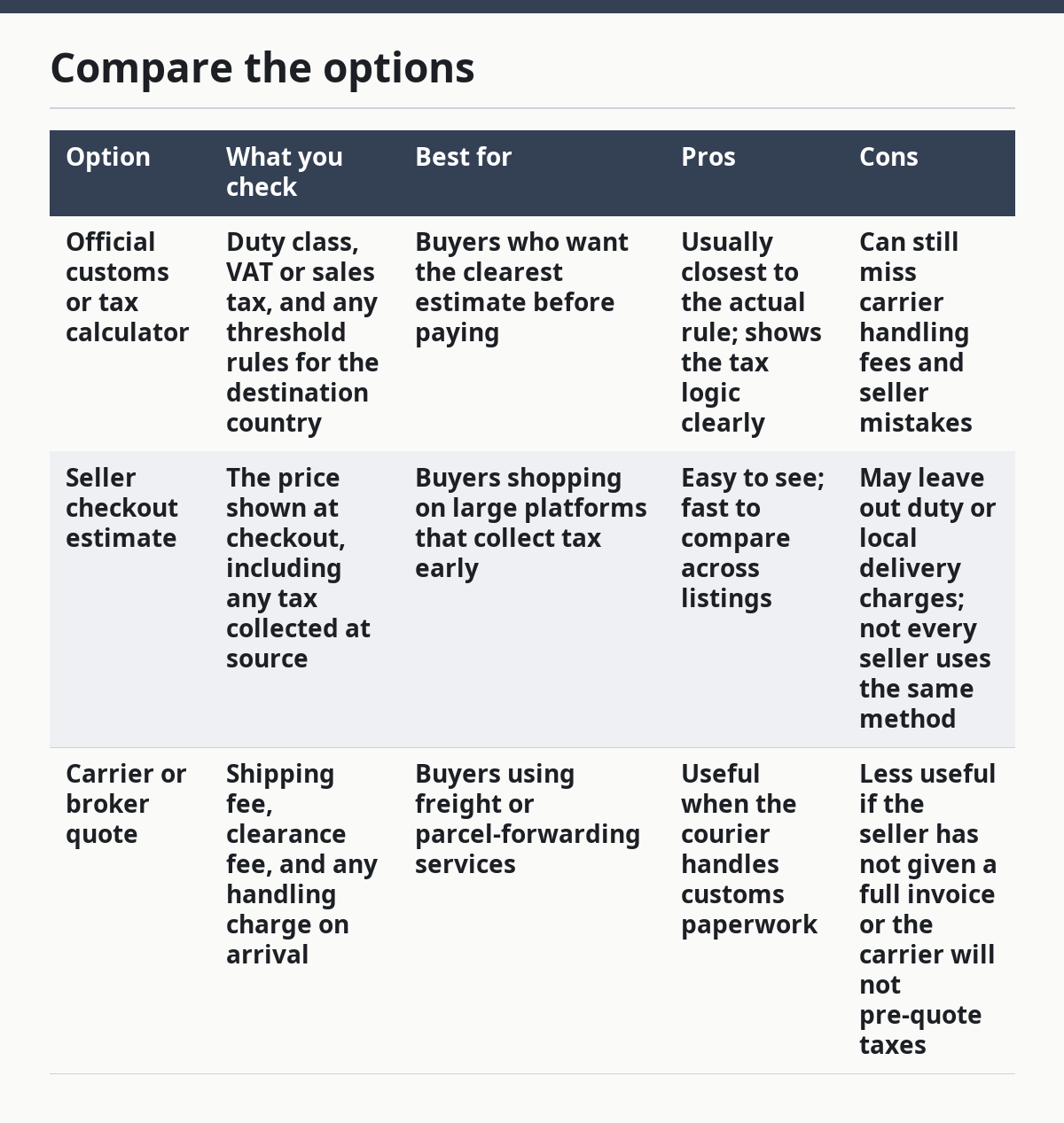
For many buyers, the official customs or tax calculator is the best first check because it gives the rules behind the price rather than only a checkout estimate. If you need a final door-to-door quote, though, the carrier bill may be more useful because it can include brokerage, which the official calculator may not show.
How do I compare the total cost step by step?
Compare the total cost by building one line-item estimate for each country or seller, then putting the totals side by side. A careful comparison usually takes 10 to 15 minutes per phone once you know the local tax rules.
- Write down the phone price exactly as shown. Use the same model name, storage size, and currency for each listing. Verify that the base price excludes tax if the seller says so; a problem is a price that already hides local tax in one market but not the other.
- Add the shipping fee in full. Include standard delivery, express delivery, and any “remote area” surcharge if it appears before checkout. Verify whether the shipping fee is charged once or per item; a problem is a quote that looks low because postage is split out later.
- Check whether customs duty applies. Look for the duty rate or the customs classification used for mobile phones in the destination country. Verify that the rule covers the phone itself, not only accessories; a problem is assuming duty is zero because the seller called it a “personal item.”
- Check VAT or sales tax separately. Some countries charge VAT, some charge sales tax, and some use both names for different systems. Verify whether tax is charged on the phone price only or on price plus shipping; a problem is ignoring tax on delivery charges when the local rule includes them.
- Look for seller-collected tax. Some checkout pages collect tax before dispatch, while others leave it to the buyer on arrival. Verify who collects it and when; a problem is paying twice because the seller collected tax but the parcel still reaches customs without the right paperwork.
- Ask whether a handling or brokerage fee applies. Carriers and customs agents may charge for clearance work. Verify whether the fee is fixed or variable; a problem is missing a courier charge that arrives after the phone ships.
- Convert every total into one currency. Use the same exchange rate date for each option so you are not comparing today’s rate with last week’s. Verify the conversion date; a problem is a false “saving” created by currency movement rather than a cheaper phone.
- Add all lines into one landed-cost total. Landed cost means the phone price plus shipping, duty, tax, and handling. Verify the total against the seller’s checkout and any official calculator; a problem is a number that looks low because one fee line is still blank.
If you want a quick rule, compare the final landed cost, not the advertised phone price. A £20 or $20 difference at checkout can vanish once tax and delivery are added, and a price that looks low can become the expensive option after border charges are applied.
What can make the estimate wrong?
The estimate can be wrong when the seller, the courier, or the customs rule uses a different value from the one you assumed. Because of that, a buyer should treat any single quote as a starting point, not a guarantee, and should check official customs guidance or ask a qualified adviser if the shipment is complex.
One common problem is declaring the wrong item value. If the invoice understates the price or bundles accessories with the handset in a way customs does not accept, the border value can change. Another problem is forgetting that shipping fee may be taxed in some countries, which raises the taxable base.
A second problem is assuming every phone order gets the same treatment. A refurbished phone, a handset with bundled accessories, or a cross-border purchase from a marketplace can be classified differently from a new retail unit. A third problem is relying on an online checkout that collects only one tax but not the other.
Use official guidance where possible. Government customs pages, tax authority pages, and customs calculators are better than forum guesses because they show the rule, not a rumor. The UK government’s guidance on buying goods from abroad and U.S. Customs and Border Protection’s online shopping guidance are the sort of primary sources that explain the mechanism, though the exact page you need depends on the country involved.
When should I stop relying on a simple estimate?
Stop relying on a simple estimate when the tax rule, shipping route, or product description is unclear. In those cases, the landed cost can be wrong by enough that a basic comparison is no longer useful.
The seller will not show an invoice value: customs may use its own valuation — ask for a proper invoice before ordering.
The checkout total does not mention tax at all: the bill may arrive on import — verify who collects VAT or sales tax before you pay.
The carrier says “fees due on delivery” but gives no amount: handling charges may appear later — get the courier’s clearance fee policy in writing if possible.
The phone is bundled with accessories or a contract: the tax base may not match the handset price — split the items and compare them separately.
The destination country has a low-value threshold that you do not understand: the order may cross from no tax to full tax with a small price change — check the current rule from the customs authority.
Because the route is unclear, the same warning applies if the seller uses a marketplace with mixed tax treatment. Some platforms collect tax at checkout, while others leave the buyer to deal with import charges after dispatch. If the route is unclear, a simple spreadsheet is safer than a guess.
What mistakes change the answer most?
The biggest mistakes are using the wrong base price, ignoring shipping, and treating VAT as the same thing as customs duty. Each one can distort the final figure enough to flip which phone looks cheaper.
A frequent error is comparing one listing with tax included against another with tax excluded. That makes the lower-looking price a trap. The correct alternative is to strip both options down to the same base and then add the same categories back in.
Another mistake is forgetting the delivery fee. A phone may seem cheaper from abroad until a high shipping charge or remote delivery charge is added. The correct alternative is to use the full shipping charge from checkout, not an estimated parcel price.
A third mistake is assuming the seller’s “import included” label means every fee is paid. In some cases, only one tax is collected at checkout and the carrier still charges a handling fee on arrival. The correct alternative is to check who is responsible for customs clearance.
A fourth mistake is comparing prices in different currencies without the same exchange date. A small currency move can make a bad deal look good for a day. The correct alternative is to convert every option on the same day with the same rate source.
How do I know the comparison is good enough?
The comparison is good enough when every option has the same phone model, the same shipping method, and a line for duty, VAT or sales tax, and any handling fee. If one of those lines is missing, the comparison is still incomplete.
A clean result usually has three features. First, the seller’s price and the imported price are both shown in one currency. Second, the total includes delivery charges as well as border taxes. Third, the source of each fee is clear enough that another person could follow the same steps and get a similar estimate.
That standard is useful because it makes the hidden costs visible without pretending they are fixed. Tax rules change by country, and a phone that is cheap in one market may be poor value in another once border charges are added. A careful landed-cost comparison is the only way to make the two offers speak the same language.
Do import fees apply to every phone order?
No, import fees do not apply to every phone order, because the rule depends on the destination country, the value of the parcel, and the way the seller ships it. Some orders clear with tax already collected at checkout, while others trigger customs duty, VAT, sales tax, or a carrier fee on arrival. Check the local rule before paying.
How do I estimate tax before ordering a phone from another country?
Estimate tax by checking the destination country’s customs rules, then applying them to the phone price and shipping fee on the same invoice. Use the official calculator or customs guidance for that country, and separate customs duty from VAT or sales tax. If the carrier charges a clearance fee, add that last so the total is closer to the real landed cost.
Drafted with AI; not yet reviewed by a person.