
Mobile Phone Warranty and Protection Choices — The Complete Guide
Last updated: November 19, 2026
A cracked screen, a dead battery, or a lost phone can turn a $800 device into a headache fast. The right protection choice is usually either the maker’s warranty alone, or that warranty plus screen-and-theft coverage if you’d struggle to pay for a repair or replacement. This guide to Mobile Phone Warranty and Protection Choices — The Complete Guide sorts out what each option actually covers, what it leaves exposed, and when each one is the smarter buy.
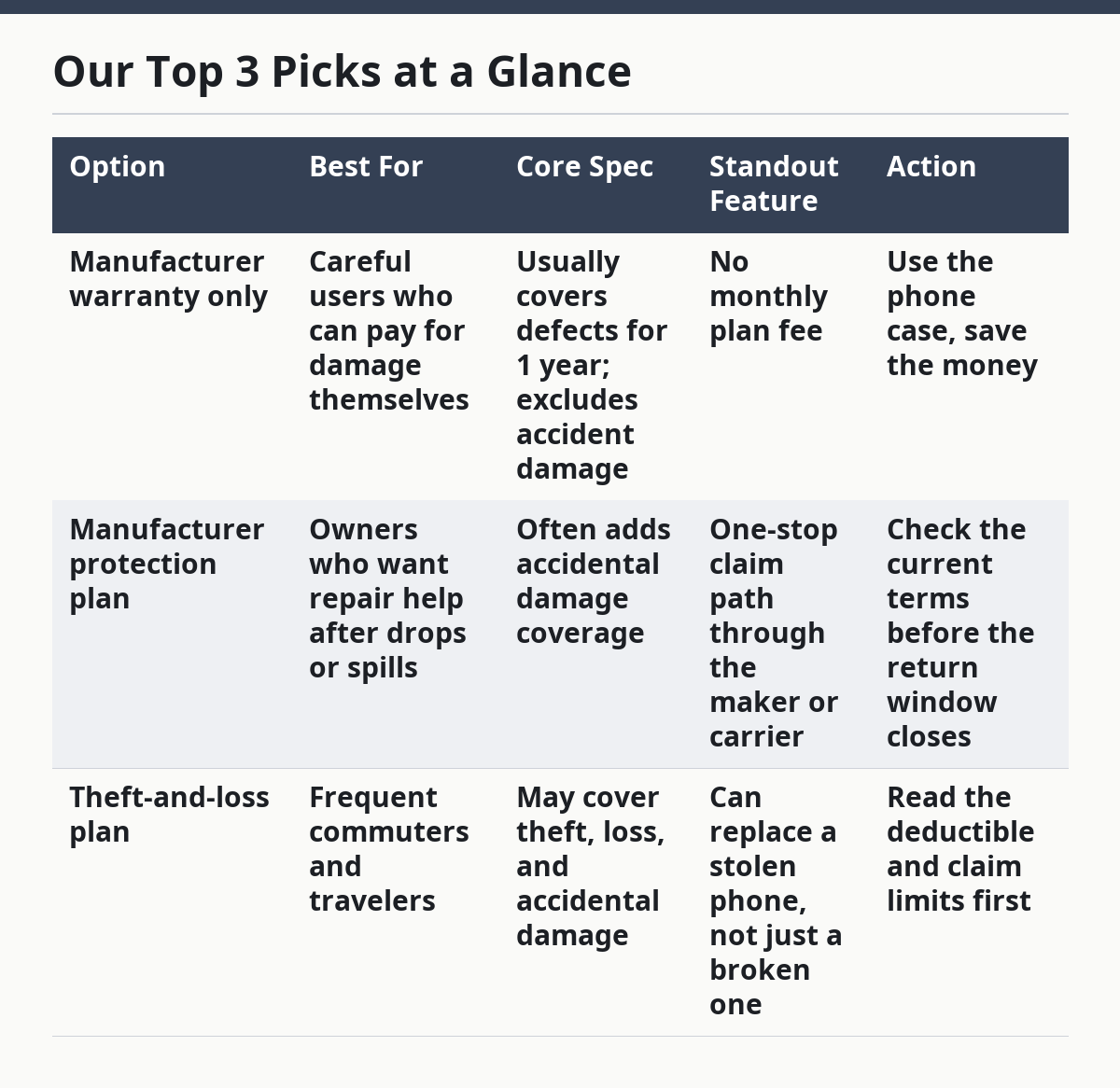
Our Top 3 Picks at a Glance
- #1 Best Overall: Manufacturer warranty + protection plan with accidental damage coverage, for people who keep phones 2–4 years and want help with drops and liquid damage.
- #2 Best Budget Pick: Manufacturer warranty only, for careful owners who can self-insure a repair or replacement.
- #3 Best Heavy-Duty / Upgrade Pick: Extended plan with theft and loss, for commuters, travelers, and anyone carrying a phone in crowded public places.
| Option | Best For | Core Spec | Standout Feature | Action |
|---|---|---|---|---|
| Manufacturer warranty only | Careful users who can pay for damage themselves | Usually covers defects for 1 year; excludes accident damage | No monthly plan fee | Use the phone case, save the money |
| Manufacturer protection plan | Owners who want repair help after drops or spills | Often adds accidental damage coverage | One-stop claim path through the maker or carrier | Check the current terms before the return window closes |
| Theft-and-loss plan | Frequent commuters and travelers | May cover theft, loss, and accidental damage | Can replace a stolen phone, not just a broken one | Read the deductible and claim limits first |
What does a phone warranty actually cover?
A phone warranty usually covers factory defects, not the everyday damage most people worry about. Picture this: your new phone won’t charge on day three, or the speaker cracks from normal use, and the maker agrees it’s a defect. That is the kind of problem a 1-year limited warranty is built for. For the exact terms, check the maker’s warranty page and, if needed, the FTC’s consumer guidance on warranties. FTC consumer guidance.
The catch is simple. Drop damage, water damage, cracked glass, bent frames, and lost phones are usually outside warranty coverage. That means a warranty can be perfect for a bad battery or a faulty button and still leave you paying full repair cost after one bad fall.
Here’s the useful way to think about it:
- Warranty = defects
- Protection plan = accidents
- Theft/loss cover = stolen or missing phone
- Case and screen protector = first line of defense
A lot of buyers overpay for protection because they never separate those four jobs. They are not the same product. They solve different problems.
For plain warranty rules, the maker’s terms matter more than the box the phone came in. Apple, Samsung, Google, and most major carriers all publish warranty and protection pages that spell out what counts as accidental damage and what does not. The language can be dense, so the key phrase to watch for is “manufacturing defect” versus “accidental damage.” For a direct example, see Apple’s Limited Warranty and AppleCare+ terms. Apple Limited Warranty, AppleCare+.
Key Takeaways
- A warranty mainly covers defects in materials or workmanship.
- Accidents usually need a separate protection plan.
- Theft and loss require a higher tier in many plans.
- A rugged case does not replace insurance, but it can lower the odds you need it.
- The best choice depends on your repair risk and cash cushion, so compare the likely repair bill with your savings before you buy.
Do you need protection, or just a case and a warranty?
For many people, a warranty plus a good case is enough. Picture this: you keep your phone in a pocket, you do not work around water or dust, and you can handle a screen repair without blowing up your budget. In that case, the extra plan may never pay for itself in peace of mind or dollars.
The best reason to buy protection is not fear. It is exposure, and the risk becomes easier to judge when you look at how often you actually drop or lose a phone. If you commute packed shoulder-to-shoulder, travel often, work outdoors, hand your phone to kids, or replace phones slowly, the chance of accidental damage matters more. That is when a plan can make sense.
A simple decision filter helps:
- Can you absorb a repair bill without stress?
- Do you usually keep phones long enough to care about accidental damage?
- Do you lose or misplace things often?
- Does your phone cost enough that one repair hurts?
- Are you likely to crack glass, not just scratch it?
If you answered “yes” to most of those, protection deserves a close look. If you answered “no,” the warranty may be the better deal.
The truth is, many people buy coverage for a problem they are unlikely to have. They pay for a plan because the phone was expensive, not because the risk is real. That is backwards. The cost of the plan, the deductible, and the claim limits all matter.
Manufacturer warranty only: who it fits and where it fails
Manufacturer warranty only wins for the disciplined owner who treats the phone like a tool, not a toy. Picture this: you use a protective case, keep the charging port clean, and want help only if the phone arrives defective or dies young. Then the warranty does the core job without adding a monthly bill. For a safe read on coverage limits, consult the maker’s warranty page and the FTC’s warranty guidance before you skip protection. FTC consumer guidance, Samsung warranty.
This choice is especially good if you replace phones often, buy midrange models, or keep an emergency fund. It also suits readers who hate filing claims. Fewer moving parts. Fewer surprises.
But the limits are real. A warranty will not save you from:
- a shattered display after a drop
- liquid damage from a spilled drink
- a stolen phone
- a lost phone
- most cosmetic wear
That means one cracked screen can wipe out the value of the warranty decision fast if you are accident-prone. On the flip side, if you rarely break devices, paying for accidental damage coverage can be money you never recover.
A warranty-only approach also puts the repair burden back on you. If the phone’s problem is not clearly a defect, you may spend time arguing the case, shipping the device, or waiting for inspection. That is not a flaw in the warranty; it is how warranty systems work.
Who Should Skip This: People who work construction, ride bikes in dense traffic, or keep a phone for years should look at accidental damage coverage instead.
Buy this if: you can pay for an out-of-pocket repair and you mainly worry about defects, not accidents.
Skip this if: your phone lives a rough life and one cracked display would throw off your budget.
Manufacturer protection plans: what you pay for and what you still don’t get
Manufacturer protection plans win for owners who want a clean path after drops, spills, or cracked glass. Picture this: the phone slips from your hand onto pavement, the display spiderwebs, and you want a repair process tied to the same company that made the device. That is the main appeal.
These plans usually add accidental damage coverage, and some carriers or makers bundle battery service, express replacement, or access to authorized parts. AppleCare+, Samsung Care+, Google Preferred Care, and carrier plans all take slightly different shapes, but the idea is the same: reduce the bill when human error breaks the phone. AppleCare+ lists coverage details and service fees on its terms page, and Google’s Preferred Care page does the same. AppleCare+, Google Preferred Care.
That does not mean “covered” equals “free.” Most plans include deductibles or service fees, and some use claim limits. Read those terms carefully. A plan that covers more events can still cost more when you actually file a claim.
There are two honest drawbacks people miss:
- Recurring cost: If you keep a phone three years and never claim, you may spend a lot for nothing.
- Claim friction: You still need to document the damage, follow claim steps, and sometimes ship or drop off the device.
Protection plans are strongest when your phone is expensive enough to hurt, but not so old that replacement makes more sense than repair. They also fit people who hate surprise spending. Predictable monthly or yearly cost can beat a sudden repair bill.
Who Should Skip This: Careful owners who already use a thick case and can replace a screen without stress may be better off with warranty only.
Buy this if: you crack phones now and then and want accident coverage from the maker or carrier.
Skip this if: you rarely damage devices and would rather keep the money than pay ongoing fees.
The Honest Side-by-Side
Manufacturer warranty wins on simplicity; protection plans win on damage coverage. Picture this: two phones fail in two different ways. One has a dead microphone from a defect. The other has a cracked back after a fall. Only one of those problems is likely to be covered by warranty alone.
Here’s the real split in plain terms.
| Criteria | Manufacturer warranty only | Protection plan | Winner for this condition |
|---|---|---|---|
| Factory defects | Usually covered | Usually covered too | Warranty only if you want the cheapest defect coverage |
| Accidental drops | Usually not covered | Often covered | Protection plan |
| Liquid damage | Usually not covered | Often covered, with limits | Protection plan |
| Theft or loss | Not covered | Only some plans include it | Theft-and-loss plan |
| Up-front cost | No extra plan fee | Extra fee or monthly charge | Warranty only |
| Claim process | Fewer claims, simpler if defect is obvious | More steps, more documentation | Warranty only for easy defect cases |
| Out-of-pocket shock | Higher after accidents | Lower after covered damage, but deductibles apply | Protection plan |
| Best for long ownership | Only if the phone is used carefully | Better if you keep the phone several years | Protection plan |
| Best for careful users | Strong fit | Often unnecessary | Warranty only |
The main takeaway is not subtle. If your biggest fear is accidental damage, warranty only is the wrong tool. If your biggest fear is paying for coverage you never use, the protection plan may be the wrong tool.
What about theft, loss, and carrier insurance?
Theft-and-loss coverage wins only when the phone is exposed to real disappearance risk. Picture this: you ride transit, travel through airports, or use a phone in crowded spaces where it can be stolen or left behind. A normal warranty does nothing there.
Carrier insurance and some manufacturer plans add theft and loss to accidental damage. That sounds broad, but the fine print matters. These plans often require quick reporting, proof of ownership, and a deductible. Some also limit how many claims you can make in a period.
Here’s the catch: theft coverage is not a free replacement program. A lost phone can still cost you a deductible, time, and paperwork. If you are the kind of person who never misplaces a device, you may be paying for a risk that barely exists.
Theft and loss is strongest for:
- frequent travelers
- people using phones in public transit
- owners of high-value phones kept for several years
- anyone who uses a phone for work and cannot go long without it
It is weaker for:
- homebodies
- careful users who keep phones on a desk or in a bag
- people with older phones whose replacement cost is modest
One more point: theft and loss usually does not replace common-sense backup. A cloud backup, a strong passcode, and Find My / Find My Device matter because they shorten downtime even when the phone is gone. Google’s Find My Device and Apple’s Find My pages are the practical starting points for that layer. Find My Device, Find My.
When do extended plans stop making sense?
Extended plans stop making sense when the phone is old enough that replacement is cheaper than coverage. Picture this: the device is past its first warranty year, the resale value has dropped, and a monthly plan keeps running. At some point, the premium eats into the device’s remaining value.
That turning point depends on three things: the phone’s current replacement cost, the deductible, and how long you plan to keep it. If the plan lasts another year but the device is already near the end of its life, the math usually gets ugly fast. Apple’s and Samsung’s plan pages both show how service fees and claim rules shape that math. AppleCare+, Samsung Care+.
A practical rule works better than a guess:
- Buy coverage early if you are going to buy it at all.
- Skip coverage late if the phone already feels replaceable.
- Recheck after one major repair if the same device keeps failing.
- Cancel when the phone value falls below the plan’s remaining cost plus deductible.
This is also where generic advice often goes wrong. A lot of people hear “insurance is worth it” and apply it to every phone. That is sloppy thinking. A plan on a flagship phone with long ownership has a different case than a plan on a budget phone that you’ll replace next year.
If you are buying a new phone now, decide on protection before the return window closes. That is when the terms are easiest to review and the choice is still reversible. Waiting six months usually means you already know your real usage pattern.
Which choice should you make today?
Choose manufacturer warranty only if you are careful, can pay for an accident, and mainly want defect coverage. Choose a protection plan if a cracked screen, spill, or back glass repair would hurt your budget or interrupt work. Neither if you own a lower-cost phone, use a solid case, and already have enough savings to self-insure.
That is the cleanest split, and it works because it matches risk to cost.
A few common scenarios push the answer one way or the other:
- You drop phones often. Protection plan.
- You never crack screens and hate extra fees. Warranty only.
- You travel often or ride crowded transit. Theft-and-loss coverage.
- You upgrade every year. Warranty only, usually.
- You keep phones 3–4 years and rely on one device for work. Protection plan often makes sense.
The real mistake is buying protection by habit, not by risk. If the plan does not match the way you use the phone, it is just an extra line item.
Which phone protection choice is best for you?
The best choice is the one that matches your damage risk, not the one with the biggest label. Picture this: two buyers walk into the store with the same phone model. One works at a desk and never drops devices. The other rides a bike, travels, and has already broken one screen. They should not buy the same coverage.
Use this quick map:
- Pick warranty only if you want defect coverage and nothing more.
- Pick accidental damage coverage if drops and spills are your main fear.
- Pick theft-and-loss if losing the phone would be the biggest problem.
- Pick neither if the phone is cheap enough to replace or you already self-insure.
The final clue is the deductible. A plan with a low monthly fee can still sting at claim time if the deductible is high. That is why the cheapest-looking option is not always the cheapest choice.
Can a case or screen protector replace insurance?
No, a case or screen protector cannot replace insurance, but it can make a protection plan less necessary. Picture this: the phone falls from pocket height, and the case absorbs the corner hit while the screen protector takes the scratch. That kind of damage prevention is exactly what accessories are for.
A good case reduces the odds of the biggest common repair: a broken screen. A screen protector helps against scratches and some cracks. These are not perfect shields, but they are the first layer every owner should think about before buying coverage.
The right order is simple:
- Buy a case.
- Add a screen protector if the phone has a glass front.
- Then decide whether accident coverage is still worth it.
That sequence keeps you from paying twice for the same risk. Accessories are cheap compared with a major display repair, and they work every day without a deductible.
A case does not help much with theft, loss, or a defect that appears on day two. That is why cases and warranties are partners, not substitutes. The case handles impact. The warranty handles defects. A protection plan only becomes worth it after both of those still leave you exposed.
What should you read before buying any protection plan?
You should read the deductible, exclusions, claim cap, and replacement terms before paying for any plan. Picture this: the marketing says “peace of mind,” but the contract says you pay a service fee for each claim and must report damage within a set time. Those details decide the real value.
Before buying, check these four things:
- Coverage type: defect only, accidental damage, or theft and loss
- Deductible or service fee: what you pay when you file a claim
- Claim limit: how many times you can use it
- Replacement method: repair, refurbished device, or like-for-like swap
Also check whether you can buy through the maker, the carrier, Amazon’s device-protection partners, Walmart, Best Buy, or the brand’s own site. A plan can look identical at first glance but differ in billing, claim handling, and refund rules.
The safe move is to compare the written terms, not the ad copy. A single page titled “coverage summary” is worth more than a dozen slogans.
What are the best authoritative sources to check?
The best sources are the phone maker’s warranty page, the protection-plan terms, and consumer guidance from standards or government sites. Picture this: you want the rule straight from the source instead of a blog paraphrase. That’s the right instinct.
Start with:
- Apple Limited Warranty and AppleCare+ terms
- Samsung warranty and Samsung Care+ terms
- Google Pixel warranty and Preferred Care terms
- FTC consumer guidance on warranties and service contracts
- U.S. Consumer Financial Protection Bureau pages on service contracts and add-on products, where relevant
- Wireless industry or standards bodies when you need technical terms like IP ratings or repair norms
Those pages are the ones that settle what is covered, what a claim costs, and what counts as damage. They also tell you what the listing does not say, which is often the most useful part.
FAQ
Is a phone warranty the same as insurance?
No, a phone warranty is not the same as insurance. A warranty usually covers defects in the phone itself, while insurance or a protection plan can cover accidental damage, theft, or loss depending on the policy. If you care about drops and spills, warranty alone is usually too narrow.
Should I buy protection for a new phone right away?
Yes, if you plan to buy it at all, the best time is usually right away or within the maker’s enrollment window. That is when the device is eligible and the terms are easiest to compare. Waiting often means you miss the enrollment period or learn too late that you need it.
Is a case enough protection for most people?
For many people, a case plus a screen protector is enough day-to-day protection. That setup lowers the odds of the most common damage, especially drops and scratches. It does not cover theft, loss, or factory defects, so it is protection, not a full replacement for coverage.
When is phone protection not worth it?
Phone protection is often not worth it when the device is inexpensive, you replace phones often, or you can handle a repair without stress. If the plan cost and deductible are close to the phone’s repair value, the math gets weak fast. In that case, self-insuring is usually cleaner.
What is the biggest mistake people make with phone protection?
The biggest mistake is buying coverage without reading the deductible and exclusions. A plan can sound broad and still leave you paying a lot when you file a claim. The second biggest mistake is assuming theft, loss, and accidental damage are all included in every plan.
Drafted with AI; not yet reviewed by a person.