
How to Compare Mobile Phone Resale Value by Storage Size
Last updated: November 20, 2026
128GB usually gives the best resale balance, 256GB often brings the strongest demand in premium phones, and 64GB is the easiest to outgrow. I follow used-phone pricing and trade-in rules closely, so the storage tier matters most when you want a phone that sells quickly without paying for capacity the next buyer does not value.
Key takeaways
- Bigger storage does not always mean a better resale return.
- 128GB is the safest middle ground for many phones because it is easy to sell and rarely feels cramped.
- 256GB can hold value well when the model attracts heavy camera, game, or video buyers.
- 64GB usually loses appeal fastest because many buyers see it as too small.
- 512GB can be hard to recover fully unless the phone sits in a premium tier and the buyer pool is large enough.
What changes resale value by storage size?
Storage size changes resale value because it changes who will buy the phone, not just what the phone can do. A 64GB phone often attracts budget buyers, while 256GB and 512GB models appeal to people who store more photos, 4K video, and offline apps.
The key point is simple: resale value is shaped by buyer preference and used market demand, not by storage alone. If a buyer can get the same model in 128GB and the 256GB version only costs a little more used, the larger version often looks like the smarter buy. If the jump is big, the premium may shrink in resale.
This is why you should compare storage tiers against the market you plan to sell into, not against the original launch price. Apple’s trade-in page and Samsung’s trade-in pages show that device condition and model matter first, but storage still affects how the used market talks about a phone: https://www.apple.com/shop/trade-in and https://www.samsung.com/us/trade-in/
How do 64GB, 128GB, 256GB, and 512GB compare?
The comparison below shows the resale pattern that usually matters most: demand, buyer pool, and how easy it is to keep value when the phone moves from first owner to second owner.
| Criteria | 64GB | 128GB | Winner for this condition |
|---|---|---|---|
| Buyer demand | Usually lower; many buyers see it as tight | Usually strong; broad appeal | 128GB for most resale markets |
| Budget appeal | Best for low-cost listings | Still competitive without feeling stripped down | 64GB for strict budget buyers |
| Premium buyer interest | Weak | Good | 128GB |
| Photo and video buyers | Poor fit | Works for light-to-moderate use | 128GB if the buyer is not a heavy creator |
| Storage premium recovery | Small premium, often hard to defend | Easy to defend as the practical default | 128GB |
| Risk of buyer pushback | Higher | Lower | 128GB |
| Suitability for long-term use | Weak unless the phone is simple and cloud-based | Strong for most users | 128GB |
| Best fit for power users | No | Sometimes | 256GB and 512GB, depending on the model |
| Resale liquidity | Can move, but with a narrower pool | Usually easiest to move | 128GB |
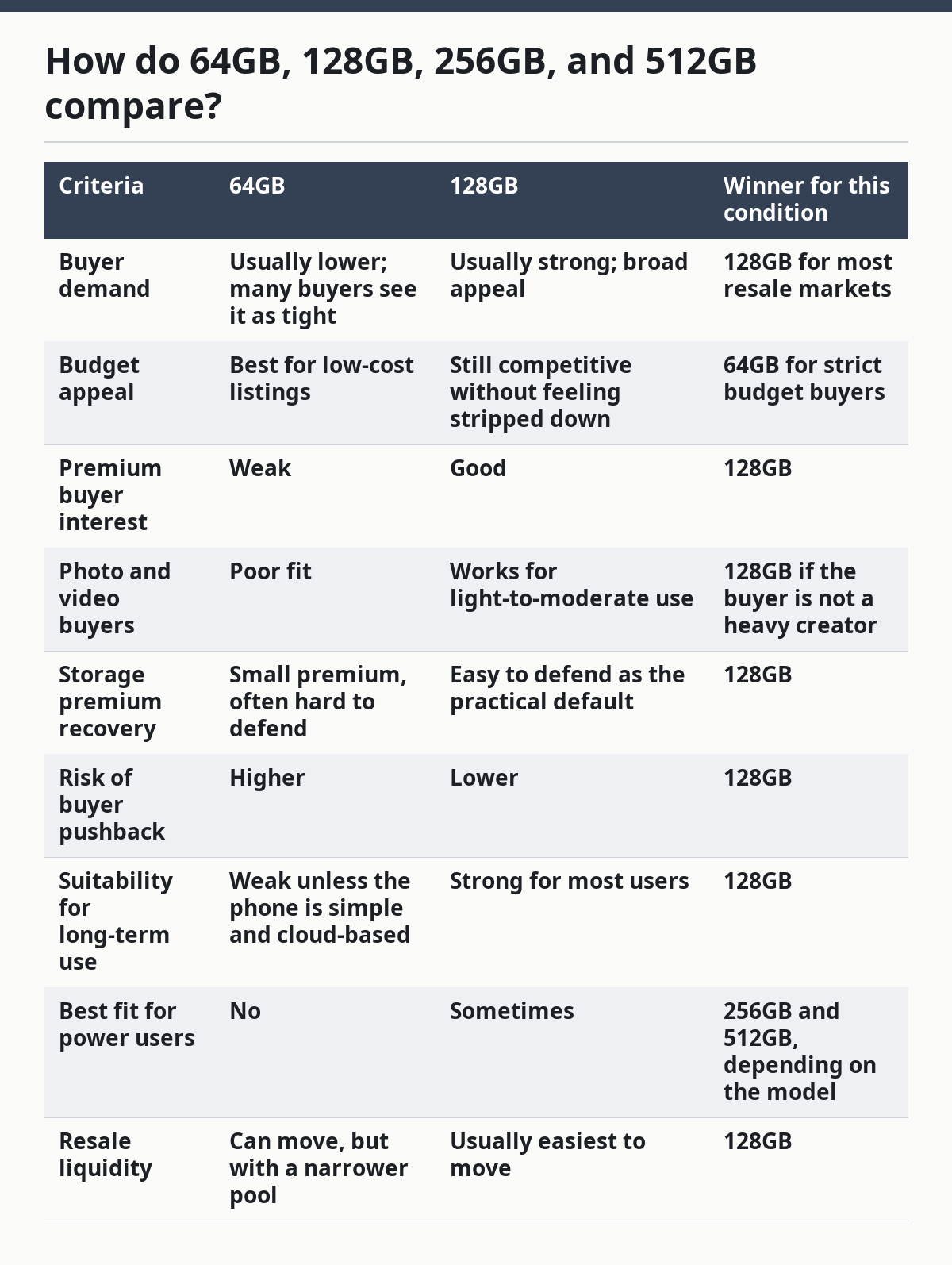
The table points to one clear pattern: 128GB is the most dependable resale tier for mainstream phones. 256GB becomes more attractive when the phone is a higher-end model with a buyer who actually needs the extra room. 64GB and 512GB sit at the edges, where the market gets less predictable.
Is 64GB worth less when you resell it?
Yes, 64GB is usually worth less at resale because it narrows the buyer pool and feels outdated faster. That does not mean it is unsellable, but it often needs a lower asking price to move.
The strength of 64GB is that it can fit a strict budget buyer who uses streaming, cloud backup, and few large apps. It also makes sense for a secondary phone, a child’s first phone, or a basic work line. In those cases, the lower capacity is not a flaw; it matches the use.
The weakness is obvious: storage runs out sooner, and that problem becomes the buyer’s problem. A person comparing two similar phones is more likely to pick 128GB unless the 64GB version is priced clearly lower. That is why 64GB phones often face more negotiation and slower sales.
Who should use it? Buyers who want the lowest practical entry point and are fine living close to the storage limit.
Who should skip it? Anyone who shoots a lot of video, keeps many offline apps, or wants the easiest resale later. If the phone is a midrange or premium model, 64GB can look too small for the price class.
Why do 128GB phones usually hold value best?
128GB usually holds value best because it sits in the sweet spot between price, capacity, and buyer comfort. It is large enough for everyday photos, video, apps, and updates, but not so large that the resale premium feels excessive.
This is the storage tier most buyers recognize as the practical default. That matters in the used market, where people want a phone that feels safe to buy without paying for storage they may never fill. A 128GB listing often faces less resistance than a 64GB listing and less sticker shock than a 256GB or 512GB listing.
The downside is that 128GB is not the right call for everyone. Heavy video users, gamers, and people who keep large local files may outgrow it. It also may not deliver the strongest resale on premium phones where 256GB is common enough to feel normal.
Who should use it? Most people who want the best mix of resale strength and broad demand.
Who should skip it? Buyers who know they keep large media libraries on the device and do not want to manage storage often.
When does 256GB make the most sense?
256GB makes the most sense when the phone is already in a higher-value model line and the buyer expects to keep the phone for a while. That is where the storage tier can help resale, because it matches the habits of people who pay for premium devices.
The main strength of 256GB is that it signals room to grow. Buyers who record video, play large games, or keep years of photos on-device often see it as the safer option. In those cases, the extra capacity can support a stronger asking price, especially if the phone model itself already attracts premium buyers.
The weakness is that the storage premium can be too large for the average buyer. If a person only uses a phone for calls, messaging, and social apps, 256GB may look unnecessary. That can slow the sale unless the model is desirable enough on its own.
Who should use it? People who want strong resale potential on a premium or upper-midrange phone and know storage matters in their daily use.
Who should skip it? Buyers on a tighter budget who only care about basic use and fast resale. For them, the extra capacity may not return enough value.
What about 512GB?
512GB can be strong for the right buyer, but it is the hardest tier to justify if you are trying to maximize resale across the widest market. It wins when the phone is a flagship model and the next buyer is clearly a heavy-storage user.
The advantage is obvious: a 512GB phone feels future-ready and suits creators, gamers, and people who keep a lot of local media. In a strong premium market, that can support a higher resale asking price than smaller tiers.
The drawback is just as clear. The buyer pool is smaller, so the phone may sit longer before selling. Many people do not need 512GB, and that makes the extra capacity feel like a luxury rather than a value add. If the phone model itself is not in demand, 512GB does not rescue it.
Who should use it? Heavy users who want the largest pool of local storage and are buying a top-tier model.
Who should skip it? Anyone who wants the broadest resale audience or who plans to sell to a price-sensitive buyer pool.
Which storage tier should you choose for resale?
Choose 128GB if you want the safest mix of resale demand and everyday usefulness. Choose 256GB if you have a premium phone and want to appeal to buyers who care about storage enough to pay for it. Neither if you are buying 512GB only because it sounds better; that tier makes sense only when you already know the next owner will need it.
The clear call is this: for most people comparing resale value by storage size, 128GB is the best default. It is easier to sell, easier to explain, and less likely to scare off buyers than 256GB or 512GB. If the phone is a creator-focused or flagship model, 256GB can be the smarter resale play.
When should you change that choice?
The verdict flips in a few specific cases. A 64GB phone can make sense if the model is very cheap and the buyer treats it as a backup device. A 256GB phone can beat 128GB when the phone line is premium and storage is a common concern for that audience.
A 512GB phone makes sense when the buyer is clearly storage-heavy and the model has a strong used market. If the device is older, off-peak, or already hard to sell, extra storage alone will not save the resale value. In that case, the better move is often to focus on condition, not capacity.
The same rule applies in reverse if the market is full of cloud-first users. When the buyer expects streaming, cloud photo backup, and little offline storage, the gap between 128GB and 256GB shrinks. That is when the storage premium becomes harder to recover.
What should I compare before I list or buy?
Compare the storage tier against the phone’s model, condition, and the type of buyer you want to reach. Storage size is one part of resale value, not the whole story.
A phone with 256GB in excellent condition can still beat a 128GB phone with poor battery health or visible wear. A 64GB phone in very good shape can sell faster than a larger model if the price gap is wide enough. The real question is not “which size is biggest,” but “which size gives the next buyer a reason to pay more without feeling overcharged.”
If you want a broader view of how phone value changes across variants, the hub page on mobile phone price comparison and value is the right next stop.
Does more storage help resale value?
Yes, but only up to the point where the buyer sees a use for it. More storage helps most when the phone model attracts people who store photos, apps, games, or video on the device.
The value boost is not unlimited. Once the storage tier looks larger than the average buyer needs, the extra capacity can stop paying back at resale. That is why 128GB often performs better than 64GB, while 256GB and 512GB need a stronger buyer match to justify themselves.
Which storage size resells best?
128GB usually resells best because it fits the widest buyer pool. It feels practical without looking stripped down, and that balance matters in used-phone listings.
256GB can beat 128GB in some premium markets, but only when the model and buyer type support the larger tier. 64GB usually has the weakest resale appeal, while 512GB is too niche to win in most mainstream sales.
Drafted with AI; not yet reviewed by a person.