
How to Compare Mobile Phone Software Support Costs Over Time
Last updated: November 20, 2026
Quick answer: over a typical 3- to 5-year ownership period, the lower total cost is often the phone with longer software support, because it can delay one replacement purchase. In How to Compare Mobile Phone Software Support Costs Over Time, the safest way to judge value is to compare the full ownership path, not just the day-one price.
Key takeaways
The key takeaway is that longer software support usually lowers total cost over 3 to 5 years if you keep the phone that long.
- A phone with longer software support can cost less over time even if it costs more upfront, because it delays replacement.
- A phone with shorter support can look cheap at purchase and still end up more expensive if it forces an early upgrade.
- Security patches and feature updates matter differently: one protects the phone, the other keeps the phone useful.
- The real comparison is not “which phone is cheaper,” but “which phone stays safe and usable long enough for your plans.”
- The wrong choice is a phone that outlives its software support before you are ready to replace it.
What counts as software support cost over time?
Software support cost over time is the total burden of keeping a phone usable and secure after purchase, and that includes more than just the update itself. It includes the value of the software updates, security patches, feature updates, and the replacement cost when the device lifecycle ends before you wanted it to. This is the core idea in How to Compare Mobile Phone Software Support Costs Over Time.
That matters because software support has two jobs. Security patches reduce risk, while feature updates keep apps, battery tools, camera tools, and system features current enough for daily use. If support stops early, the phone may still power on, but it can start to feel old long before the hardware fails.
A good comparison starts with the time you plan to keep the phone. If you replace phones every 12 to 18 months, support cost is a smaller part of the decision. If you keep a phone for 3 to 5 years, support becomes one of the main cost drivers because it affects when you are pushed into a new purchase.
For background on why patching matters, the NIST guidance on patch management explains why timely updates are part of basic device hygiene. For consumer guidance on keeping a phone updated, the UK’s National Cyber Security Centre is a useful reference, and if you are unsure how to apply that advice to your own device, a cybersecurity professional or qualified retailer can help.
Which support path is usually cheaper after 3 to 5 years?
The longer-support path is usually cheaper after 3 to 5 years if the phone is still fast enough for your needs. The reason is simple: one extra year or two of usable updates can delay a replacement purchase, and delaying a replacement often matters more than a small difference in upfront price.
The shorter-support path can still win if you already upgrade often or if you buy phones at a lower upfront cost and accept an earlier replacement cycle. That choice makes sense only when the phone’s lower purchase price and your upgrade habit outweigh the cost of losing support sooner.
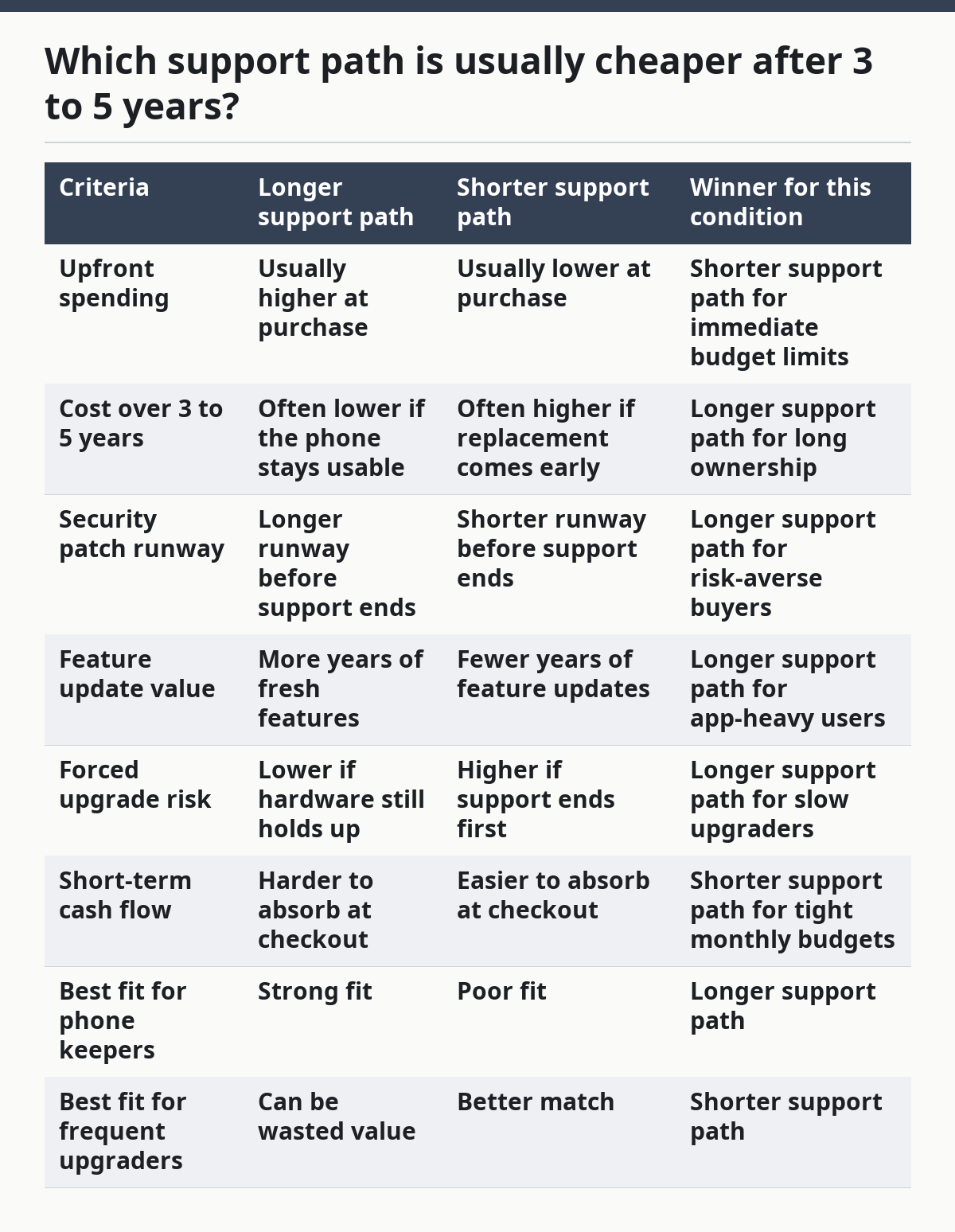
Here is the core trade-off in plain terms: longer support spreads the phone’s cost across more months, while shorter support concentrates the cost into a shorter period and may force an earlier upgrade. The real loser is the buyer who chooses a short-support phone but keeps it long enough to run into unsupported software.
| Criteria | Longer support path | Shorter support path | Winner for this condition |
|---|---|---|---|
| Upfront spending | Usually higher at purchase | Usually lower at purchase | Shorter support path for immediate budget limits |
| Cost over 3 to 5 years | Often lower if the phone stays usable | Often higher if replacement comes early | Longer support path for long ownership |
| Security patch runway | Longer runway before support ends | Shorter runway before support ends | Longer support path for risk-averse buyers |
| Feature update value | More years of fresh features | Fewer years of feature updates | Longer support path for app-heavy users |
| Forced upgrade risk | Lower if hardware still holds up | Higher if support ends first | Longer support path for slow upgraders |
| Short-term cash flow | Harder to absorb at checkout | Easier to absorb at checkout | Shorter support path for tight monthly budgets |
| Best fit for phone keepers | Strong fit | Poor fit | Longer support path |
| Best fit for frequent upgraders | Can be wasted value | Better match | Shorter support path |
What does the longer-support path buy you?
The longer-support path buys time, and time is the main thing that lowers software support cost over multiple years. If a phone keeps getting security patches and feature updates for a longer stretch, you can hold onto it without paying for a new device just because the old one fell off support.
That is the strongest case for this path. It suits people who keep a phone until the battery or the hardware clearly fails, or people who want fewer surprise upgrades. It also fits buyers who rely on the phone for banking, work apps, or two-factor sign-ins and do not want to cross into an unsupported period early.
The weakness is that you may pay more upfront for a phone whose support window you never fully use. If you upgrade every 18 to 24 months anyway, part of that extra support value gets wasted. In that case, the better choice may be a cheaper phone with a shorter support runway.
If you are unsure how long you will keep a phone, a longer-support model is often the safer bet, but a cybersecurity professional or knowledgeable retailer can help you judge whether the extra years are worth it for your situation. That guidance matters most when the phone is also your main device for work, banking, or authentication.
What does the shorter-support path buy you?
The shorter-support path buys a lower entry cost and a simpler decision, and that can make sense if you never keep a phone long enough for software support to matter much. If you tend to replace phones often, the shorter runway may never become a real problem.
Its main strength is cash flow. A lower upfront price can matter more than future support if you need the phone now and plan to move on before support ends. That is especially true for buyers who upgrade on a fixed cycle and are already budgeting for the next phone.
The weakness is obvious: the phone can become a forced replacement sooner than expected. Once security patches stop, the device may still work, but the ownership cost rises because the next upgrade is no longer optional. That is how a cheap phone can become expensive over time.
Because of that, shorter support is a poor fit for buyers who do not want surprise costs. If you want to keep one phone as long as the hardware lasts, short support is the wrong buy because it shifts the replacement date forward.
Who should choose each option?
The longer-support path suits buyers who keep phones for 3 to 5 years, use banking or work apps, and want the lowest cost per month rather than the lowest purchase price. It also fits anyone who hates replacing a phone just because the software stopped.
The shorter-support path suits buyers who upgrade on schedule, want the lowest possible entry price, or use the phone as a temporary device. It works when the replacement cycle is already short enough that software support will not expire first.
A simple rule helps: if you expect to own the phone longer than its support window, choose longer support. If you know you will replace the phone before support ends, shorter support can be the rational choice. That is the whole comparison in one sentence.
The catch is that many buyers guess wrong about how long they will keep a phone. A 12-month plan can turn into a 30-month reality when the next upgrade looks unnecessary. That is when short support becomes a hidden cost.
When does the verdict flip?
The verdict flips in a few real cases, and those cases matter more than the marketing claims around the phone.
First, if the phone is so much cheaper that the price gap clearly outweighs the extra support years, the shorter-support option can win. That only works when the phone is still good enough for the full period you plan to keep it.
Second, if you upgrade every 12 to 18 months no matter what, long support is not buying much. You are paying for years you will not use, so the cheaper short-support phone may be the better deal.
Third, if the longer-support phone keeps feature updates long enough for the daily apps you rely on, the balance can shift back. That matters more for people who depend on the device as a primary computer, not just a calling tool.
Fourth, if your current phone is already close to the end of its device lifecycle, support cost becomes urgent rather than theoretical. At that point, the question is not “Which phone keeps support longer?” but “Which replacement avoids another early forced upgrade?”
How should you compare real phones on the shelf?
You should compare the support window, the likely replacement date, and the phone’s role in your life, then decide which one costs less per year. That means asking three practical questions before you buy: how long will the device get security patches, how long will it receive feature updates, and how long do you expect to keep it before replacing it?
Do not compare software support in isolation. A phone with a longer update policy can still be a bad buy if the hardware is already weak for your needs. A phone with shorter support can still be fine if it is cheap enough and you know you will move on early.
The best comparison is a simple one: put the phone’s support runway next to your own upgrade habit, then check whether How to Compare Mobile Phone Software Support Costs Over Time changes the outcome. If the runway is longer than your habit, you may be paying for support you will never use. If the runway is shorter than your habit, you are likely buying a forced upgrade later.
For a broader view of how this fits into the whole purchase decision, the hub on Mobile Phone Buying Strategy and Total Cost is the right next stop.
FAQ
How long should a phone stay supported?
A phone should stay supported long enough to cover the time you realistically plan to keep it. If your ownership habit is 3 to 5 years, compare that window directly with the software support window before you buy.
Is longer support always worth paying more for?
No. Longer support is worth paying more for only if you will actually keep the phone long enough to use that support. If you upgrade quickly, the extra years may not save you money.
What is the biggest hidden cost in phone ownership?
The biggest hidden cost is often an early replacement caused by support ending before you were ready. That can turn a cheaper phone into a more expensive one over time.
Should I care more about security patches or feature updates?
You should care about both, but in different ways. Security patches help keep the phone safe, while feature updates help keep it useful and current for everyday use.
What is the verdict?
Choose the longer-support path if you keep phones for several years, want fewer forced upgrades, and care about security patches and feature updates staying current. Choose the shorter-support path if you upgrade often, need the lowest entry cost, and know you will replace the phone before support runs out. Neither if you expect to keep the phone past its support window and still want to avoid an early replacement.
Drafted with AI; not yet reviewed by a person.