

How to Compare Mobile Phone Insurance Deductibles
Last updated: November 19, 2026
Compare the excess at claim time first, then compare the monthly premium, the claim limit, and the replacement device rules. A policy with a lower excess can still cost more overall if the premium is high or the replacement device is limited, so the right choice depends on how often you think you may claim and how large the out-of-pocket bill would be when you do. This is information, not financial advice; a qualified adviser should be consulted for your own situation.
Key takeaways
- The excess is the amount you pay when you make a claim; it matters more than the monthly premium if you expect to claim even once.
- A lower excess usually means a higher premium, so the real comparison is the total cost over time, not one fee on its own.
- A claim limit can shrink the value of a policy even if the excess looks low.
- A replacement device policy can leave you with a refurbished phone, a like-for-like model, or a cash settlement, and that changes the true cost.
- The best choice is usually the policy with the smallest claim-time bill that still gives the replacement cover you actually want.
What should I compare first on a phone insurance quote?

The excess, the monthly premium, the claim limit, and the replacement device rule are the four numbers that change the decision most. Start with the excess because that is the cash you may need to find quickly after a loss, theft, or damage claim.
A generic quote can look cheap on the monthly side and still sting hard at claim time. That is why the headline premium alone is a weak comparison. A policy with a low premium and a high excess may suit someone who wants cover only as a back-up, while a policy with a higher premium and lower excess can suit someone who wants a smaller shock when something goes wrong.
The claim limit matters because some policies cap what they will pay toward a device replacement. If the limit is close to the phone’s price, the cover is more useful. If it is low, the excess is only part of the cost story. The replacement device also matters because a refurbished or like-for-like handset is not the same as a new retail device, even if the policy says “replacement.”
For this page, the useful comparison is not “cheap versus expensive.” It is “small claim-time bill versus small monthly bill,” with the claim limit and replacement policy checked beside it.
Lower excess: who should use it?
A lower excess wins for anyone who wants the smallest bill at claim time and can tolerate a higher monthly premium. That trade-off makes sense when the reader values predictability more than the lowest monthly outlay.
The main strength is simple: if a claim happens, the out-of-pocket hit is smaller. That matters most for a broken screen, a damaged device, or a stolen handset replacement, because the excess is the part you pay immediately. A lower excess can also make the policy easier to use in practice, since the claim feels less like a penalty.
The weakness is just as clear. A lower excess often comes with a higher premium, so the policy can cost more even in months when nothing goes wrong. If the phone is older, already heavily used, or close to replacement age, that extra monthly cost may not make sense. The policy can also still come with a claim limit or a replacement device that is refurbished, which means the lower excess does not erase every downside.
This option fits someone who wants one clear number to budget for at claim time. It is not a strong fit for a reader who keeps a phone only for a short time or who mainly wants the lowest ongoing cost.
Pros
- Smaller cash hit when a claim is made.
- Easier to budget for a repair or replacement.
- Better for readers who dislike surprise costs.
Cons
- Higher monthly premium is common.
- Can still come with a claim limit.
- May not be worth it for an older device.
Higher excess: when does it make sense?
A higher excess makes sense when the monthly premium matters more than a smaller claim bill, and the reader is comfortable paying more if something goes wrong. This option usually shifts cost from the monthly side to the claim side.
The strength is obvious: the regular premium can be lower, so the policy may fit a tight monthly budget. That can be useful if the phone is one part of a larger household budget and the reader wants cover without much ongoing drain. It can also work for people who are unlikely to claim and mainly want protection for worst-case events.
The weakness is the bill at claim time. A high excess can turn a repaired screen or replacement phone into a much larger out-of-pocket expense than the reader expected. If the claim limit is also low, the policy can feel thin when it is finally used. A replacement device policy may soften the blow, but it does not remove the fact that the reader still has to pay a larger share.
This option suits someone who values lower monthly cost and is willing to self-insure part of the risk. It is not ideal for a reader who would struggle to pay a larger one-time amount after a claim.
Pros
- Lower monthly premium is common.
- Can suit low-use or lower-risk owners.
- Useful when the reader wants cover but not a high regular bill.
Cons
- Larger payment at claim time.
- Can make the policy feel weak when used.
- More likely to frustrate a reader who expects strong protection.
How do the numbers compare side by side?
The lower-excess option wins for claim-time value, while the higher-excess option wins for monthly affordability. The right choice depends on whether the reader cares more about the bill today or the bill at claim time.
| Criteria | Lower excess, higher premium | Higher excess, lower premium | Winner for which condition |
|---|---|---|---|
| Claim-time cash outlay | Smaller excess to pay | Larger excess to pay | Lower excess for a reader who wants less shock at claim time |
| Monthly cost | Usually higher | Usually lower | Higher excess for a reader focused on monthly budget |
| Ease of budgeting | Clear if the claim may happen | Clear if no claim happens | Lower excess for someone planning for a possible claim |
| Value if you claim once in 12 months | Often stronger if the premium gap is modest | Can weaken fast if the excess is large | Depends on the size of the premium gap |
| Fit for an older phone | Often weaker if the premium stays high | Often stronger if cover is basic | Higher excess for a phone near replacement age |
| Claim limit sensitivity | Still matters | Still matters | Neither, if the claim limit is too low |
| Replacement device impact | Better if the policy offers a like-for-like handset | Can still be limited to refurbished replacement | Lower excess when replacement quality matters |
| Best user profile | Readers who want the smallest claim bill | Readers who want the smallest monthly bill | Depends on cash flow and claim risk |
| Weak point | The premium can eat away the benefit | The claim bill can hurt when something goes wrong | No tie; each fails in a different way |
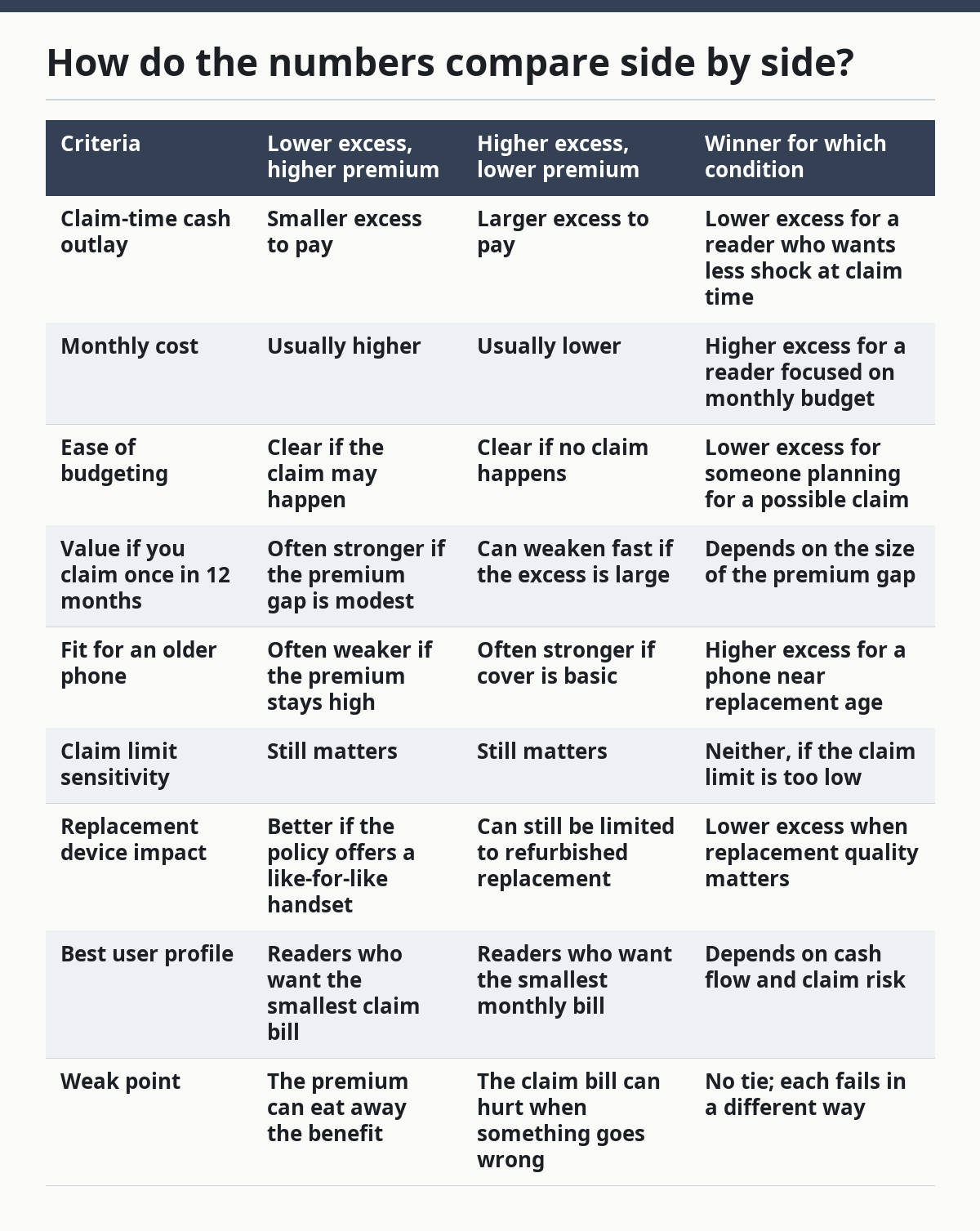
The table shows the real decision: one option reduces pain at claim time, the other reduces the ongoing bill. The better choice is the one that fits the part of the cost curve that matters most to the reader.
What does the replacement device rule change?
The replacement device rule can change the true cost even when the excess looks attractive. A policy that replaces the phone with a refurbished unit, rather than a brand-new retail device, may not give the same outcome the reader imagines when comparing excesses.
This matters because many people compare policies as if every replacement were identical. It is not. A claim limit can cap the payout, and the replacement rule can decide whether the reader gets a handset, a cash settlement, or a refurbished device. Those differences can make a low excess look better on paper than it is in practice.
A lower excess is stronger when the replacement policy is clear and the device outcome is acceptable to the reader. A higher excess is weaker when the policy also narrows the replacement choice, because then the reader pays more at claim time and still gets less than expected.
This is the part many generic articles miss: the cheapest-looking excess can be a poor deal if the replacement policy leaves the reader with a device they did not really want. The number on the quote is only one piece of the value.
Which option should I choose?
Choose the lower excess if you want the smallest claim-time bill and can accept a higher monthly premium. Choose the higher excess if you want a lower monthly premium and can handle a larger out-of-pocket cost if you claim. Neither if the claim limit is too low or the replacement device rule is too restrictive for the phone you actually use.
That is the cleanest way to compare mobile phone insurance deductibles and excess costs. The right choice is not the policy with the best-looking headline number; it is the one whose claim-time cost, premium, and replacement terms fit the way you budget.
This is also the right place to connect the decision to the wider purchase cost. A phone is not just the sticker price. The hub on mobile phone ownership costs belongs next to this choice because the insurance bill is part of the same total-cost picture.
When should I ignore the lowest excess?
Ignore the lowest excess when the monthly premium rises so much that the policy stops making sense over time, when the claim limit is weak, or when the replacement device terms are poor. Those are the three most common reasons a low excess is not the best choice.
There are a few exception scenarios where the verdict flips. First, if the monthly premium gap is large and the phone is already close to replacement age, the higher excess can be the better fit because the policy may only need to act as light protection for a short period. Second, if the reader has a strong emergency fund and would rather keep monthly costs lower, a higher excess can be the practical choice. Third, if the replacement device is clearly better in one policy, that may outweigh a small excess difference.
A fourth exception is a short ownership window. If the reader plans to change phones within 6 to 12 months, a policy with a low premium may matter more than a low excess, because there is less time for the lower claim-time bill to justify a higher ongoing cost.
The mistake to avoid is judging the excess in isolation. The monthly premium, claim limit, and replacement device are part of the same package, and one weak term can wipe out the value of the others.
Drafted with AI; not yet reviewed by a person.