

Mobile Phone Discount Evaluation Guide
Last updated: November 20, 2026
Quick Answer: In most cases, the best mobile phone discount is the one that lowers your total cost over 24 months without hiding that savings inside a longer plan, a trade-in requirement, or a bill credit you may never finish collecting. This guide to mobile phone discount evaluation uses the same pricing terms carriers and retailers use: upfront discount, bill credits, trade-in value, financing term, activation fee, and total device cost. That matters because a phone that looks “discounted” at checkout can end up costing more over 24 months than a plain lower sticker price.
Key takeaways
- A real discount cuts the total amount you pay, not just the number shown in a banner.
- Instant price cuts are easier to verify than monthly bill credits spread over 24 months.
- Trade-in offers can be strong, but only if your old phone matches the condition rules.
- Contract length, plan type, and cancellation risk matter as much as the phone price.
- If the offer depends on a trade-in you cannot complete, it is not your deal.
What counts as a real discount?
A real discount is one that reduces your final out-of-pocket cost, not just the headline price. The cleanest offers are plain price cuts on the handset, because the savings show up right away and do not depend on staying with one carrier for 24 months.
That matters because mobile phone deals often hide the savings in other places. A carrier may offer bill credits over 24 months, a retailer may require a financed plan, or a trade-in may only be accepted if the old phone powers on and meets condition rules. The offer can still be good, but only if you can keep every condition intact.
Therefore, the quickest practical check is to ask four questions rather than assume the banner tells the whole story. What is the current price? Is the savings upfront or spread out? Does it require a plan, a trade-in, or both? What happens if you leave early? Those four questions usually tell you more than a giant “save big” banner ever will.
A useful check is total cost, not monthly sparkle. If a phone costs less today but the plan is $10 more per month for 24 months, the real discount may disappear. If the deal depends on a trade-in, the old phone’s condition and model matter just as much as the phone you want to buy. If the listing does not clearly show those terms, treat the discount as incomplete, and if you are unsure, review the carrier’s written terms or consult a qualified consumer adviser and FTC guidance at https://www.ftc.gov/.
The strongest pages and listings usually state the phone model, financing term, trade-in conditions, and whether the discount is an instant reduction or a rebate. The weaker ones leave those details in the fine print. A buyer who wants a safe choice should prefer the offer that can be understood in one pass, without hunting for exclusions.
Is an instant rebate better than bill credits?
An instant rebate is usually better for anyone who wants certainty, while bill credits can be better only if the plan will stay unchanged for the full term. The reason is simple: instant savings are finished the moment you pay, but bill credits can vanish if you cancel, upgrade, or fail to keep the required line active.
Bill credits sound larger because the carrier can advertise a bigger total savings figure. That number is often tied to 24 monthly statements, which makes the discount feel bigger than it is on day one. The catch is that the savings are conditional. If you stop the line early, the remaining credits may stop too.
An instant rebate gives you a cleaner comparison against other stores. If one retailer drops the phone price now and another spreads the savings over 24 months, the instant deal is easier to measure. It is also easier to compare across carriers, because the discount is attached to the handset price rather than the service relationship.
The weakness of instant rebates is that they are often smaller on paper than the largest advertised bill-credit deal. That can make the instant offer look less exciting at first glance, even when it is safer. The weakness of bill credits is the opposite: they can look best in the ad and worse in real life if your plan changes or the phone gets returned.
A practical rule helps here. If the buyer wants flexibility, the instant rebate wins. If the buyer is sure about keeping the same line for the full 24 months and accepts the plan terms, bill credits can be worth it. If the buyer is unsure about any of that, the bill-credit deal is too fragile to treat as the better bargain; in that case, it is wise to verify the terms with the carrier or a consumer-resource source such as the FCC at https://www.fcc.gov/ before deciding.
What should you check before accepting a trade-in offer?
A trade-in offer is worth taking only when the device condition, model, and timing all match the listing exactly. Trade-in promotions can be strong, but they are not simple cash. They depend on whether the old phone powers on, has the right screen condition, is not blocked by account issues, and is sent in by the deadline.
The first thing to check is the condition language. Many trade-in offers separate acceptable wear from damage that kills the offer. A cracked screen, missing buttons, water damage, or a non-functioning battery can change the value fast. If the listing gives a condition checklist, read that before you promise yourself the full credit.
The second thing to check is the model list. Some promotions pay more for newer flagship phones and less for older or budget models. A trade-in can be excellent for one model and weak for another. If your current phone is not on the preferred list, the advertised discount may shrink once the system assigns the actual trade value.
The third thing is timing. Trade-in bonuses often depend on mailing the device back within a set window, sometimes after the new phone ships. If the old phone is your backup device, that timeline may matter more than the discount itself. A missed deadline can turn a strong deal into an ordinary one.
Trade-ins also create a hidden cost: you surrender a spare phone. That matters if you like having a backup for travel, work, or resale. A person with a reliable old handset may be better off selling it separately or keeping it as a spare if the trade-in figure is weak.
The trade-in route is strongest for a buyer who already planned to replace the old phone, wants a lower upfront cost, and can follow every condition exactly. It is weaker for anyone whose device has cosmetic damage, whose backup phone still has value, or whose schedule makes mailing the old device annoying.
Upfront discount or trade-in credit?
Upfront discounts win for simplicity, while trade-in credits win only when the old phone qualifies for a strong offer. The difference is not just style. It changes how much risk the buyer takes and how much proof is needed before the discount is real.
| Criteria | Upfront Discount | Trade-in Credit | Winner for [condition] |
|---|---|---|---|
| Ease of comparison | Easy to compare across retailers because the cut shows up now | Harder to compare because value depends on phone model and condition | Upfront Discount for quick comparisons |
| Risk of losing savings | Low, because the reduction is already applied | Higher, because failed condition checks can reduce the payout | Upfront Discount for cautious buyers |
| Best use case | Buyers who want a simpler purchase | Buyers with a strong, eligible old phone | Trade-in Credit when the old phone is high-value |
| Need to keep a contract | Often no long commitment required | Sometimes tied to a financed line or service term | Upfront Discount for flexibility |
| Speed of savings | Immediate | May depend on approval and return timing | Upfront Discount for immediate relief |
| Hidden conditions | Usually fewer, but still check taxes and fees | More moving parts: model list, condition, deadline | Upfront Discount for low-friction buying |
| Backup phone value | You keep your old phone if you want it | You give up the old phone | Upfront Discount if a spare phone matters |
| Chance of strongest value | Moderate and predictable | Can be very strong for the right model | Trade-in Credit for premium eligible phones |
| Who should skip it | Buyers chasing the largest headline number | Buyers with damaged or uncertain devices | Depends on condition and patience |
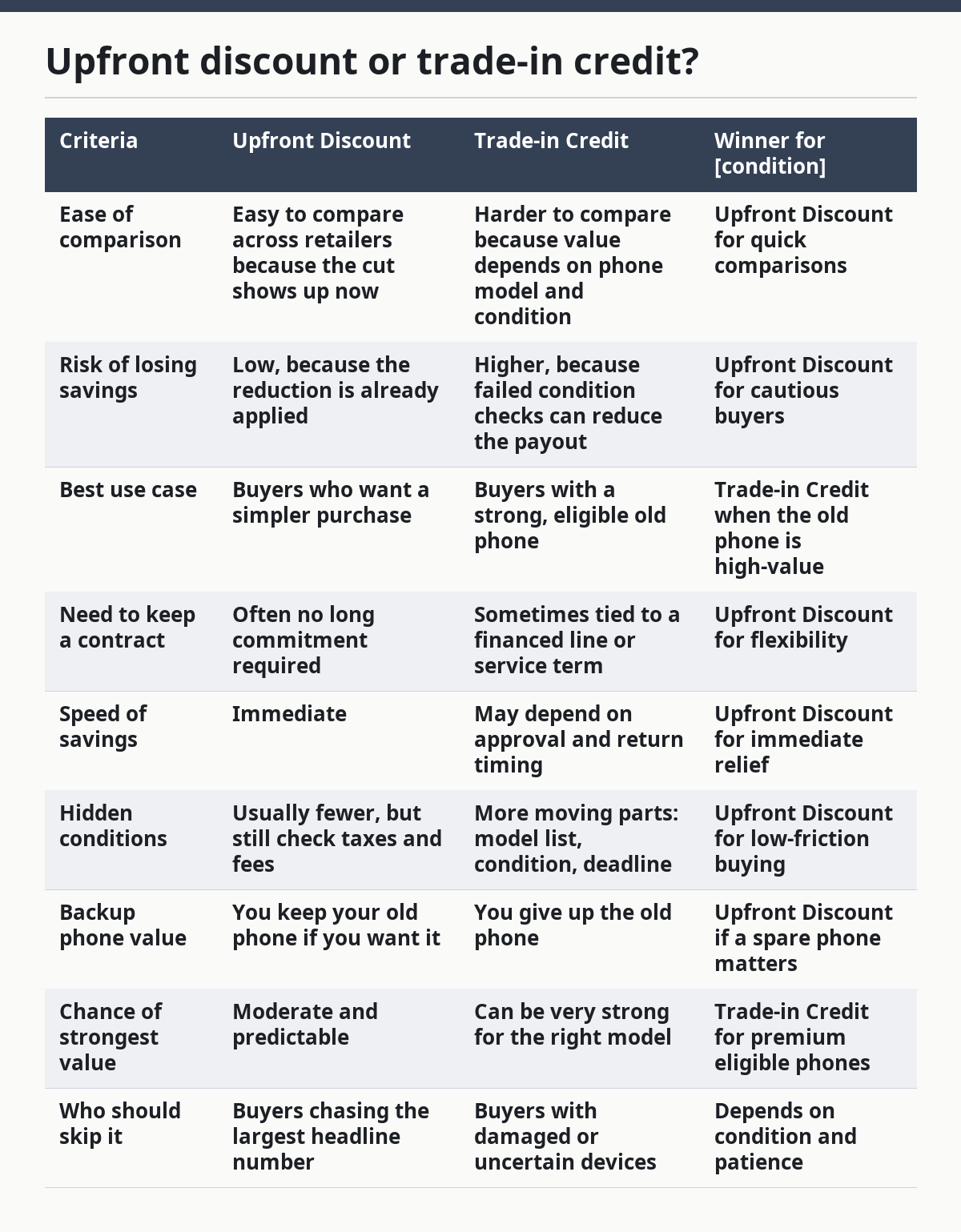
Therefore, the table points to the real split: upfront discounts are safer, while trade-in credits can be more powerful but demand more from the buyer. If the old phone is in good shape and the offer is clearly stated, trade-in value can beat a simple price cut. If the phone is worn, the model is older, or the return window is tight, the upfront discount is usually the better pick.
The drawback of the upfront route is that the immediate savings may be smaller than the flashiest trade-in headline. The drawback of the trade-in route is that the final value can change after inspection. A buyer who hates surprises should favor the simpler path even if the ad looks less dramatic.
Which discount type fits a carrier plan?
A carrier-linked discount fits only when the plan cost, term length, and device savings still work together after the promotion is added. A discounted phone does not help if the required plan is more expensive than the one you would normally buy.
Carrier deals often look strongest when the phone price is spread across bill credits and the plan is long-term. That can make a premium device feel more reachable. The problem is that the discount is tied to staying put. If you plan to switch carriers within a year, the deal may not survive long enough to matter.
The strongest case for a carrier-linked discount is a buyer who already wants the carrier, already needs the line, and is comfortable with a 24-month commitment. In that case, the phone savings can be real and the contract is not an extra burden. The buyer is paying for service anyway, so the device credit becomes part of the package.
The weakest case is a buyer shopping only for the phone. If you are comparing a carrier promotion against an opened phone sold at Amazon, Walmart, Best Buy, or the brand’s own store, the carrier offer may lose once you include the service cost. That is why the plan price matters as much as the handset promotion.
A second weak case is anyone who expects to change plans often. Bill credits, activation steps, and line requirements punish flexibility. A person who values freedom over a long credit trail should usually avoid making a device decision around a service contract.
Carrier-linked discounts are not bad. They are just specific. They work best for a buyer who wants that carrier, will keep the line, and is comfortable reading the terms line by line. They are wrong for a buyer who wants a clean phone purchase and no long tail of conditions.
What is the honest side-by-side?
The honest side-by-side is that instant discounts are simpler, while trade-in and bill-credit offers can be larger only if the buyer keeps every condition intact. That is the whole decision in one sentence.
The main difference is how risk is priced. An upfront cut lowers the phone cost now. A trade-in discount makes the savings depend on device condition. A bill-credit offer makes the savings depend on time, service, and account status. Those are not small differences; they change the deal.
For a buyer comparing phones at different retailers, the most reliable way to judge the offer is to ask what remains true after the fine print is applied. Does the phone still cost less if the trade-in value is reduced? Does the deal still look better if the service plan is $10 higher each month? Does the discount survive cancellation after 6 months? Those questions expose the real value.
The simplest offer is not always the best, but it is often the easiest to trust because it leaves less room for the discount to change later. The most complex offer is not always bad, but it requires the most discipline from the buyer. That means the safer choice is often the one with fewer moving parts, even when the headline savings looks smaller.
The next table keeps the comparison plain.
| Criteria | Instant Discount | Bill Credits | Winner for [condition] |
|---|---|---|---|
| Payment timing | Savings apply right away | Savings arrive over time, often monthly | Instant Discount for immediate certainty |
| Cancellation risk | Lower | Higher if the line ends early | Instant Discount for flexible buyers |
| Comparison ease | Simple across stores | Harder because total savings are delayed | Instant Discount for shopping fast |
| Headline value | Often smaller on paper | Often larger in the ad | Bill Credits for buyers who stay put |
| Complexity | Low | High | Instant Discount for low-stress buying |
| Plan dependency | Usually lighter | Usually tied to service terms | Instant Discount when you want the phone only |
| Best match | Buyers who may switch plans | Buyers committed to 24 months | Bill Credits for long-term subscribers |
| Hidden downside | Less dramatic savings | Credits can stop if terms change | Instant Discount for anyone uncertain |
Overall, the table makes the trade-off obvious. If the buyer wants certainty and freedom, instant discount wins. If the buyer will keep the line and accepts the service terms, bill credits can be worthwhile. The wrong choice is the one that relies on conditions you cannot guarantee.
When should you walk away from the discount?
You should walk away when the discount depends on a condition you cannot control. That includes a trade-in you cannot complete, a plan term you do not want, or bill credits that require you to stay longer than you are comfortable staying.
A deal also deserves a hard pass if the listing hides the most important terms in small print. If you have to dig through multiple screens to find whether the savings is upfront, monthly, or conditional, the discount is already doing too much work. Clean offers explain themselves in a few lines.
Another reason to walk is mismatched timing. If you need the phone now and the discount only arrives after a trade-in arrives or after the first billing cycle closes, the offer may not fit your actual need. A good discount should fit the purchase timeline, not force you to wait.
A third reason is weak trade-in value. If the old phone has only modest worth and the promotion asks for too much in return, the net gain may be too small to matter. In that case, the discount is not really a discount; it is a complicated way to move a used device.
The last reason is plan drift. If the required service plan is more expensive than your normal plan, the discount may be illusory. A phone that costs less but forces a pricier plan for 24 months can leave you paying more overall. That is not a bargain; that is a rearranged bill.
This is the point where the smartest move is often to buy the phone separately, without a promo, or to wait for a cleaner offer. A decent phone at a fair price is better than a “discount” that only works if everything stays perfect. If perfection is required, the discount is fragile.
What should the buyer choose?
Choose an instant discount if you want the simplest path, may switch carriers, or care about keeping your old phone. Choose a trade-in or bill-credit offer if you already planned to stay with the carrier, your old phone is in strong condition, and the savings still look good over the full 24 months. Neither if the deal depends on a plan, device condition, or cancellation timeline you cannot meet.
That is the cleanest call. The right mobile phone discount is the one that matches how you actually buy, not how the ad wishes you bought.
If the goal is a phone only, with the fewest strings, the instant price cut is the winner. If the goal is to lower the total cost while staying with the same carrier and sending in a qualifying device, the more complex offer can be the better value. The buyer who should avoid both is the person shopping with no clear plan, because discount offers punish uncertainty.
This is why “cheapest” is the wrong word until the fine print is done. A phone can be cheapest at checkout and expensive over 24 months. A phone can also look expensive upfront and end up cheaper if the discount is real and the conditions are easy to meet. The only reliable comparison is total cost under the terms you can actually keep.
What if the deal looks good but still feels off?
The deal probably feels off because one part of it is being hidden, and that is a good reason to pause. Discounts on mobile phones often look attractive before taxes, fees, service costs, and term conditions are added back in.
The first red flag is vague wording like “up to” without a clear path to the top number. The second is a trade-in that requires a phone model or condition you do not have. The third is a monthly credit that only applies if the account stays active and in good standing. Each of those can be legitimate, but they are not simple.
A deal can also feel off when the buyer is being pushed to act fast. Deadlines are normal in mobile promotions, but pressure should never replace clarity. A real offer can survive a slow read. If the deal falls apart when you ask for the terms in plain language, it is not ready for your money.
A final warning: do not let the discount hide the usefulness of the phone itself. A bigger savings on a phone that does not fit your storage needs, camera needs, or battery expectations is still a bad buy. Discount evaluation only works when the phone is one you would want even at a lower, honest price.
The best rule is simple. If the discount is clear, the terms are short, and the savings still makes sense after the requirements are included, the offer is worth serious attention. If not, keep looking. A mobile phone promotion should make the purchase easier, not harder to understand.
Which sources should you trust while checking a discount?
The safest sources are the carrier’s own terms, the retailer’s product page, and consumer guidance from organizations such as the Federal Trade Commission and the Federal Communications Commission. The carrier terms tell you what the promotion actually requires, while the consumer guidance helps you spot plan and billing traps.
A useful starting point is the FTC’s consumer guidance on discounts, rebates, and promotional offers. The FTC explains how to read conditions and avoid marketing that makes savings look larger than they are. The FCC also publishes consumer information on wireless service and device purchasing, which can help you understand contract-linked offers and billing issues.
FTC: https://www.ftc.gov/
FCC: https://www.fcc.gov/
Those are the right kinds of sources because they focus on the rules behind the offer, not just the ad copy. If a discount depends on a trade-in, the seller’s own terms are the first source to read. If the plan changes the economics of the phone, the carrier terms matter more than any banner on the product page.
One last check helps a lot. Compare the same phone at more than one retailer, such as Amazon, Walmart, Best Buy, and the brand’s own store, then line up the conditions next to each other. A discount that is generous at one seller can be ordinary at another once the plan, trade-in, and credit timing are all counted. That comparison is where the real decision is made.
Drafted with AI; not yet reviewed by a person.