

How to Compare Mobile Phone Warranty Coverage Before Buying
Last updated: November 19, 2026
Quick answer: compare 3 things first—exclusions, battery terms, and claim process. The topic of How to Compare Mobile Phone Warranty Coverage Before Buying is simple: a 24-month plan can still be weaker than a 12-month plan if it excludes accidental damage, battery wear, or easy repairs. A short plan with clearer terms can be better.
Key takeaways
- A better warranty is the one that covers the failure you actually fear, not just the one with the longest term.
- Manufacturer warranty, retailer warranty, and extended warranty do different jobs; if you are unsure, consult the seller or a consumer-rights source before you buy.
- Battery replacement terms matter as much as screen repair terms, because battery wear is one of the few issues that shows up in normal use.
- A clean claim process can save days of waiting, especially when the policy names who handles the repair and where the phone goes.
- If accidental damage is excluded, the warranty may still be fine for defect-only protection, but it is not full peace of mind.
What should you compare first?
Compare exclusions first, because exclusions decide whether the warranty pays when the phone actually breaks. A phone warranty that looks generous on paper can still leave you paying for cracked glass, liquid damage, or battery wear if those items sit outside the coverage list.
Start with the named coverage term, then read the exclusion list, then check the claim process. The order matters because a 12-month manufacturer warranty and a 24-month retailer warranty may look different in the checkout box, but the real question is whether both cover the same fault types, the same repair path, and the same battery terms.
This is also where you separate a manufacturer warranty from a seller warranty. A manufacturer warranty usually covers defects in materials and workmanship. A retailer warranty may add its own promises, but it can also send you through a different support desk, which matters if the phone needs a return within the first 14 days or a repair after that. If the wording is unclear, consult a consumer-rights guide or the seller before paying.
For a quick source check, the U.S. Federal Trade Commission explains warranty basics on its consumer pages, and the UK Competition and Markets Authority has plain-language guidance on consumer rights and warranties. Both are useful anchors when a product listing is vague:
- FTC consumer warranty guidance: https://consumer.ftc.gov/articles/warranties
- UK CMA consumer rights guide: https://www.gov.uk/consumer-protection-rights
How does a manufacturer warranty compare with a retailer warranty?
However, a manufacturer warranty wins for clarity, while a retailer warranty wins only when it spells out extra help in plain language. The reason is simple: the maker is usually the party most likely to define defect coverage, parts standards, and authorised repair channels in one place.
A manufacturer warranty is the cleaner baseline. It usually tells you what counts as a defect, how long the term lasts, and where to send the phone. On flagship phones, that often means a predictable process tied to the brand’s own support system, which is useful when the issue is a screen fault, charging problem, or audio failure rather than drop damage.
A retailer warranty can help when the store handles the first contact and offers an easier swap window. That is useful if the phone arrives faulty or fails very early. The weakness is that the promise may be narrower, and the language may be less standard than the maker’s document. A retailer can also add conditions such as in-store inspection, proof of purchase, or a strict deadline for reporting the fault.
The practical rule is this: choose the manufacturer warranty when you want the clearest defect coverage; choose the retailer warranty only when the store states the repair or replacement path in writing and the terms are easier to use than the maker’s. If the retailer gives no better battery, screen, or claim terms, it is mostly a second copy of the same protection. For more detail, see our phone buying guide and consumer rights basics.
What does accidental damage protection really add?
In contrast, accidental damage protection is the upgrade that matters most if you are worried about drops, spills, or cracked glass. Standard warranty coverage usually does not treat those events as defects, so this add-on changes the value of the whole package; if you are not sure, consult the policy wording or a consumer adviser. The FTC and CMA both note that warranty terms depend on the written promise, not the marketing headline.
AppleCare+ and Samsung Care+ are well-known examples because they show the split clearly. The name of the plan matters less than the wording inside it: what counts as accidental damage, what service fee applies, whether the phone gets repaired or replaced, and whether the policy limits claims. If the listing does not say how many claims are allowed or who does the repair, that is a warning sign.
The strength of accidental damage cover is obvious: it closes the biggest gap in a normal warranty. The weakness is cost and friction. Many plans still require a service fee, and some route you to specific repair centers or mailing steps. That can be acceptable for a premium phone, but it is less attractive for a lower-cost handset where a single repair could approach the value of the device.
This option is for people who carry a phone everywhere, keep it in a bag with keys, or have already broken a screen before. It is not for someone who wants defect-only protection and plans to use a rugged case and screen protector from day one. If accidental damage is the whole reason for buying the plan, read the exclusions twice. Water, cosmetic marks, and accessories are often handled differently from a cracked display.
Is battery replacement coverage worth checking?
Because of that, battery replacement coverage is worth checking because battery wear is one of the few warranty issues that can show up during ordinary use. A phone that still turns on but loses charge quickly can be far more annoying than a dead feature, especially in the second year of ownership.
This is where many buyers miss the real fine print. Some warranties cover a battery only if it is defective. Others use a capacity threshold or a wear standard before replacement is approved. If the policy says nothing about battery degradation, assume it is not covered unless the battery is clearly faulty. That silence matters more than marketing copy on the sales page.
Battery terms are a major divider between good and weak coverage. A stronger policy tells you whether a battery replacement is included, who decides if it qualifies, and whether labor is covered. A weaker one hides behind broad defect language and leaves the buyer to argue with support after the phone starts dying early in the day.
This matters most for people who keep phones for several years rather than upgrading quickly. If the phone is likely to be sold or traded in early, battery terms matter less than screen or liquid-damage coverage. If the phone is expected to stay in use past the first year, battery language deserves the same attention as the warranty length.
The honest side-by-side
Ultimately, the manufacturer warranty wins for defect coverage, while the extended warranty wins only when it clearly extends the same repair promise beyond the first term. The useful comparison is not “longer versus shorter”; it is “what exact failures are still covered on day 366?”
| Criteria | Manufacturer warranty | Extended warranty | Winner for this condition |
|---|---|---|---|
| Defect coverage | Usually covers faults in materials and workmanship | May repeat or extend defect coverage | Manufacturer warranty for clear baseline terms |
| Accidental damage | Usually excluded | May be included in some plans | Extended warranty if accidental damage is named |
| Battery wear | Often covered only if defective | May include battery replacement terms | Extended warranty if battery terms are explicit |
| Claim process | Usually tied to maker support and authorised repair | Can be through seller, insurer, or repair partner | Manufacturer warranty for simpler routing |
| Repair quality control | More standardised within brand channels | Depends on the policy partner | Manufacturer warranty when consistency matters |
| Early fault handling | Good for defect claims after purchase | May include faster exchange terms | Retailer or extended warranty if exchange is named |
| Exclusions | Usually clear but strict | Can be broader or narrower | Whichever lists fewer hidden exclusions |
| Value for a rugged-cased phone | Good if defects are the main worry | Less useful unless battery or repair terms add real value | Manufacturer warranty |
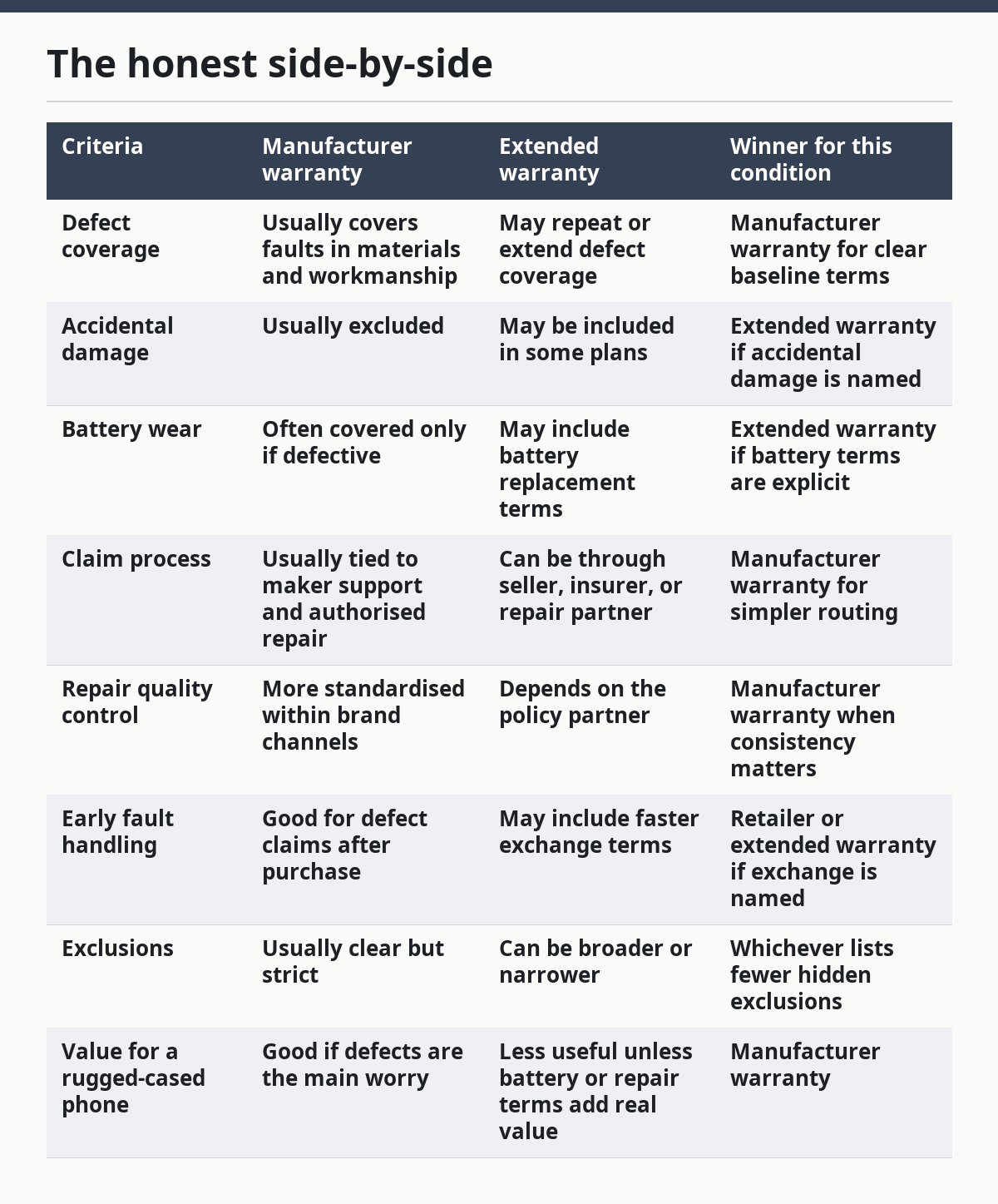
The table points to a simple rule: if the extended warranty only repeats defect coverage, it adds little. If it adds accidental damage or battery terms in writing, it may be worth more than the base warranty. The reader should not pay for a longer promise that still excludes the one failure that matters most. See also our warranty terms glossary.
Which coverage is worth paying attention to?
The coverage worth paying attention to is the one that matches the way the phone will fail in real life. For most people, that means accidental damage, battery replacement, and the claim process, not the headline warranty length.
A phone that will live in a pocket, on a desk, and in a charger dock needs different protection from a phone carried on worksites or in a school bag. For the first phone, a manufacturer warranty plus clear battery language may be enough. For the second, accidental damage cover such as AppleCare+ or Samsung Care+ can matter more than the standard term.
The claim process is the part most listings underplay. Look for whether the repair is mail-in or in-store, who pays shipping, whether the phone needs inspection before approval, and whether a loaner is offered. A policy that sounds generous but takes several steps to approve can be harder to use than a narrower plan with a direct repair route.
This is also where an extended warranty can disappoint. If it copies the maker’s defect promise but adds a long approval chain, the buyer gets little beyond paperwork. The stronger option is the one that names its repair channel, its excluded damage types, and its battery rules in the same document.
When should you skip the longer plan?
Therefore, skip the longer plan when it adds years but not coverage types. A 24-month warranty that still excludes accidental damage and says nothing useful about battery wear is weaker than it looks.
The clearest skip case is a budget phone with a low repair value and no named accidental damage benefit. In that case, the warranty may be a backup, not a reason to spend more. Another skip case is a policy with vague wording around “normal wear,” “cosmetic damage,” or “unapproved repairs,” because those phrases often leave the buyer exposed when a claim is made.
A longer plan is also a bad fit when the phone will be replaced quickly. If the buyer expects to upgrade before the first term ends, the extra months may add little real protection. The same is true if the phone will stay in a case, use a screen protector, and be handled carefully; the defect risk may be low enough that the base manufacturer warranty is the sensible choice.
The point is not to avoid protection. The point is to avoid paying for an extra year of words that do not change the repair outcome.
What is the verdict before checkout?
In short, choose manufacturer warranty if you want the clearest defect coverage, the simplest support path, and a phone you plan to protect with a case rather than with insurance-style add-ons. Choose accidental damage protection or an extended warranty if the policy clearly names cracked screens, liquid damage, or battery replacement and the phone is likely to face real daily risk. Neither if the plan only advertises longer coverage but hides exclusions, battery rules, or claim steps in vague language.
For a buyer who wants one plain rule, this is it: compare the exclusions first, then the battery terms, then the claim process. If those three are weak, the warranty is weak no matter how long it lasts.
What should you ask before you pay?
Before you pay, ask: What counts as covered damage? The answer should name defects, accidental damage, and battery wear separately. If the wording blurs them together, the policy may be harder to use when the phone fails.
Ask next: Who handles the claim? The answer should tell you whether the maker, the retailer, or a repair partner runs the process. That matters because a support desk, a mail-in label, and a store counter are not the same thing.
Ask also: What happens to the battery after the first year? The answer should tell you whether replacement needs a defect, a capacity drop, or some other standard. If it says nothing useful, assume battery wear is not a strong feature of the plan.
Finally, ask: What exactly is excluded? The answer should list cracked screens, liquid damage, cosmetic wear, and unauthorised repairs if they are excluded. A warranty with a long term and a long exclusion list can be poor value even when the number on the box looks good.
Drafted with AI; not yet reviewed by a person.