

How to Compare Mobile Phone Prices on Contract and SIM-Free
Last updated: November 18, 2026
Quick answer: in a typical 24-month comparison, the contract total is monthly payment × 24, plus upfront cost and any one-off fees; the SIM-free total is handset price plus 24 months of airtime. Compare those two numbers first. In short, compare the total cost over the full term, not the headline monthly payment, then match that number against the SIM-free handset price plus the airtime plan you actually need. A phone contract deal can look cheaper because the upfront cost is lower and the handset is spread across 24 or 36 months, but SIM-free often wins if you already have a cheap plan or want to change carrier without friction. This guide on how to compare mobile phone prices on contract and SIM-free keeps the focus on total cost and the plan length you actually need.
Because I write about mobile pricing and value, the useful question here is not “Which is always cheaper?” It is “Which payment structure costs less for the way I use the network?” Keep that in view and the comparison becomes much simpler.
Key takeaways
- Compare the full contract outlay, not the monthly fee alone.
- SIM-free makes sense when you want network freedom or already have a good plan.
- Contract can be easier on cash flow because the upfront cost is often lower.
- The deal with the smallest monthly bill is not always the lowest total cost.
- A long plan length can hide a pricey handset over 24 or 36 months.
The real difference between contract and SIM-free
Contract usually bundles the handset with airtime into one monthly payment, often with a smaller upfront cost. SIM-free splits the purchase: you buy the handset outright, then add a separate plan or keep your current SIM. That one structural difference changes everything you compare.
The contract side wins on convenience and cash flow. You may leave the shop with little or no upfront cost, and the bill is simple because device and service sit together. The downside is that the handset cost is often hidden inside the monthly payment, so the headline number can mislead. A 24-month or 36-month commitment also ties you to one arrangement for longer than many people expect.
SIM-free wins on transparency. You can see the handset price directly, compare it across retailers, and pair it with any compatible plan. That matters if you want to keep a rolling monthly SIM, switch networks often, or buy a model once and keep it for years. The trade-off is obvious: the upfront cost is higher, and you carry the full device cost on day one.
For a clean comparison, use the same time frame on both sides. If a contract runs 24 months, compare it with 24 months of SIM-free ownership: handset price plus 24 months of airtime. That is usually the only reliable way to judge whether the bundle is genuinely good value.
Comparison table
| Criteria | Contract | SIM-free | Winner for condition |
|---|---|---|---|
| Upfront cost | Usually lower at sign-up because the handset is subsidised or spread out | Usually higher because the handset is paid in full | Contract, if cash flow matters most |
| Monthly payment | Combines handset and service into one bill | Separate handset purchase and airtime bill | SIM-free, if you want to see device cost clearly |
| Plan length | Commonly 24 or 36 months | No handset term; airtime can be monthly rolling or fixed | SIM-free, if you want flexibility |
| Network switching | Limited until the contract ends, unless you pay to leave early | Easier once the handset is opened | SIM-free, for switchers |
| Total ownership cost | Must be calculated across the full term to judge value | More visible because handset and plan are separate | SIM-free, for straightforward cost comparison |
| Upgrade timing | Often tied to contract milestones | Can upgrade handset whenever you choose | SIM-free, if you change devices often |
| Credit check impact | Often part of the sign-up process | Usually applies to the airtime plan, not the handset purchase itself | SIM-free, for simpler purchasing |
| Risk of overpaying for data | Higher if the bundle includes more data than you use | Lower, because you can buy only the plan you need | SIM-free, for light data users |
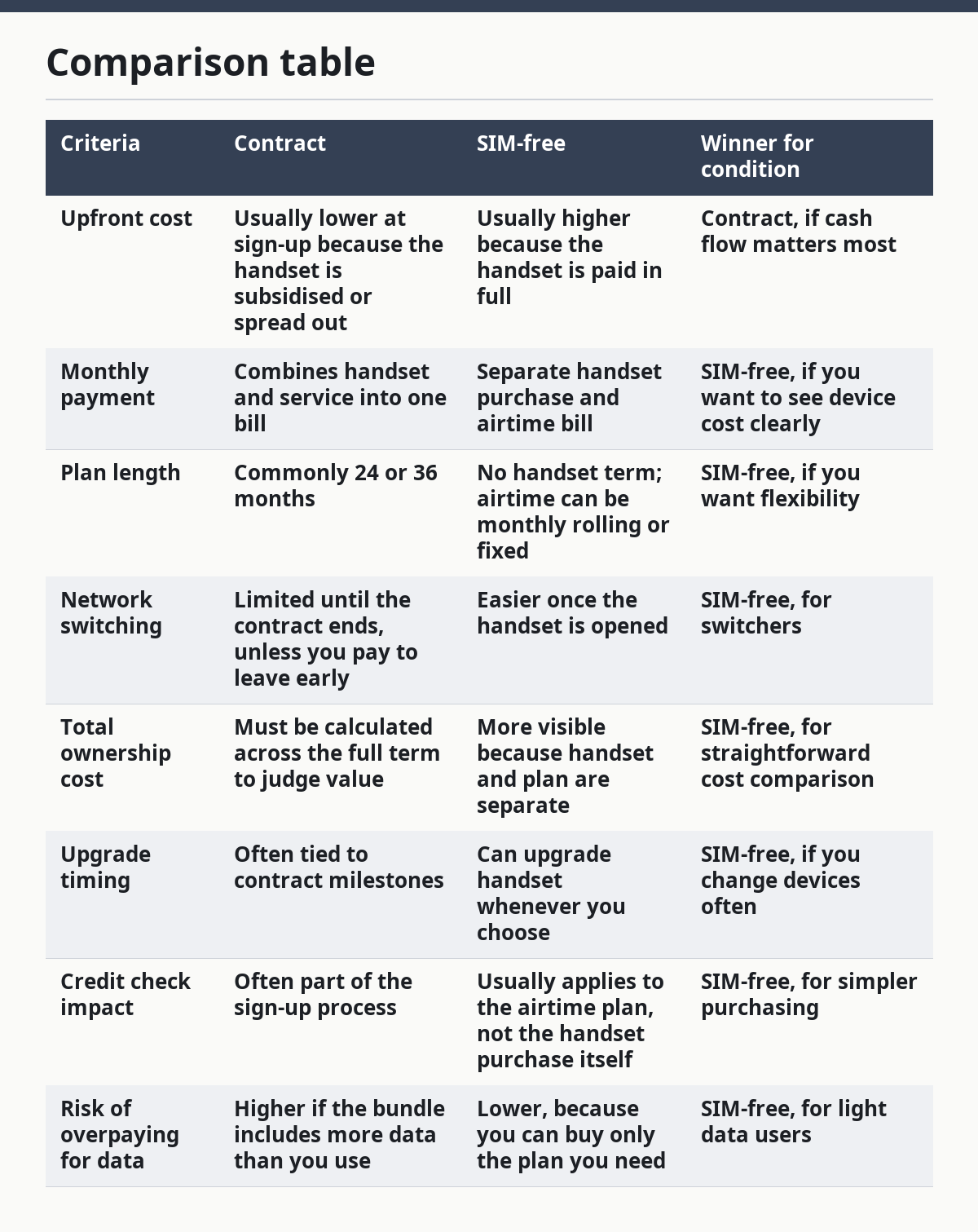
The table only helps if the figures behind it are honest. A contract with a tiny upfront cost can still be expensive over 24 months; a SIM-free handset with a high sticker price can still be cheaper in the end if the monthly plan is modest. For consumer-value decisions, the winner is often whichever route lets you avoid paying for features you do not use.
How to compare total contract cost without getting fooled
Contract wins only when the total over the full term is better, and the comparison has to include every charge you will actually pay. Start with the monthly payment, multiply it by the full term, then add the upfront cost. If the deal includes a one-off connection fee, add that too. That simple formula is usually the safest way to avoid a fake bargain.
A 36-month plan deserves special caution. The monthly figure can look attractive because the handset cost is spread thinly, but the longer term keeps you tied in for three years. That can make a “cheap” offer more expensive than a shorter deal, especially if the monthly service portion is high or if the allowance is larger than you need.
This is where the handset and airtime split matters. Some contract deals wrap a premium device into a large monthly bill even when the data allowance is more than enough for the buyer. If you compare only the monthly number, you miss the cost of the unused allowance. If you compare only the upfront cost, you miss the device being paid off slowly in the background.
Use the standards bodies and consumer guidance that govern the bill, not the sales pitch. Ofcom’s guidance on mobile contracts is a useful place to check rights around contract terms and switching: https://www.ofcom.org.uk/phones-and-broadband/saving-money/make-the-right-choice/mobile-phones-and-contracts. For device access and compatibility, the GSMA’s explainer on eSIM and SIM basics is another useful reference: https://www.gsma.com/esim/. The relevant point is not the logo on the page; it is whether the plan locks you in longer than you want. For contract checks, Ofcom also publishes guidance on switching and savings: https://www.ofcom.org.uk/phones-and-broadband/mobile-phones-and-plans.
Contract strengths
Contract is strongest when you need a new handset and want to spread the cost over 24 or 36 months. It also suits buyers who prefer a single bill and do not want to shop separately for device and airtime. If you like predictable budgeting and a low upfront outlay, this structure is easy to live with.
Contract weaknesses
The weakness is hidden cost. The consequence is paying for convenience through a higher total, or being trapped in a long term while the network market moves around you. If the allowance is bigger than your use, the bundle can be poor value. If you change your mind halfway through, leaving early can be expensive.
Contract is for the person who values simplicity, needs the handset now, and is willing to trade flexibility for a smoother monthly bill. It is not for the buyer who switches networks every year, keeps a phone for a long time, or watches the total cost closely enough to notice inflated airtime allowances.
Why SIM-free can be the better value
SIM-free wins when the handset price matters more than the payment packaging. You pay for the device once, then choose a plan separately, which makes the numbers easier to compare across retailers and networks. That clarity matters if you already know your data, call, and text needs.
The big strength is freedom. If you want to move from one network to another, SIM-free usually makes that simpler because you are not untangling a handset subsidy from a service contract. It also helps people who keep their phones for several years. Once the device is paid for, the monthly cost can drop to the airtime only, which can make long-term ownership cheaper than a recurring contract.
The weakness is the initial hit to cash flow. A handset bought outright may cost much more on day one than a contract’s upfront payment. That can be awkward even if the longer-term maths is better. SIM-free also asks for more discipline: you must compare the device price, the network plan, and any extras yourself rather than accepting a bundled offer.
This option is for the buyer who wants control, not just convenience. It is a strong fit for anyone who already has a low-cost SIM-only plan, upgrades on their own schedule, or uses a phone long enough to make the upfront spend worthwhile. It is not the best choice if the cash cost today is the deciding factor.
SIM-free strengths
SIM-free gives you cleaner pricing, easier switching, and fewer surprises. You can buy from a manufacturer store, a specialist retailer, or a major general retailer, then pick the service separately. That makes it easier to compare like with like and avoid paying for allowances you will not use.
SIM-free weaknesses
The main drawback is the large upfront purchase. If you need the handset now but cannot or do not want to pay in full, SIM-free can be impractical. It also asks you to manage two decisions instead of one: the device and the plan. If that extra step leads to delay or confusion, the savings may not feel worth it.
Which option is cheaper in real life?
SIM-free is often cheaper overall for light and moderate users, but contract can be cheaper when it includes a handset discount that genuinely offsets the bundled service cost. The deciding factor is not the label; it is the full 24- or 36-month bill.
A practical comparison looks like this: take the handset price on a SIM-free listing, then add the airtime plan you would actually buy. Then calculate the contract total using monthly payment times term plus upfront cost. If the contract includes more data than you need, reduce the SIM-free side to a plan that matches your real usage rather than a hypothetical maximum.
That approach is the one that catches hidden value. A contract deal may look attractive because the upfront cost is low, yet the monthly fee can remain high for years. A SIM-free purchase may look expensive on the shelf, yet the total can come in lower if your chosen plan is modest and you keep the device for the whole term.
The sensible rule is simple: if you need the handset and prefer one bill, compare contract totals carefully; if you want the lowest long-run ownership cost and can handle the upfront cost, SIM-free usually gives you the cleaner route. The right answer changes with the term length and the allowance, not with the marketing headline.
When the usual rule flips
The verdict changes in a few specific situations, and ignoring them leads to the wrong choice.
If you need the lowest possible cash outlay today, contract can win even when the total cost is higher. A tiny upfront payment matters more than perfect value if your budget is tight this month.
If you plan to keep the handset for a long time, SIM-free often pulls ahead because the device is paid off once and the monthly bill can stay low on a rolling plan. The longer you keep the phone, the less sense it makes to hide the device price inside a long contract.
If your usage is unpredictable, SIM-free is safer because you can pair it with a flexible plan. A contract is a bad fit when you may need to change allowance, carrier, or device before the term ends.
If a contract deal includes a genuinely lower total across the same term and the allowances match your use, it can be the better buy. That is especially true when a retailer offers the handset and service at a bundle price that is lower than buying both separately.
The verdict: which one to choose and why
Choose contract if you need a new handset now, want the lowest upfront cost, and are happy to stay put for 24 or 36 months. Choose SIM-free if you want the clearest pricing, the most flexibility, and the best chance of lowering the total ownership cost over time. Neither if you are comparing only the monthly payment and ignoring the full term.
For the reader trying to make a fair comparison, SIM-free is the better default. Contract is the right answer only when the bundle genuinely beats the separate purchase or when cash flow matters more than long-term value.
What should I compare first on a phone contract deal?
Compare the total cost over the full term first. That means monthly payment multiplied by the plan length, plus the upfront cost and any one-off fees. After that, check whether the data, minutes, and texts match your real usage. A cheap-looking monthly price can hide a long commitment or a larger allowance than you need.
Is contract cheaper than SIM-free for phones?
Sometimes, but not by default. Contract can be cheaper upfront, while SIM-free can be cheaper over the full term if you buy the handset once and choose a modest airtime plan. The only fair comparison is the same time period on both sides, with the same usage needs and any fees included.
How do I compare total contract cost?
Add the monthly payment for every month in the term, then add the upfront cost and any fees. Then compare that number with the SIM-free handset price plus the cost of a plan you would actually use. If the contract includes more data than you need, it may look cheaper than it really is.
What should I include in a phone contract comparison?
Include upfront cost, monthly payment, plan length, total cost over the full term, data allowance, early exit conditions, and whether the handset is opened. If you also compare the same phone model on SIM-free, the decision becomes much clearer. Without those figures, the “best” deal is only a guess.
Drafted with AI; not yet reviewed by a person.