

How to Compare Mobile Phone Prices Across Storage Variants
Last updated: November 18, 2026
Quick answer: the best choice is usually the storage variant that costs least per extra gigabyte while still leaving enough room for your photos, apps, and video needs.
Start with the jump in price between the base model and the higher storage tier. Then divide that jump by the extra gigabytes. This tells you whether you are paying for useful capacity or just a fancier label. Plainly put, this guide explains How to Compare Mobile Phone Prices Across Storage Variants.
Key takeaways
- Compare the price gap, not the sticker price alone.
- Check the base model and the next higher storage tier side by side.
- A bigger capacity jump can be better value when the gap per extra gigabyte stays reasonable.
- Skip the upgrade if your storage use is light and the phone supports a fast memory card; skip the phone entirely if the maker only offers tiny storage with no expandability.
- The best choice is often the variant that leaves enough headroom for photos, apps, and video without forcing you to overpay for unused space.
The real difference between storage variants
It is not just “more space.” The real issue is how much extra you pay for each step up in capacity, and whether that step actually changes how you use the phone.
A storage variant is the same phone sold with a different internal capacity, such as 128 GB, 256 GB, or 512 GB. The lowest-capacity version in the lineup is the base model, while the next version up is the higher storage tier. Manufacturers often keep the processor, screen, cameras, and battery the same, then move the price mainly on storage. So two listings can look nearly identical and still part ways at checkout by a meaningful amount.
Most shoppers miss the trap: they compare only the absolute price. Better to look at price per added capacity. If the 256 GB version costs only a little more than the 128 GB version, the upgrade may be efficient. If the jump is steep, you may be paying a premium for room you will never fill. Honestly, that math stops working fast. For many buyers, the middle tier ends up the best-value option, but the size of the jump decides that.
Phone makers also tweak the deal in subtle ways. Some lines offer 128 GB as the base and 256 GB as the upgrade. Others start low and make the leap to 512 GB expensive enough to push buyers into a pricier bracket. The model name stays the same; the value picture does not.
For broader context on where storage fits inside phone value decisions, the hub page on mobile phone price comparison and value belongs upstream from this one. This page has one job: comparing storage variants only.
How to compare storage variant pricing without getting fooled

Line up three things first: capacity, price gap, and your actual storage need.
Begin with the base model. Write down the included storage capacity and the current price at the retailer you plan to use. Next, check the next higher storage tier and calculate the difference in price. Then ask whether the extra capacity is worth that amount. If the upgrade adds 128 GB and the gap is small, the higher tier may be the smarter buy. If the gap is large, the base model may be the better value unless you already know you are a heavy local-storage user.
Think of it this way: storage has no resale magic. You are not paying for better photos or faster charging. You are paying for room. That room matters only if you actually use it. People who stream music, keep photos backed up to cloud storage, and delete apps they do not use often need less internal capacity than people who shoot lots of 4K video or keep large offline media libraries.
According to Apple’s storage guidance, 4K video uses substantially more space than HD video, which is why heavy camera use changes the storage calculation quickly. That is also why a storage comparison works better when you look at your own habits than when you lean on a generic “more is better” rule. Apple’s support pages and other manufacturer documentation are better references than reseller summaries for these details.
There is another wrinkle many generic guides skip: some phones reserve part of the advertised storage for the operating system and system files. So “128 GB” does not mean 128 GB is free for your files. The listing usually does not spell out exact usable space, so if you are unsure, consult the manufacturer’s documentation or a qualified retailer before you buy.
Use this rule to keep it clean: if the higher storage tier costs a lot more but only solves a problem you do not have yet, stay with the base model. If the jump is modest and the base model would force constant cleanup, choose the larger one. That is the decision line.
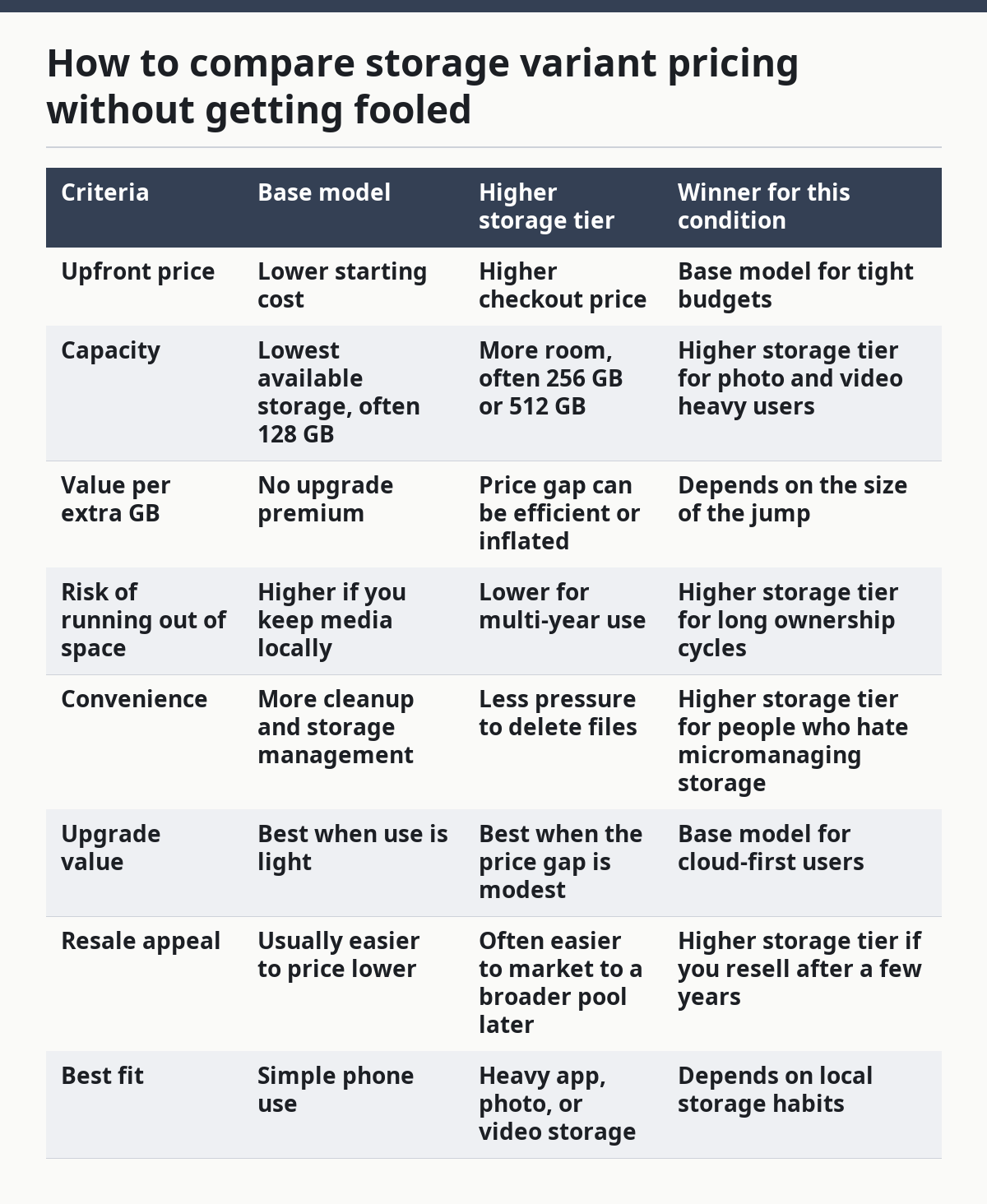
| Criteria | Base model | Higher storage tier | Winner for this condition |
|---|---|---|---|
| Upfront price | Lower starting cost | Higher checkout price | Base model for tight budgets |
| Capacity | Lowest available storage, often 128 GB | More room, often 256 GB or 512 GB | Higher storage tier for photo and video heavy users |
| Value per extra GB | No upgrade premium | Price gap can be efficient or inflated | Depends on the size of the jump |
| Risk of running out of space | Higher if you keep media locally | Lower for multi-year use | Higher storage tier for long ownership cycles |
| Convenience | More cleanup and storage management | Less pressure to delete files | Higher storage tier for people who hate micromanaging storage |
| Upgrade value | Best when use is light | Best when the price gap is modest | Base model for cloud-first users |
| Resale appeal | Usually easier to price lower | Often easier to market to a broader pool later | Higher storage tier if you resell after a few years |
| Best fit | Simple phone use | Heavy app, photo, or video storage | Depends on local storage habits |
Which storage variant wins for most people?
For many people who keep a phone for several years, the middle or higher storage tier wins — but only when the gap is not excessive.
The reason is practical. App sizes have grown, camera files are larger than they used to be, and people often keep more media on-device than they expect. A 128 GB model can be plenty if you stream music, back up photos, and do not install large games. But once a phone becomes your main camera, notebook, map, and entertainment screen, the base model can feel cramped well before the battery or processor wears out. The phone starts to feel stuffed to the gills.
“More storage” is not automatically smarter, though. If the higher tier is priced far above the extra capacity it provides, the upgrade becomes a tax on indecision. You are not buying more performance. You are buying a buffer. When that buffer costs too much, it is better to hold the line at the base model and manage storage with cloud backups and periodic cleanup.
The stronger case for a higher tier shows up in three situations: you shoot a lot of video, you keep many offline files, or you hate storage alerts. The weaker case is everyday use with light local storage. In that case, paying for 256 GB or 512 GB may feel comfortable, but that comfort still needs to justify the price gap.
The right comparison is not “Can I afford the bigger one?” It is “Will I use the extra capacity enough to make the extra price feel small over the life of the phone?” If the answer is no, the base model is the cleaner buy.
Base model: who should actually use it
The base model wins for cloud-first users, light app users, and anyone who cleans up storage every few weeks without annoyance.
It is the right pick if you mainly stream audio and video, store photos in cloud backup, and keep only a limited number of games or offline downloads. It also makes sense if you upgrade phones often and do not want to pay for capacity you will hand back in 18 to 24 months. In many lineups, the base model is the one that keeps the phone’s total cost easiest to justify.
Its main strength is straightforward value. You get the same screen, chipset, camera hardware, and battery as the larger variant in the same product line, but at a lower price. That matters because the storage upgrade does not improve speed in a meaningful way for ordinary use. If your phone is mostly a messaging device and camera, the base model often covers the job cleanly.
The drawback is obvious: space pressure arrives sooner. If you keep lots of 4K clips, large game installs, or offline downloads, you may spend time managing storage, moving files, or paying for extra cloud space. That can turn a low-cost buy into a recurring chore. People who store their entire media library locally should skip the base model.
Higher storage tier: the specific situations where it wins
The higher storage tier wins for buyers who create content, travel with offline media, or keep a phone for a long cycle.
It is the better choice if you shoot lots of high-resolution photos and video, especially 4K footage, or if you keep large app libraries and games installed at the same time. It also helps people who are not disciplined about cleanup. Instead of deleting files every month, you buy headroom up front and reduce friction later. That matters more than many comparison charts admit.
The biggest strength is not luxury; it is margin. Extra capacity delays the moment when the device feels crowded. That can be worth paying for if the phone is a work tool, a travel companion, or your main camera. The bigger tier is also easier to live with across software updates, which tend to consume more room over time.
The weakness is cost. The upgrade premium can be hard to justify if your use is light, and that premium buys no extra camera quality, no faster charging, and no better display. The money may be better spent elsewhere if you do not routinely fill the base model. Skip the larger tier if you mostly stream, back up to the cloud, and replace phones often.
The honest side-by-side
Choose the version that matches your storage habits, not the one that sounds safer on paper.
The table above shows the trade-off clearly, but the real choice comes down to usage pattern. Base model pricing usually makes sense when the lower capacity covers daily life with room to spare. Higher storage makes sense when you want to stop thinking about space altogether. That difference is the whole point of comparing storage variants. The same model delivers a different day-to-day experience.
When comparing, do not let brand names or launch hype distract you. A 128 GB version and a 256 GB version of the same phone can be separated by a price gap that feels small in a listing and large over time. The useful question is whether the added capacity removes a real burden. If it does, the larger tier is value. If it does not, it is just a larger bill.
Also compare retailer listings carefully. Some stores bundle memory variant names differently, and some highlight only the model name while burying the capacity in fine print. Read the capacity line first, then the price, then the storage difference. A comparison that starts with the color or the carrier is already off track.
The clearest rule is this: if the base model would force you to manage storage within months, do not buy it just because it is cheaper today. If the bigger tier only gives you emotional comfort and not practical headroom, do not pay extra for peace of mind you may never use.
When to reconsider this choice entirely
Four cases can flip the verdict: you use cloud storage heavily, you keep a phone for years, you rely on offline media, or the listing offers no expandable storage and the base capacity is unusually small.
First, if your whole workflow lives in cloud services and you almost never store large files locally, the base model can be the better value even when the higher tier looks tempting. Second, if you keep a device for a long time, the higher storage tier becomes more attractive because software, apps, and photos tend to grow over that period. Third, if you travel often and keep offline maps, downloads, and media, the bigger variant usually earns its premium quickly. Fourth, if the phone offers no memory card slot and the base storage is low, you should be more cautious than usual; you cannot patch the gap later.
A good outside check is manufacturer documentation and standards bodies. For storage and file management terms, the GSMA’s device and ecosystem material and the manufacturer’s own product page are better references than a reseller summary. For general consumer-rights guidance around purchases and returns, the UK’s Citizens Advice and the U.S. Federal Trade Commission both publish practical consumer information. Those pages do not tell you which storage size to buy, but they help you verify what the listing actually promises.
In these exception cases, the usual rule can reverse. That is not indecision; it is the right response to a different use pattern.
The verdict: which one to choose and why
Choose the base model if you stream most media, use cloud backup, replace phones often, and do not keep large files locally. Choose the higher storage tier if you shoot lots of video, store downloads offline, hate cleanup, or plan to keep the phone for several years. Neither if the listing gives you too little storage for your habits and no way to expand it later.
That is the cleanest answer. The cheapest variant is not automatically the best value, and the biggest variant is not automatically the smartest buy. For How to Compare Mobile Phone Prices Across Storage Variants, the real test is whether the extra storage saves you enough time, hassle, and cleanup to justify the price gap.
Drafted with AI; not yet reviewed by a person.