

How to Track Mobile Phone Announcement vs Release Dates
Last updated: November 18, 2026
Quick answer: track four milestones—announcement, preorder, availability, and regional release—because they rarely land on the same day. In mobile phone announcement vs release dates tracking, the announcement tells you when the maker first reveals the device; the release date is when a buyer can usually get one in hand. If you only watch one date, you will miss the rest of the launch sequence.
Key Takeaways
- Announcement and release are separate milestones; don’t use one date for both.
- Build the timeline in order: reveal, preorder, availability, then regional sale dates.
- The announcement date comes first, but the release date is the one buyers can act on.
- Most trackers merge milestones and can mislead readers by one or two weeks.
What each launch date means

The announcement date is the day the company unveils the device, and the release date is the day it goes on sale or ships to buyers. Those are not the same thing, and the gap can be a few days, a few weeks, or longer depending on the brand and the market. A preorder date usually lands between them, while an availability date tells you when stock is expected to reach stores or carriers.
A lot of confusion comes from sites and social posts using “launch date” as if it means everything at once. In practice, that phrase can point to the press event, the preorder window, the first shipping day, or the first day a retail shelf has units. If you are tracking a specific model, treat the four milestones as separate fields: announcement date, preorder date, availability date, and release date, and consult the official brand page, retailer page, or a trusted industry source before you label any one of them as final.
- Announcement date: first official reveal
- Preorder date: when reservations or purchases open
- Availability date: when stock starts appearing in stores or online
- Release date: the day buyers can receive or pick up the device
This distinction matters most for buyers outside the first release market. A handset may be announced globally on 9 September, open for preorder on 12 September, ship in the first countries on 19 September, and reach other regions later. That is a single launch cycle, not four different products.
A better rule is to ask what the source actually names, because “launch date” can mean the reveal date, preorder date, or sale date. The hub page for mobile phone launch tracking is the right place to start if you want the broader calendar view.
How do I track mobile phone announcement vs release dates?
Track them by building a timeline from the official reveal first, then checking preorder, availability, and regional sale dates in that order. That gives you a clean sequence instead of a pile of loose rumors.
Use this process for any model, from a flagship Android handset to a midrange device:
-
Start with the manufacturer’s event page or newsroom.
Look for the exact day and time of the keynote, livestream, or press release. That is the announcement date. A press event time stamp in the company’s newsroom is more reliable than a social post reposted by a fan account. -
Record the wording used in the official announcement.
Save the phrase the brand uses, such as “available to preorder,” “shipping begins,” or “in stores from.” Those words tell you whether the page is naming preorder, availability, or release. A product page can update later, so the original wording matters. -
Check the preorder window separately.
Many brands open preorders 0 to 7 days after the announcement, but that timing changes by market and product tier. If a retailer page says “preorder now,” note the exact date and time, because that is when demand starts affecting stock. -
Search for regional rollout notes.
Look for country lists, carrier pages, or local retail pages that specify which markets get the first wave. A device can be “released” in the United States before it reaches the UK, India, or Australia. -
Compare at least two authoritative sources before you mark the release date as final.
Use the manufacturer plus one retailer, carrier, or trusted industry publication that cites the launch schedule. If the two disagree, keep the later of the two dates as provisional until the brand clarifies it. -
Save the milestone dates in one note or spreadsheet.
A simple table with four columns — announcement, preorder, availability, region — is enough. That makes it easy to spot when a site is quoting the reveal date but labeling it as the sale date.
This is the part most readers skip. They screenshot a teaser, then wonder why a pre-order page is not live on the same day. The timeline is the product.
A comparison table for announcement, preorder, availability, and release
The announcement date is the earliest signal, but the release date is the one that tells you when a buyer can actually get the device. The table below shows how each milestone behaves so you can track them without mixing them up.
| Milestone | What it tells you | Typical source | What to watch for | Best for |
|---|---|---|---|---|
| Announcement date | The company has officially revealed the device | Brand event page, newsroom, livestream replay | Event time, teaser language, full specs reveal | People following the launch story |
| Preorder date | Buyers can reserve or order before stock lands | Brand store, carrier page, retailer listing | “Preorder,” deposit, reservation, cart open time | Buyers who want first-wave inventory |
| Availability date | Stock starts showing up in a market or channel | Retailers, carriers, local stores | “In stock,” “ships from,” pickup windows | Buyers who care about actual stock access |
| Release date | The device is generally on sale in a specific region | Official launch page, retail partners, local press release | First sale day by country or carrier | Buyers timing purchase decisions |
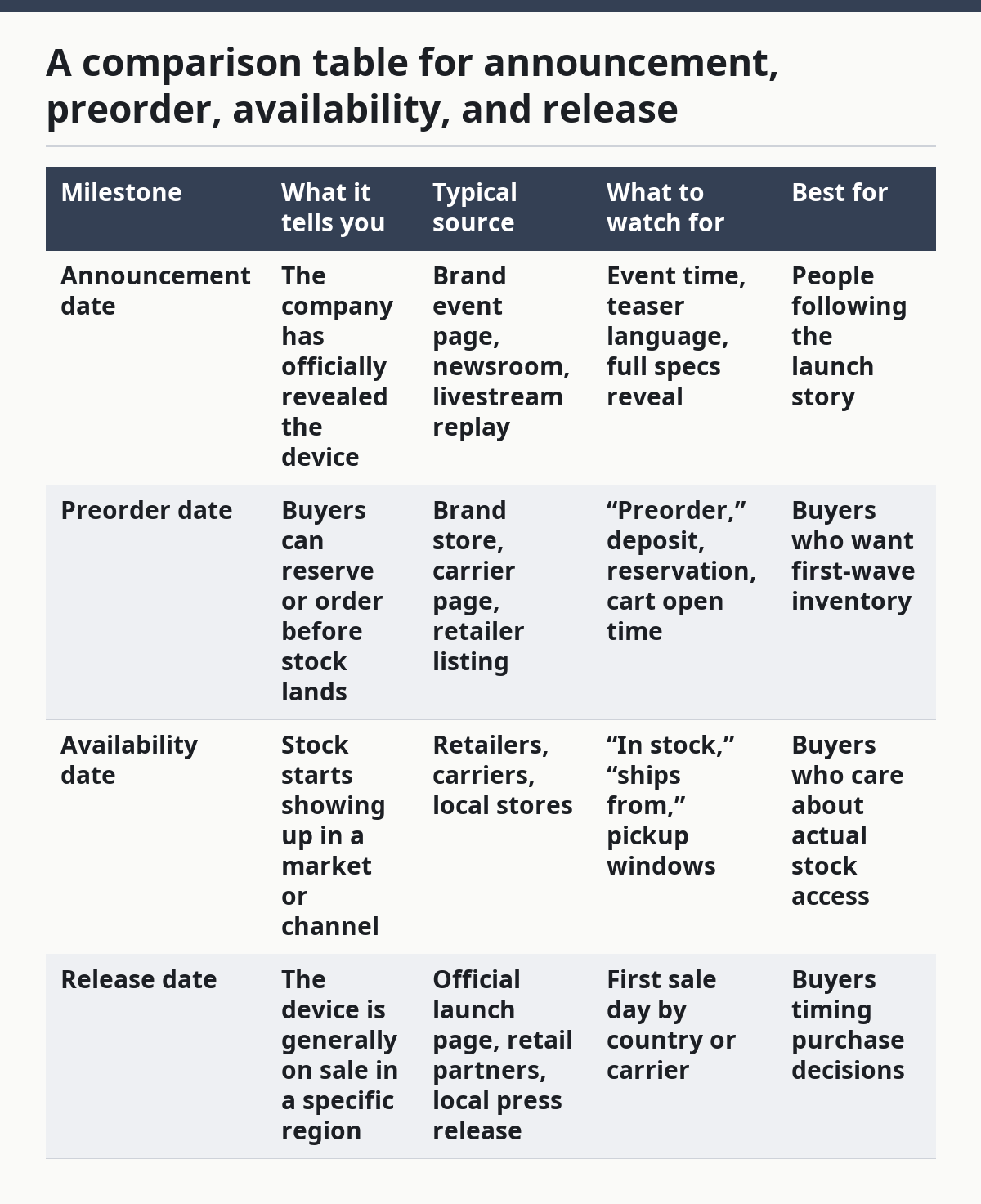
The useful thing about this table is that it prevents false certainty. A device can have a clean announcement date and still have muddy availability. A company may say it is “available now” in one country while the broader release lands 2 weeks later elsewhere. If you track only one row, you will miss the rest of the chain.
For a reader comparing dates across multiple models, the release date is the least ambiguous field, but even that needs a region tag. “Release date” without a country is only half a fact. In launch tracking, half a fact is usually how rumors spread.
Which sources should you trust first?
The official brand announcement should come first, and retailer or carrier pages should come second. That order matters because the brand controls the event schedule, while resellers often update their pages late or early depending on inventory systems.
Here is the order I would use when a date matters:
- Manufacturer newsroom or event page
- Official product page
- Carrier launch page
- Major retailer listing
- Trusted publication quoting the official schedule
That hierarchy is not perfect, but it cuts down on bad dates fast. A retailer can accidentally leave up a placeholder date. A carrier page can show “coming soon” for days after the brand has already announced the device. The company’s own announcement is the anchor.
For a regional release, a local market page can be the best source if the brand has published one for that country. If a brand announces a device globally but publishes a country-specific page for India, Germany, or Japan with a local sale date, use that local page for that region. Global tech coverage often flattens those differences, which is how people end up expecting a handset a week early.
Two source types deserve special care. First, rumor accounts and “leak” posts can be useful for early watchlists, but they are not dates you should treat as final without official confirmation. Second, calendar reminders from enthusiasts are helpful only after the official dates exist. They are not a source of record.
For launch tracking, one independent reference is useful too: the GSMA’s official understanding of mobile ecosystem terminology can help keep terms like device, handset, and network access separate, while a standards body or carrier announcement clarifies regional compatibility. If a source uses launch language loosely, the official product page usually settles the matter. See the GSMA at https://www.gsma.com/ and the FCC device guidance at https://www.fcc.gov/consumers/guides/consumer-guide-mobile-phone-broadband-services.
What most launch trackers get wrong
Most launch trackers collapse at least two milestones into one line, and that creates the wrong expectation by one or two weeks. The usual error is to label the announcement date as the release date, then leave out preorder and regional timing. That mistake costs the reader time and causes missed purchase windows.
The common problems are predictable:
-
Using a teaser date as the announcement date.
Cost: you mark the launch too early and chase a product that has not been fully revealed.
Better: wait for the official event or newsroom post that names the device. -
Treating preorder as release.
Cost: buyers expect shipping that day and get a reservation instead.
Better: label preorder as its own milestone and note whether the order is shipping now or later. -
Ignoring region changes.
Cost: a U.S. date gets copied into the UK, India, or EU without verification.
Better: append the country or carrier every time. -
Confusing “available” with “in stock.”
Cost: a page says the device is “available” even though the first batch is sold out.
Better: record whether the device is merely listed, actually in stock, or open for pickup. -
Relying on one source only.
Cost: one stale page can keep bad data alive for days.
Better: confirm with the brand and one second source.
A good tracker is boring in the right way. It should show sequence, not hype. The moment the dates start contradicting each other, the article or spreadsheet has failed the reader.
A simple way to build your own release timeline
The release timeline is easiest to manage in a four-column sheet with a region field, and that works for one model or fifty. You do not need a complicated tool; a notes app or spreadsheet is enough.
Use these columns:
- Model name
- Announcement date
- Preorder date
- Availability / release date
- Region or market
Then add two optional fields if you want more precision:
- Source
- Notes
Here is the working method:
- Add the model name exactly as the company writes it. A name like “Galaxy S” or “Pixel” is too vague unless the variant is clear.
- Enter the announcement date from the official event page.
- Enter the preorder date only if the brand or retailer gives a start time, not just a vague “soon.”
- Enter the release date with the market attached, such as “US,” “UK,” or “India.”
- Add one source link per row so you can check it again later. For example, use the official product page or a carrier launch page for confirmation.
- If the source says “shipping starts” rather than “release,” keep that wording in the notes.
This setup helps because it mirrors how launches actually happen. One device can be announced on day 1, open preorder on day 3, start shipping in one country on day 10, and hit another region on day 24. A single date field cannot show that sequence cleanly.
If you only want one number to remember, make it the release date in your own country. If you want to plan around press coverage, review embargoes, or stock drops, keep all four dates. That is the difference between knowing a launch happened and knowing when you can act on it.
Recommendation: use the official announcement plus a regional release check
The best way to track mobile phone announcement vs release dates is to start with the official announcement and then verify the regional release on a local product page. That method is the most dependable for a buyer because it captures both the first reveal and the day the device becomes available where you live.
This approach is best for readers who want clarity, not speculation. It is not ideal for people who want one giant “upcoming phones” feed or a rumor-heavy watchlist. Those readers need a different page. It is also a poor fit if you only care about price timing; launch dates and pricing are related, but they are not the same question.
The drawback is that it takes a little more work than reading a single roundup. You have to check the brand, then check the market you care about, then note which milestone the source actually names. That extra step pays off because it prevents one of the most common launch mistakes: assuming the announcement day is the day a buyer can place an order.
If you build your own tracker this way, you will always know the difference between reveal, preorder, availability, and release. That is the whole job.
What is the difference between announcement and release date?
The announcement date is when the brand first reveals the mobile device, usually in a keynote, livestream, or press release. The release date is when buyers can typically purchase or receive it in a specific market. Those dates are often separated by days or weeks, and sometimes by region.
Why do preorder dates matter for phones?
Preorder dates matter because they show when demand opens, not just when the product is revealed. A preorder can sell out before the release date, and some retailers use it to allocate early stock. If you want first-wave inventory, the preorder date is often more useful than the final sale date.
How can release dates vary by region?
Release dates vary by region because brands and carriers roll out stock country by country. A device may be available first in the United States, then later in the UK, India, or Australia. Local taxes, carrier approvals, logistics, and retail agreements all affect when a market gets the device.
Drafted with AI; not yet reviewed by a person.