

How to Spot Delays in Mobile Phone Launches
Last updated: November 18, 2026
Quick Answer: In most cases, a mobile phone launch delay shows up in three places first: a missing event, a changing preorder date, or a launch page that shifts from a fixed day to a wider window. If you are tracking How to Spot Delays in Mobile Phone Launches, start with the brand’s official page, then compare it with one retailer or carrier page.
Key takeaways
- A delayed phone launch rarely looks dramatic at first; it usually appears as a date that goes vague, a launch page that changes wording, or a regional rollout that no longer matches the original plan.
- Supplier trouble, certification lag, and software issues leave different traces. The clue is not just “something changed,” but what changed and where the change first appeared.
- The most reliable signal is usually an official statement from the brand, but if the company has not said anything yet, treat retailer listings, leaks, and rumor posts as hints, not proof; if you are making a buying decision, consider checking a consumer or telecom professional source as well.
- A delay can affect one country, one carrier, or one color variant without changing the global launch. That distinction matters if you are trying to know whether the whole phone launch has slipped.
What a phone launch delay actually looks like
Therefore, a phone launch delay is a change in the promised timing of a new model’s announcement, preorder window, shipping date, or regional release. In practice, the first clue is often a small wording change, not a headline, which is why How to Spot Delays in Mobile Phone Launches usually starts with checking the wording on official pages.
Readers usually miss this because they look for one obvious sign. Real launch delays tend to arrive in layers: a keynote date stays the same but preorders move, or preorders stay the same but first shipping slips by 1 to 2 weeks. Sometimes the launch event happens, yet a carrier in one market says stock will arrive later than the company implied.
There are four common forms:
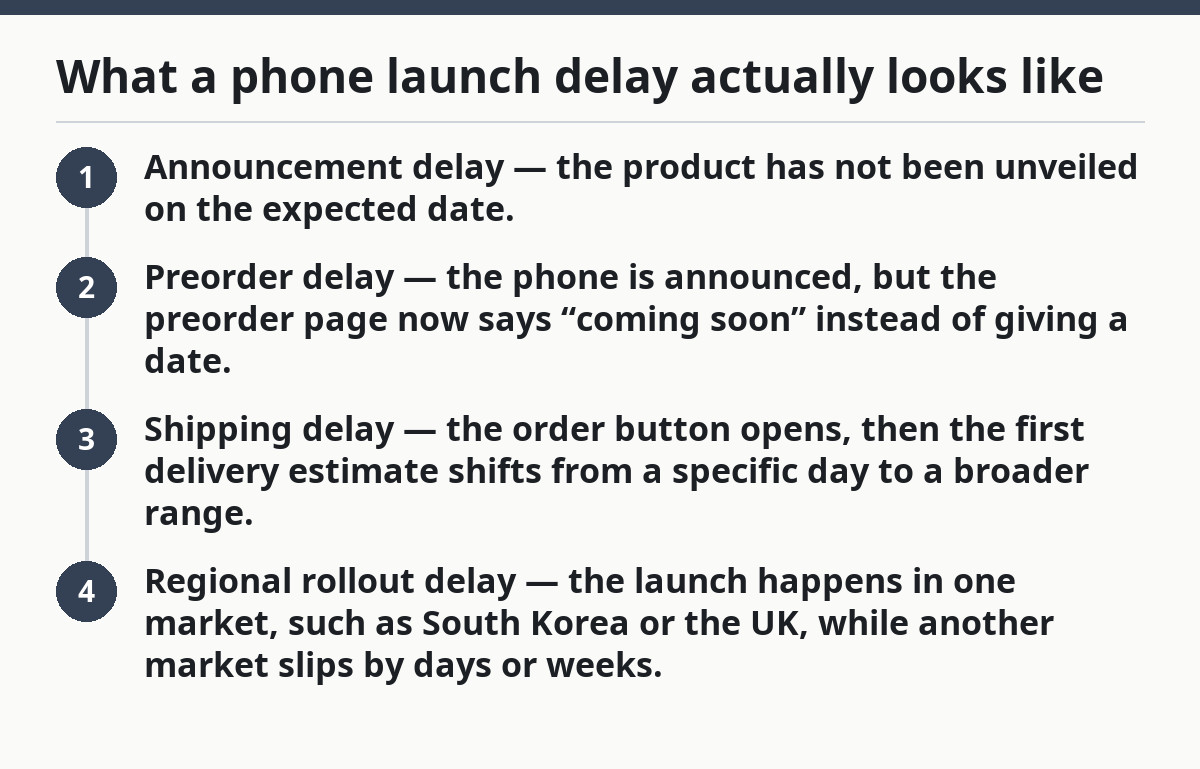
- Announcement delay — the product has not been unveiled on the expected date.
- Preorder delay — the phone is announced, but the preorder page now says “coming soon” instead of giving a date.
- Shipping delay — the order button opens, then the first delivery estimate shifts from a specific day to a broader range.
- Regional rollout delay — the launch happens in one market, such as South Korea or the UK, while another market slips by days or weeks.
For example, a generic article often treats all of these as the same problem. They are not. If you want to spot a real delay, you need to know which stage changed, and consumer guidance from a carrier or regulator can help you interpret what that change means.
The earlier the stage, the harder it is to prove. A rumor about a keynote date is weak. A changed preorder page from the manufacturer is stronger. A carrier saying “later this month” after it previously said “April 12” is a much stronger sign still.
The fastest signs to watch before a delay becomes official
So the fastest signs are date changes, wording changes, and missing launch assets. These show up in company channels, carrier pages, and certification records before an official statement appears, which is why How to Spot Delays in Mobile Phone Launches depends on checking them early.
The most useful habit is to compare the current version of a launch page with the earliest version you saw. Even a small change matters. “Preorders start March 14” turning into “availability will vary by market” is not harmless copy editing. It usually means the schedule no longer fits the original plan.
Here is a practical way to check for delay signals:
- Check the brand’s launch page for exact date language. Look for phrases such as “available from,” “preorder,” or “shipping begins.” If a page that once named a day now says “later this spring,” the launch timing has probably shifted.
- Compare the announcement to retailer pages. Major retailers and carriers often publish a date, such as April 5 or May 22. If the brand page and the retailer page stop matching, the rollout is under strain.
- Watch for missing assets. A launch page without a press kit, spec sheet, or preorder form on the expected day is a red flag. Companies usually do not remove these for no reason.
- Check whether the date changed on more than one market page. If the UK page slips but the US page stays fixed, you may be seeing a regional delay, not a full delay.
- Look for soft language in support or promo emails. Phrases like “subject to change,” “while supplies last,” or “delivery estimates may vary” often appear when teams are unsure of inventory.
The strongest clue is not one sentence. It is a pattern across at least two sources. If the official store, a carrier, and a press post all stop giving the same date, the launch is moving.
What this does not tell you is why the launch slipped. A change on its own can come from inventory, software, certification, or a planned staggered rollout. That distinction matters before you spread the news.
Why supplier issues are the most common reason
Therefore, supplier problems are the most common reason a mobile phone launch slips, because one missing part can hold up the whole production line. A phone needs a chain of vendors for displays, camera modules, chipsets, batteries, and final assembly.
This is where the topic gets more specific than a typical rumor post. A supplier issue does not always mean a factory fire or a dramatic shortage. It can be as ordinary as one component arriving late, a quality check failing, or a packaging change that forces a new shipment schedule. If a model uses a new camera sensor or an in-house chip, the launch risk rises because fewer substitute parts are available.
You can sometimes spot supplier trouble through indirect signs:
- a product page appears without a final spec sheet;
- one color or storage tier is delayed while others are still listed;
- a launch event is announced, but shipping details are absent;
- a component certification or regulatory filing appears late.
The important trade-off here is that supplier trouble often looks like “just inventory.” That is why people get fooled. They see a preorder page still live and assume nothing is wrong. In fact, the company may already know it cannot ship enough units on the promised date.
This is also where rumor tracking goes wrong. A supply rumor may be true, but it is not enough on its own. Unless an official statement confirms the issue, treat it as a lead. Use it to watch the launch page more closely, not to declare the launch broken, and if the purchase is time-sensitive, verify the claim with a retailer, carrier, or consumer-advice source.
If you want one clean rule: a supplier problem is likely when the delay is tied to hardware availability, not marketing timing. That is the kind of delay that can push a product from one week into the next even when the event date still stands.
How to tell a regional rollout from a full launch delay
Meanwhile, a regional rollout delay affects one market, while the global launch still happens on schedule elsewhere. The difference shows up in where the dates move, not just that dates move, and that is central to How to Spot Delays in Mobile Phone Launches.
This is one of the easiest mistakes to make. A reader sees a phone launch delayed in India and assumes the whole release is delayed everywhere. Often, the brand simply chose a staggered release. Many phones launch in one region first, then reach another market days or weeks later because of carrier approval, local testing, logistics, or inventory planning.
Look for these signs of a regional rollout delay:
- The announcement says “available in select markets” rather than naming all regions at once.
- One country’s preorder date is specific, such as June 7, while another market says “coming later this quarter.”
- The product appears in one online store but not in another country’s store.
- A carrier release page is updated independently from the brand page.
The common mistake is to assume every country follows the same schedule. It does not. A launch can be on time in Europe and delayed in the US, or vice versa. That is especially common when carriers are involved, because carrier testing can take longer than an opened retail release.
The cost of misreading a regional rollout is simple: you waste time waiting for a date that was never meant for your market. You also spread bad information if you share the wrong schedule in a local group or forum.
The better approach is to ask one precise question: “Delayed where?” If the answer names a market, carrier, or channel, you are probably looking at a rollout issue rather than a true launch delay. That distinction is the difference between a global problem and a local one.
Where official confirmation usually appears first
Because of that, official confirmation usually appears on the brand’s launch page, press newsroom, email campaign, or retailer update before it appears in headlines. If you want proof, start there.
A lot of people wait for a news article and miss the source. The company’s own channels are more reliable because they show the exact wording the brand chose. That wording matters. A sentence such as “availability will begin in early May” is not the same as “preorders open May 3.” The first gives room for movement; the second does not.
Check these places in order:
- The brand’s product page. This is where wording changes usually show up first. If a release window changes from a fixed date to a range, you have a real signal.
- The official newsroom or press release page. Brands often issue a short note when timing changes. Even a brief update can settle the question.
- Order confirmation or preorder email. If you already signed up, the company may send a revised estimate. Keep the original email so you can compare the dates.
- Carrier announcements. Carriers sometimes publish the most concrete timing, especially for subsidy or trade-in launches.
- Retailer listings. Third-party stores may update stock and delivery estimates before the brand does.
Two authoritative sources are worth keeping in mind here: the company’s own newsroom and the retail or carrier page that handles actual orders. They are not interchangeable, but they should point in the same direction if the launch is still on track.
A strong official confirmation usually does one of two things. It names a new date, or it gives a new time window. A weak confirmation avoids both and uses words like “soon” or “in due course.” That kind of language is often a sign the team is still sorting out supply or regional logistics.
For broader tracking, the mobile phone launch tracking hub can help connect these signals across a launch cycle without turning the page into a rumor feed.
A simple routine for checking a launch in under 10 minutes
Overall, a launch delay check takes under 10 minutes when you use the same sequence every time. Start with the official source, then verify against one retailer and one regional page, because that gives you a practical way to spot delays in mobile phone launches without relying on headlines.
Here is a routine that works well:
- Open the brand’s launch page first. Note the exact wording around the date, preorder, and shipping. If the page says “from June 18,” write that down.
- Check the newsroom or press release. Look for a matching date or a revision. If the newsroom no longer matches the product page, the launch timeline is unstable.
- Open one retailer or carrier page. Compare its language with the brand’s. If it says “expected July 2” while the brand says “available now,” one of them is wrong or behind.
- Look for market differences. Check at least one regional page if the phone is sold in more than one country. A local delay often shows up there first.
- Search for one direct official statement. Use the company name plus “launch delay,” “availability,” or “preorder update.” If nothing official appears, do not treat speculation as confirmation.
- Save the version you saw. A screenshot or timestamp helps if the page changes later. You do not need a tool more complex than your browser and a notes app.
This routine works because it separates signal from noise. A leak, a rumor account, or a forum post can tell you where to look. It cannot tell you whether the launch has actually slipped.
The main limitation is that some companies update pages slowly. A stale page can lag behind the real schedule by a day or two. That is why the best rule is to look for agreement across sources, not a single perfect source.
Common mistakes that make launch delays harder to spot
However, the biggest mistake is treating leaks as proof. A leak can be early, but it can also be stale, and a stale leak is worse than no leak at all.
A second mistake is reading a regional delay as a global one. If a phone launches in Japan on March 1 and arrives in the US on March 15, that is not always a delay. It may be the intended rollout. People often turn this into a false alarm because they did not check the market.
A third mistake is watching only headlines. Headlines compress details, and launch timing lives in the details. A headline may say “phone delayed,” while the actual change is only a preorder slip in one region. That matters if you are trying to buy, compare, or wait for your market.
A fourth mistake is ignoring the wording around shipping. “Available” and “ships” are not the same. A page can accept orders today and ship a week later. If that window gets longer, the launch has slipped even if the store still looks active.
A fifth mistake is assuming silence means no delay. Silence can mean the company has not decided how to word the problem yet. It can also mean the delay is small enough that the brand plans to absorb it without a public statement.
The fix is boring, but it works: compare official wording, compare regions, and compare stages of the launch. If all three move together, the delay is real. If only one forum thread moved, it is probably noise.
Why official confirmation matters more than rumor
Ultimately, official confirmation matters more than rumor because it tells you whether the date changed, not just whether people expect it to. A rumor can point to a problem; an official statement tells you the launch plan itself has moved.
That does not mean rumor has no value. It can give you an early warning, especially when it matches a pattern in supplier reports, retailer edits, or missing preorder pages. But rumor is only useful when it leads you to evidence.
A practical rule helps here: if a change is visible on the brand site or in a carrier update, treat it as real. If the only source is a reposted screenshot with no date, no URL, and no company name, treat it as unconfirmed.
This is the point most readers need most. You are not trying to become a rumor tracker. You are trying to tell the difference between a real launch delay and background noise.
Drafted with AI; not yet reviewed by a person.