
Mobile Phone Compatibility and Network Fit
Last updated: November 18, 2026
Quick Answer: in Mobile Phone Compatibility and Network Fit — The Complete Guide, the safest first check is 3 items: the exact model number, the carrier’s compatibility tool, and VoLTE support. A phone is compatible with a network if it supports the carrier’s bands, calling system, and SIM setup; it fits well only if it can also use the carrier’s voice, 4G LTE, and 5G features without missing key functions. To reduce risk, check the exact model number against the carrier’s compatibility tool before paying, because two phones with the same name can behave very differently. For the most reliable result, use the carrier’s own checker and the FCC’s mobile guidance, then compare the model code against the listing.
Key takeaways
- A phone can be “opened” and still fail on a network if it misses the right LTE or 5G bands.
- Voice calling now matters as much as data, because many carriers rely on VoLTE instead of older voice systems.
- The same phone name can hide different model numbers, especially across regions and storage variants.
- Carrier fit is not just signal strength; it also includes eSIM support, SIM type, and whether the device is approved for that carrier.
- The safest check is often the exact model code, not the marketing name on the box.
What does network fit actually mean?
Mobile Phone Compatibility and Network Fit means a phone can do the jobs your carrier requires on its live network, not just show bars at the top of the screen. A device may accept a SIM card and still miss voice calling, 5G access, or hotspot use, which is why “it turns on” is not the same as “it fits.”
The term covers four layers. First is the radio hardware, which must support the bands your carrier uses. Second is the call system, usually VoLTE for modern networks. Third is the SIM setup, either physical SIM or eSIM. Fourth is carrier approval, because some carriers block or limit phones that are not on their approved list even when the radio bands match.
This is where many buyers get tripped up. A phone sold in one country may look identical to one sold in another, but the internal band set can differ. A model may also support 5G in one market and not another. That is why the full model number matters more than the brand name. For a quick cross-check, see the FCC’s consumer wireless guidance and your carrier’s device page, such as Verizon’s compatibility checker or AT&T’s device support pages.
Because the carrier’s compatibility checker can accept an exact model and IMEI, the phone is often more likely to work as expected when those details match. If it only “should work” based on the brand, treat that as a warning and consider checking with the carrier or a qualified retail expert before buying. The FCC and carrier support pages both make the same basic point: network access depends on device support, not appearance alone.
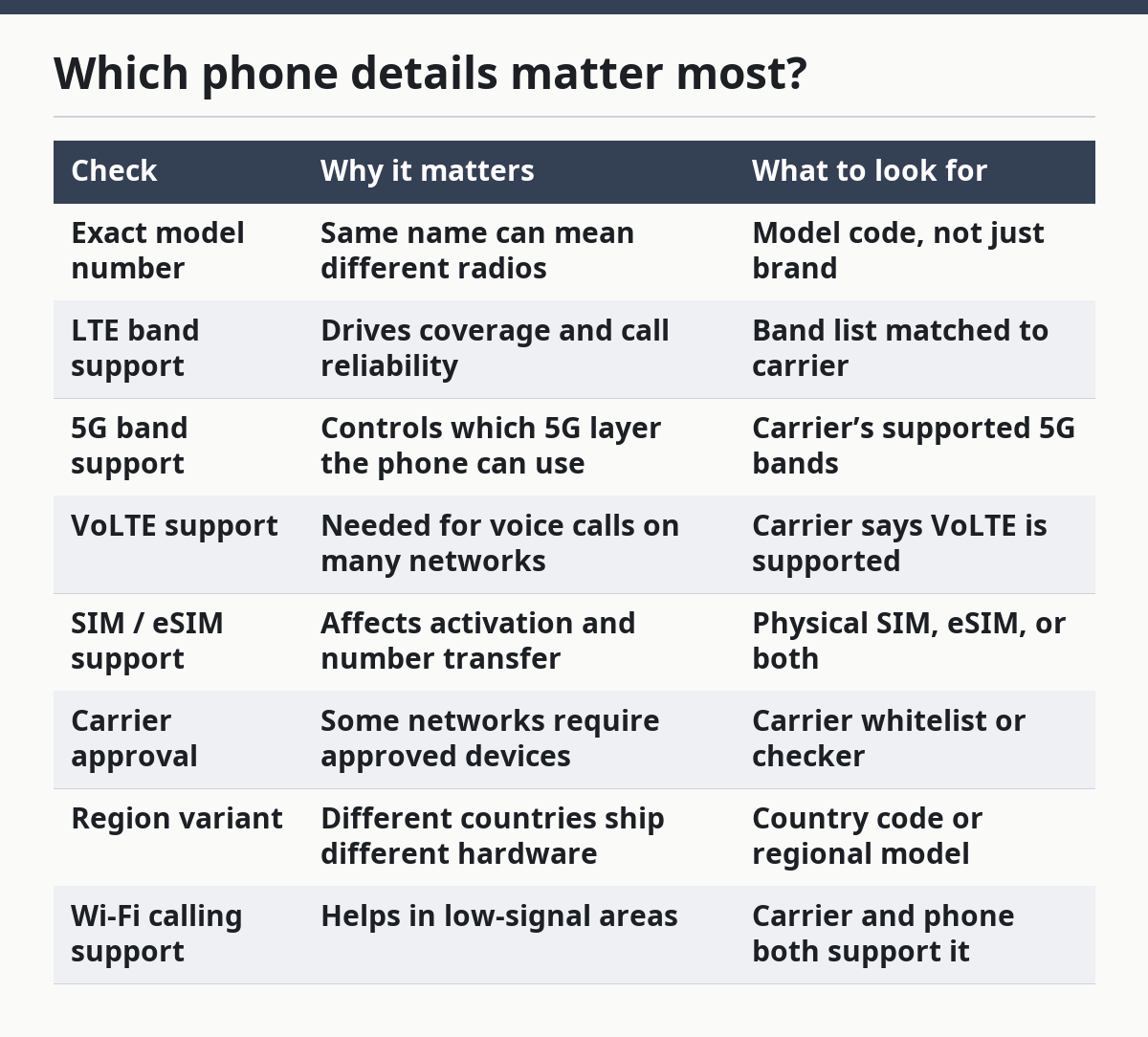
Which phone details matter most?
The exact model number matters most, because it tells you what radio hardware and software package you are actually buying. A model name like “Galaxy S,” “iPhone 15,” or “Pixel 8” is too broad to confirm compatibility by itself.
The first detail to check is the LTE band list. LTE still carries a large share of everyday phone traffic in many places, and carriers often rely on specific bands for coverage and building penetration. If a phone misses a band the carrier uses heavily, you can end up with weak indoor coverage or slow speeds even in a city. For example, a missing band can turn one strong connection into two weak ones: voice and data.
The next detail is 5G support. 5G is not one thing; it includes different frequency ranges, and not every phone supports every carrier’s 5G setup. A phone can be “5G capable” and still miss the carrier’s main 5G layer. That can mean you do not get the speed or coverage you expected from the label. If the carrier uses a specific 5G band in your area, that number matters more than the marketing badge.
VoLTE support is just as important as data bands. Voice over LTE is how many modern networks place calls now, and some carriers require it even for simple calling. A phone that cannot use VoLTE on that carrier may have data but lose reliable voice service. That is a deal-breaker for many buyers.
SIM and eSIM support come next. Some phones take one physical SIM, some take dual SIM, and some use eSIM alongside or instead of a tray. If your plan depends on switching carriers often, traveling, or keeping work and personal numbers separate, the SIM setup can matter as much as the bands. A clean-looking spec sheet that leaves out eSIM is a problem if you need it.
Use this checklist before buying:
| Check | Why it matters | What to look for |
|---|---|---|
| Exact model number | Same name can mean different radios | Model code, not just brand |
| LTE band support | Drives coverage and call reliability | Band list matched to carrier |
| 5G band support | Controls which 5G layer the phone can use | Carrier’s supported 5G bands |
| VoLTE support | Needed for voice calls on many networks | Carrier says VoLTE is supported |
| SIM / eSIM support | Affects activation and number transfer | Physical SIM, eSIM, or both |
| Carrier approval | Some networks require approved devices | Carrier whitelist or checker |
| Region variant | Different countries ship different hardware | Country code or regional model |
| Wi‑Fi calling support | Helps in low-signal areas | Carrier and phone both support it |
This is also the point where a lot of generic buying advice fails. “Opened” does not mean “works everywhere.” It only means the phone is not tied to one carrier. Compatibility still depends on the band map and the carrier’s own rules.
Opened phone or carrier phone?
An opened phone is often the better default choice for most buyers, but a carrier phone can be the safer option when you want the least setup risk and the best chance of getting carrier-specific features on day one. The right answer depends on whether you value freedom or a more managed activation path.
Here is the side-by-side view:
| Criteria | Opened phone | Carrier phone | Winner for this condition |
|---|---|---|---|
| Carrier switching | Easier to move between carriers | Often tied to one carrier at first | Opened phone |
| Compatibility certainty | Can be strong, but must be checked | Usually preselected for that carrier | Carrier phone |
| Band support | Varies by model and region | Usually aligned to that carrier | Carrier phone |
| VoLTE and feature setup | May need manual support | Often preconfigured | Carrier phone |
| Travel use | Better if it supports global bands | Can be more limited by region | Opened phone |
| Resale value | Often stronger | Often weaker after lock period | Opened phone |
| Activation friction | Can be higher | Usually lower | Carrier phone |
| Risk of hidden mismatch | Higher if model code is wrong | Lower, but not zero | Carrier phone |
| Freedom to use prepaid plans | Better | Sometimes restricted during lock period | Opened phone |
An opened phone works well for people who change carriers, buy phones abroad, or want to keep the device after the plan ends. That flexibility has real value, especially if you care about resale or if your carrier changes too often to stay loyal. The downside is that the burden shifts to you: you must confirm the exact model, bands, and VoLTE support.
A carrier phone works well for the buyer who wants less guesswork. If the carrier sold the device, the odds are better that the phone has the right band set and the right provisioning for calls, messaging, and hotspot features. The trade-off is control. Carrier phones can be locked for a period, can carry carrier apps, and can be less attractive when you later want to switch to another network.
This is where price can fool people. A carrier phone may look cheaper at checkout because the cost is spread across monthly billing, while an opened phone shows the full amount up front. That does not make the carrier phone a better fit. It only means the payment structure is different. If the buyer plans to keep the phone for years, the freedom of an opened model can matter more than the first bill.
The wrong choice is a locked device bought only because the sticker looks lower. If the carrier fit is weak, the buyer can spend months with a phone that calls badly, holds weak signal, or misses eSIM support. That is a bad trade even when the first payment looks small.
How do I check if a phone will work on my carrier?
The safest way to check is to match the exact model number and IMEI against the carrier’s compatibility tool before you buy or activate the phone. If the carrier does not support the model, stop there and do not rely on the box, the marketing page, or a sales rep’s verbal guess.
Start with the model number on the listing or in the phone’s settings. Then compare it to the carrier’s support list. This matters because many phone families share a name but not a radio package. A U.S. model, a European model, and a global model can all carry the same brand badge and still differ in band support. For example, the FCC mobile pages explain device rules, while carrier pages such as Verizon’s device checker and AT&T’s support pages show carrier-specific acceptance.
Next check whether the carrier supports VoLTE on that model. If the carrier’s help page mentions voice over LTE, Wi‑Fi calling, or 5G provisioning, make sure the phone is listed for those services, not just for “data.” A phone that can connect for web use but cannot complete calls is a partial fit, not a full one.
Then check the SIM requirement. Some carriers want a physical SIM; some prefer eSIM; some support both but with different steps. If you plan to use dual lines, confirm whether the phone supports dual SIM in the form you need. A dual-SIM label may mean two physical slots, one physical plus one eSIM, or a different combination entirely.
The final check is the carrier’s policy on opened and imported phones. This is where many mismatches happen. A device can technically support the band list and still be blocked because the carrier has not certified it. That is especially common with phones purchased outside the carrier’s normal retail channel.
Use this order:
- Find the exact model number.
- Check the carrier’s compatibility page.
- Confirm VoLTE and 5G support for that model.
- Check SIM or eSIM support.
- Verify carrier approval, not just radio support.
- Only then decide on purchase.
The FCC explains wireless device compatibility and consumer rights on its mobile and wireless guidance pages, and carrier support pages usually spell out the model-level requirements in more detail. Those two sources together give the cleanest answer, because one covers the general rules and the other covers the carrier’s own network policy. If you want a second point of reference, check the carrier’s published support pages for the exact model before you buy.
Why do bands matter more than the brand name?
Bands matter more than the brand name because the phone’s radio hardware decides which parts of the network it can actually hear. A premium phone with the wrong bands can perform worse than a cheaper one that matches the carrier’s network map.
Think of the band list as the phone’s passport. Without the right entries, the device may not enter the parts of the network that provide coverage in your area. That can affect rural range, indoor signal, data speeds, and the stability of voice calls. A user may blame the carrier when the real problem is the phone’s missing hardware support.
This is especially important with 5G. A phone may advertise 5G but still miss the exact 5G layer your carrier uses most. In that case, the buyer gets the logo without the benefit. That does not always mean the phone is bad. It means the phone is only partly suited to that network.
The band issue also explains why two versions of the same phone can have different value. If one regional variant supports more of the local carrier’s bands, it fits better and keeps its usefulness longer. If another variant lacks those bands, the discount can disappear the first time the phone drops to 4G indoors or loses reliable calling in a fringe area.
There is a second reason bands matter: they affect resale. A phone that is broadly compatible tends to be easier to sell later. A device with niche band support narrows the pool of buyers to the few networks it truly fits. That matters even if the phone itself is in perfect condition.
A generic article often stops at “check if it’s opened.” That misses the point. Opened status only says the phone is not tied to one account. It says nothing about whether the radio inside can support the network you care about.
What can go wrong even when the phone is “compatible”?
A phone can still disappoint even when the compatibility checker says yes. That is because compatibility is only the starting gate, not a guarantee of every feature.
The most common problem is partial support. The phone may work for calls and texts but not for hotspot, visual voicemail, Wi‑Fi calling, or full 5G access. That is annoying if you expected the same feature set as a carrier-sold flagship. It is worse if you depend on one of those extras for work.
Another problem is software provisioning. Some carriers need the device to be recognized in a certain way before they enable full calling or messaging features. If that provisioning fails, the phone may connect poorly until support updates the line or the device profile. A user might see signal bars and still not get a working call path.
Imported phones can also run into region limits. The phone may be physically fine but miss emergency features, local firmware support, or the carrier’s preferred VoLTE profile. In some cases the device can receive data but not complete all calling functions. That is a poor fit even when the spec sheet looks impressive.
There is also the issue of future network changes. A phone that works today can age out if the carrier retires an older voice path or shifts more traffic to a band the phone does not support well. This is one reason to avoid buying a phone with only narrow band support if you plan to keep it for several years.
The practical lesson is simple: a compatibility check should be read as “eligible,” not “perfect.” If the phone is for a person who needs maximum certainty, carrier-sold hardware or a model already approved by the carrier is safer. If the buyer is comfortable checking every detail, an opened phone can be a better long-term move.
When does the answer change?
The answer flips in a few specific situations, and those are the cases where a standard “buy opened” recommendation can fail. A buyer should change course if any of these are true.
First, the carrier requires a device from its approved list for full service. In that case, a supposedly “universal” opened phone may still be the wrong choice if it is not on the list. The safe move is to prioritize the carrier’s approved model over the nicer spec sheet.
Second, the buyer depends on eSIM for travel or dual lines. If the phone’s eSIM support is limited or poorly documented, the cheaper opened option can become the more expensive mistake. A careful check of the model page and carrier support can save a month of activation trouble.
Third, the buyer lives in an area where indoor signal is already weak. In that case, band support and VoLTE support matter more than brand or price. A phone that misses the carrier’s strongest local coverage band is a poor fit, even if it seems fine in a shop.
Fourth, the phone is being bought used or imported. That raises the odds of region mismatch, missing support, and unclear lock status. A used phone can still be a good buy, but the model code and IMEI check become non-negotiable.
| Situation | Better choice | Why |
|---|---|---|
| Carrier has a strict approved list | Carrier-sold model | Less activation risk |
| User needs easy switching | Opened model | Easier to move between carriers |
| User depends on eSIM | Model with confirmed eSIM support | Activation depends on it |
| Weak indoor coverage area | Model with stronger band match | Better signal odds |
| Imported or used phone | Carrier-checked model | Fewer hidden mismatches |
If none of those cases apply, the broader rule holds: buy the model that matches the network best, not the phone with the biggest name.
The verdict: which one should you choose?
Choose an opened phone if you plan to switch carriers, travel often, or keep the device beyond one contract and you are willing to check the exact model number and bands first. Choose a carrier phone if you want the safest activation path, the least setup friction, and the highest chance that calls, 5G, and Wi‑Fi calling work without extra effort. Neither if the carrier’s approved list does not include the exact model or if the phone lacks the voice standard your network requires.
That is the cleanest rule. The opened route offers more freedom, but it demands more homework. The carrier route offers less freedom, but it lowers the chance of a mismatch. For many buyers, the right choice is not about the phone brand at all. It is about how much risk they can tolerate if one feature does not work on day one.
For price-focused readers, this is the key link between compatibility and cost: a lower upfront number is not a good deal if the phone cannot use the carrier properly. A model that fits the network better can save money later by avoiding returns, trade-in loss, and an early replacement. That is why compatibility is part of the price conversation, not a separate technical detail.
What should I ask before I buy?
Ask the seller for the exact model number, the supported LTE and 5G bands, and whether the phone supports VoLTE and eSIM on your carrier. Those four questions catch most of the problems before money changes hands.
The answer should not be “it works with most carriers.” That phrase is too vague to protect you. A real answer names the model code and the carrier’s own support status. If the seller cannot give that, the risk is on you.
One more useful question is whether the phone is locked, opened, or only conditionally opened after a billing period. A locked phone can still be a good choice in the right plan, but the lock should be part of the decision, not a surprise later. If you want freedom to switch, ask before you buy.
FAQ
Can an opened phone still fail on my network?
Yes. An opened phone can still miss the bands, VoLTE support, or carrier approval needed for full service. Opened only means it is not tied to one carrier account, not that it is guaranteed to fit every network.
Do I need to check the IMEI?
Yes, if the carrier offers an IMEI checker, it is one of the best final checks. The IMEI tells the carrier exactly which device is trying to join the network, which is more reliable than judging by brand name alone.
Is 5G enough to prove compatibility?
No. A 5G label only means the phone can use some 5G service. It does not prove the phone supports your carrier’s exact 5G bands, voice setup, or feature profile.
Should I buy a carrier phone or an opened phone?
Choose a carrier phone if you want the least risk and easiest setup. Choose an opened phone if you want flexibility and plan to check the model carefully before buying.
What matters more, bands or price?
Bands matter more. A cheaper phone that matches the carrier’s network is more useful than a more expensive phone that cannot use the right voice or data bands.
Drafted with AI; not yet reviewed by a person.