
How to Compare Mobile Phone Prices Between Online and In-Store
Last updated: November 18, 2026
Quick answer: in a sample comparison, the choice can come down to $20 in shipping or a 1 to 5 day delivery wait. Compare the mobile phone store price by adding up the full online total, then lining it up against the physical store price for the same model, storage size, and condition. The number on the tag is not enough; delivery fee, pickup option, activation charges, and any in-store bundle all change the real comparison. For How to Compare Mobile Phone Prices Between Online and In-Store, the key is the final checkout total, not the first price you see.
Key Takeaways
- Online deals can work best if you can wait 1 to 5 delivery days and want the widest range of offers.
- Store pricing can win when it includes same-day pickup, local handoff, or a negotiated discount on a display model.
- The choice depends on whether you care more about cash today or the full cost after fees and convenience.
- Pick the physical store if you want the device today, can inspect the exact unit before paying, or expect a local discount on open-box or clearance stock.
I write on consumer pricing and retail comparison, so the useful question here is not “where is it cheaper?” but “which channel gives the lower real-world total for this exact phone on this exact day?”
The comparison that actually matters

The online listing often looks lower until you add the delivery fee, and the in-store tag can look higher until you factor in pickup option, same-day possession, and any open-box or carrier incentive that is only available inside the shop. That is why the right comparison is line by line, not sticker by sticker.
The cleanest way to compare is to use the same model name, storage tier, and condition on both sides. Compare the base price, taxes, shipping or delivery, pickup option, and any required accessories or activation fees. If one seller offers a bundle, strip the bundle value out before judging the phone itself. A retailer that includes a case or charger can look cheaper even when the handset price is not.
Here is the practical rule: online wins when the total stays lower after shipping, or when a promo is online-only; in-store wins when the shelf price is close, but you can leave with the device today or negotiate an open-box unit. The mistake most readers make is comparing a website coupon to a showroom tag without matching the fine print.
Head-to-head comparison
| Criteria | Online retailer | Physical store | Winner for this condition |
|---|---|---|---|
| Base listed price | Often shows the lowest headline figure on the product page | Can be the same, higher, or lower depending on local pricing | Online retailer if the page price stays unchanged at checkout |
| Delivery fee | May add a shipping charge before checkout | No home delivery charge if you walk out with it | Physical store if shipping is not waived |
| Pickup option | Curbside or store pickup may be offered, sometimes at no extra cost | Immediate pickup is the default | Physical store for same-day need |
| Stock transparency | Can show inventory by warehouse or region | Depends on the branch you visit | Online retailer for broader stock visibility |
| Price matching | Sometimes easier to compare against rival sites | Some stores match competitors, but only under store rules | Physical store if a local match policy applies |
| Bundled extras | May include accessories in a kit | May bundle protection plans or accessories at the counter | Depends on whether you want the bundle |
| Return handling | Usually requires shipping or mailing back | Can be handled in person at the service desk | Physical store for faster returns |
| Negotiation room | Usually fixed by the site | Sometimes possible on open-box or clearance stock | Physical store for shoppers who can ask in person |
| Payment flexibility | Depends on the site and may include buy-now-pay-later or card offers | Depends on the retailer and local payment systems | Online retailer if the payment offer is better |
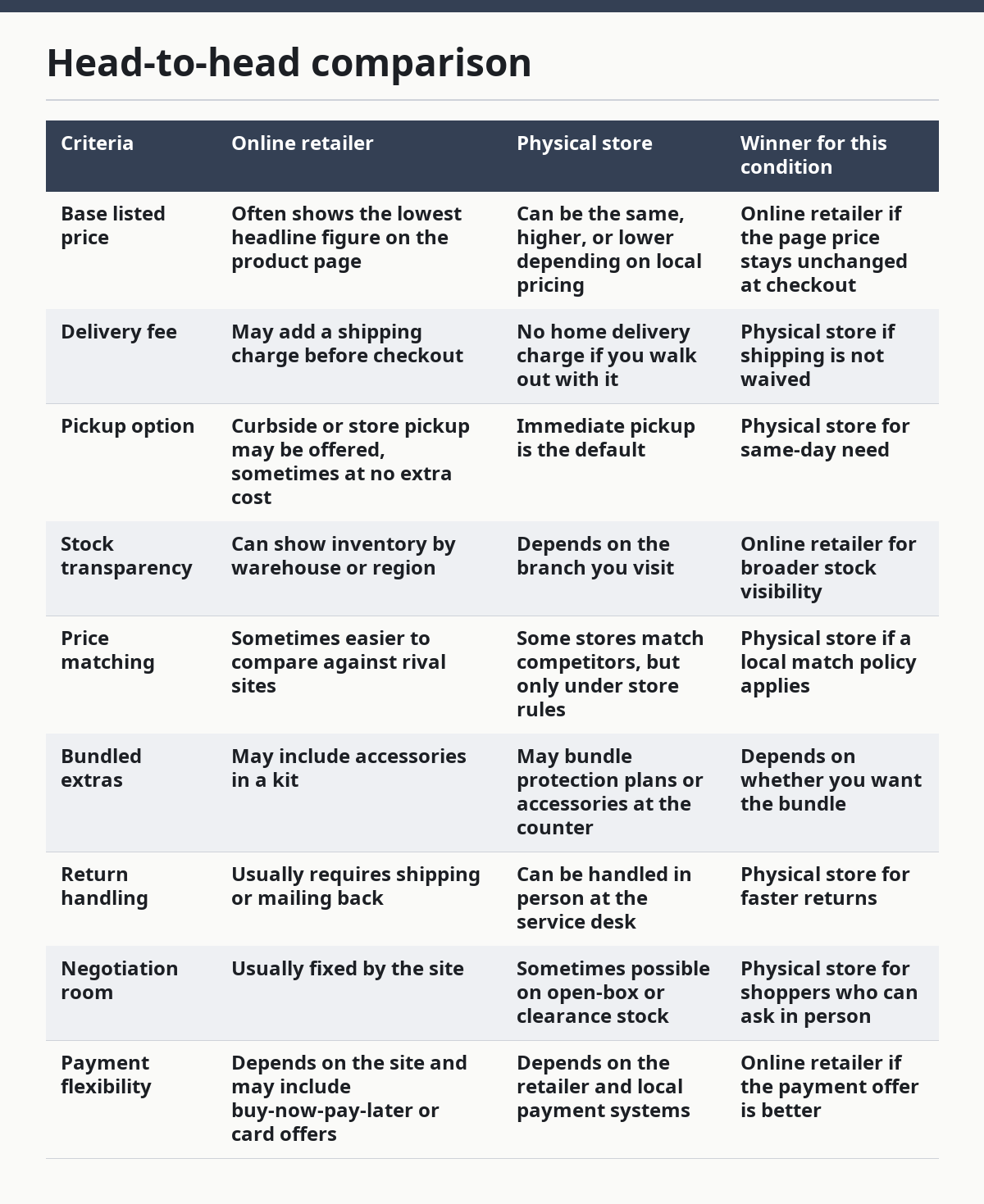
The table matters because it separates a true lower price from a merely lower-looking one. A $30 shipping charge, a 2-day delivery window, or a local pickup policy can change the winner even when the handset itself is identical.
Online retailer: who should use it, and who should skip it
Online retailer pricing wins for the shopper who can wait 1 to 5 delivery days and wants the widest view of offers. That is the person comparing exact model names across multiple sellers, then checking whether the total still beats the store price after shipping. Online is also the better channel when a listing includes store pickup without forcing a trip across town, because the checkout total becomes the real number to compare.
Its biggest strength is consistency. The same page shows the base price, any financing terms, and the delivery fee in one place, which makes it easier to compare a Galaxy S24, iPhone 15, or Pixel 8 in the same afternoon. It also helps when local stock is thin; a physical store may only have one color or storage size left, while an online retailer can still show available inventory. For comparison shopping, that breadth matters more than people admit.
The weakness is that the apparent bargain can evaporate at checkout. Shipping, signature delivery, and restocking rules can all change the final total. Some sites also bury condition details in small print, especially with refurbished or open-box units, so the reader must check whether the listing says new, renewed, or used. If the page does not state the condition clearly, the price comparison is incomplete.
This route is not for anyone who needs the device today, wants to inspect the box before paying, or plans to haggle on an open-box phone. It is also a poor fit when the online price looks low but the seller is vague about return handling. In that case, the phone may be cheaper on paper and costlier in practice.
Physical store pricing: where it beats the web
Physical store pricing wins when the store price includes same-day possession, local pickup, or a negotiated discount on a display model. The advantage is not just speed; it is the chance to see the exact unit, verify the color and storage size, and avoid paying a delivery fee that can erase an online discount.
The best case for in-store comparison is often a clearance shelf or open-box counter. A store may cut the price on a last-unit model, a discontinued color, or a customer return that is still under warranty. That kind of markdown is hard to capture online, because many sites list those units separately or not at all. If the store also offers price matching, the comparison can tilt further in person.
The weakness is less obvious: the physical store often shows only one location’s pricing, while the website may show regional or warehouse pricing. That means the tag at one branch is not the whole market. Some stores also separate the handset price from activation, setup, or accessory sales in ways that are hard to spot unless you ask for an itemized receipt before paying. A reader who wants a clean, apples-to-apples comparison should insist on the exact model number, storage, and condition in writing.
Skip the store if the branch has no stock, if you are comparing several retailers at once, or if you know you will be tempted by add-ons that have nothing to do with the phone price. A physical showroom is a poor place to do calm price research when the clerk is steering the conversation toward a case, screen protector, or service plan.
The honest side-by-side
The right choice depends on which cost matters more: cash outlay today, or total cost after fees and convenience. Online usually wins on comparison breadth; in-store usually wins on immediacy and local flexibility.
If the same mobile phone store price appears in both channels, the online quote still needs a checkout check. A delivery fee of any kind can flip the result. If the store quote is higher, that does not automatically make it worse, because a pickup option, same-day support, or open-box discount may erase the difference in practical terms. The comparison only becomes meaningful when both sides are stripped to the same variables.
Two authoritative references help frame this discipline. The Federal Trade Commission explains that consumers should compare the full cost, not just the headline price, and the U.S. Postal Service and major carriers outline how shipping charges are calculated before delivery. Those principles are basic, but they are exactly what people forget when a phone is on sale.
The channel that looks cheaper is not always the better value. Online can be cheaper for a clean, standard purchase with no surprises. In-store can be cheaper when the shop has one unit left, a local promotion, or a price match policy that the website does not surface.
Which option is better for your situation?
Choose the online retailer if you are comparing the same model across multiple sellers, you can wait for delivery, and the final checkout total still stays below the store price after shipping. Choose the physical store if you want the device today, can inspect the exact unit before paying, or have reason to expect a local discount on open-box or clearance stock. Neither if the listings do not match on model number, storage, condition, or return terms.
That is the straight answer. A reader who needs a clean comparison should favor online research first, then use the store as the tie-breaker when local pickup, same-day possession, or negotiation could change the result.
This is also where the broader mobile phone price research methods hub fits: it covers the wider process, while this page stays focused on the channel comparison itself.
When the verdict flips
The usual online-versus-store rule changes in a few specific cases. First, if the online seller adds a delivery fee that wipes out the discount, the physical store wins even when the tag is nominally higher. Second, if the store has an open-box unit with a clear warranty and the model is still current, the in-store deal can beat the website because the condition is better stated and the discount is real.
Third, if the online listing includes a store pickup option at no extra cost and the local branch has the same unit ready, online can become the best research channel and the best purchase channel at once. The price is easy to compare, and the pickup removes shipping from the equation. Fourth, if the store is bundling the phone with accessories you do not need, the lower-looking in-store total is a trap; the online standalone listing may be the cleaner buy even at a slightly higher sticker price.
The flip cases all point to the same lesson: the winner is the channel that gives you the lowest full total for the exact unit you want, not the one with the flashiest headline number.
Are phone prices lower online or in store?
Online prices are often lower at the headline level, but the full total is not always lower. A delivery fee, required signature, or worse return policy can erase the gap. In-store prices can undercut the website on clearance, open-box, or local promo stock, especially when the branch wants to move one unit quickly.
Should I include shipping when comparing phone prices?
Yes, shipping belongs in the comparison because it changes the real total. A phone that is $20 cheaper online can become more expensive once a delivery fee is added. If the retailer offers free store pickup, compare that number against the in-store price instead of the shipped total.
Why do store prices differ from website prices?
Store prices differ from website prices because the channel may use different inventory, local promotions, or branch-level markdowns. A physical store may also bundle setup, accessories, or open-box discounts differently from the website. The safest comparison is the exact model, storage, and condition at checkout, not the first number you see.
External sources
- Federal Trade Commission: https://consumer.ftc.gov/
- U.S. Postal Service pricing and shipping rates: https://www.usps.com/ship/ship-with-us.htm
Drafted with AI; not yet reviewed by a person.