
How to Compare Mobile Phone Prices by Warranty Length
Last updated: November 18, 2026
Quick Answer: compare mobile phone prices by warranty length by normalizing the warranty first, then comparing the price. A 12-month phone and a 24-month phone are not equal unless the extra year is priced in.
Key Takeaways
- Compare the phones on the same warranty basis first, then judge the price.
- Manufacturer coverage is usually the clearest baseline for most buyers.
- Seller warranties and extended plans can win when written benefits are stronger and the seller is reliable.
- A manufacturer warranty is often the safest default for a new phone.
A phone with a longer warranty is not automatically a better deal; the better deal is the one where the extra warranty cost is lower than the risk and inconvenience it removes. Compare the phone warranty offer itself—manufacturer warranty, seller warranty, and any extended coverage—before you compare the sticker price. This article on How to Compare Mobile Phone Prices by Warranty Length uses warranty terms as part of the total cost, not as a bonus line item.
I write on mobile value and consumer buying decisions, so I look at warranty terms the way a careful buyer should: as part of the total cost, not as a bonus line item.
The fastest way to compare phone prices by warranty length
The fastest way to compare phone prices by warranty length is to compare the same warranty basis first, then compare the price. If one handset includes 24 months of manufacturer coverage and another includes 12 months, the shorter warranty is not a clean apples-to-apples price unless you price the missing year of protection.
The key mistake is assuming “price” means the same thing across listings. It does not. A phone sold with a 1-year manufacturer warranty, a phone sold through a marketplace seller with its own 6-month warranty, and a phone bundled with a paid 2-year extended plan all carry different levels of protection. The cash outlay may look similar, but the risk sitting behind that number is different.
Use a simple rule: treat warranty length like a feature with value, then compare the net package. If the listing does not state who backs the warranty, how long it lasts, and what it covers, pause before comparing price at all. A missing term often matters more than a small price gap, so consider checking the terms with a professional or the retailer before you buy. For warranty basics, the FTC guidance is a useful reference: FTC warranty guidance.
The honest side-by-side: manufacturer warranty vs seller warranty vs extended coverage
A manufacturer warranty is usually the cleanest baseline, seller warranty is the most variable, and extended coverage is only worth paying for when the phone is expensive enough that a repair would hurt. That is the practical ranking for most buyers.
| Criteria | Manufacturer warranty | Seller warranty | Winner for this condition |
|---|---|---|---|
| Who stands behind it | The phone maker | The retailer or marketplace seller | Manufacturer warranty for consistency |
| Typical clarity of terms | Usually clearer and more standardized | Often varies by seller and listing | Manufacturer warranty for easier comparison |
| What usually changes price | Longer coverage can justify a higher listed price | Price may look lower, but protection can be thinner | Depends on how much coverage is missing |
| Repair channel | Often tied to authorized service | Can mean repair, replacement, or store credit terms | Manufacturer warranty for predictability |
| Coverage scope | Usually defects, not accidental damage | Can be narrow or broad depending on seller policy | Depends on the written exclusions |
| Risk of confusing terms | Lower | Higher | Manufacturer warranty for first-time buyers |
| Best use case | Buying a new phone with straightforward support | Buying from a trusted retailer with a clearly stated policy | Manufacturer warranty for most buyers |
| Common weakness | May still leave you exposed after the term ends | Terms can be harder to compare across sellers | Neither is perfect on its own |
| Where extended coverage fits | As a paid add-on after the base warranty ends | As a seller upsell, if the written benefits are real | Extended coverage for accident-prone users |
This table shows why warranty length changes the comparison. A lower sticker price can hide a shorter or weaker warranty, while a slightly higher price can buy a more defensible support package. If you are comparing two phones with the same storage, chipset class, and network support, warranty terms can be the tiebreaker.
For standards-minded buyers, the Federal Trade Commission’s guidance on warranties is a useful reference point, especially for understanding written terms and exclusions: FTC warranty guidance. Those pages help you read the fine print instead of guessing.
Manufacturer warranty: who should pick it, and who should skip it
The manufacturer warranty wins for most buyers because it is usually the most legible offer on the page. It is the easiest to compare across brands, and it gives the clearest sense of what happens if the phone has a factory defect within the stated term.
The strength of a manufacturer warranty is not that it covers everything. It does not. The strength is that the terms are usually written by the company that built the phone, so the repair path is more predictable than a loose seller promise. On a new handset, that predictability matters. If the phone is meant to last three years or more in your household, a warranty that is easy to activate is part of the value.
The weakness is just as important: manufacturer coverage usually ends well before the phone’s useful life does. It commonly excludes accidental damage, liquid damage, and wear from ordinary use. If you are rough on devices, carry a phone without a case, or want peace of mind against drops, a standard manufacturer warranty may not move the needle enough to justify a higher price.
Choose this option if you want a clean comparison and the phone is a normal everyday purchase. Skip it if your main concern is screen breaks, battery wear after the first year, or replacement costs that would hurt your budget. A buyer who wants the lowest possible upfront cost and does not care about support terms will not get enough extra value from a stronger manufacturer warranty to pay more for it.
Seller warranty and extended coverage: the specific situations where they win
Seller warranty and extended coverage win when the written benefits are better than the base offer and the seller is trustworthy enough to honor them. That is a narrower win, but it is real.
A seller warranty can make sense on refurbished phones, open-box listings, or discounted handsets where the retailer is clearly stating the duration and the remedy. The appeal is simple: if the seller’s offer adds meaningful coverage without pushing the price too far above the base unit, the total package can be better value than a bargain listing with thin protection. The catch is that seller warranties vary more than manufacturer warranties. One listing may mean repair; another may mean a replacement; another may mean store credit. If the remedy is vague, the value is vague.
Extended coverage is a different animal. It is usually worth considering only when the phone sits in a higher value bracket, or when replacement cost would sting enough that a second year of protection is worth paying for. The sensible use case is not “I want the longest number on the page.” It is “I am likely to keep this phone past the base warranty, and I want help if a covered defect appears later.”
The downside is obvious: extended coverage is often an add-on with exclusions that shrink the practical benefit. It may not cover the kind of damage people most want covered, and if the plan is overpriced relative to the phone, you end up paying for reassurance rather than value. That makes it a poor fit for buyers who upgrade often, treat phones as disposable, or already use a strong case and screen protection. If you are unsure, compare the numbers and consider a professional recommendation before paying extra.
A seller warranty or extended plan is for the buyer who reads terms line by line. It is not for anyone comparing phones only by headline price.
How to compare phone prices without getting fooled by warranty length
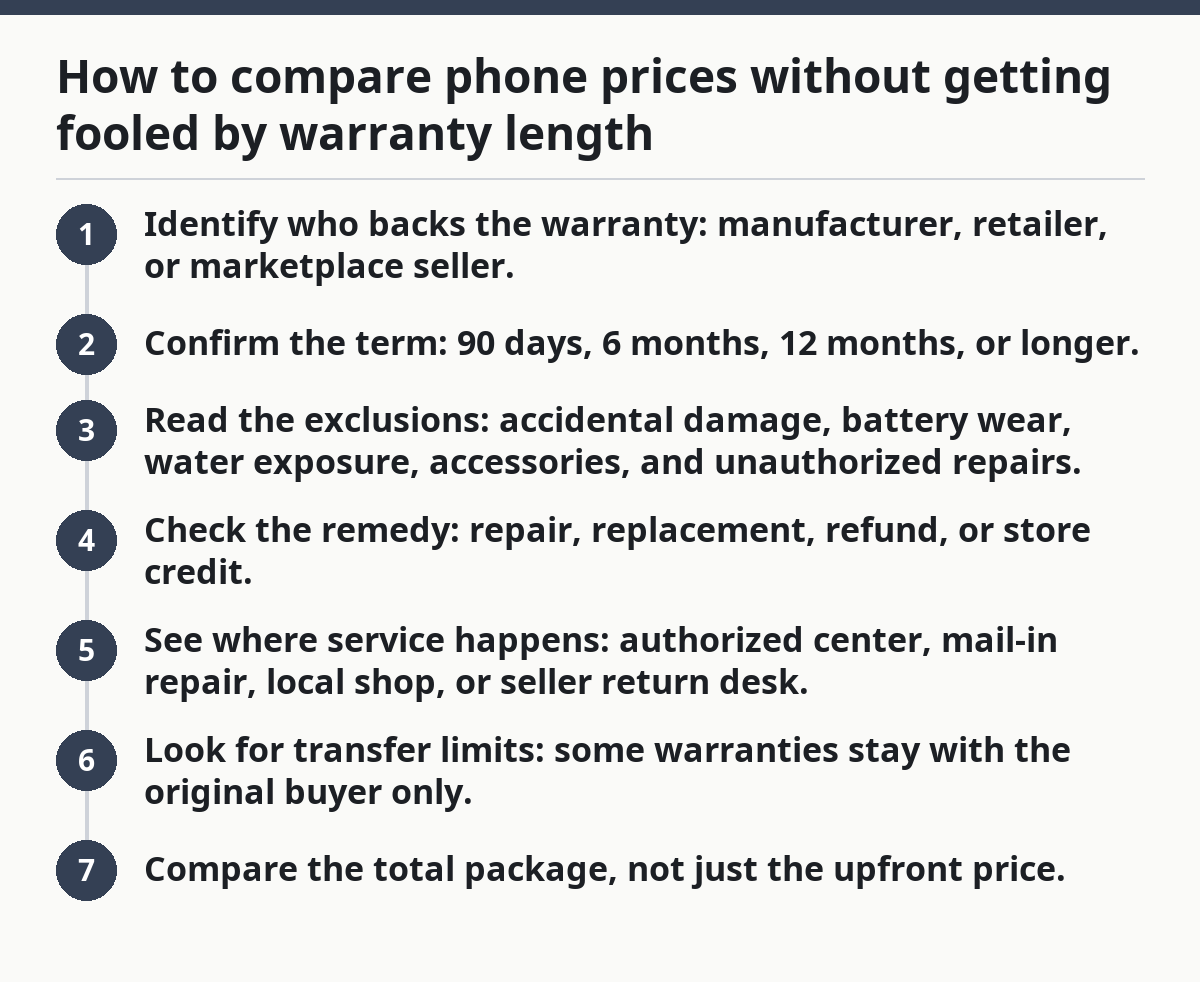
A fair comparison starts by normalizing the warranty before you decide what the phone “costs.” That means comparing the same model, same storage tier, same condition, and then checking whether the warranty is 12 months, 24 months, or an add-on with separate conditions.
Use this checklist:
- Identify who backs the warranty: manufacturer, retailer, or marketplace seller.
- Confirm the term: 90 days, 6 months, 12 months, or longer.
- Read the exclusions: accidental damage, battery wear, water exposure, accessories, and unauthorized repairs.
- Check the remedy: repair, replacement, refund, or store credit.
- See where service happens: authorized center, mail-in repair, local shop, or seller return desk.
- Look for transfer limits: some warranties stay with the original buyer only.
- Compare the total package, not just the upfront price.
A useful habit is to write the phone price and the warranty term side by side. A phone with a slightly higher listed price and 24 months of clear coverage may be the better buy than a cheaper one with only 12 months and a weak seller promise. That is especially true if you plan to keep the device for two years or more.
One important detail: the listing should state what it does not cover. If it never mentions battery capacity decline, water damage, or cosmetic damage, assume those are excluded unless the terms say otherwise. Silence is not coverage.
The verdict: which one to choose and why
Choose the manufacturer warranty if you want the cleanest comparison, the least ambiguous terms, and the safest default choice for a new phone. Choose seller warranty or extended coverage if the written terms are clearly stronger, the seller is reputable, and you expect to keep the phone long enough for that extra protection to matter. Neither if the listing hides the warranty terms, the remedy is unclear, or the add-on pushes the total cost past what the phone is worth to you.
That is the decision rule I would use. For most readers, manufacturer warranty wins because it makes price comparison honest. Seller warranty and extended coverage only win when the extra protection is specific, written down, and worth the gap.
If this phone is part of a broader value comparison, the hub page on mobile phone price comparison and value is the right next stop after you settle the warranty question.
When to rethink the comparison entirely
You should rethink the comparison entirely if the warranty is the only thing making a weak phone look attractive. A 24-month warranty does not rescue a handset that is already wrong on storage, display quality, network support, or battery size. Warranty is a tie-breaker, not a miracle fix.
You should also step back if the seller is unclear about who actually handles claims. A one-line “warranty included” note with no service details is not a strong offer. If the support route is hidden, the warranty length may be more marketing than protection.
Another reason to stop comparing by warranty length alone is repairability. If parts are hard to source or the device is commonly replaced rather than repaired, a longer warranty can still leave you stuck in a slow claims process. The value of warranty depends on the path to a remedy, not just the calendar months.
Finally, do not overpay for extended coverage when the phone is low-cost or likely to be replaced quickly. That is one of the easiest ways to lose the value of a discount. In that case, the lower-price phone with standard manufacturer coverage is the smarter buy.
Does warranty change phone price?
Yes. A longer or better-defined warranty can raise the effective price because you are paying for more protection, even if the sticker price looks similar. The difference matters most when one phone includes 12 months of manufacturer coverage and another includes 24 months or a separate extended plan. The written terms should be compared before the price is treated as final.
How do I compare warranty offers on phones?
Start with the length, then check who provides the warranty, what it covers, and what happens if something fails. A 12-month manufacturer warranty is not the same as a 12-month seller warranty. Read the remedy, exclusions, and service process, then compare the total package rather than the headline number alone.
Is an extended warranty worth it on a phone?
It is worth it only when the plan’s written benefits are meaningful and the phone is expensive enough that a covered repair would matter. If the add-on mainly covers defects you already get under the base warranty, or if the exclusions are broad, skip it. Buyers who replace phones quickly usually do not get enough value from it.
Drafted with AI; not yet reviewed by a person.