

Mobile Phone Purchase Timing: The Complete Guide
Last updated: November 20, 2026
Quick Answer: The best time to buy a mobile phone is usually after a new model launches, during a major sale, or when your current phone stops doing its job. In Mobile Phone Purchase Timing — The Complete Guide, the practical answer is simple: if your phone is still reliable, waiting can improve value; if it is failing, buy now. If you can wait, the strongest bargains usually show up right after a new phone launches, during major holiday promos, or when last year’s model is still new enough to feel current.
Key takeaways
- Buying at the right time matters more than chasing the lowest sticker price on a random day.
- New launches can cut prices on older models, but launch-day buyers usually pay for being early.
- Carrier deals can look big, yet they often depend on trade-ins, long payment plans, or a specific plan.
- If your phone is unreliable today, waiting for a “better” deal can cost more in missed calls, poor battery life, and repair risk.
- The smartest timing depends on one question: do you need a phone now, or can you wait for the market to move?
When is the best time to buy a phone?
The best time to buy a phone is usually just after a new model arrives if you want value, or during a major sale window if you want the lowest hassle. That is when older flagships, midrange phones, and last year’s models usually become easier to justify.
A simple rule helps: if your current phone still works well, timing can save real money and get you a better model for the same budget. If your battery is failing, your storage is full, or updates are ending soon, the “best time” is now, because downtime has its own cost.
Because of that, the usual timing windows that matter most are launch season, holiday sales, and carrier promotion periods. Each one changes a different part of the deal. Launch season affects older-model pricing. Holiday sales affect advertised discounts. Carrier promos affect the real cost only if you are willing to follow all the conditions.
A phone purchase is not like buying groceries. Waiting two weeks can change the market in a useful way. Waiting six months can also mean you miss a model that fits your needs, or you keep paying for a phone that is slowing you down.
For context, Consumer Reports and the FTC both advise shoppers to compare the full deal, not just the headline price or monthly payment. See Consumer Reports’ smartphone buying advice and the FTC’s shopping tips for mobile service offers: Consumer Reports and FTC.
Should I buy now or wait for a new release?
Buy now if your current phone is broken, very slow, or no longer getting the software support you need. Wait if your phone still does its job and the model you want is likely to get cheaper when the next launch cycle starts.
This is the central decision for most shoppers, and it comes down to use, not hype. A newer release does two things at once: it gives eager buyers a fresh model, and it often pushes older stock into discount territory. That is why launch season matters even if you do not want the newest phone.
Here is the cleanest way to think about it:
| Criteria | Buy now | Wait for a new release | Winner for this condition |
|---|---|---|---|
| Current phone reliability | Better if the battery, screen, or storage is already causing problems | Worse if you are already dealing with daily friction | Buy now if the phone is failing |
| Price pressure on older models | Limited unless a sale is already running | Better odds of a lower price on last year’s models | Wait if you want value, not urgency |
| Access to the newest features | No guarantee | Better chance of getting the latest camera, chip, or design changes | Wait if you care about the newest hardware |
| Risk of overpaying | Lower if you need a phone now and can compare quickly | Higher if you chase launch hype | Buy now if you are replacing a dead device |
| Choice of colors and storage | Can be uneven late in a cycle | Often wider right before a new launch is announced | Wait if you want more options |
| Trade-in offers | Sometimes weaker outside promo periods | Often stronger around launch campaigns | Wait if trade-in value matters |
| Time without a working phone | None if you buy quickly | Risk rises every week you delay | Buy now if your phone is unreliable |
| Model age at purchase | You may end up with a current model | You may get a last-year model at a better value | Wait if you want the best value per dollar |
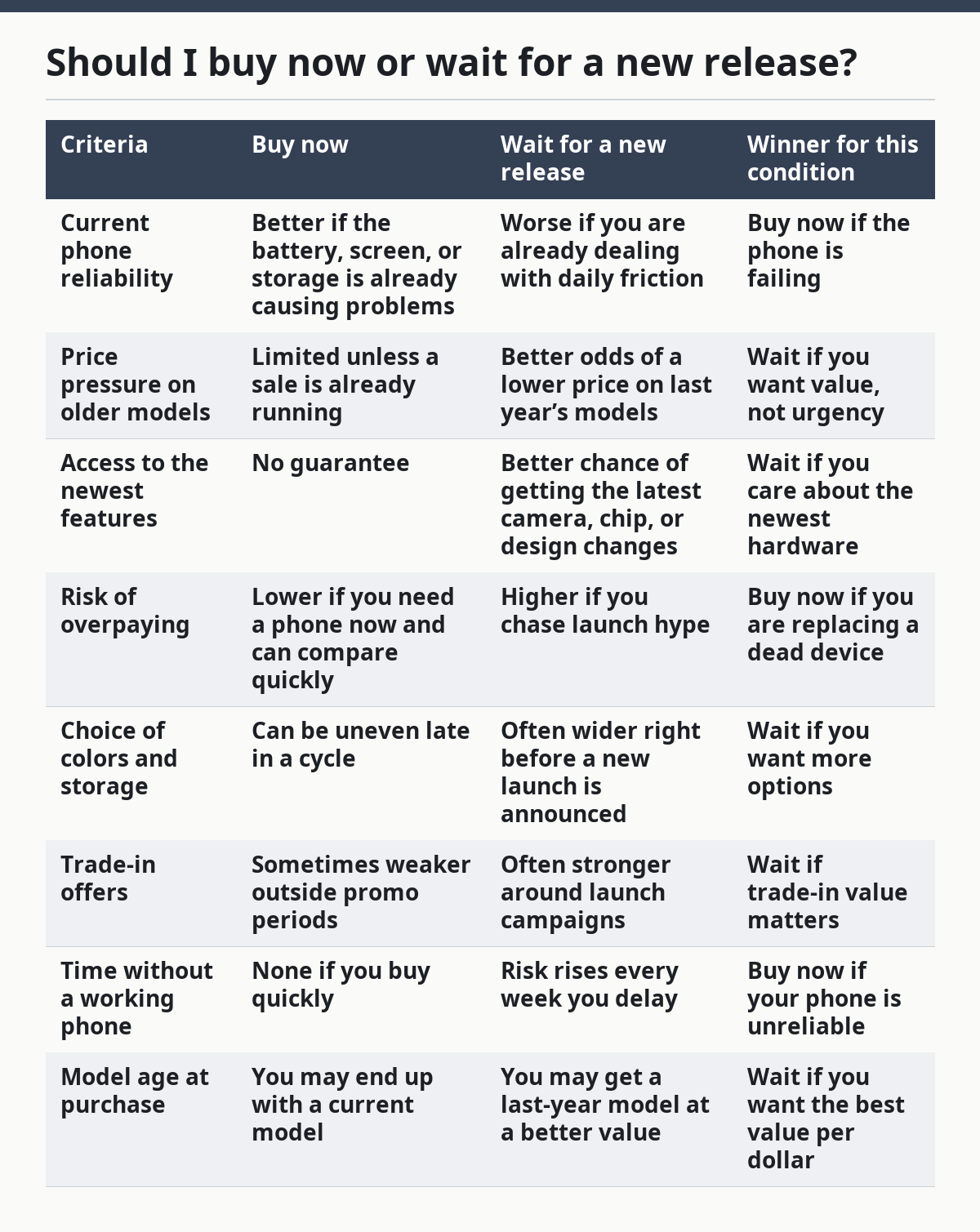
The right answer is not “always wait.” Waiting works best for patient buyers who can keep using their current device for another few months. It is the wrong move for someone stuck on a phone with weak battery life, cracked glass, or support that is already close to ending.
A useful test is this: if the phone in your hand still gets you through a normal day, waiting may pay off. If it does not, the timing benefit disappears fast.
What happens when a new phone launches?

A new phone launch usually creates the biggest price shift for the last generation, not for the model just announced. That is the moment when the previous flagship can become much easier to buy without giving up much in day-to-day use.
Launch timing matters because buyers split into two groups. Some want the newest model no matter what. Others only care about getting a solid phone and do not need the headline feature. That split is what creates room for older models to drop in price or show up in bundles.
The catch is that launch discounts are not the same as real value. Some stores clear out old stock with a decent reduction. Others keep the old model around at a price that still makes little sense because the phone is only one generation behind. The model name alone does not tell you if the deal is good.
Launch season also has a downside: the new model often starts at a premium, and the older model may not get the exact color or storage size you wanted. If you are picky about storage, you may find the cheaper option is only available in a configuration you would not choose if you had a full range of choices.
Because that launch-season shift is about the previous flagship, the better comparison is usually old versus new, not “discounted” versus “full price.” The launch itself is the signal. The question is whether the newer model’s gains are worth the gap in price.
Are holiday sales actually worth waiting for?
Holiday sales are worth waiting for only if the phone you want is already on your shortlist and you can judge the discount against the model’s normal market position. A sale tag by itself is not proof of value.
Promotions around big shopping periods can help two types of buyers. The first type wants an opened phone at a better retail price. The second type can use a carrier rebate, trade-in, or bill credit and is willing to accept the paperwork that comes with it. In both cases, the discount is more useful when you already know the model you want.
The weak spot in holiday sales is confusion. A big advertised discount can hide a plan requirement, a trade-in condition, or a credit that arrives over many months. That means the true timing question is not just when to buy, but whether you are buying from a store that shows the full cost clearly.
Holiday sales also reward patience less than people think. If the phone you want is still in stock, the sale can be useful. If it is already a popular model with supply limits, the “sale” can vanish into limited colors, limited storage, or a not-very-good bundle. That makes a holiday bargain more practical than dramatic.
For many buyers, the real benefit of holiday timing is simple: more stores compete at once. That gives you room to compare the same model across retailers instead of accepting the first listing that looks busy. For extra price checking, compare the same phone at Best Buy and Amazon.
Carrier deals or opened phones: which one fits your timing?
Opened phones usually win for timing if you want freedom, while carrier deals can win if you are already on the right plan and the promotion matches a phone you wanted anyway. The difference is not just price; it is control.
An opened phone is easier to compare across stores because the phone itself is the main product. That makes timing cleaner. You can wait for a launch drop, a holiday sale, or a last-generation clearance without tying the decision to a carrier contract. You also avoid the trap of a discount that only works through future bill credits.
Carrier deals can still make sense, but they are more fragile. They often depend on trade-ins, eligible plans, or a long payment schedule. That can make the headline savings look larger than the real savings if you had to move to a more expensive plan to get them.
The timing lesson is blunt: if your goal is to buy on the best day, opened phones are easier to time. If your goal is to stretch the lowest possible upfront payment, carrier deals may look attractive, but they can lock the discount behind conditions that stretch over months.
A good rule is to compare the total cost over the full commitment, not just the day-one outlay. If that feels tedious, opened is usually the cleaner path. It is less flashy, but the timing is easier to control and the terms are easier to judge. For a carrier comparison, start with the carrier’s own pricing pages, such as AT&T or Verizon.
Is it better to buy a flagship now or a midrange phone later?
A flagship now is better if you want top camera quality, top-end chip performance, or the longest runway before the phone feels old. A midrange phone later is better if you can wait and only need a reliable device for calls, apps, photos, and everyday use.
This is one of the most common timing mistakes: people wait for the perfect flagship deal when a well-timed midrange phone would have solved the problem sooner and with less money tied up. The reverse mistake is also common: people buy a midrange phone too early because they do not want to wait, then realize they could have gotten a stronger previous-generation flagship at about the same time.
The difference is not abstract. Flagships tend to hold value and stay desirable longer, which means their best deals often appear after a release cycle turns over. Midrange phones can hit useful price points without much waiting, but they also vary more in camera quality, storage speed, and long-term polish.
If timing is your main concern, a previous-generation flagship often gives the best balance. It gives you premium hardware without the full launch premium. A midrange phone can still be the right pick, but it wins most clearly when the budget is tight and the buyer does not care about premium extras.
The wrong buyer for a midrange wait is the person who expects high-end camera output or heavy gaming performance. The wrong buyer for a flagship rush is the person who only needs a dependable phone and could save money by waiting for the right midrange sale. To compare options, use Samsung Galaxy phones or Apple iPhone models.
What timing traps should I avoid?
The biggest timing trap is buying because a deal looks urgent, not because the phone fits your needs. Limited-time banners, countdown timers, and “last chance” labels can push a rushed choice that ignores model age, storage size, and support life.
Another trap is thinking the cheapest day is always the best day. A low price can still be poor value if the phone is already near the end of its software support, has too little storage, or forces you into a plan you do not want. A phone that looks cheap today can cost more later if it frustrates you for two years.
A third trap is ignoring repair timing. If your battery is already weak and the screen is damaged, waiting for the perfect sale can backfire. Repairs may not be worth it, but the decision should be made with the phone’s condition in mind, not only the calendar.
A fourth trap is assuming that every cycle works the same way. Some models hold their price longer than others. Some retailers reduce stock quickly. Some carrier promos change fast. That means you should always compare the model’s normal position in the market, not just its temporary sale label.
The safest timing approach is to set a target model, a target storage level, and a ceiling for total spend before the sale begins. That keeps the clock from making the decision for you. If you are checking software support, start with the manufacturer’s support page, such as Apple support or Google support.
What should I do if my phone is failing right now?
Buy now if your phone is failing in a way that affects daily use, because waiting for a perfect timing window is usually a false economy. A dead battery, broken charging port, cracked screen, or support cutoff changes the question from “when should I buy?” to “how quickly can I replace this without making a bad choice?”
If the phone still works but is close to the edge, there is room to wait briefly for a better match. That short wait should have a purpose: a known launch date, a known sale period, or a clear plan to compare the current model against the one that is about to replace it.
A failing phone changes the timing math in a way people often ignore. Every extra month of use can mean more charging stress, more repairs, or more time spent around a device that cannot keep up. That does not mean buying the first phone you see. It means refusing to treat delay as free.
The best move in this situation is usually to buy the right phone when a reasonable deal appears, not to chase the absolute lowest price. A phone that works well and arrives on time is worth more than a small discount that costs you another month of frustration.
When should I skip waiting altogether?
Skip waiting altogether if the current phone is unreliable, the support window is near its end, or the model you want is already priced fairly and matches your needs. That is the cleanest answer for buyers whose phones are actively getting in the way.
There are also cases where waiting is a bad strategy even if the phone still turns on. If you are traveling soon, need a dependable camera for work, or cannot risk being without a device, the calendar should stop driving the decision. A phone is a tool, not a trophy.
The same applies if you only need one specific model and it is already available at a fair market position. Waiting for a bigger discount can backfire if supply tightens or the preferred storage option disappears. That is especially true with popular colors and larger storage sizes.
Waiting is most useful when it has a clear target. “Maybe a better deal will come” is weak. “I can wait until the next launch because my current phone is fine” is strong. The difference is whether the wait is tied to a real reason or just hope.
The Verdict: which timing strategy should you choose?
Choose buy now if your phone is failing, your battery is weak enough to annoy you daily, or the model you want is already priced fairly for your budget. Choose wait if your current phone still works, you want a better value on last year’s model, and you can survive until the next launch or holiday sale. Neither if you are buying only because a countdown timer says so.
That is the clearest timing rule for mobile phones: urgency beats waiting when the device is already costing you time, and waiting beats urgency when your current phone still does the job. The wrong choice is usually the one made without a reason.
If you want the shortest version, it is this: buy when the phone in your hand is no longer doing enough, wait when the market still has a clear chance to reward patience.
Is launch week a bad time to buy?
Launch week is not a bad time to buy if you want the newest model and do not mind paying for early access. It is a bad time if you want the best value, because older models are often the ones that become easier to justify after the new release.
The key detail is that launch week mostly benefits two groups: people who want the new device immediately, and people who want to watch older models lose shine. If you fall into neither group, waiting usually makes more sense.
Are carrier promotions worth waiting for?
Carrier promotions are worth waiting for only if the phone, plan, and trade-in terms all match your situation. If you have to change plans, stretch payments over many months, or give up flexibility, the deal may be less attractive than it first appears.
The safest way to judge a carrier promo is to compare the full commitment against the price of an opened phone. If the carrier version only wins because of credits spread over time, that is a timing choice with strings attached.
Should I wait for Black Friday or buy sooner?
Wait for a big sale only if your current phone still works and the model you want is likely to be part of the promo. If you need a phone now, waiting for Black Friday can cost more than it saves.
Sale timing works best for prepared buyers, not emergency buyers. A phone bought under pressure rarely feels like a deal, even if the sticker price drops a little later.
Can I save money by buying last year’s model?
Yes, buying last year’s model is one of the best ways to improve timing value, as long as you are comfortable missing the very latest features. Previous-generation phones often give most of the real-world experience without the launch premium.
The trade-off is that you may give up the newest camera tricks, chip gains, or design changes. If those matter, the cheaper model is not really a bargain for you.
Drafted with AI; not yet reviewed by a person.