
How to Compare Mobile Phone Resale Value by Brand
Last updated: November 20, 2026
Quick answer: Apple usually has the strongest resale value by brand, Samsung is the closest Android alternative, and Google and OnePlus are more niche. This guide to How to Compare Mobile Phone Resale Value by Brand explains why that happens. Brand matters because buyers pay more for phones they recognize, trust, and can resell again. Years of used-listing patterns make that easy to spot, even before age, storage size, or condition enter the picture.
Key takeaways
- Brand resale value is mostly about buyer demand, not just the phone’s original price.
- Apple usually has the deepest used market, so older iPhones are easier to sell.
- Samsung often does well with recent Galaxy flagships, but the drop can be steeper once a model ages.
- Google and OnePlus can sell well in the right niche, but the pool of buyers is smaller.
- The best brand for resale is usually the one with the broadest demand in used phone marketplaces, not the one with the longest spec sheet.
What should I compare first?
Compare brand demand, used-market depth, and upgrade cycle first. Those three signals tell you more about resale value than glossy launch specs do.
Since demand comes first, start with the brands people search for by name. Apple has the broadest buyer pool, which helps old iPhones stay liquid. Samsung usually has the next-strongest pull, especially for Galaxy S and Ultra models. Google and OnePlus can still sell well, but their audience is narrower.
Then check used-market depth. A brand with many listings is easier to price because there are more real comps. That matters when you want a quick sale and not a long wait. It also matters when you are choosing between keeping a phone for one more upgrade cycle or selling it now. See the resale pattern in the Which phone brand holds value best? section for the practical version of that rule.
Finally, look at the upgrade cycle. Brands that keep software support and launch cycles visible tend to keep buyers confident. Apple’s yearly iPhone cycle is easy for buyers to understand. Samsung’s flagship cycle is also familiar, while Google and OnePlus rely more on enthusiasts who already know the line.
Two useful reference points are Apple’s trade-in page at https://www.apple.com/shop/trade-in and Samsung’s at https://www.samsung.com/us/trade-in/. Those pages do not prove resale value by themselves, but they show how each brand frames used-phone demand and upgrade behavior. For a broader market view, Counterpoint Research tracks used smartphone trends here: https://www.counterpointresearch.com/insights/.
Which phone brand holds value best?
Apple holds value best for most sellers because the used market is deepest and the buyer pool is widest. That is the main reason an iPhone usually resells more easily than a similar-age Android phone.
The strength is not magic; it is market shape. People shop for used iPhones in a wide range of conditions, storage sizes, and colors. That means a seller can usually find a buyer without needing a perfect model match. Used phone marketplaces also tend to show more active iPhone listings, which keeps pricing visible and demand steady.
Apple’s weakness is that this advantage is expected, so buyers know they can be selective. If a model has cracked glass, weak battery life, or carrier lock issues, the resale hit can be sharp because buyers have more choices. A lower-tier iPhone can also be a bad hold if the next upgrade cycle makes it feel old fast.
Apple is usually the safest resale bet for someone who plans to sell into a broad, mainstream market. It is not the best choice for a buyer who wants the cheapest entry price and does not care about later resale. A budget buyer can often find more phone for the money in Android, but usually at the cost of weaker resale.
Pros
- Widest buyer pool on used phone marketplaces
- Easier to price because there are many listings
- Strong demand for recent and older iPhone models
Cons
- Buyers are picky about condition
- High demand does not erase battery or damage penalties
- Premium models still lose value if the next upgrade cycle moves on
Where does Samsung beat Apple?
Samsung wins when the buyer wants a current Galaxy flagship and the seller wants a large, but slightly more price-sensitive, audience. That is why Galaxy S and Ultra models often remain attractive in resale even when they do not match iPhone liquidity.
The brand covers many price bands, so there is often used demand at the top end and in the midrange. That helps recent Galaxy flagships keep attention in marketplaces. Samsung also has a broad retail footprint, which makes the brand familiar to more buyers than many Android rivals.
The weakness is consistency. Samsung resale can be uneven across the lineup. A premium Galaxy S or Ultra often sells better than a midrange Galaxy A phone, and the gap can be large. That means the brand name alone does not rescue every model. If the phone is not a flagship, resale can soften fast.
Samsung is the right choice for someone who wants Android flexibility but still cares about exit value. It is not the best choice for a seller who needs the highest possible resale liquidity from any phone brand. Apple still has the edge in ease, while Samsung tends to win on choice and feature set rather than pure resale certainty.
Pros
- Strong demand for flagship Galaxy models
- Big used-market presence
- Familiar brand across many buyer segments
Cons
- Midrange models usually resell much less well than flagships
- Value can vary more by exact model
- Buyers compare Galaxy phones very closely on condition and specs
How do Google and OnePlus compare?
Google and OnePlus sit behind Apple and Samsung in resale strength, but they can still make sense in the right use case. Their value depends more on the exact model and the buyer niche than on broad brand pull.
Google Pixel phones often attract buyers who care about clean software, camera processing, and a compact used market with clear model names like Pixel 8 or Pixel 8 Pro. That helps when the device is current and in good shape. The drawback is simple: the market is smaller. Fewer casual buyers search for a Pixel than for an iPhone or Galaxy, so resale can take longer.
OnePlus can appeal to buyers who want fast hardware and a known enthusiast brand. That can help specific models move in used phone marketplaces. The downside is that the brand does not have the same broad resale floor as Apple, and often not the same mainstream recognition as Samsung either. That means a OnePlus phone may be easier to like than to resell.
Google is best for someone who wants a cleaner Android experience and expects a narrower resale market later. OnePlus is best for someone who wants to buy for use first and resale second. Neither is the best brand if resale value is the top priority from day one.
Pros
- Can attract buyers who already want that brand
- Good fit for specific model fans
- Often more appealing than generic budget Android phones
Cons
- Smaller buyer pools than Apple or Samsung
- Pricing is less forgiving when condition slips
- Resale speed can be slower on used marketplaces
The honest side-by-side
Apple wins on resale certainty, Samsung wins on Android breadth, Google wins in niche demand, and OnePlus wins only when a buyer specifically wants that model. The table below shows which brand usually fits each condition better.
| Criteria | Apple | Samsung | OnePlus | Winner for condition | |
|---|---|---|---|---|---|
| Used-market depth | Deepest buyer pool | Large pool, especially flagships | Smaller but active | Smaller and more niche | Apple when speed matters |
| Brand recognition | Very high | Very high | Moderate | Moderate to niche | Apple or Samsung |
| Resale consistency across models | Strong across most recent iPhones | Strong at the flagship end only | Varies by Pixel model | Varies by model and market | Apple |
| Buyer price sensitivity | Less sensitive | More sensitive | Moderate | Moderate to high | Apple |
| Fast flip potential | High | High for flagships | Moderate | Lower unless demand is hot | Apple |
| Flagship resale strength | Very strong | Strong | Good | Variable | Apple, with Samsung close |
| Midrange resale strength | Usually better than rivals | Uneven | Limited | Limited | Apple |
| Best fit for a mainstream seller | Yes | Yes, if flagship | No | No | Apple |
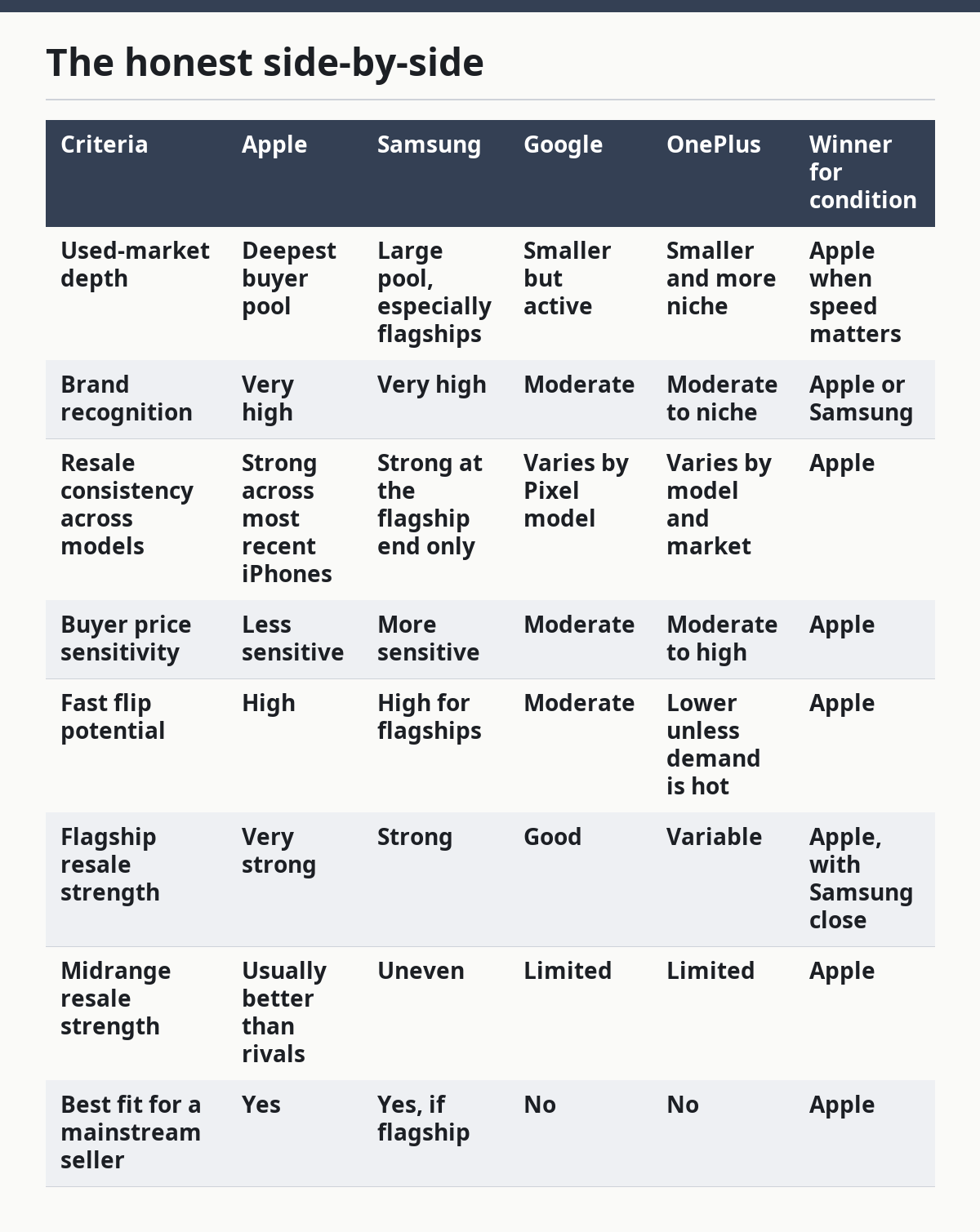
The table is blunt for a reason. If the goal is to sell quickly and keep price pressure low, Apple is the safest brand choice. Samsung is the best fallback if the phone is a current flagship. Google and OnePlus are better treated as use-first phones, not resale-first purchases. For a tighter model-by-model view, jump back to What should I compare first?.
When does brand matter less?
Brand matters less when condition, carrier lock, or storage size overwhelms everything else. A clean phone from a weaker resale brand can beat a damaged phone from a stronger one.
This is where many generic guides go wrong. They act as if brand alone decides resale value, when used phone marketplaces punish obvious flaws. A scratched screen, worn battery, or blocked activation status can erase a brand advantage fast. The same is true for a phone with a low-demand storage size or a color that nobody is searching for.
Brand also matters less if you are selling into a narrow buyer pool. For example, a person who needs a specific Android feature may accept a Google or OnePlus device that a mainstream buyer would skip. In that case, the brand edge is about fit, not mass demand.
The upgrade cycle matters here too. If a brand has just pushed a new flagship line, older models may feel more dated even if the phone still works well. That does not mean the brand is weak. It means resale timing can matter as much as the badge on the back. For a concrete example, compare that timing with the Samsung trade-in cadence and Apple’s trade-in page.
The verdict: which brand should you choose?
Choose Apple if you want the strongest resale odds and the broadest used-market demand. Choose Samsung if you want an Android phone with good flagship resale and a large buyer base. Neither is right if you plan to keep the phone until it is heavily worn, because condition will matter more than brand by then.
That is the cleanest rule for this comparison. Apple is the safest resale brand for most people, Samsung is the strongest Android alternative, and Google or OnePlus make sense only when the phone is chosen for use first. If resale value is the main goal, buy the brand that other buyers already search for by name.
What if the answer changes?
The verdict flips in a few real cases. If the phone is a Samsung Galaxy S or Ultra model in current condition, Samsung can beat a weaker iPhone model from the same market window. If the buyer base is highly technical, a Pixel or OnePlus can sell faster than expected because the niche is already waiting.
The verdict also changes if the phone has a trade-in offer attached through the brand or carrier. That is not the same as resale value in the open market, so it should not be confused with real marketplace demand. And if the seller needs cash fast, the brand with the largest listing pool usually wins, even if another brand might hold a slightly better number in a slower sale. See the Key takeaways section for the shortest version of that rule.
Which phone brand holds value best?
Apple usually holds value best because the used market is deepest and the buyer pool is widest. That makes iPhones easier to resell across more conditions and model years than most Android phones. Samsung is the strongest challenger, especially for recent Galaxy flagships, but it usually does not match Apple’s resale floor.
Does brand affect resale price?
Yes, brand affects resale price because it changes demand, trust, and listing depth. A phone from a strong resale brand can attract more buyers and hold a cleaner price band in used marketplaces. Brand does not override condition, though, so a damaged phone from a top brand can still lose value quickly.
Drafted with AI; not yet reviewed by a person.