
How to Compare Mobile Phone Battery Capacity and Battery Life
Last updated: November 19, 2026
Quick Answer: Start with the mAh number, but trust published battery-life results more; in many comparisons, a phone with 4,500 mAh can be the better buy if it lasts longer in real use. This guide shows you how to compare battery capacity, real-world battery life, charging speed, and power efficiency without getting tricked by a single spec.
Battery capacity vs battery life: what the numbers actually tell you
When comparing how to compare mobile phone battery capacity and battery life, battery capacity tells you how much charge the battery can hold, usually in mAh. Battery life tells you how long the phone actually lasts in use, and that depends on the screen, chip, software, modem, and even signal strength.
Picture this: you’re comparing two phones on a spec sheet and one lists 5,000 mAh while the other says nothing about endurance. The bigger number looks safer, but the smaller battery can still last longer if the phone wastes less power.
- Capacity = stored energy
- Battery life = runtime under real use
- Efficiency = how much runtime the phone gets from each unit of stored energy
- Charging speed = how fast the phone refills, not how long it lasts
A phone with a 4,500 mAh battery and efficient hardware can outlast a phone with 5,000 mAh and a thirsty display. The mAh figure is the starting point, not the verdict.
Battery University and the GSMArena battery test section are useful reference points because they separate rated capacity from runtime behavior.
Key takeaways
- mAh tells you battery size, not the whole story.
- Runtime depends on how the phone uses power, not just how much it stores.
- A smaller battery can beat a larger one if the phone is more efficient.
- Charging speed changes downtime, not endurance.
How to compare mobile phone battery capacity and battery life the right way
The right way to compare mobile phone battery capacity and battery life is to read mAh, then check published battery-life results, then look at charging speed and power efficiency together. If you stop at the capacity number, you may buy the wrong phone for your day.
Picture this: you’re choosing between two phones with the same 5,000 mAh battery. One charges at 25W and the other at 45W, but the second also lasts longer because its chip and display sip less power. The better pick depends on how long you stay away from a charger and how fast you can top up.
Next, use this order:
- Check the mAh rating to compare battery size.
- Look for endurance tests or runtime claims in normal use, not just standby.
- Compare charging speed if quick top-ups matter to you.
- Check power efficiency clues like chipset generation, display type, refresh rate, and modem support.
- Look at battery health behavior if you plan to keep the phone for years.
A good comparison separates three questions: how much energy it stores, how fast it can refill, and how long the phone lasts before it needs that refill again. In practice, those numbers only make sense together when you compare the same type of phone and the same kind of test.
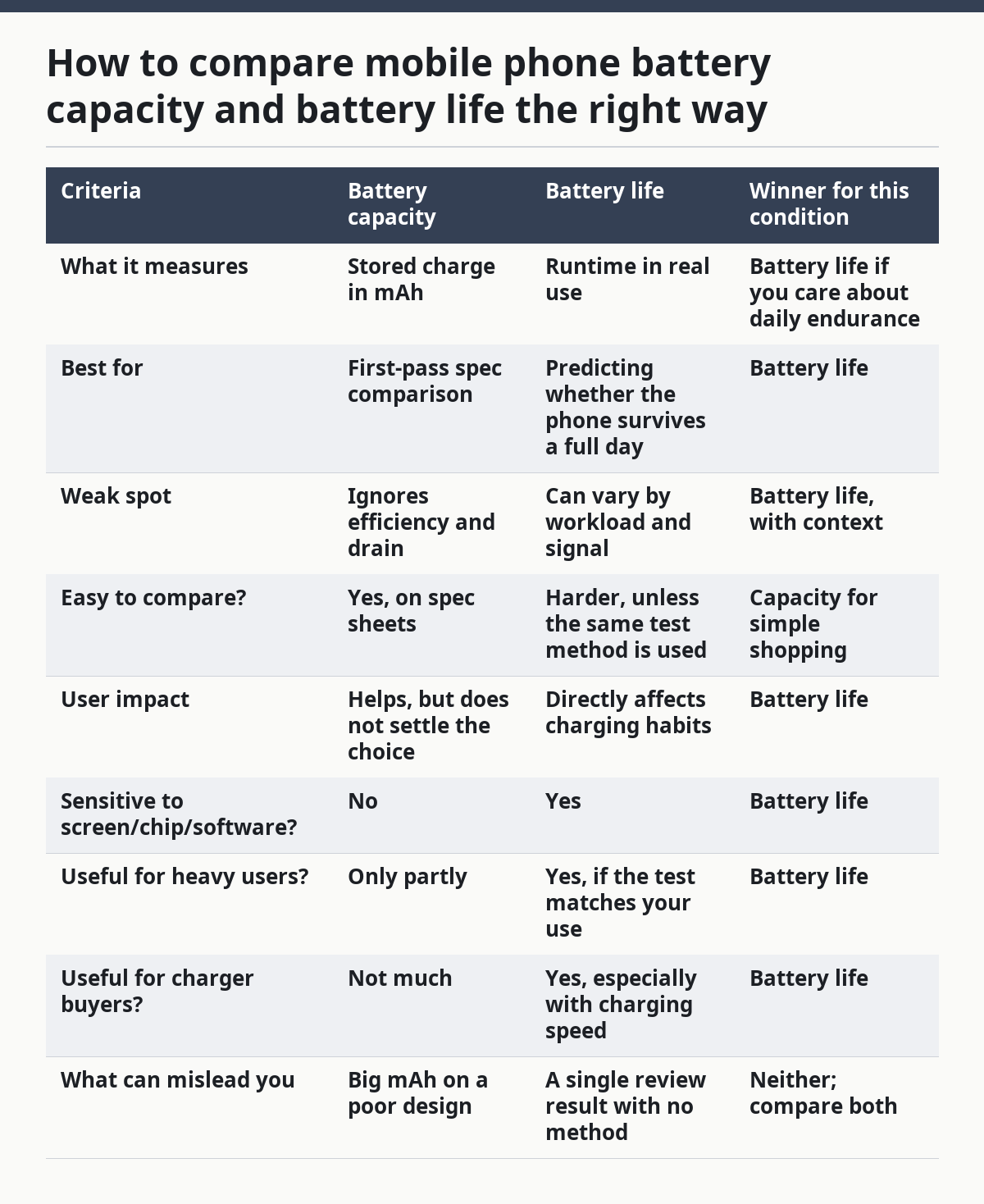
| Criteria | Battery capacity | Battery life | Winner for this condition |
|---|---|---|---|
| What it measures | Stored charge in mAh | Runtime in real use | Battery life if you care about daily endurance |
| Best for | First-pass spec comparison | Predicting whether the phone survives a full day | Battery life |
| Weak spot | Ignores efficiency and drain | Can vary by workload and signal | Battery life, with context |
| Easy to compare? | Yes, on spec sheets | Harder, unless the same test method is used | Capacity for simple shopping |
| User impact | Helps, but does not settle the choice | Directly affects charging habits | Battery life |
| Sensitive to screen/chip/software? | No | Yes | Battery life |
| Useful for heavy users? | Only partly | Yes, if the test matches your use | Battery life |
| Useful for charger buyers? | Not much | Yes, especially with charging speed | Battery life |
| What can mislead you | Big mAh on a poor design | A single review result with no method | Neither; compare both |
The main mistake is treating 5,000 mAh as if it were a full answer. It isn’t. It is one line in the file.
What battery capacity tells you — and what it hides
Battery capacity is the cleanest number on the page, but it hides the part that matters most: how long the phone lasts in your hands. A 5,000 mAh battery should usually beat a 4,000 mAh battery on paper, yet the phone with the smaller pack can still win in practice.
Picture this: you’re looking at a budget phone with a big battery and a bright LCD screen, then a pricier phone with a smaller battery and an efficient OLED panel. The budget model may need more power to keep that screen lit, while the pricier one wastes less energy per hour. Here’s the catch: the bigger battery can still lose.
For similar phones, capacity is most useful when:
- two phones use the same chip family
- the displays are similar in size and refresh rate
- the software load is close
- you want a rough sense of backup time
Capacity is less useful when:
- one phone has a 120Hz display and the other does not
- one uses an efficient modem and the other struggles in weak signal
- one phone is built for heavy gaming and the other is not
- the manufacturer gives no endurance data at all
The best practical use of mAh is simple: it helps you separate small batteries from large ones, but it does not tell you which phone will get you through a day. For that, you need runtime data or a solid proxy such as published battery tests.
Battery life: the number that matters at the end of the day
Battery life is the number that decides whether you hunt for a charger at 4 p.m. or not. It matters more than capacity because it reflects the whole phone: display, processor, modem, battery size, and software tuning.
Picture this: you’re commuting, streaming, texting, taking photos, and checking maps with weak signal. That mix drains phones very differently. A device with a 4,400 mAh battery may outlast a heavier phone with 5,000 mAh if its chip wastes less energy and its display is less demanding.
When comparing battery life, look for:
- video playback hours
- web browsing runtime
- mixed-use battery results
- standby drain
- the test method and brightness setting
A single published number can still mislead you if you do not know the conditions behind it. A phone that lasts a long time in idle mode may not do well under maps, camera use, or 5G data. That is why battery life should be read as a pattern, not a trophy.
If a review or lab result gives multiple use cases, trust that more than a lone “all-day battery” claim. Real life is messy. The test should be, too.
How charging speed changes the decision
Charging speed is the backup plan, and it can make a mediocre battery easier to live with. If a phone charges at 45W instead of 18W, a shorter battery can still feel less annoying because you spend less time plugged in.
Picture this: you’re at a desk for 20 minutes before leaving again. A phone with fast charging can claw back useful runtime in that short window, while a slower model may barely move. The battery size matters, but so does how fast the phone gets back on its feet.
Compare charging speed by checking:
- the stated wattage
- whether the charger is included
- whether the phone supports fast charging on the box or only in fine print
- how long a meaningful top-up usually takes, if published
- whether wireless charging is slow or absent
Fast charging does have trade-offs. It can add heat, and heat is not kind to battery health over time. A phone that charges very quickly may still be the right pick, but only if you know you’ll use the speed. If you charge overnight and forget about it, the feature matters less.
Power efficiency is the hidden tie-breaker
Power efficiency is the hidden tie-breaker because it decides how much life the phone gets from each milliamp-hour. Two phones with the same 5,000 mAh battery can feel very different if one uses a more efficient chip, display, and modem.
Picture this: you’re comparing two similar phones, and one uses an older processor while the other uses a newer one built for lower power draw. The newer one may not just last longer — it may also stay cooler and drain less during light tasks. That is a real advantage, not marketing fluff.
Look for efficiency clues such as:
- newer chipset generation
- OLED vs LCD behavior
- adaptive refresh rate
- strong low-signal modem performance
- software updates that improve standby drain
Efficiency is hard to reduce to one neat number, which is why buyers get misled. A phone can have a large battery and still feel weak if it burns too much power at idle or while the screen is on. On the flip side, an efficient phone can make a moderate battery look better than it should.
This is why capacity and life must be compared together. One number tells you the tank size. The other tells you the miles.
Which phones should you choose based on battery comparison?
Choose the phone with the larger battery and better endurance data if you are a heavy user, travel often, or spend long stretches away from a charger. Choose the faster-charging phone if your day includes short plug-in breaks and you care more about top-ups than absolute runtime.
Picture this: you’re a commuter, a gamer, or a delivery driver. You need a phone that survives long sessions, not just a nice spec sheet. In that case, a 4,500 mAh phone with strong published battery life can be a smarter buy than a 5,000 mAh phone with weak efficiency.
Here are the simple fit rules:
- Pick higher battery life if you value all-day use more than spec-sheet size.
- Pick faster charging if you often top up in 15 to 30 minutes.
- Pick larger capacity if the two phones are otherwise close.
- Ignore capacity alone if one phone has a much more efficient chipset or display.
The honest truth is that battery capacity is a shortlist tool, not a final decision tool. Battery life is the final test. Charging speed and efficiency decide how forgiving the phone feels when the battery starts to run low.
Exception scenarios that flip the verdict
The overall verdict flips in a few clear cases, and these are the ones shoppers miss most often.
Picture this: you’re ready to buy, but one detail changes the whole call. Maybe the phone has a huge battery and terrible charging, or a smaller battery and exceptional efficiency. Those exceptions matter because they change how the phone fits real life.
- If the phone is for emergency use only, a high mAh number may matter more than polished endurance data.
- If you travel with a power bank, charging speed may matter less than raw battery life.
- If the phone runs a bright 120Hz screen, capacity alone can look better than it behaves.
- If battery health over years matters, gentler charging habits may matter more than the fastest refill number.
These exceptions do not cancel the main rule. They just remind you to compare the whole package, not one line on the spec sheet.
The verdict: which one should you trust?
Choose battery life if you want to know whether the phone will last through your day. Choose battery capacity if you need a quick spec-sheet comparison between similar phones. Neither is enough if the phone’s charging speed is slow and its power efficiency is poor.
Picture this: you’re down to two models and one has 5,000 mAh while the other publishes stronger runtime results and faster charging. The one with better endurance data is the safer choice for most people because it tells you more about real use than the raw battery size does.
If the phones are close, pick the one with the stronger combination of:
- real-world runtime
- charging speed
- efficiency
- sensible battery health behavior
That is the cleanest way to shop without overreading a single number. It also keeps you from buying a phone that looks big on paper and feels small by dinner.
Is higher mAh always better?
No, higher mAh is not always better. A larger battery can still deliver worse battery life if the phone has a power-hungry display, an inefficient chip, or weak software tuning. A 5,000 mAh phone is not automatically better than a 4,500 mAh phone. Compare runtime data, not just the battery size line.
What affects phone battery life most?
The biggest factors are the display, processor, modem, and software power management. Screen brightness and refresh rate matter a lot, and weak signal can drain a phone fast because the modem works harder. Battery capacity helps, but power efficiency is usually what separates a good battery phone from a disappointing one.
How do I compare battery life across phones?
Compare phones using the same kind of runtime data, such as video playback, web browsing, or mixed-use results. Battery life is only useful when the test method is clear and the conditions are similar. If one phone has 5,000 mAh and another has 4,500 mAh, the winner is the one that lasts longer in the same kind of use.
Drafted with AI; not yet reviewed by a person.