

How to Compare Mobile Phone Prices on Carrier, Retailer
Last updated: November 20, 2026
Quick Answer: compare all three listing types by total cost, not just sticker price. For How to Compare Mobile Phone Prices on Carrier, Retailer, and Marketplace Listings, the key number is three channels: carrier, retailer, and marketplace. A phone that looks cheaper on one page can cost more once activation, trade-in terms, accessory bundles, or carrier restrictions show up.
Key takeaways
- Carrier listings often look simple, but the real deal can depend on activation terms, contract length, and service requirements.
- Retailer listings are easier to compare because the phone is usually sold as a clearer standalone item.
- Marketplace listings may be the cheapest-looking, but seller identity, warranty handling, and return friction matter more here.
- A careful comparison checks the listing format, not just the headline price.
- The safest choice depends on how much risk is acceptable and whether the phone must work on a specific network.
What is the real difference between carrier, retailer, and marketplace prices?

The real difference is that each channel packages the same phone in a different way. Carrier listings are tied to service terms, official retailer listings are usually cleaner on the product itself, and marketplace listings depend on the third-party seller behind the page.
That matters because the price on the screen may leave out different things in each place. A carrier page may spread the value across monthly billing or bill credits. A retailer page often shows the device more plainly, while a marketplace page may mix new, open-box, refurbished, and used units in the same search results.
If the goal is to compare mobile phone prices on carrier, retailer, and marketplace listings, the first question is not “Which is cheapest?” It is “What exactly is included, and what strings come with it?” This is the best way to compare like with like.
The Federal Trade Commission’s guidance on online shopping and the FCC’s consumer pages on mobile device compatibility are useful reference points when checking seller claims and network fit. See the FTC’s Online Shopping page and the FCC’s wireless device compatibility guidance.
How should you read a phone listing before comparing prices?
A phone listing should be read as a bundle of facts, not a single price tag. The first thing to check is whether the phone is sold by the carrier, the retailer, or a third-party seller, because that changes the risk profile and the fine print.
The second thing is what the listing actually includes. Some pages show the device only. Others fold in trade-in promises, activation fees, opened status, accessories, or service-plan conditions. A lower number can hide a narrower offer.
The third thing is channel restriction. Some carrier offers only make sense on a specific network or with a qualifying plan. Some marketplace offers are opened, but the seller may not state whether the device was originally made for another region or carrier band. That can affect compatibility, warranty handling, and resale value later.
A useful habit is to compare four details side by side:
- seller type
- device condition
- network status
- return or warranty handling
If those four do not match across the listings, the prices do not match either. A marketplace price on a refurbished unit should not be compared directly with a new carrier listing that includes network perks or bill credits. That is the most common comparison mistake.
Carrier listings: who they fit and where they mislead
Carrier listings win for buyers who want one number tied to service and do not mind restrictions. They are strongest when the buyer already knows the network, wants a current model, and is comfortable reading plan terms.
The main appeal of a carrier listing is clarity inside that carrier’s system. The device is usually set up to work on that network, and the promotion may be easy to apply if the service requirement is met. For some buyers, that is simpler than sorting through dozens of third-party pages.
Carrier pages also tend to make channel restrictions obvious, which helps avoid compatibility surprises. If a phone is tied to activation, trade-in eligibility, or bill-credit timing, the page usually says so. That is useful because it gives the buyer a real boundary instead of guessing.
The weak spot is that carrier prices can look lower than they really are when the savings are spread over time. A buyer who only sees the headline number may miss the service condition, the commitment period, or the fact that the discount depends on keeping the line active. That makes carrier listings a poor fit for anyone who wants a clean, no-strings device purchase.
Pros
- Good for buyers already committed to one network
- Clear network fit and activation terms
- Promotions may be easy to apply when conditions are met
- Often useful for getting a current model without much search work
Cons
- Service requirements can narrow the real deal
- Headline price may hide bill-credit timing
- Poor fit for buyers who want to switch networks soon
- Not ideal for simple, contract-free comparison
Carrier listings are for the buyer who cares more about network fit than about the lowest standalone device price. They are not for anyone who plans to move between carriers in the near term. For carrier terms and device policy details, start with the carrier’s own support pages and our carrier phone deals resource.
Retailer listings: why they are easier to compare
Retailer listings win when the buyer wants the clearest price comparison across devices, colors, and storage sizes. They are usually the easiest channel for comparing the phone itself without having to decode service terms first.
That is because retailer pages often present the device as a straightforward product listing. The buyer can compare storage size, color, opened status, and condition without sorting through a carrier contract. That makes the retailer channel useful for anyone who wants a simple purchase decision.
Retailers also make it easier to compare one phone against another from the same screen. If the question is whether a 128GB model is worth the jump over a 64GB model, retailer listings are usually better at showing that difference in one place. The comparison is more direct because the product format is more consistent.
The downside is that retailer listings can still vary by seller, fulfillment method, and return policy. A listing may look simple while still hiding differences in who ships it, who handles warranty claims, or whether the phone is locked. The page may also omit the service perks that a carrier would have made obvious.
Pros
- Cleaner side-by-side price comparison
- Easier to compare storage, color, and model variants
- Good fit for opened or standalone purchases
- Less likely to hide service terms in the main offer
Cons
- Warranty and fulfillment can still vary
- Some listings leave seller details too thin
- Can miss carrier-only promotions
- Not always the best place for deep bundle value
Retailer listings are for the buyer who wants the least confusing starting point. They are not for anyone whose main goal is extracting value from a carrier-specific promotion. For more on set-up and compatibility, see our opened phones page and the FCC guidance above.
Marketplace listings: when the lower number is real and when it is not
Marketplace listings win when the buyer knows how to sort seller type, condition, and return terms quickly. They are the most variable channel, which is why they can look attractive and still be the hardest to judge.
The big advantage is choice. Marketplaces often put new, open-box, refurbished, and used phones in the same search flow, so the buyer can find lower-priced options that would not appear in a carrier catalog. That makes the channel valuable for people who care more about the price range than about a single clean retail path.
The catch is that marketplace listings depend heavily on third-party sellers. That means the buyer has to check seller rating, item condition, device status, and the exact return window. A marketplace page may also blur the difference between “factory opened,” “opened by seller,” and “compatible with most carriers,” which are not the same thing.
This is where many comparisons go wrong. A marketplace listing can be the cheapest-looking option only if the seller is clear and the device is described precisely. If the listing is vague, the low number may simply reflect more risk, weaker warranty support, or a used device with missing parts. Our refurbished phones guide explains what to check before you buy.
Pros
- Wide range of conditions and price points
- Useful for buyers open to refurbished or used phones
- Can surface deals not shown on carrier sites
- Good for shoppers who can inspect seller details carefully
Cons
- Third-party seller risk is real
- Warranty and return handling can be weaker
- Listing language may be inconsistent
- Lowest-looking price may not be the safest value
Marketplace listings are for the buyer who is willing to read closely and accept some uncertainty. They are not for anyone who wants the cleanest path to a new, fully supported phone.
The honest side-by-side
Carrier listings win on network certainty, retailer listings win on clean comparison, and marketplace listings win on range. The best channel depends on what the buyer values most: service tie-in, simple product comparison, or wider price spread.
| Criteria | Carrier listings | Retailer listings | Winner for [condition] |
|---|---|---|---|
| Seller type clarity | Usually clear, because the carrier is the seller | Usually clear, but can vary by retailer page | Carrier, when network fit matters |
| Listing simplicity | Can be harder because service terms are attached | Usually the easiest to compare device-only offers | Retailer, for quick device comparison |
| Price transparency | May be split across monthly credits or service terms | Often more direct and readable | Retailer, for standalone pricing |
| Network restrictions | Often explicit and important | Usually less tied to one network | Carrier, for buyers on one network |
| Condition variety | Mostly new phones tied to the carrier’s offer | Mostly new, sometimes open-box depending on seller | Marketplace, for condition choice |
| Return friction | Can depend on activation and service timing | Often straightforward, but policy varies | Retailer, for simple returns |
| Seller risk | Low when buying directly from the carrier | Moderate if multiple sellers are listed | Carrier, for trust in the seller |
| Deal flexibility | Limited to carrier terms | Moderate | Marketplace, for bargain hunters |
| Best comparison use | Best for service-linked offers | Best for straight phone-to-phone comparison | Retailer, for apples-to-apples checks |
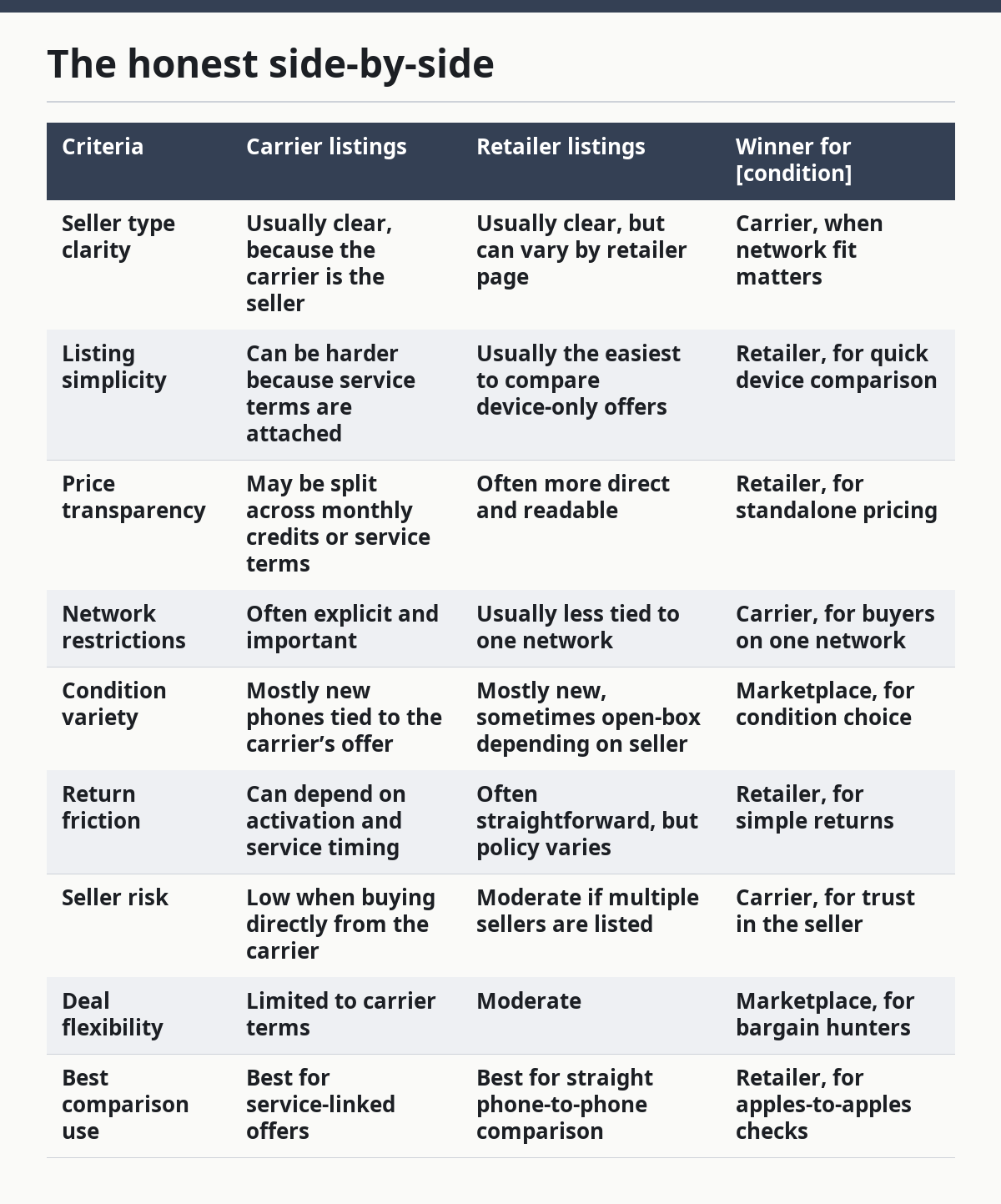
That table shows the pattern clearly: the “best” channel changes with the buyer’s condition. A carrier can look expensive on paper and still be the right choice if the buyer needs that network and promotion. A marketplace can look cheap and still be the wrong choice if the seller terms are vague.
Which one should you choose?
Choose carrier listings if the phone must work on a specific network and the buyer is comfortable with service terms. Choose retailer listings if the goal is the clearest side-by-side comparison of the phone itself. Choose marketplace listings if the buyer wants the widest spread of prices and can judge seller quality, condition, and return policy.
That is the short version, but the practical version is sharper. Retailer listings are the safest default for most comparison shoppers because they keep the device offer clearer. Carrier listings are best for buyers already locked into a network choice. Marketplace listings are best for experienced shoppers who can tell a real deal from a risky one.
One useful way to decide is to ask which problem is bigger: confusing terms, network mismatch, or seller risk. If the answer is “confusing terms,” stay with retailer listings. If the answer is “network mismatch,” use a carrier. If the answer is “I need more price range and can inspect details closely,” use a marketplace.
When should the verdict change?
The verdict flips in a few specific cases. First, if a carrier listing includes a device promotion that depends on a plan the buyer already has, the carrier may become the better value even if the headline price is not the lowest.
Second, if the buyer is shopping for a refurbished phone and accepts a shorter or more limited warranty, a marketplace can make more sense than a retailer page for a new device. The channel choice changes because the buyer is no longer comparing the same condition.
Third, if the retailer listing is from a third-party seller with weak return terms, the retailer channel stops being the safer choice. In that case, the marketplace-style risk looks too similar to the retailer page, and the buyer should compare seller details more than the storefront name.
Fourth, if the buyer needs a phone that can switch networks later, a carrier listing with a lock or activation condition becomes a poor fit even when the opening number looks good. A lower price is not useful if it blocks the next move.
What should you ignore when comparing prices?
A buyer should ignore any listing detail that does not change ownership, compatibility, or return risk. Decorative photos, vague “best deal” labels, and generic savings banners do not help much. The same goes for comparison claims that do not explain whether the phone is new, used, opened, or tied to service.
What matters more is seller identity, device condition, network status, and what the listing fails to say. If a page does not clearly state whether the phone is opened or whether the warranty is manufacturer-backed, that silence is part of the comparison. A missing detail can matter as much as a missing discount.
The Federal Trade Commission’s consumer advice on online shopping and the FCC’s consumer information on phone compatibility both support this approach: read the terms, check the seller, and confirm the device will actually work where it is going. See the FTC’s shopping advice and the FCC’s consumer guides for more.
Where is the cheapest place to buy a phone?
The cheapest place to buy a phone is the one with the lowest total cost for the exact condition and terms you need. A carrier, retailer, or marketplace listing can look cheapest at first glance, but the real comparison changes when activation rules, seller risk, return policy, and device condition are included.
Should I buy a phone from a marketplace or carrier?
Buy from a carrier if network certainty and service support matter most, and buy from a marketplace if wider price choice matters more and the seller details are clear. A carrier is usually the safer path for a buyer who wants fewer unknowns; a marketplace is better for a buyer who can check condition, seller, and return terms closely.
Drafted with AI; not yet reviewed by a person.