

Mobile Phone Purchase Channels: The Complete Guide
Last updated: November 20, 2026
The best mobile phone purchase channel is the one that matches how you pay, whether you want an opened phone, and how much trade-in or contract fine print you can handle. For most buyers, the safest default is the manufacturer store, because it is usually the clearest path to an opened model, direct warranty support, and clean device records. Carrier stores win when bill credits, bundle deals, or same-number upgrades matter more than flexibility.
Key takeaways
- The channel shapes the real price, not just the sticker price. Trade-ins, bill credits, activation fees, and return rules can move the final cost a lot.
- Manufacturer stores usually fit buyers who want an opened phone and fewer surprises.
- Carrier stores fit buyers who want financing tied to a phone plan and are willing to stay in that carrier’s system.
- Big-box retailers are useful when you want to compare phones in person and keep options open.
- Marketplace and used-phone channels can save money, but they also raise the risk of lock status, warranty gaps, and device-history problems.
- The fastest way to avoid regret is to check lock status, return window, IMEI status, and warranty terms before payment.
What are the main mobile phone purchase channels?

The main mobile phone purchase channels are carrier stores, manufacturer stores, big-box retailers, online marketplaces, and refurbished or second-hand sellers. Each one changes the deal in a different way: who owns the financing, who handles returns, whether the phone is locked, and how easy it is to check the fine print.
A beginner usually thinks the choice is only about price. That misses the real issue. A phone with a low monthly payment can cost more over time if the plan is sticky, the trade-in credit is spread out, or the phone is locked to one carrier for months.
The cleanest way to think about channels is by control. Carrier stores give the carrier the most control over the device and the billing. Manufacturer stores give the maker the most control over the phone itself. Retailers sit in the middle, while marketplaces and used sellers shift more risk to the buyer. The FTC’s consumer advice on buying phones is a useful starting point, and the FCC’s guidance on opening rules helps explain why lock status matters so much. See the FTC at https://consumer.ftc.gov/ and the FCC at https://www.fcc.gov/consumers/guides/cell-phone-unlocking.
The right channel depends on one question: do you want the phone first, or do you want the monthly deal first? That single choice explains most of the difference between a clean purchase and a frustrating one.
Which channel fits most buyers?
The manufacturer store fits most buyers best because it keeps the purchase simple, especially for an opened phone on day one. That does not mean it is always the cheapest path, but it is usually the easiest to understand.
Carrier stores are the opposite. They can be the right move if the buyer wants one bill, a new line, an upgrade on the current account, or trade-in credits tied to service. The drawback is that the savings often come with conditions that are easy to miss. If the trade-in credit is paid over time, leaving early can shrink the benefit fast.
Here is the head-to-head that matters most for day-to-day shopping:
| Criteria | Manufacturer store | Carrier store | Winner for this condition |
|---|---|---|---|
| Lock status | Usually easier to buy opened | Often tied to one carrier at first | Manufacturer store for travel or switching |
| Financing | May be available, but often simpler | Usually tied to the service bill | Carrier store for account-based payments |
| Trade-in handling | Direct and straightforward | Often tied to bill credits | Manufacturer store for clear value |
| Plan pressure | Lower | Higher | Manufacturer store for low-stress buying |
| Setup speed | Usually simple | Can be fast if you stay with one carrier | Carrier store for in-store activation |
| Return complexity | Usually fewer moving parts | Can involve device and service rules | Manufacturer store for easier returns |
| Upgrade path | Depends on the maker | Often built around carrier upgrade cycles | Carrier store for existing customers |
| Freedom to switch carriers | Better | Worse if the device is locked | Manufacturer store for flexibility |
| Bundle offers | Fewer | More likely | Carrier store for bundle seekers |
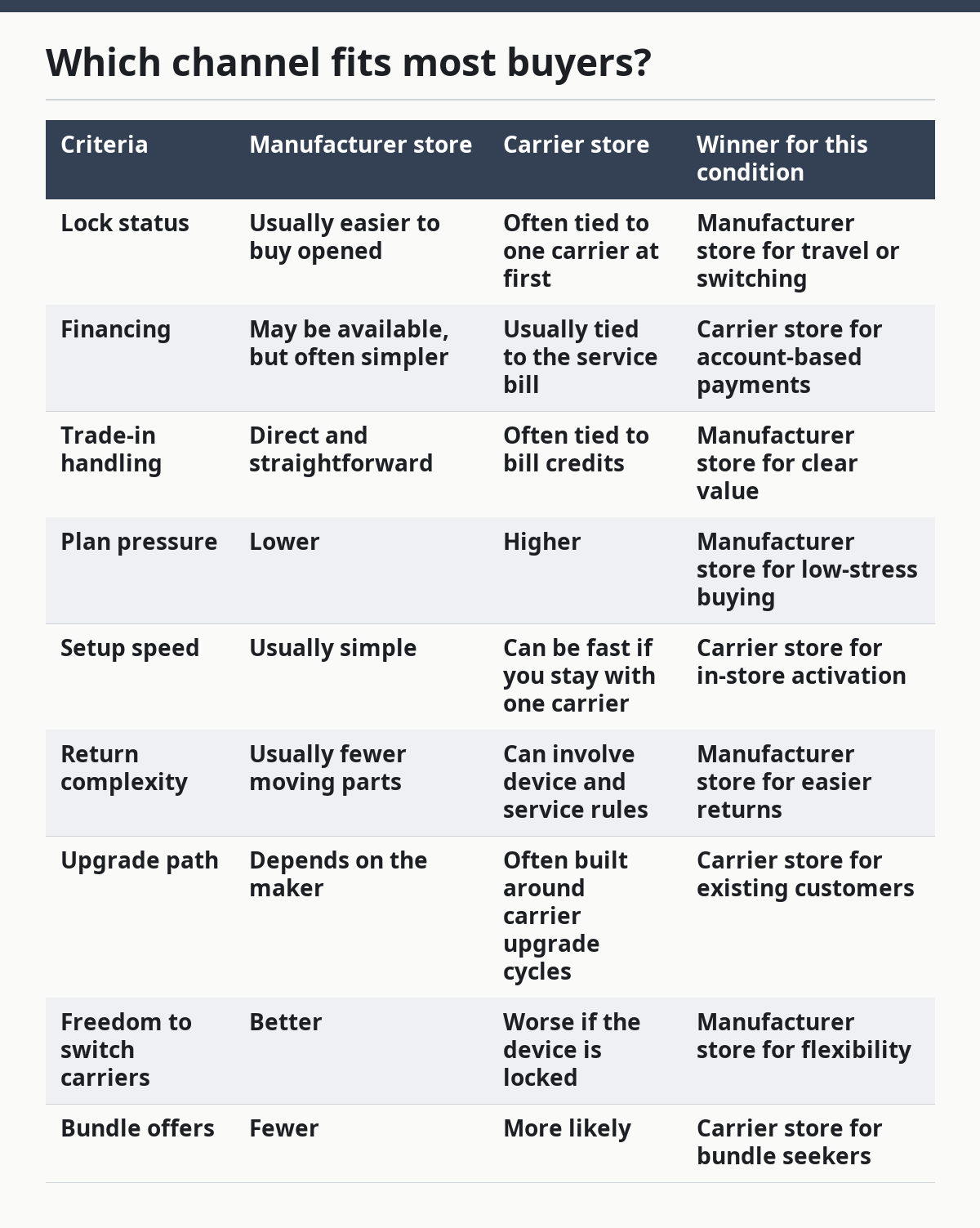
The manufacturer store wins for buyers who want the cleanest ownership path. The carrier store wins for buyers who are already committed to a network and want the billing system to do more of the work. A generic article often says “carrier deals are best” without saying that the deal can depend on staying put. That omission is where people get burned.
Carrier stores: when they make sense and when they do not

Carrier stores win when the buyer wants financing, trade-in credit, and activation in one place. That is the main appeal, and it is real. If the goal is to replace an old phone and keep the same phone number and service plan, a carrier store can feel efficient.
The catch is that a carrier deal often comes with strings. The phone may be locked, the trade-in may be paid back as monthly credits, and the advertised savings may only appear after several billing cycles. If the buyer leaves early, misses a payment, or changes plans, the math can change quickly. The FCC’s opening guidance matters here because a locked phone can limit where it works, even if the hardware itself is the same.
Carrier stores are not ideal for people who switch networks often, travel with local SIMs, or want to resell the phone later without trouble. They are also a poor fit for buyers who hate account fine print. A discount that depends on 24 monthly credits is not the same as a lower purchase price.
The strongest use case is a simple one: an existing customer who wants to stay with the same carrier, trade in an old handset, and spread payments across the bill. The weakest use case is a buyer who wants freedom first and savings second. A carrier store can be a good channel, but it is not a neutral channel.
Manufacturer stores: why they are the cleanest default
Manufacturer stores are usually the cleanest default because the buyer starts closest to the phone itself, not the network behind it. That matters when the goal is an opened device, a direct warranty path, or a purchase with fewer billing surprises.
This channel is especially useful for buyers who travel, switch carriers, or want to compare storage sizes and colors without a sales script built around service plans. It also helps when the buyer wants to know exactly what the device includes, such as whether it is eSIM-only, whether a charging brick is in the box, or whether the phone supports a specific network band. Those details are easier to check when the maker is the seller.
The downside is that manufacturer stores can be less aggressive on carrier-style bill credits. A headline deal may look weaker at first glance because the savings are not wrapped into a phone bill. That is not a flaw if the buyer values freedom, but it can feel expensive if the only thing being watched is the monthly payment.
This channel is not for someone who wants the carrier to handle everything. It is also not the easiest route for buyers who want to bundle a phone with a new plan in one visit. Still, for many informed buyers, it is the safest channel because the lock status, warranty source, and ownership line are easier to see. The buyer gets more clarity and fewer moving parts.
Big-box retailers and marketplaces: the middle ground is not the same thing
Big-box retailers and online marketplaces are not the same channel, even though both can look like simple shopping carts. Big-box stores usually sit closer to the manufacturer or carrier rules, while marketplaces often put more responsibility on the buyer to check seller identity, return policy, and device condition.
A big-box retailer can be a smart middle ground for someone who wants to hold the phone, compare sizes, and leave with a clear receipt. It can also help if the buyer wants to combine a phone purchase with accessories and see the phone in person before paying. The risk is that the available models may be limited, and the best finance or trade-in terms may still be tied to a carrier activation.
Marketplaces are different. They can offer more model variety, including older flagships and niche storage variants, but the buyer has to verify the seller, the device history, and the lock status. A phone that is listed as “opened” is not automatically safe unless the listing, seller terms, and device checks all line up. A phone can also come with no meaningful warranty if the seller is not the original manufacturer or a recognized refurbisher.
These channels are not wrong. They are just less forgiving. The buyer who already knows how to check an IMEI, confirm return terms, and compare seller ratings can do well here. The buyer who wants a simple, low-risk purchase should not start here.
What should you check before paying?
You should check four things before paying: lock status, return window, warranty source, and IMEI history. Those four checks tell the buyer far more than the headline price ever will.
Lock status is the first filter. An opened phone gives the buyer more freedom to switch carriers or use a travel SIM. If the phone is locked, the buyer should know what open rule applies and when it applies. That is where the FCC’s consumer guidance becomes practical instead of theoretical.
Return policy is the second filter. A channel with a short or confusing return process can turn a small mistake into a big problem. If the phone feels wrong in the hand, the screen size is not comfortable, or the battery performance does not match the buyer’s habits, the return path becomes part of the real value.
Warranty source is the third filter. A direct manufacturer warranty is easier to understand than a patchwork of seller promises. Some sellers offer their own limited support, but that is not the same as the maker standing behind the device.
IMEI history is the fourth filter. A clean IMEI does not guarantee a perfect phone, but a bad history can create major trouble with activation or resale. This is why used-phone channels need more care than new-phone channels. The buyer should treat an IMEI check as a required step, not a bonus.
A channel that hides these details is a bad channel for a careful buyer, even if the sticker price looks attractive.
How do you compare channels without getting lost?
You compare channels by asking what the buyer is really paying for: device freedom, bill credits, convenience, or risk reduction. That question is more useful than “Which channel is cheapest?” because the cheapest headline number is often not the cheapest outcome.
Start with the phone’s status. New and opened is the easiest combination to understand. New and locked can still be fine, but the buyer needs to know the carrier rules. Used and opened may be a bargain, but it needs stronger checks on IMEI, battery life, and warranty. Refurbished can sit between new and used, but the value depends on who refurbished it and what the seller promises in writing.
Then compare the cost structure. Some channels lower the upfront payment but stretch the value across monthly credits. Others ask for more money at checkout but remove future strings. That difference matters more than most glossy promotions admit.
The best way to avoid confusion is to compare the total buying path, not only the checkout page. That means looking at the phone price, the plan requirement, the trade-in conditions, the lock period, and the return process together. A buyer who compares only one line item is not comparing channels; that buyer is comparing advertising.
The channel that wins is the one that makes the buyer’s next six months easier, not the one that looks clever for six minutes.
When should you skip a channel entirely?
You should skip a channel entirely when it hides the device’s status, forces a confusing payment structure, or makes the buyer depend on a promise that is hard to verify. That is the honest cutoff.
Skip carrier stores if the buyer wants to change networks soon, hates contract-style credits, or needs an opened phone for travel. Skip marketplaces if the seller is unclear, the return path is short, or the listing does not explain whether the phone is refurbished, used, or carrier-locked. Skip used-phone sellers if the IMEI cannot be checked or if the battery condition is vague. Skip big-box convenience if the model selection is weak and the buyer is being pushed into a plan bundle that does not fit.
This is where a lot of generic advice goes wrong. It treats every channel as equally valid if the price is low enough. That ignores the real cost of a locked phone, a bad return process, or a warranty dispute. A phone is not a shirt. If the channel makes the device hard to activate, hard to return, or hard to resell, the buyer is paying for that trouble later.
The safest rule is simple: if the channel cannot explain the phone’s lock status, warranty source, and return terms in plain language, leave it out of the running.
The verdict: which mobile phone purchase channel should you pick?
Choose the manufacturer store if you want an opened phone, fewer billing strings, and the clearest path to ownership. Choose the carrier store if you want bill credits, account-based financing, or the easiest upgrade inside an existing plan. Neither if you need the cheapest-looking deal but cannot confirm lock status, IMEI history, and return terms.
That is the clean split. The manufacturer store is the best default for most informed buyers because it gives more control and fewer surprises. The carrier store is the better fit when the buyer values monthly convenience and is comfortable staying inside one network’s rules.
The wrong move is letting the monthly payment decide everything. A phone channel can look cheap and still be the wrong choice if it traps the buyer in a locked device, a delayed credit, or a weak resale position. For a learning reader, that is the main lesson: the channel is part of the product.
FAQ
Is it better to buy a phone from a carrier or the manufacturer?
It is usually better to buy from the manufacturer if the buyer wants an opened phone and fewer conditions. A carrier can still be the better choice for someone who wants bill credits or account financing tied to service.
Are opened phones always the safer choice?
Opened phones are usually safer for flexibility, but “safer” does not mean “best in every case.” A buyer who never switches carriers may find a locked phone acceptable if the deal is strong and the terms are clear.
Are refurbished phones worth considering?
Refurbished phones can be worth considering if the seller explains the condition, warranty, and return policy clearly. The channel matters a lot here because a good refurbisher is very different from a random marketplace seller with no clear device history.
What is the biggest mistake people make when buying a phone?
The biggest mistake is comparing only the checkout price and ignoring the lock status, trade-in rules, and return window. A phone that looks cheaper can become more expensive if the buyer cannot switch carriers, resell it easily, or return it without hassle.
What should a first-time buyer check first?
A first-time buyer should check whether the phone is opened, who provides the warranty, and how the return policy works. Those three checks answer most of the questions that matter before money changes hands.
Drafted with AI; not yet reviewed by a person.