
How to Compare Mobile Phone Prices from Direct Sales
Last updated: November 20, 2026
Quick Answer: Compare 3 numbers — base price, shipping, and return cost — before you decide. For How to Compare Mobile Phone Prices from Direct Sales and Third-Party Sellers, the cheaper-looking listing is only better if the full checkout total stays lower after shipping terms, tax, and return costs. For price-checking basics, I lean on consumer guidance from the FTC and warranty rules from the Magnuson-Moss Warranty Act.
Key takeaways
- Direct sales from the brand store or official online shop are easier to compare because the seller, warranty, and support path are usually clearer.
- Third-party sellers can post lower-looking prices, but the real comparison is the full checkout total and the risk of weaker support.
- Shipping terms matter because a “better” price can disappear once you add delivery fees, slower dispatch, or a return cost.
- If you care most about support after purchase, direct sales usually wins.
- If you are buying for the lowest possible upfront price and you can verify the seller, third-party sellers can make sense.
- The wrong choice is the one that ignores warranty handling, model condition, or return windows.
What is the real difference here?
Direct sales wins on clarity, while third-party sellers win on price variety. Direct sales means you are buying from the manufacturer’s own channel, such as a brand store or official online shop. Third-party sellers are resellers, which can include independent stores and marketplaces listing phones they did not make.
That difference changes more than price. The direct channel usually makes it easier to see the exact model, storage size, color, shipping terms, and warranty process. Third-party listings can be competitive on price, but they also vary more in condition, included accessories, and support quality.
This is why the headline price alone misleads. A phone listed at a lower amount from a reseller is not necessarily the better deal if the return policy is tight or the seller’s support is thin. The comparison you want is not “Which price is smaller?” It is “Which offer leaves me with fewer surprises after checkout?”
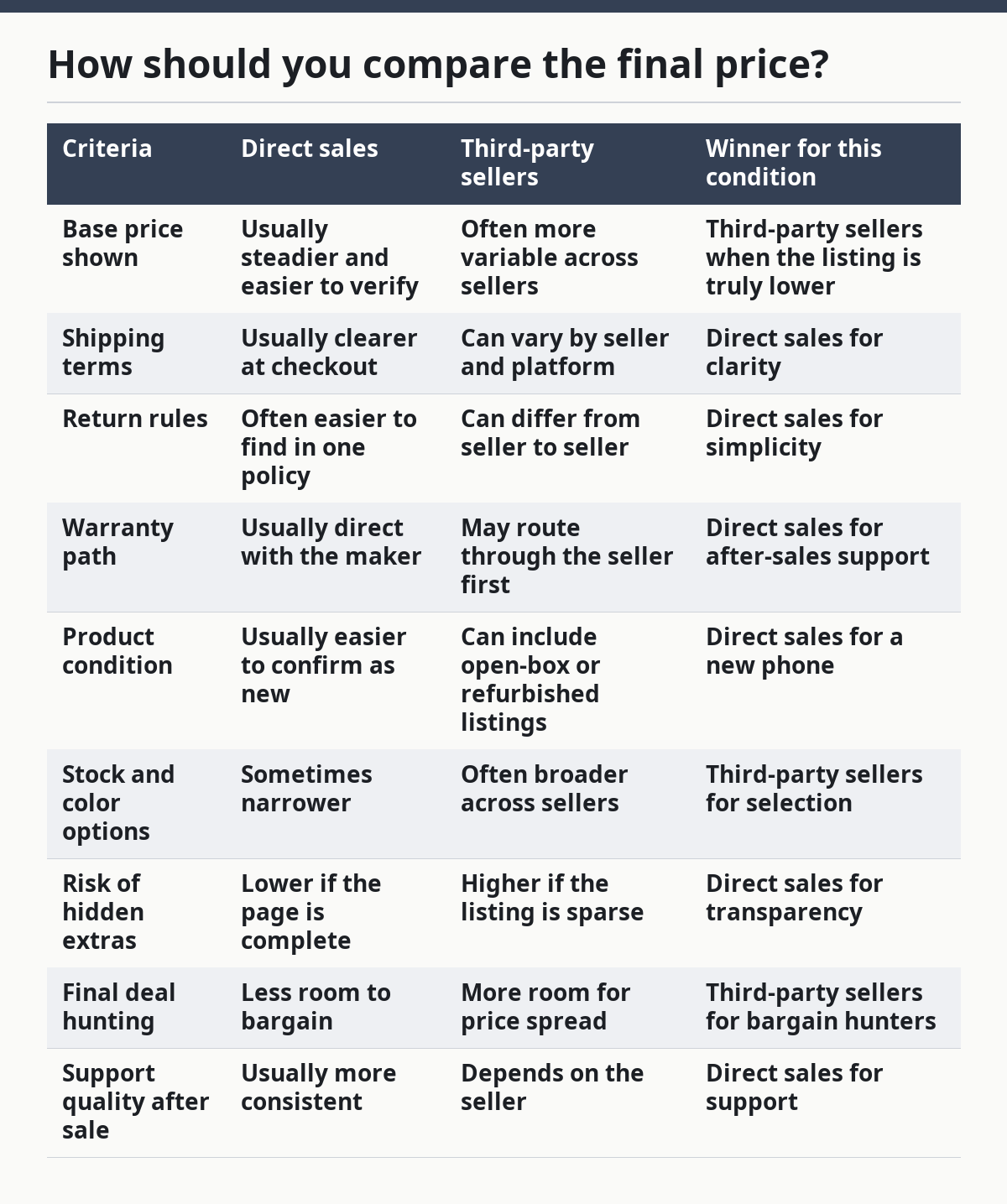
How should you compare the final price?
The final price is the number that matters, not the display price on the product page. Start with the base phone price, then add shipping, tax if shown, and any seller fees before deciding which listing is better.
That is where direct sales often looks steadier. Brand stores and official online shops usually make the package easier to read: one seller, one support path, one warranty route. Third-party sellers can still beat the direct channel, but only if the lower sticker price survives the checkout screen and the seller’s terms do not offset it.
Use the same checklist on both sides:
- Exact model and storage size
- Shipping cost and shipping speed
- Return window and return shipping cost
- Warranty terms and who handles the claim
- Whether the phone is new, open-box, refurbished, or used
A reader who skips those details can end up comparing a sealed device to an open-box unit, which is not a fair comparison. If you are looking at a model like an iPhone or Galaxy device, the model number and storage tier must match exactly, or the price comparison is meaningless.
| Criteria | Direct sales | Third-party sellers | Winner for this condition |
|---|---|---|---|
| Base price shown | Usually steadier and easier to verify | Often more variable across sellers | Third-party sellers when the listing is truly lower |
| Shipping terms | Usually clearer at checkout | Can vary by seller and platform | Direct sales for clarity |
| Return rules | Often easier to find in one policy | Can differ from seller to seller | Direct sales for simplicity |
| Warranty path | Usually direct with the maker | May route through the seller first | Direct sales for after-sales support |
| Product condition | Usually easier to confirm as new | Can include open-box or refurbished listings | Direct sales for a new phone |
| Stock and color options | Sometimes narrower | Often broader across sellers | Third-party sellers for selection |
| Risk of hidden extras | Lower if the page is complete | Higher if the listing is sparse | Direct sales for transparency |
| Final deal hunting | Less room to bargain | More room for price spread | Third-party sellers for bargain hunters |
| Support quality after sale | Usually more consistent | Depends on the seller | Direct sales for support |
Direct sales: who should use it?
Direct sales wins for anyone who values certainty more than a small price gap. If you want a phone from a brand store or official online shop, you are usually paying for a cleaner purchase path, clearer support, and less guesswork about who owns the problem if something goes wrong.
That matters most when the phone is a major purchase and you want the simplest paper trail. If the device arrives with a defect, the direct channel often makes the next step easier to understand because the maker and seller are the same side of the transaction. The same is true when you want to keep the process simple for a return inside the stated window.
The weakness is that direct sales does not always show the most aggressive price. It can also look less flexible than a reseller’s rotating offers. If your only goal is the lowest number on the page, direct sales can lose on that single metric even when it wins on support.
Direct sales is not the right choice if you are chasing a temporary bargain and you are comfortable checking seller reputation, shipping terms, and warranty handling in detail. It is the safer fit for cautious buyers, busy buyers, and anyone who would rather avoid a support headache later.
Third-party sellers: when do they make sense?
Third-party sellers win when price spread, stock choice, or device condition matters more than channel simplicity. A reseller can sometimes post a better-looking deal than the direct channel, especially when the brand store holds firm on its pricing or does not discount a model in the way the market does.
This channel also helps if you need a phone that is harder to find through the maker’s own shop. Third-party sellers may list more storage tiers, color options, or open-box units. That wider selection can be useful, but it is also the reason you need to read the listing closely. A lower price may reflect a shorter return window, a different warranty path, or a device that is not sealed new.
The weakness is the support gap. If the seller is handling the sale, the process after purchase can be less predictable than buying direct. Some listings are excellent; others bury key terms. That means the buyer has to do more work before paying.
Third-party sellers are best for shoppers who can compare several offers, know exactly which model they want, and are willing to verify the details line by line. They are a poor fit for anyone who wants the simplest possible service path or who does not want to inspect the listing carefully.
What are the main pros and cons?
Direct sales has a stronger support story, while third-party sellers have more price competition. That is the short version, but the details matter because the wrong trade-off can erase the savings.
Direct sales pros
- Clearer warranty and support path
- Easier to match the exact model
- Less confusion about who handles defects
- Usually cleaner return information
Direct sales cons
- Often less room for price variation
- Fewer unusual bundle or clearance deals
- Less useful if you are shopping only for the lowest upfront number
Third-party seller pros
- More chances to find a lower sticker price
- Wider mix of stock, colors, and conditions
- Better for bargain hunting when you can compare offers carefully
Third-party seller cons
- Support quality can vary
- Shipping and return terms can change by seller
- A lower price can hide a weaker after-sales path
- The listing may not be as clear about condition or included extras
If the buyer cares about resale value, condition, and warranty confidence, direct sales usually feels easier to defend. If the buyer cares about squeezing the price and can tolerate more risk, third-party sellers may be worth the extra checking.
What should you check before you buy?
You should check five things before you compare the number on the tag. First, confirm the exact model and storage size, because a 128GB version and a 256GB version are not the same purchase. Second, read the shipping terms, since a lower price with slower shipping may not be worth it if you need the phone soon.
Third, inspect the return policy and the cost of sending it back. Fourth, confirm whether the phone is new, open-box, or refurbished. Fifth, look at after-sales support, including who handles warranty claims and repairs.
This is the point where many shoppers make the wrong call. They compare two listings with different support terms and then act surprised when the cheaper one becomes harder to return. A clean comparison often includes the “what happens if something is wrong?” question.
If a seller page does not clearly state condition, return rules, and warranty handling, treat that as a warning sign and, if needed, consult a consumer-rights professional or the FTC guidance on phone purchases. The cheaper listing is not the better listing if it leaves you guessing.
Which one should you choose?
Choose direct sales if you want the clearest warranty path, the simplest return process, and the least confusion about support. Choose third-party sellers if you are comfortable checking seller terms closely and the listing gives you a better total checkout price for the exact same model. Neither if the listing is vague about condition, warranty, or shipping, because the savings are not worth the risk.
That is the decision line. Direct sales is the safer default, and third-party sellers are the price-shopping option. If you are buying a phone you plan to keep for a while, support and clarity usually matter more than a small discount. If you are price-sensitive and patient, a reseller can be the better deal.
When does the answer flip?
The overall verdict flips in a few specific cases. If the third-party seller is the only place with the exact model, storage size, or color you want, then the reseller becomes the practical choice. If the direct channel is out of stock and you need the phone soon, waiting for a brand store can cost more than a modest reseller premium.
The verdict also changes if the third-party listing clearly beats the direct channel after shipping and return terms are added. In that case, the lower total price is real, not cosmetic. A lower number with identical condition and a solid policy is worth taking.
Another flip happens when the direct channel is offering a bundle or support benefit that the reseller cannot match. That can make the direct purchase the better value even if the sticker price looks higher. The right comparison is the full deal, not the first number you see.
Finally, if the seller does not clearly state whether the phone is new, open-box, or refurbished, stop there. No discount makes up for a blurry listing.
FAQ
Is direct from the brand always cheaper?
No. Direct sales is often clearer, but not always cheaper. A third-party seller may show a lower price, especially on a model with broad resale competition. The real test is the total checkout cost and whether the warranty and return terms still make sense.
Do third-party sellers offer better phone prices?
Sometimes, yes. Third-party sellers can offer better-looking prices because they compete harder on the sticker number and may clear stock faster. The catch is that the cheaper listing can come with weaker support, different shipping terms, or a less generous return policy, so the total value can still be worse. For a broader comparison, see our refurbished vs. new phone guide.
Drafted with AI; not yet reviewed by a person.