

How Carrier Subsidies and Installment Plans Change Phone Prices
Last updated: November 26, 2026
How Carrier Subsidies and Installment Plans Change Phone Prices
Quick Answer: A carrier subsidy can spread a phone discount across 12, 24, or 36 months, so the upfront price may not be the final device cost. How Carrier Subsidies and Installment Plans Change Phone Prices depends on bill credits, payoff timing, and whether you keep the line active long enough to earn every promised discount.
Carrier subsidies and installment plans make a phone look cheaper up front, but the real price depends on bill credits, payoff timing, and whether you keep the line long enough to earn every promised discount. The sticker price is only part of the cost; the rest is spread across your monthly bill, and that can disappear if you cancel or pay off the phone early. For a broader guide to mobile phone pricing, this is the place to start.
Key takeaways
- A lower advertised price on a carrier deal usually comes from monthly credits, not a true lower device cost.
- An installment plan spreads the handset price across the bill, so the phone and service charges are tied together.
- The deal can change if you leave early, upgrade early, or stop meeting the carrier’s credit rules.
- The cheapest-looking offer is not always the cheapest total cost, especially if credits depend on staying on the plan.
- A contract term, a device finance agreement, and an opening rule can all affect what you finally pay.
What changes the phone price?
Carrier subsidies and installment plans change the phone price by moving part of the cost from the checkout page to the monthly bill. A phone that looks discounted on launch day may still be priced at, or near, its normal retail value, with the savings arriving later as bill credits over 12, 24, or 36 months.
That difference matters because the headline price is not always the amount you end up paying for the device. With a carrier subsidy, the carrier may help cover the phone cost if you sign up for service or stay on a qualifying plan. With an installment plan, you usually finance the device and pay it off bit by bit, often through a device finance agreement tied to the line. For related details, see device finance agreements and cell phone contracts.
The practical result is simple: the real phone price depends on three things at once. Second, the device price on paper. Third, the monthly credits or discounts. Finally, the rules that decide whether those credits keep flowing.
For example, a reader comparing offers should look past the “free phone” language. A phone is rarely free in the strict sense. It is usually paid for in installments, then offset by credits that only appear if the account stays active and in good standing.
Meanwhile, two offers that show the same handset can end up with very different real costs. One may give an instant discount. Another may spread the savings across 24 months. A third may require you to keep the same line for the full term before the savings fully land.
How do bill credits affect the real phone price?
Bill credits lower the real phone price only if they keep posting every month until the promised term ends. The credit is usually not taken off the device at checkout; it shows up later as a reduction on the bill, which means the upfront price and the final price can be very different.
Here is the clean way to read a bill-credit offer.
- Find the full device price on the offer page, not just the promotional banner.
- Find the monthly installment amount and the monthly bill credit amount.
- Count the credit term, such as 24 or 36 months.
- Multiply the monthly credit by the number of months to see the total discount.
- Check whether the credit starts right away or after the first bill cycle.
- Confirm what happens if the line is cancelled, upgraded, or moved off the eligible plan.
Therefore, the result should be a simple total: device price minus all expected credits, plus any activation fees, upgrade fees, or remaining device balance. If the offer does not clearly show that math, the “discount” is not really clear.
A common mistake is to treat the monthly credit like cash in hand; it is not. It is a future bill reduction that depends on the account staying eligible, so if you are unsure how the terms work, review the carrier’s written offer or consult a qualified consumer adviser. The FTC and FCC both warn consumers to read the fine print on mobile offers and device terms before committing: FCC wireless device opening guide and FTC consumer guidance. If the credit is supposed to continue for 24 months and you leave after 10 months, the unearned part of the deal usually disappears.
So a bill-credit offer can be harder to compare than a plain price cut. A direct discount changes the cost on day one. A credit changes the cost only if you stay long enough to collect it.
Why does a phone cost less on a plan than sim free?
A phone costs less on a plan than sim free because the carrier is trading a lower device price today for a longer relationship and, often, a higher monthly service bill. The savings are usually tied to the line, not just the handset, so the device price alone does not tell the full story.
Specifically, the simplest way to compare the two is to place the device options side by side.
| Offer type | What happens at checkout | What changes later | Main risk |
|---|---|---|---|
| SIM free | You typically pay the full device price up front | Nothing tied to service | Higher upfront cost |
| Carrier subsidy | The phone looks cheaper because the carrier helps cover the cost | Savings may depend on keeping service active | Credits can stop if you leave |
| Installment plan | You pay the phone off over time | Monthly payments continue until the balance is zero | Early payoff may end the promo credits |
| Bill-credit offer | You pay installments and receive credits on the bill | Credits arrive across months, often 12, 24, or 36 | The “discount” can vanish if terms break |
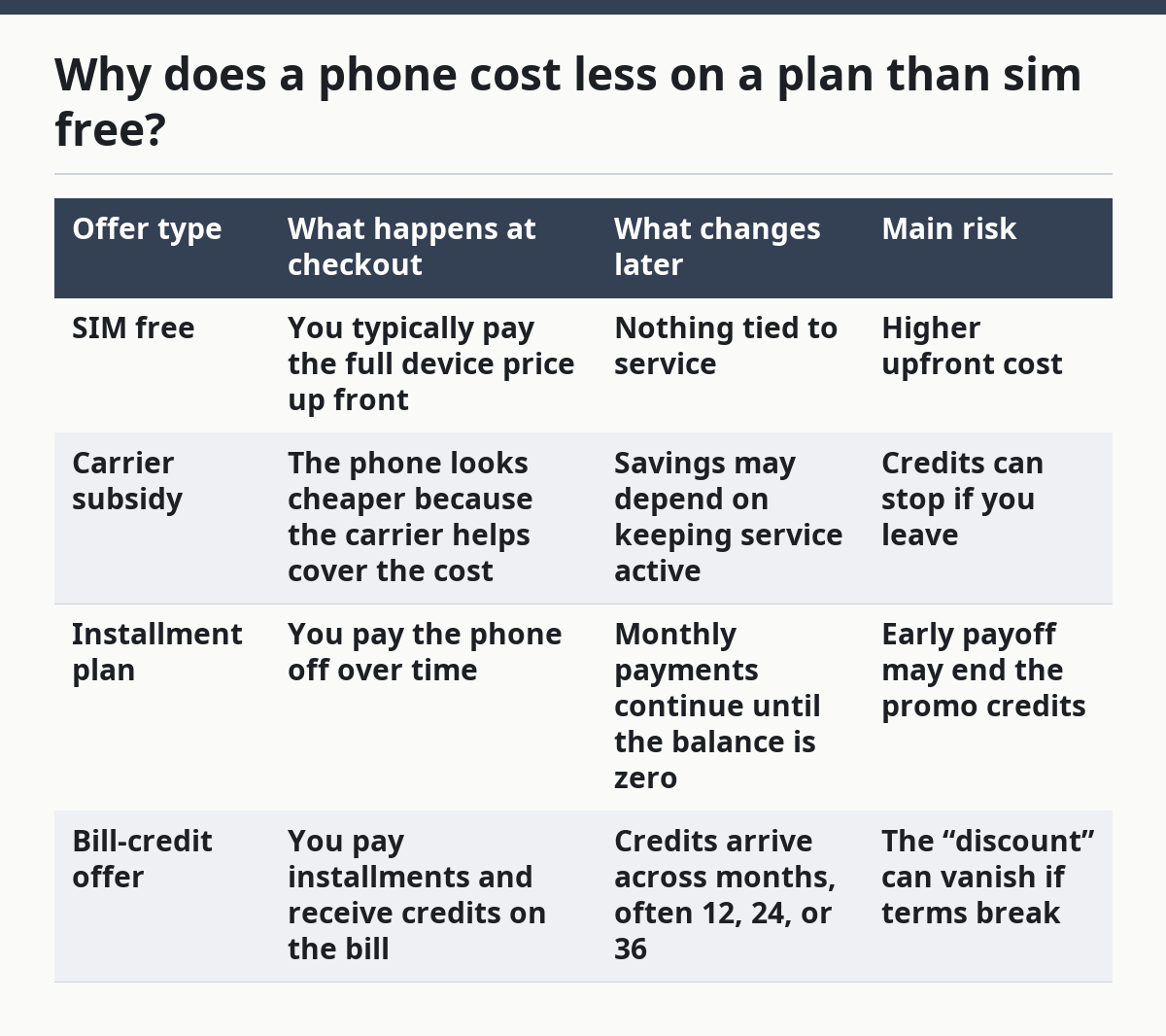
However, a generic article often gets this wrong by treating the plan as the only cost difference. It is not. The service plan may be part of the deal, and the phone discount may be attached to a specific line, a specific term length, or a specific device finance agreement.
So, the real comparison is not “plan versus no plan.” The better question is: what is the total out-of-pocket cost over the full term, and what happens if the deal ends early?
In particular, if a carrier subsidy lowers the phone price by spreading savings over 24 months, the “cheap” phone may no longer be cheap once you add the monthly service charge and any fee for leaving before the credits finish.
What should you check before you sign?
You should check the device finance agreement, the bill-credit rule, the early upgrade fee, and the opening policy before you sign. Those four items decide whether the advertised price is the price you keep.
After that, a good checklist is short and concrete:
- Device finance agreement: Read the handset payment term, such as 24 or 36 months, and see whether the phone is financed separately from service.
- Bill credit terms: Check the exact months required for the credits and whether they depend on a specific plan.
- Early upgrade fee: Look for any charge or remaining balance that applies if you swap devices before the term ends.
- Opening policy: Check when the carrier will open the phone, and whether the balance must be paid off first. See also opened phones.
- Contract term length: Confirm whether the service obligation is the same length as the device payment term or different.
Likewise, the most useful habit is to read the offer as a timeline, not a slogan. On day one, you may pay a small down payment and start a 24-month agreement. On month three, you may still owe most of the device balance. On month 12, the bill credits may still be running. That timeline tells you more than the headline discount does.
Meanwhile, a second mistake is ignoring the distinction between paying off the phone and ending the whole offer. Those are not the same event. Paying off the balance can stop future device credits, even if your service line stays active. Ending service can also stop the credits, and the remaining balance may still be due.
Ultimately, when an offer includes a “free” or “almost free” phone, the real question is not whether the device is discounted. The real question is which conditions keep the discount alive.
What happens if you pay off early or leave?
Paying off early or leaving can remove future bill credits and leave the remaining device balance due. That is the central trade-off in almost every carrier subsidy or installment plan.

Because of that, if you pay the phone off before the term ends, the carrier may stop the monthly credits that were designed to offset the installments. In that case, the payoff can raise your net cost because you lose the unpaid future discounts. If you cancel the contract or move the line off the eligible plan, the same thing can happen: the credits stop, and any unpaid balance may still be billed.
That is why a deal that looks best on paper can become expensive after month 8, 10, or 14. The timing of your exit matters as much as the advertised discount. A deal that depends on 24 months of service is not the same as a plain handset discount.
In contrast, the opening policy also matters here. Some carriers will not open a phone until certain payment or service conditions are met. The FCC’s consumer page on wireless device opening is a useful reference point for understanding that carriers can have conditions before opening a phone: https://www.fcc.gov/consumers/guides/wireless-device-unlocking.
Therefore, the financial lesson is plain. If you know you may switch carriers soon, the subsidy can be a bad fit. A smaller upfront discount with no long commitment may cost less in the end than a larger promo that disappears halfway through.
Who is this deal not for?
This deal is not for a buyer who wants the lowest total cost with the fewest strings attached. A carrier subsidy or installment plan can be useful, but it is a poor fit if you change phones often, switch carriers often, or hate reading account terms.
It also does not suit someone who wants the device opened right away without meeting carrier conditions. The handset may be locked until the balance is paid or the carrier’s policy is satisfied, which limits how fast you can move the phone to another network.
Before choosing, a plain SIM-free purchase is often easier for that kind of buyer because the price is visible on day one and there are no bill credits to lose. The trade-off is the larger upfront payment. That is the cleanest way to think about it: lower monthly pain now, or simpler ownership later.
So if the carrier offer depends on you staying put for 12, 24, or 36 months, treat the discount as conditional savings, not as a guaranteed price cut. If you are unsure, check the carrier terms or get help from a consumer adviser before you sign.
Where this fits in the bigger price picture
Carrier subsidies and installment plans are only one part of mobile phone pricing, but they are one of the biggest reasons the same phone can seem cheap in one place and expensive in another. The device price you see on a carrier page can hide a longer payment schedule, a service tie-in, or a rule that changes the final total if you leave early.

For the wider picture, this page sits inside the larger set of mobile phone pricing factors. That matters because the phone price is not just the sticker, and it is not just the monthly bill either. It is the sum of device cost, service rules, credits, fees, and timing.
So, if the offer sheet does not let you trace those pieces for the full term, assume the real price is higher than the headline suggests. The numbers may still be worth it, but only if the conditions fit your timeline.
How do bill credits affect the real phone price?
Bill credits lower the real phone price only when they keep posting for the full term. The savings usually show up over 12, 24, or 36 months, so the up-front number is not the final cost. If the line stops qualifying, the remaining credits may stop too.
Why does a phone cost less on a plan than sim free?
A phone costs less on a plan because the carrier is often discounting the device in exchange for a longer service commitment. The lower device price can be real, but it is usually tied to monthly credits, a specific plan, or both. The savings are spread out instead of paid all at once.
What happens to the price if I pay off the phone early?
Paying off early can make the phone more expensive in net terms if it stops the remaining bill credits. You may remove the installment balance, but you can also lose future discounts that were supposed to offset that balance. The payoff number alone does not show the full picture.
Do carrier discounts disappear if I cancel the contract?
Carrier discounts often stop if you cancel the contract or move off the eligible line before the term ends. The unpaid device balance may still be due, and future bill credits may not continue. The exact rule depends on the device finance agreement and the carrier’s opening and credit policy.
Drafted with AI; not yet reviewed by a person.