

Mobile Phone Pricing Factors: The Complete Guide
Last updated: November 18, 2026
Mobile phone prices change because of chipsets, display tech, camera hardware, storage, 5G radios, battery size, build materials, brand position, and sales channel markups. This guide breaks down each factor in Mobile Phone Pricing Factors — The Complete Guide so you can see where the money goes and what actually matters before you buy.
Quick Answer: the biggest price jumps usually come from the processor, camera system, display type, and storage tier, and a phone at $300 often costs less because it uses a weaker mix of those parts.
Key Takeaways
- Two phones with the same screen size can still be priced very differently because the parts inside are not the same.
- The biggest price jumps usually come from the processor, camera system, display type, and storage tier.
- A premium price can sometimes mean better battery life or better photos, but not always.
- The carrier price, opened price, and launch price can tell different stories.
- The right phone price depends on how long you want to keep it, not just what looks affordable today.
I write about phone hardware and market positioning, so I can separate real cost drivers from the features that only sound expensive in Mobile Phone Pricing Factors — The Complete Guide.
Why one phone costs $300 and another costs much more
The answer is that phone makers often stack expensive parts, software support, and brand positioning on top of the base hardware cost. The biggest jump usually comes from the chip, the camera stack, the display panel, and the storage tier.
For example, IDC has repeatedly shown that premium phones can sell for far more than entry models because the bill of materials is higher and the brand can charge for the extras. In practice, that gap often starts around $300 and climbs quickly from there.
Picture this: you’re comparing two phones that both look slim, both have glass backs, and both say “5G” on the box. One uses a basic LCD, modest storage, and a midrange chip; the other uses an OLED panel, faster memory, a stronger modem, and a camera system with optical stabilization. The second phone costs more because the bill of materials is higher, and the brand knows buyers will pay for the extras.
Here’s the catch: price is not one thing.
- Hardware cost: chip, display, cameras, battery, frame, memory, and storage
- Software support: how long the maker keeps updating the phone
- Brand tier: flagship, midrange, or budget positioning
- Channel markup: carrier deals, retailer cuts, and regional taxes
- Launch timing: new models usually carry a premium for the first months
A cheap phone often cuts more than one corner at once. A midrange phone may keep one premium feature, like a good OLED screen, and save money everywhere else. That mix is why two phones with similar looks can sit hundreds of dollars apart.
Which parts of a phone push the price up the most?

The chip, the display, the camera system, and the storage tier usually drive the biggest price changes. Those four parts are the easiest place for a maker to spend more and the easiest place for buyers to feel the difference.
Picture this: you open a spec sheet and see one model with a Snapdragon 8-series or Apple’s A-series flagship chip, while another uses a lower-tier processor. You may never notice the chip name in daily use right away, but the cost shows up in speed, gaming, camera processing, and how long the phone stays competitive.
The main cost drivers are:
- Processor and modem: Flagship silicon costs more because it is faster, more efficient, and usually paired with stronger 5G support.
- Display technology: OLED and LTPO panels cost more than basic LCD panels. Higher refresh rates and brighter panels also add cost.
- Camera hardware: Larger sensors, optical image stabilization, telephoto lenses, and better video hardware all raise the price.
- Storage and memory: More RAM and more internal storage increase the price, especially at higher tiers like 256GB or 512GB.
- Battery and charging hardware: Bigger batteries, faster wired charging, and wireless charging add cost.
- Build materials: Aluminum, stainless steel, titanium, and higher-grade glass cost more than plastic frames and backs.
- Water and dust resistance: Better sealing and higher IP ratings usually cost more to engineer and certify.
The better part is that these upgrades do not all matter equally to every buyer. If you stream video and browse all day, display quality may matter more than a telephoto lens. If you shoot kids, pets, or concerts, the camera hardware earns its keep faster than a flashy frame.
How does the processor change phone pricing?
The processor changes phone pricing more than most buyers realize because it affects speed, camera processing, gaming, and the phone’s lifespan. A flagship chip usually pushes the price up because it is built for higher performance and better efficiency.
Picture this: you are choosing between a phone with a top-tier chip and one with a cheaper processor that still handles calls, texts, and social apps. On paper, both can look fine. In real use, the stronger chip keeps the phone smoother under pressure, especially when you switch apps, edit video, or push high refresh-rate graphics.
A stronger chip usually means:
- faster app launches
- better long-term performance
- smoother gaming
- better camera processing
- stronger modem performance in some models
That said, a high-end processor is not free value. It can raise the phone’s price without improving the parts you touch every day. A buyer who mostly messages, scrolls, and takes casual photos may pay for speed they barely use.
The trade-off is simple:
- Buy the stronger chip if you keep phones for years, game often, or care about fast camera and video performance.
- Skip it if you mainly want a reliable phone for everyday use and would rather put money into battery life or storage.
A lot of buyers get trapped by benchmark talk. Benchmarks matter, but they do not tell you whether the phone has a weak battery, a dim screen, or poor thermal control. The chip is a price factor, not the whole story.
Why do cameras make phones expensive so fast?
Cameras make phones expensive because the costs are not just in the sensor; they are in the lens, stabilization, image processing, and the physical space those parts need. A phone with one good camera can still cost less than a phone with several average ones.
Picture this: you are looking at two phones that both say “48MP” or “50MP.” That number alone tells you almost nothing about price or quality. One model may use a small sensor with basic software, while the other may use a larger sensor, optical stabilization, and a telephoto lens that adds real zoom.
Camera pricing usually rises with:
- Sensor size: larger sensors can capture more light, but they cost more and need more space
- Optical image stabilization: steadier photos and video, higher build cost
- Telephoto lens: true zoom usually costs more than digital zoom
- Ultra-wide lens quality: better edge performance and less distortion cost more
- Video hardware: stronger chips and image pipelines help with 4K and higher frame rates
- Computational photography: software tuning takes time and engineering
The truth is, a “camera phone” premium is only worth it if you take enough photos to notice it. If your shots are mostly daylight, travel snapshots, and the occasional portrait, a good midrange phone can be enough. If you want clean low-light shots or stable video, expect to pay more.
Here’s the useful rule: the more lenses a phone has, the more you should inspect what each lens actually does. Two extra circles on the back can mean two extra reasons to spend, but not always.
Does storage and RAM really affect price that much?
Yes, storage and RAM can move the price a lot, especially when you jump to the next tier. The storage upgrade is often one of the easiest ways for a maker to charge more without changing the phone’s shape.
Picture this: you start with a base model and see a second version that doubles the storage. That upgrade looks simple on the product page, but the price jump can be meaningful because the maker is charging for a higher-capacity chip and a more premium SKU.
What changes the price here:
- Internal storage: 64GB, 128GB, 256GB, 512GB, or more
- RAM tier: more memory helps multitasking and app retention
- Storage speed: faster storage can improve app loading and large file work
A bigger storage tier matters most if you:
- shoot lots of photos and video
- keep offline music, maps, or streaming downloads
- use big games
- hold onto a phone for years without deleting files
A lot of people overpay for RAM they will never notice. For basic use, extra memory may not change the day-to-day feel enough to justify the jump. Storage, though, is harder to fake. Once a phone fills up, the frustration is real.
The catch is that cloud storage does not solve every problem. If you need local space for video, travel files, or work documents, the cheaper storage tier can become a bad deal fast. A phone with 128GB may look attractive until it starts nagging you for space every few weeks.
Why do build materials and design choices matter so much?
Build materials matter because they affect durability, feel, weight, and manufacturing cost. Metal frames, premium glass, and tight water sealing all add to the price, even when the phone looks similar to a cheaper model.
Picture this: you hold a phone with a plastic frame and plastic back, then another with a metal frame, glass panels, and more careful fit and finish. The second one feels more expensive because it is more expensive to make. It also tends to need more careful engineering to keep antennas, wireless charging, and heat in check.
Design choices that raise price:
- Metal frames: more premium feel, higher cost than plastic
- Glass backs: better look, often supports wireless charging, but adds fragility
- Titanium or stainless steel: more expensive than aluminum or plastic
- Water resistance: better sealing takes engineering and testing
- Slim bezels and curved edges: harder to manufacture consistently
But premium materials have downsides.
- Glass can crack easier than plastic after a drop.
- Metal can add weight and affect signal design.
- Thin phones may look sleek but can feel worse with a case.
That is why a cheaper plastic phone is not automatically a bad phone. For some buyers, plastic is a sensible choice because it keeps cost and weight down and can survive everyday abuse better than shiny glass.
On the flip side, premium materials are part of the product a buyer pays for. If you want a phone that feels like a top-tier object every time you pick it up, that feeling has a cost.
How do software support and brand name change the price?
Software support and brand name change the price because you are paying for trust, update length, app support, and resale value. A phone maker that promises longer updates can justify a higher price than a no-name brand with thin support.
Picture this: you compare two phones with similar specs, but one comes from a major brand with a clear update policy and a stronger service network. The other looks cheaper at checkout. The first one often costs more because the company expects to support it longer and can charge for the reputation that comes with that support.
What you’re paying for:
- Update policy: security patches and OS upgrades
- Service network: easier repairs and parts access
- Resale value: known brands often hold value better
- App and accessory support: cases, chargers, and software compatibility
This is one of the few pricing factors that can save money later. A phone that gets updates for longer may stay useful longer, which spreads the cost over more years. That said, brand premium can also be pure markup. A famous name does not guarantee better battery life, stronger cameras, or fewer glitches.
A buyer should be wary when a brand premium is hiding weak specs. If the processor is old, the display is basic, and the cameras are mediocre, a big logo on the back is not a good enough reason to pay more.
What makes carrier pricing different from opened pricing?
Carrier pricing is different because the phone price is often tied to service plans, installment deals, trade-ins, and contract terms. The sticker price you see first is not always the real cost you pay over time.
Picture this: you see a phone advertised with a monthly payment that looks manageable, and the carrier says you can save with a trade-in. That can be a real deal, but the price depends on the plan, the bill credits, and how long you stay with that carrier.
Carrier pricing usually includes:
- Installment plans: spread the cost over many months
- Bill credits: discounts applied over time, not all at once
- Trade-in value: the value of your old device affects the deal
- Plan lock-in: better pricing may require a more expensive service plan
Opened pricing is cleaner. You pay the device price directly and can use the phone on compatible networks. That makes it easier to compare models honestly.
The trade-off is obvious:
- Carrier deals can lower the upfront hit but may raise your total commitment.
- Opened phones usually cost more up front but give you more freedom.
Here’s the part many buyers miss: a “free” phone is rarely free. The cost often shows up in the plan, the billing terms, or the trade-in rules. If you want a real price comparison, compare the full cost over the time you expect to keep the phone.
When is a higher phone price actually worth it?
A higher phone price is worth it when the upgrades match the way you use the phone every day. If the extras save you time, reduce frustration, or extend the phone’s useful life, the price can make sense.
Picture this: you are deciding between a midrange phone and a flagship. The flagship gives you a better display, stronger chip, better cameras, and longer support. If you keep phones for four or five years and use them hard, that extra cost can be easier to justify than it first appears.
A higher price is usually worth it if you:
- keep your phone for several years
- game or edit video on your phone
- take a lot of photos in poor light
- want top-tier display quality
- care about long software support
- need fast charging or wireless charging
A higher price is not worth it if you:
- use your phone mainly for messaging, browsing, and streaming
- replace phones often
- do not care much about camera quality
- would rather spend less and upgrade sooner
The clearest mistake is buying a flagship for status and never using the parts that made it expensive. That is wasted money. The second clearest mistake is buying the cheapest phone and then hating the lag, weak camera, or tiny storage six months later.
The honest side-by-side: what changes the price, and what does not?
The answer is that a few parts matter a lot, and a few parts are mostly marketing. The table below separates the factors that usually move the price from the ones that matter less than buyers think.
Picture this: you have two phones in front of you and need a fast way to decide where the money is going. This side-by-side view keeps the focus on the parts that affect the bill and the daily experience.
| Criteria | Phone with premium parts | Phone with budget parts | Winner for this condition |
|---|---|---|---|
| Processor | Flagship chip with stronger performance and better camera processing | Midrange or budget chip with enough speed for basics | Premium parts for gaming, video, and long keep-time |
| Display | OLED or LTPO, often brighter and smoother | LCD or lower-end OLED | Premium parts for media, outdoor use, and smooth scrolling |
| Camera hardware | Larger sensor, stabilization, and sometimes telephoto zoom | Smaller sensor, fewer lenses, simpler processing | Premium parts for low light and zoom |
| Storage tier | Higher capacities like 256GB or more | Lower capacities like 64GB or 128GB | Budget parts if you store little and want to save money |
| Build materials | Metal, glass, or stronger frame materials | Plastic-heavy construction | Budget parts for durability per dollar; premium for feel |
| Water resistance | Better sealing and a clearer IP rating | Basic sealing or limited claims | Premium parts if you use the phone in wet conditions |
| Software support | Longer update window from a major maker | Shorter or unclear update commitment | Premium parts for long ownership |
| Carrier deal | Lower upfront cost with plan strings attached | Higher upfront cost, no carrier lock-in | Budget parts if you want freedom; carrier deal if you want low upfront cost |
| Brand premium | Higher trust, resale value, and service access | Lower name recognition | Premium parts when support and resale matter |
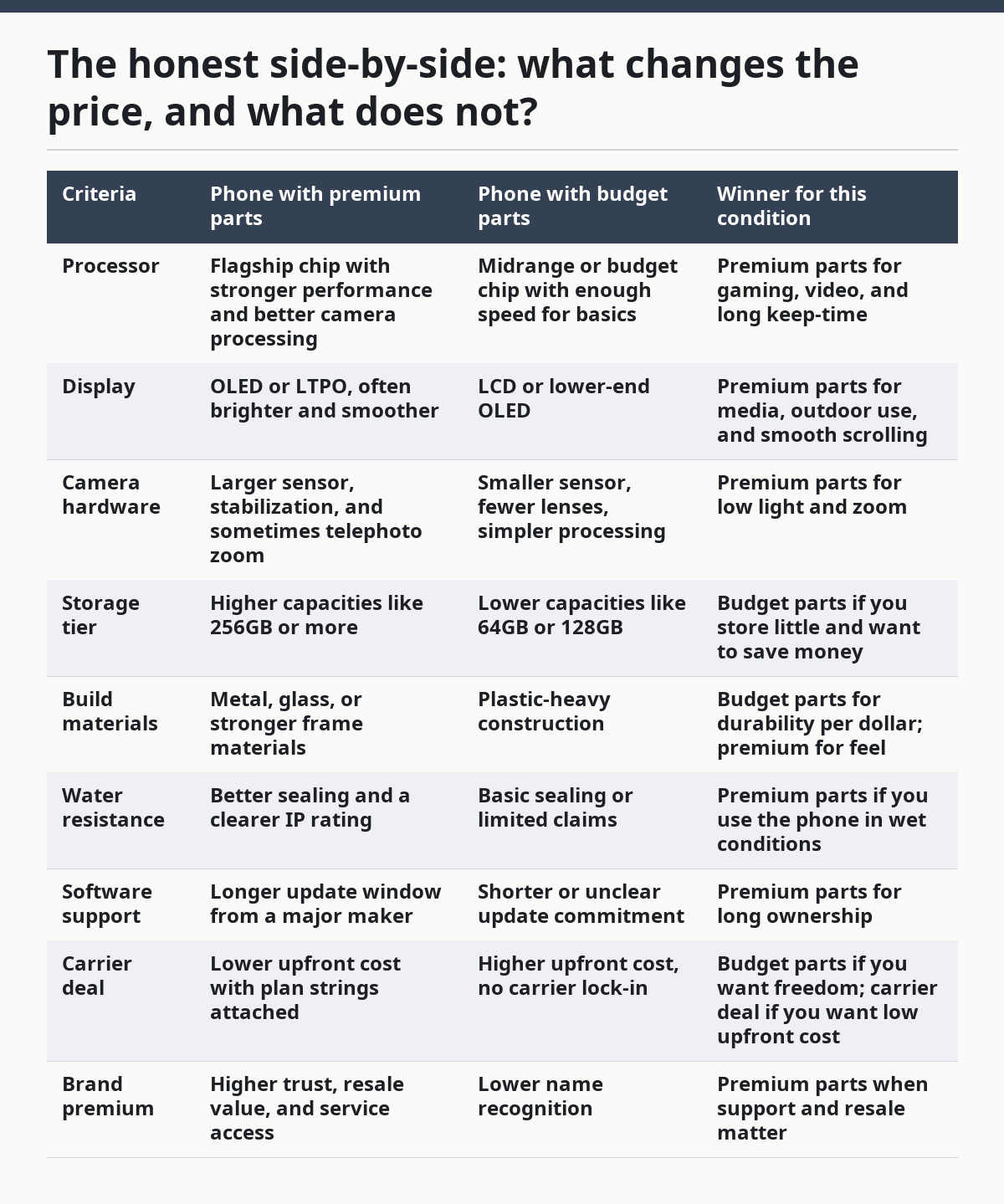
The best reading of this table is simple: pay more for the parts you will feel every day, not for the parts that only look impressive on a spec sheet. A phone with a weak chip and a weak display can feel cheap even if it has a famous logo. A phone with sensible parts can be a better buy at a much lower price.
Which phone pricing factors matter least to most buyers?
The answer is that some factors sound important but do not change daily use enough to justify much of a premium. Finish details, minor camera counts, and marketing phrases often matter less than battery, chip, screen, and storage.
Picture this: you are reading a product page full of terms like “pro,” “ultra,” and “AI-powered.” Those labels can hide small real changes, or they can distract you from bigger differences like a slower chip or a dimmer screen.
Lower-priority price factors often include:
- cosmetic design tweaks
- extra camera lenses that are rarely useful
- brand slogans
- special colorways
- slight body slimness that hurts battery or grip
Higher-priority factors usually include:
- battery life and charging
- display quality
- processor speed
- storage size
- software support
- camera quality in real light, not just marketing shots
If the sales pitch leans hard on a color finish or a fancy name for a feature you will barely use, that is a clue. The actual value may be weaker than the price suggests.
How should you judge a phone price before you buy?
You should judge a phone price by asking what you get for the money, how long you plan to keep it, and what you are willing to give up. The lowest price is not always the best deal, and the highest price is not always the best phone for you.
Picture this: you have a list of phones at different price points and need to rank them fast. Start with the features you will notice every day, then check the support window, then compare storage and camera hardware.
Use this quick test:
- Screen first: OLED or LCD? Bright enough for outdoor use?
- Chip second: strong enough for your apps and years of use?
- Storage third: enough for photos, video, and app growth?
- Battery fourth: will it last a full day in your hands?
- Camera fifth: good enough for the light you actually shoot in?
- Support sixth: will the phone still get updates when you still want to keep it?
If a phone fails the first three checks, a low price may still not save it. If it passes them and still costs less than the premium model, that is the kind of value worth chasing.
What are the biggest mistakes people make when judging phone prices?
The biggest mistake is treating the sticker price as the whole story. That misses the storage tier, the carrier terms, the support window, and the features you’ll use daily.
Picture this: you find a phone with a low monthly payment and assume it is cheap. Then the plan runs longer than expected, the storage fills up, and the camera disappoints. The “cheap” phone was not cheap at all.
Common mistakes:
- buying on logo alone
- paying for camera specs you won’t use
- ignoring storage size
- overvaluing thinness and finish
- forgetting that carrier deals can hide the real total cost
- skipping update policy research
The best move is to compare phones on use, not hype. A model that costs less and does the basics well can be the smartest purchase in the room.
FAQ
Why do phone prices vary so much between similar models?
Phone prices vary because the parts inside are not equal, even when the phones look similar. A better chip, brighter display, larger storage tier, and stronger camera hardware can raise the price fast. Brand support and carrier terms can also change the number you see.
Is a more expensive phone always better?
A more expensive phone is not always better for the way you use it. If you only call, text, browse, and stream, a midrange model may be the better value. The more expensive phone is worth it when you will actually use its better screen, camera, chip, or support window.
What matters more, camera quality or processor?
The processor matters more for overall speed and long-term smoothness, while the camera matters more if you take lots of photos and video. A strong chip helps the camera too, since image processing depends on it. If you care about both, do not buy a phone with one strong spec and one weak one.
Are carrier phone deals worth it?
Carrier deals can be worth it if you want lower upfront cost and you are happy with the plan terms. They are less attractive if you want full freedom or plan to switch carriers soon. Always compare the total cost over the time you expect to keep the phone.
Should I pay more for more storage?
You should pay more for storage only if you actually need it. If you keep lots of video, games, or offline files, the extra storage can be worth every dollar. If you use cloud storage and keep your phone light, the base tier may be enough.
Drafted with AI; not yet reviewed by a person.