
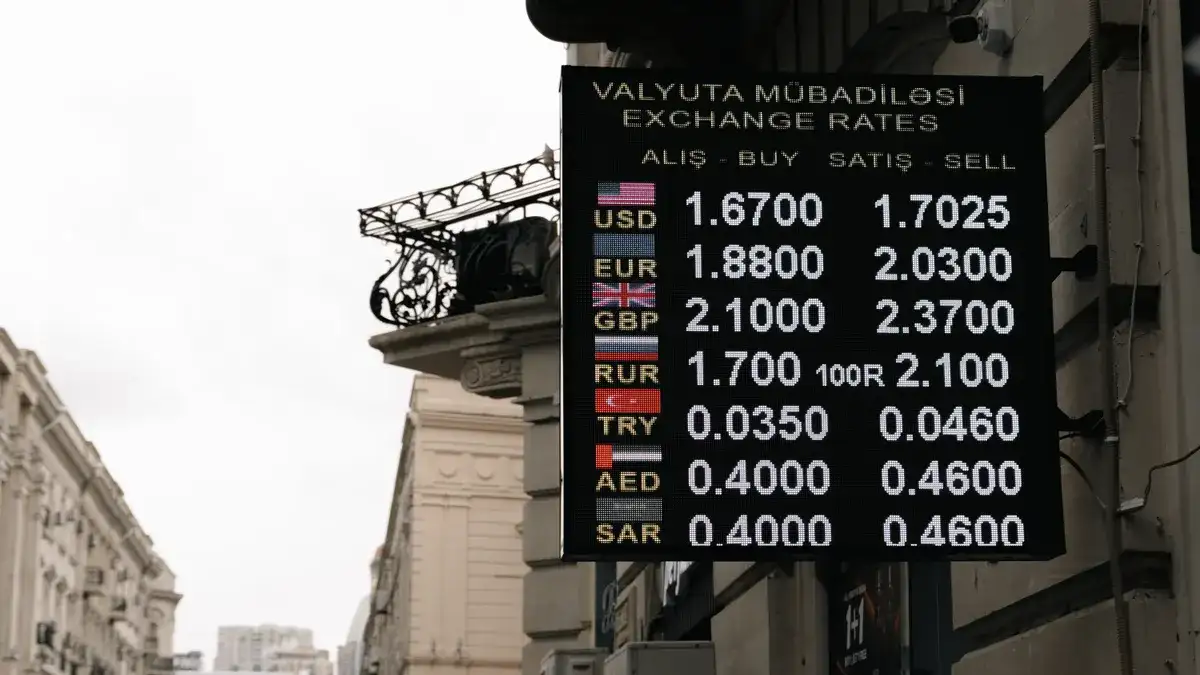
How Currency Exchange Rates Affect Imported Phone Prices
Last updated: November 26, 2026
Quick Answer: If a retailer is still selling stock bought at the old rate, a phone price may not change for 60 days or more. Currency moves can still affect imported phone prices, but the shelf price often changes later, in smaller steps, or not at all for a while because of retailer repricing and exchange-rate lag.
Currency exchange rates change imported phone prices because the seller often pays for the phone, shipping, and inventory in another currency, then converts that cost into your local price. When the exchange rate moves, the landed cost moves too, but the shelf price may change later, in smaller steps, or not at all for a while because of retailer repricing and exchange-rate lag.

Key takeaways
- A weaker local currency usually makes an imported phone cost more, even if the phone’s list price abroad has not changed.
- The price you see in a store is not a direct conversion; it also includes stock costs, local overhead, and the retailer’s margin.
- Retailers do not always change prices on the same day the exchange rate moves. Lag can be days or weeks.
- A “discount” can be real markdown, or it can just be a price that was raised earlier and then held steady.
- The right comparison is the local shelf price today, not a simple currency conversion on a calculator.
Why does a foreign exchange move change the phone price?
A foreign exchange move changes the phone price because the importer’s cost changes before the shopper’s price does. If a phone is bought in dollars, euros, or yuan and sold in a different currency, the local seller has to convert that cost before adding tax, shipping, storage, warranty support, and profit.
That matters most for imported phones, especially brands and models that do not have fully local manufacturing or local pricing buffers. A phone that lands at a wholesale cost of 800 units of a foreign currency may not stay at the same local cost when the local currency weakens. The same invoice now takes more local money to pay.
The reverse is also true. If the local currency strengthens, the imported cost falls on paper. That does not guarantee the sticker price drops right away, because the seller may still be clearing stock bought at the old rate. That gap is the exchange-rate lag that makes phone pricing feel random.
This is why a phone can seem to get “more expensive for no reason” even when nothing about the model changed. The model is the same. The local currency is not.
A useful way to think about it is this: the exchange rate sets the floor under the importer’s cost, and retailer pricing decides how much of that cost reaches the shopper. For a broader look at the other forces behind handset pricing, see the hub on what affects mobile phone prices.
How do retailers turn exchange rates into shelf prices?
Retailers turn exchange rates into shelf prices by converting their landed cost, then adding markup and local expenses. The shelf price is usually built from several pieces: supplier invoice, shipping, customs handling, warehousing, warranty allowance, staff costs, rent, card fees, and margin.
That means the converted price on a currency app is only a starting point. A phone that costs the equivalent of 500 in one currency abroad does not become 500 on the shelf in another country. The retailer still has to protect itself against future exchange swings and unsold stock.
A simple way to picture the chain is:
- The importer buys stock in a foreign currency.
- The exchange rate shifts before the stock is sold.
- The importer converts the new cost into local currency.
- Retail pricing adds local costs and profit.
- The shelf price appears, often rounded to a clean number.
That last step matters more than people expect. A retailer may hold a price at 999 rather than move it to 1,023, or cut it from 1,099 to 1,049 instead of tracing the currency change exactly. The result can look like a sale even when it is just pricing psychology.
One honest limitation: this does not explain every price tag. Some sellers keep prices higher for longer because they bought inventory before the currency moved against them and do not want to reset the market too often. Others adjust fast because they import small batches and reprice often. See also our guide to how phone discounts work and imported electronics pricing.
What is exchange-rate lag in phone pricing?
Exchange-rate lag is the delay between a currency move and the retail price changing. It exists because stores rarely reprice phones in real time, even when the wholesale market changes in hours.
Lag happens for practical reasons. Inventory already on the shelf was often bought at an older exchange rate. If a store changes prices too fast, it can confuse customers, damage trust, or leave the price bouncing around every week. Many retailers wait until the next stock order, the next pricing review, or the next promo cycle.
That delay is why people often think the phone market is “slow” or “unfair.” In reality, the price can be following a cost that changed earlier. A phone imported in January may still be sold in March at a price based on January’s exchange rate, even if the local currency moved sharply in between.
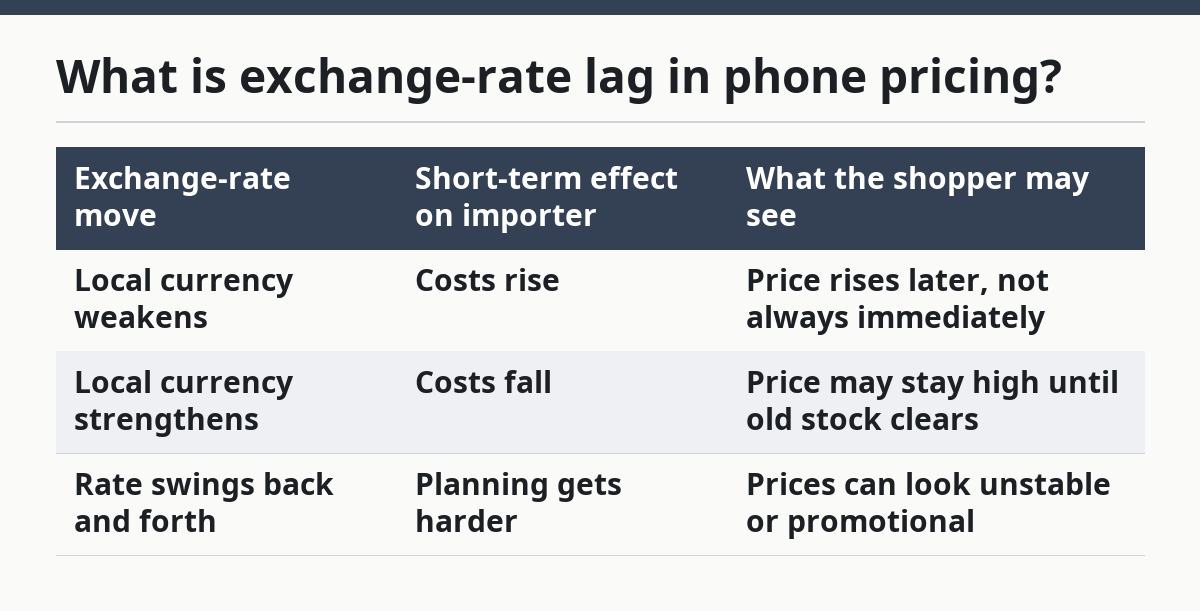
The lag can work in either direction:
| Exchange-rate move | Short-term effect on importer | What the shopper may see |
|---|---|---|
| Local currency weakens | Costs rise | Price rises later, not always immediately |
| Local currency strengthens | Costs fall | Price may stay high until old stock clears |
| Rate swings back and forth | Planning gets harder | Prices can look unstable or promotional |
This is one reason a phone sometimes gets more expensive, then “discounted” back to the old price. The store may be adjusting to a newer exchange rate rather than cutting into margin.
If a price changed twice in a month, that does not automatically mean the first price was wrong. It may mean the seller was smoothing risk across shipments that landed at different rates.
Should you trust the converted price you see online?
No, you should not trust the converted price you see online as the final phone price. A currency converter tells you the exchange rate only; it does not include local tax, import handling, shipping, retailer pricing, or the exchange-rate lag between buying stock and selling it.
This is the mistake many shoppers make when cross-border shopping. They compare a foreign listing with the local shelf price and expect the difference to be small and obvious. In practice, the gap can be larger because the foreign listing may exclude local selling costs, while the domestic price may already include the seller’s risk buffer.
The better comparison is between the local price today and the total amount a cross-border order would really cost after conversion and shipping. Even then, the timing matters. A phone that looks cheap on Monday may not stay cheap by Friday if the exchange rate moves and the seller reprices.
Here is a practical way to check the real effect of currency movement:
- Check the phone’s local shelf price in your market, not the advertised foreign price.
- Look at the current exchange rate for the currency that the supplier uses.
- Compare that rate to the rate from the last time the price changed, if you know it.
- Ask whether the phone is new stock or stock bought before the currency move.
- Decide whether the gap is a currency effect, a promo, or just normal retailer pricing.
That process does not give a perfect answer, but it does stop the most common error: treating a live exchange rate as if it were the full price.
For reference, exchange-rate reference pages from the European Central Bank and the Bank for International Settlements are good places to see how official rate data is presented: ECB euro reference exchange rates and the Bank for International Settlements statistics pages.
Why does the local phone price not match the math?
The local phone price does not match the math because retailers price for survival, not for purity. A pure currency conversion ignores the seller’s stock risk, local demand, competition, warranty costs, and the fact that not every unit was bought at today’s exchange rate.
That is why two stores can show different prices for the same imported phone on the same day. One store may still be selling old stock bought at a better rate. Another may have a newer shipment landed at a worse rate and needs to protect its margin. Both prices can be sensible from the seller’s side even if they look inconsistent from the shopper’s side.
This is also why price conversion can mislead people during short spikes in the currency market. A one-week move can hit some sellers hard and barely touch others. If a retailer has 60 days of stock on hand, the shelf price may not move until that stock is replaced. If it imports in smaller batches, the change can show up much faster.
That said, not every price difference is about exchange rates. Local promotions, model age, and simple retailer strategy still matter. A phone can fall in price because a newer model is arriving, not because the currency got stronger. A currency move may be part of the story, but it is rarely the whole story.
How can you spot a currency-driven price change?
You can spot a currency-driven price change by looking for a pattern across time, not one price tag on one day. If several imported phones from the same brand rise at once, or if a seller changes prices soon after a sharp currency move, exchange rates are likely part of the cause.

The clue is often in the timing. A retailer may hold prices steady for a short period, then raise them across a range of models after the next stock cycle. That is exchange-rate lag in action. The change may be small on each model, but the pattern across the lineup can be clearer than the movement on one phone.
A currency-driven change also tends to affect imported models more than phones with strong local supply. If one brand jumps while a locally assembled or locally priced model stays flat, the exchange rate is doing more work on the imported brand.
This is where people get tripped up by “discounts.” If a phone was priced high after a currency squeeze and then moves back to its older number, the shelf label may look like a special offer. It may not be. It may simply be the retailer catching up with a better conversion rate or selling through older inventory.
The honest judgment is simple: currency rates matter a lot, but they do not set the final phone price by themselves. This topic is for anyone trying to understand why a phone jumps in price from one month to the next. It is not enough for someone who wants a precise landed-cost calculation for a specific country or a duty estimate for a specific import.
Why does an imported phone price change from week to week?
An imported phone price changes from week to week because the seller may be reacting to a moving exchange rate, new stock costs, or a planned repricing cycle. The change is often not immediate. Retailers may wait until the next shipment or the next price review before adjusting what shoppers see.
How do exchange rates affect electronics prices?
Exchange rates affect electronics prices by changing the local cost of goods bought abroad. Phones are especially sensitive because they are high-value items with tight margins, so even a small currency move can push the seller to reprice. The shelf price may move less cleanly than the exchange rate itself.
Can retailers delay price changes after currency moves?
Yes, retailers can delay price changes after currency moves, and they often do. A shop may hold the current price while it sells older stock bought at a better rate. That delay can last days, weeks, or until the next shipment lands, which is why the market can look slow to react.
Why is the local price different from the converted price?
The local price is different from the converted price because the converted figure leaves out retail costs and pricing strategy. Shipping, handling, local taxes, warranty coverage, and margin all sit on top of the currency conversion. A calculator gives the exchange rate, not the final shelf price.
Drafted with AI; not yet reviewed by a person.