
How Phone Age, Model Lifecycle, and Clearance Pressure Affect Prices
Last updated: November 26, 2026
Phone prices fall as a model gets older, then move in waves when the product lifecycle shifts and retailers want stock gone. The biggest drops usually show up when a replacement model is near, stock is aging on shelves, or support cycle pressure makes a phone harder to sell at full price.
Key takeaways
- Older phones do not get cheaper at a steady pace; price changes usually come in jumps tied to the model lifecycle.
- Clearance pressure matters most when retailers still hold unopened stock and want it out before the next model takes attention.
- A phone can be old, yet still cost a lot if it has scarce stock, a strong reputation, or a long support cycle.
- Discontinued does not always mean cheap. Some models rise in price when supply dries up.
- The best signal is not age alone. Look at stock age, replacement model timing, and how long software support still has left.
What actually sets the price?
Phone age sets the floor, but model lifecycle and clearance pressure decide how fast the price moves. A 2-year-old phone usually costs less than a current model because it is no longer the newest thing on the shelf, yet the real cut often arrives when the retailer wants to clear the last units.
This is why two phones with the same launch year can sit at very different prices. One may still be in normal sale stock, while the other is in a clearance phase because the replacement model is already on sale. The older unit gets pushed down by the new one, not by the calendar alone.
A useful way to think about it is simple: age changes demand, lifecycle changes position, and clearance changes urgency. If a phone is 18 months old but still in active promotion, the price can hold better than a 12-month-old model that has been marked down to empty shelves.
The page on what affects mobile phone prices goes wider than this, but this guide stays on the part many buyers miss: the drop is often driven by stock pressure, not just how long ago the phone launched. A model that is still current can stay firm. A model that is no longer the focus can soften fast.
How does phone age change the price?
Phone age changes the price by making the model less current, less promoted, and more likely to be compared with newer phones. The older the model, the more likely buyers are to ask why they should pay near-launch money for it instead of choosing the replacement model.
The price effect is not smooth. A phone can hold its value for a long stretch, then drop quickly when a newer generation lands or when retailers shift away from it. A 1-year-old model and a 3-year-old model may not differ by a neat step; the gap depends on whether one of them is still being pushed by the seller.
Here is the basic pattern in plain terms:
| Phone stage | What is happening | Price pressure |
|---|---|---|
| Fresh launch | Newest model gets the most attention | Low pressure |
| Early lifecycle | Main stock is still current | Mild pressure |
| Mid lifecycle | Replacement model exists or is close | Rising pressure |
| Late lifecycle | Clearance stock starts building | Strong pressure |
| After lifecycle | Supply thins or support fades | Mixed pressure |
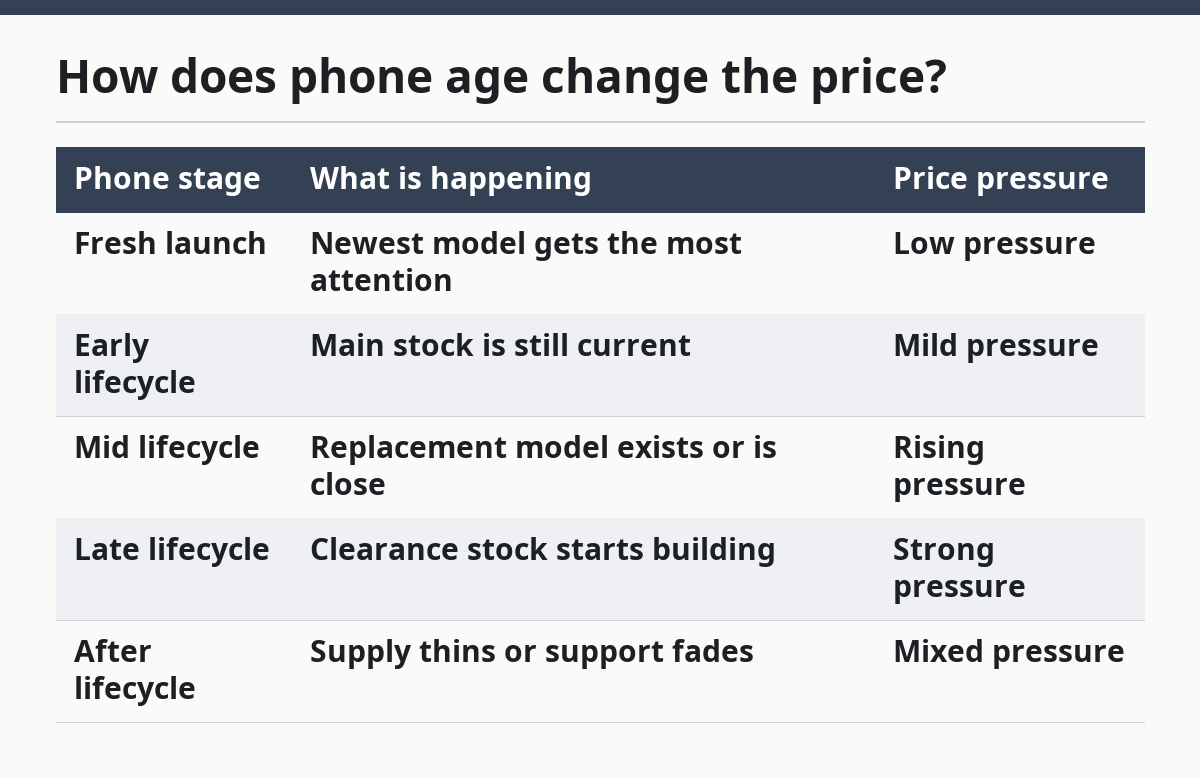
Age alone does not decide everything. A well-known model with a strong battery reputation can stay expensive longer than a newer phone that buyers distrust. The same goes for storage size, color, and opened status. But once age moves a phone out of the main sales window, the price rarely stays at launch levels for long.
One common mistake is treating age like a straight line. It is not. The price can sit still for months, then drop in one move when the product lifecycle changes. That is why a buyer who waits for “older” often gets a better result than someone who waits for “a little older.”
What is the product lifecycle in a phone model?
The product lifecycle is the path a phone model follows from launch to replacement to end of active selling, and that path explains most price changes. A model is usually most expensive when it is new, then it starts to lose value as the next model approaches and the old one becomes the backup option.
For pricing, the important stages are launch, active sale, replacement, and clearance. Launch pricing reflects novelty and demand. Active-sale pricing reflects normal retail competition. Replacement pricing begins when the next model is visible and the older phone becomes the obvious fallback. Clearance pricing begins when the seller wants the last stock gone.
That lifecycle matters because retailers price against the model’s role, not just its age. If a phone is still the main version in the line, the seller has less reason to discount it hard. If a replacement model is already on the shelf, the older one has to fight for attention. Once the older model becomes shelf clutter, the price can shift quickly.
This is also why “model lifecycle” is a better phrase than “old phone.” A phone may be old in months, but still current in the market if stock remains healthy and the support cycle is long. Another phone may be older by the calendar and already treated like dead stock because the line has moved on.
For a buyer, the lifecycle question is not “How old is it?” It is “Where is it in the seller’s plan?” That answer tells you whether the price is stable, drifting, or being pushed down by urgency.
When does clearance pressure show up?
Clearance pressure shows up when the retailer wants to turn stored phones into cash and free shelf space for the replacement model. That usually happens when the old model no longer helps sales as much as the newer one, or when the stock age has gone far enough that holding it starts to look expensive.

The pressure is strongest on unopened inventory. A retailer with boxes in the back room has a reason to lower the price sooner than a seller with only a few units left. The longer the stock sits, the more likely it is to get marked down, bundled, or moved into a clearance section.
A clear way to spot it is through the language around the listing. Phrases like “last stock,” “limited colours,” “clearance,” or “end of line” usually mean the seller is trying to move the model before it becomes harder to sell. If a newer replacement model is already listed beside it, the pressure is even stronger.
A simple step-by-step way to read a clearance price is this:
- Check whether the model still looks current. If the seller still presents it as a main choice, the discount may be small.
- Look for the replacement model. If the newer version is already available, the older phone is under more pressure.
- Watch for stock age clues. Old packaging dates, long-running listings, and repeated markdown labels often point to slow-moving stock.
- Compare the price with other sellers. If the same model is cheaper only in one place, that seller may be clearing it harder than the market.
- Decide if the lower price is real value. A clear-out price is useful only if the phone still has enough support cycle left for your plans.
The mistake here is assuming any clearance tag is a bargain. Sometimes it is. Sometimes it is just a price cut on a phone that should already be priced there. The buyer’s job is to separate real pressure from lazy marketing.
Why can a discontinued phone still be expensive?
A discontinued phone can still be expensive because supply can shrink faster than demand. Once retailers stop restocking a model, the remaining units can become scarce, and scarcity can keep the price high even after the phone is no longer part of the normal lineup.
This happens most often with popular models, certain storage sizes, or colours that sell well. A phone with a loyal buyer base may keep a stubborn price because people still want it in a specific form and the seller has little competition left on that exact unit.
The support cycle also matters here. If a discontinued phone still has software support left, some buyers see it as safe enough to buy. That can keep demand alive. If the phone is discontinued but still useful for several more years, the market may not treat it as junk. It may behave like a scarce item instead.
There is another wrinkle: some older models become harder to source in new condition. That can make the few remaining units more expensive than the previous month’s clearance price. The phone is not pricey because it is new. It is pricey because it is hard to find in the condition the buyer wants.
This is the point many generic guides miss. “Old” does not always mean “cheap.” A discontinued phone can sit in a strange middle zone where the seller has no reason to discount deeply and the buyer still wants that exact model. That is why age, lifecycle, and clearance pressure need to be read together.
How should you judge a price before you buy?
Judge the price by asking where the phone sits in the lifecycle, how old the stock may be, and whether clearance pressure is real. A phone price is easier to read when you stop looking only at the number and start looking at the model’s place in the market.

A practical way to do that is to check four signals in this order:
- Model age: Is this a fresh model, a 1-year-old model, or something clearly older?
- Replacement model: Has a newer version already taken the spotlight?
- Stock age: Does the listing look like it has been hanging around for a while?
- Support cycle: Is the phone still likely to get updates for long enough to matter to you?
These signals tell you whether the price is being held up by demand, pulled down by clearance, or distorted by scarcity. A phone that is still current but lightly discounted may be a better buy than a much older model with a bigger sticker cut. A deep discount on an out-of-line phone can still be poor value if the support cycle is nearly done.
Two official support pages show how manufacturers describe update windows and model support: Apple’s iPhone software update help pages and Google’s Pixel phone support pages. The exact dates and device lists differ, but the point is the same: support cycle length changes how the market values older phones.
If the price seems low, ask what is driving it. If the answer is “clearance stock with a replacement model already out,” that is a normal reason for a drop. If the answer is “discontinued and hard to find,” the price may stay higher than you expect. That is not a contradiction. It is the market reacting to age, supply, and demand at the same time.
Which phones lose value fastest?
Phones usually lose value fastest when they are close to replacement, easy to compare against newer models, and left with little stock to protect the price. That makes mid-range models and phones with short-lived buzz especially vulnerable once the next version arrives.

The fastest drops often happen when the old model has little reason to stay premium. If the replacement model improves battery life, camera hardware, or storage at a similar price, the older one loses pricing power fast. The market then treats the older phone as a leftover choice rather than the main event.
The slower cases are different. A model with long support, strong demand, or low stock turnover can keep a firmer price even after it stops being headline news. That is why some older phones feel overpriced while others feel like clear bargains. Their lifecycle position is different.
The wrong move is assuming all older phones should fall the same way. A phone with plenty of remaining support and steady demand can stay expensive for a while. A phone with aging stock and a visible replacement can get cheap quickly. The lifecycle, not the birthday, decides the pace.
FAQ
Why do older phones get cheaper?
Older phones get cheaper because demand weakens and newer models pull attention away. Once a replacement model is available, the older one has less reason to hold its original price. Retailers also cut prices when they want to clear stock before it sits too long.
When do retailers start clearing stock?
Retailers start clearing stock when the phone stops being the main model they want to sell. That often happens after a replacement model arrives or when the remaining units become slow movers. The exact timing varies, but the discount pressure usually rises as stock age grows.
How does model age affect phone pricing?
Model age affects phone pricing by changing how current the phone feels to buyers. A newer model can stay near its normal price longer, while an older one is more likely to be marked down once it moves into the background. Age is the first signal, but it is not the only one.
Why can a discontinued phone still be expensive?
A discontinued phone can still be expensive when supply is low and demand is still strong. If only a few new units remain, sellers may hold the price instead of cutting it hard. A long support cycle can also help keep demand up, which supports the price.
Drafted with AI; not yet reviewed by a person.