

How Color, Storage, and Variant Choices Change Phone Prices
Last updated: November 26, 2026
Phone variants change prices because the same phone can be sold in different storage tiers, colors, finishes, special editions, and regional models, and those choices affect parts cost, demand, and how many units a seller can stock. If you are trying to understand why one version of a phone costs more than another, the answer is usually not one single reason. It is the mix of memory size, how rare the finish is, and whether the model was made for a specific market.
Key takeaways
- Storage is the most common reason for a price jump, especially when a phone moves from a base tier to a larger one.
- Color can change price when a finish is rare, limited, or tied to a special run.
- Special editions usually cost more because they bundle branding, design changes, or extra accessories.
- Regional variants can differ in radios, SIM support, or model code, which can affect price and resale value.
- A phone that looks identical on a listing may still cost more if its variant is harder to source or sell.
How phone variants change prices
Phone variants change prices because not every version has the same cost to make, market, or replace. A standard 128GB model in black is usually the base price, while the same phone in 256GB, in a limited color, or in a special edition can sit higher on the shelf. That extra cost does not always come from parts alone; it can also come from demand and availability.
This is why two listings with the same phone name can still differ by a noticeable amount. A phone with a common finish and common storage tier is easier to stock and easier to discount. A phone with a rare color, a premium finish, or a region-specific model may stay closer to list price because fewer units are available.
The cleanest way to think about it is simple: storage changes the hardware you get, while color and variant choices often change how scarce the phone is. If you want the lowest price, the plainest configuration is usually the one to watch first. If you want a specific look or edition, expect to pay more or accept a narrower choice set.
For a broader view of the market, this page sits under the guide to what affects mobile phone prices. That wider topic covers the main forces behind phone pricing; this page is about the choices inside one model family.
Which storage tier changes price the most?
Storage tier changes price more consistently than color does, because extra memory is a real hardware upgrade. A phone sold in 128GB, 256GB, 512GB, or 1TB tiers can climb in price each time the storage doubles or increases sharply. The exact gap depends on the brand and model, but the pattern is usually easy to see.
The catch is that more storage is not always better value for every buyer. If you mostly stream music, use cloud backup, and keep a modest photo library, the base tier may be enough. If you shoot a lot of 4K video, keep offline files, or never want to think about freeing space, the higher tier can be the wiser choice even when it costs more.
A quick way to judge storage pricing is to compare the gap against your real use. If the higher tier only solves a problem you already have, the premium may make sense. If you are paying for space you will never use, the price jump is just a tax on caution.
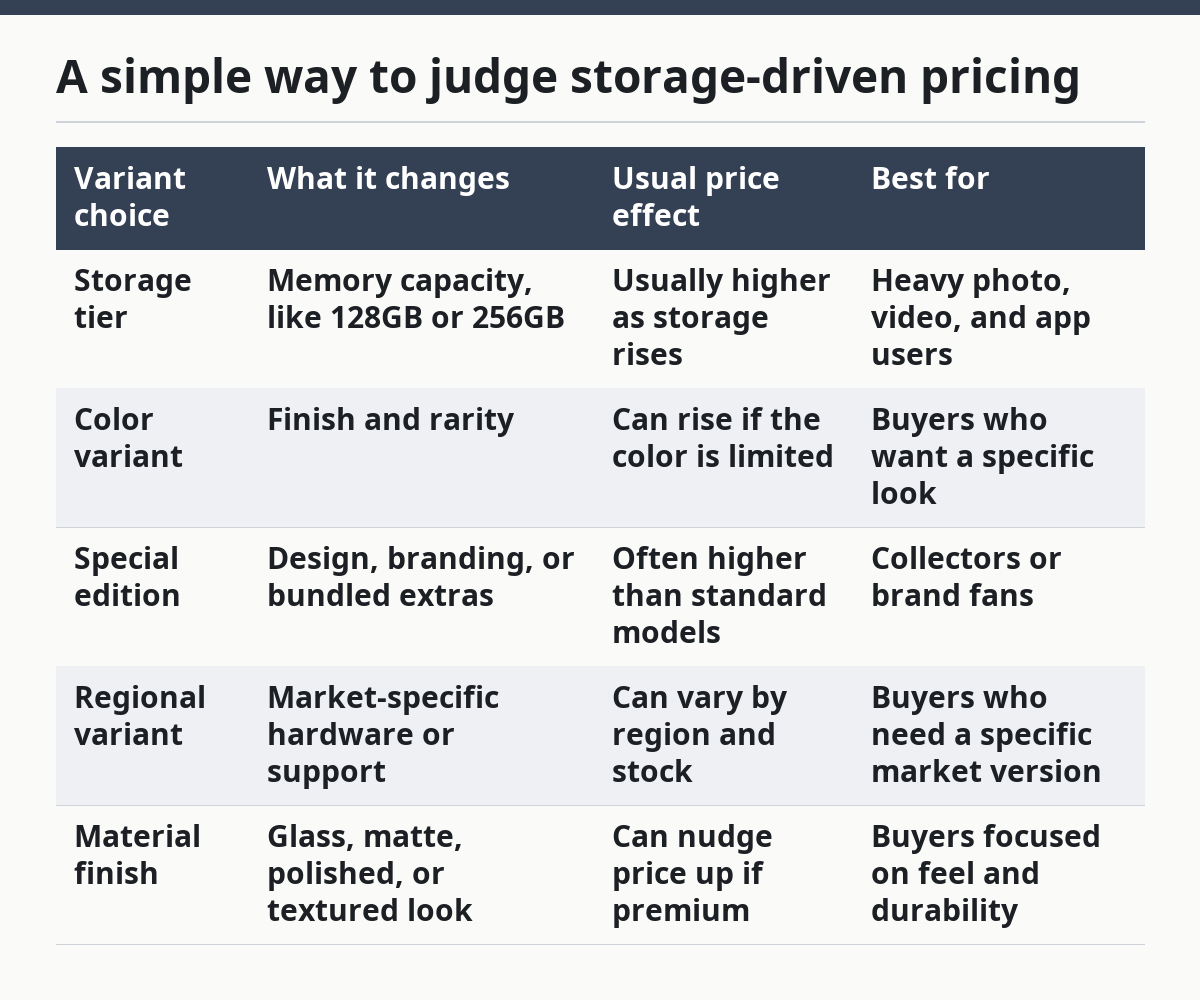
A simple way to judge storage-driven pricing
- Start with the smallest tier you could live with. On many phones that is 128GB, and it sets the floor price for the model.
- Add the tier above it only if your files will grow fast. Moving to 256GB is often the first meaningful jump for buyers who keep photos, video, and games on-device.
- Check whether cloud storage already covers your habits. If it does, the bigger tier may not buy you much.
- Look at the price difference, not the storage number alone. A larger tier is only worth it if the extra cost matches the value of the extra space to you.
| Variant choice | What it changes | Usual price effect | Best for |
|---|---|---|---|
| Storage tier | Memory capacity, like 128GB or 256GB | Usually higher as storage rises | Heavy photo, video, and app users |
| Color variant | Finish and rarity | Can rise if the color is limited | Buyers who want a specific look |
| Special edition | Design, branding, or bundled extras | Often higher than standard models | Collectors or brand fans |
| Regional variant | Market-specific hardware or support | Can vary by region and stock | Buyers who need a specific market version |
| Material finish | Glass, matte, polished, or textured look | Can nudge price up if premium | Buyers focused on feel and durability |
Why do some colors cost more?
Some colors cost more because the shade is rare, tied to a limited run, or sold as a premium finish. A standard black, white, or silver model is usually easy to produce and stock. A limited color can be made in smaller numbers, which makes it harder to find and more likely to carry a price premium.
Color can also affect demand in ways that are easy to miss. A rare color may sell faster because buyers want the look, not just the phone. That can keep prices high even when the rest of the market has softened. In other cases, a common color may be discounted first because sellers know it is easier to move.
This is where buyers get tripped up. They assume the phone itself is more expensive when the real difference is the finish. If the hardware is identical, the color premium is usually about availability and presentation, not a better camera or faster chip.
That said, color is not always a price booster. A common finish may cost the same as any other and still be the cheapest way to get the model you want. If you care more about the device than the shade, the safest move is to treat color as a cosmetic choice, not a performance upgrade.
What counts as a special edition?
A special edition is a version of a phone that goes beyond the standard color or storage choice, and it often carries a higher price because it is marketed as something distinct. That can mean a unique finish, themed packaging, extra branding, or a release tied to a partner or event. The price difference is often about collectability as much as hardware.
Special editions are not always better phones. In many cases, the core parts are the same as the regular model, and the premium comes from the label or the limited run. That is why these versions can feel expensive for what they offer if you only care about screen size, battery, or storage.
This kind of variant is not for buyers who want the cheapest path to the same specs. It is for someone who values the look, the story, or the fact that the phone is less common. The drawback is obvious: resale can be unpredictable, and the edition may disappear long before the standard model does.
Regional variants are different again. They are not usually about style; they are about market fit. A regional model may have different SIM support, radios, software features, or model numbers, and that can change how it is priced and sold.
How can regional variants change the price?
Regional variants can change the price because the same phone name may hide different hardware or market support. A version built for one region may support different network bands, dual-SIM use, or local software rules. That makes some variants easier to sell in one market than another, which can shift price.
The price effect is often indirect. A regional model that is hard to import, hard to service, or hard to resell may be cheaper on paper but riskier to buy. Another regional version may carry a premium because it is the one local buyers want, even if the box and design look identical.
This matters most when a buyer is comparing listings that look the same at a glance. A model code, SIM setup, or market label can hide the real difference. If you do not check the region, you may pay for a version that is harder to use where you live or harder to move later.
For shoppers, the best rule is to match the model to the network and market you actually need. A regional variant can be a bargain only if it works cleanly in your region. If it does not, a lower sticker price can turn into a bad deal fast.
Which variant choice matters most when you want value?
Storage usually matters most for value, while color and special editions matter most for scarcity. If your only goal is to keep the price down, pick the most common storage tier, a standard color, and a regular model from the right region. That combination usually gives the lowest friction and the widest stock.
The wrong move is paying a premium for a look you do not care about. A rare color or special edition can be pleasant to own, but it does not usually make the phone faster, last longer, or take better photos. If the extra cost does not change daily use, it is a style choice, not a value choice.
The better move is to compare the version details line by line before you think about the headline model name. Storage tier, color, special edition status, regional code, and finish all belong in the same check. When you read listings that way, the price difference makes more sense and the surprises shrink.
One last point: the cheapest variant is not always the best buy if it is too small on storage. A phone that fills up in 6 months can cost more in the long run than the higher tier that fit your needs from day one.
What mistakes make variant pricing look confusing?
Variant pricing looks confusing when buyers compare the name of the phone instead of the exact configuration. A listing that says the same model can still hide a 128GB base version, a 256GB upgrade, or a limited finish, and those are not the same product. That is the main reason people think prices are random.
The first mistake is assuming every color should cost the same. That fails when one shade is limited or tied to a special run. The second mistake is treating storage as a small detail. On many phones, storage is one of the clearest reasons the price moves upward.
A third mistake is ignoring regional labels. A model intended for one market may not match the one sold elsewhere, even if the phone looks identical in photos. That can affect price, warranty support, and how easy it is to replace later.
If you want a cleaner comparison, write down the exact storage tier, color, edition, and region before you compare prices. That one habit removes most of the noise. It also stops you from paying a premium for a variant feature you did not mean to buy.
Why do some variants disappear from sale sooner?
Some variants disappear sooner because sellers stock fewer units and buyers concentrate on the same popular options. A limited color, a special edition, or a regional model often has a smaller supply than the common version. Once that batch sells through, the listing can vanish long before the phone itself is gone.
This is most obvious with colors and special editions. A standard black or white model may stay around for months, while a rare finish shows up briefly and then disappears. The same thing happens with regional variants when a seller only has a short run from one market.
The practical effect is simple: rare variants can be harder to compare because there are fewer live listings to check. That can push prices around in both directions. A seller may charge more because the item is scarce, or discount it because they want to move the last units before demand fades.
If you need a particular variant, do not wait for it to behave like the standard model. Scarce colors and special editions move on their own schedule. Once they are gone, the only versions left may be the ones you were trying to avoid.
Why is one color of the same phone more expensive?
One color can cost more because it is harder to produce, harder to stock, or simply more desirable than the standard finish. The phone’s core parts may be identical, but the market still treats the rare color as a different item. That difference shows up fastest when supply is tight.
Does storage size always increase the price?
Storage size usually increases the price, but the size of the jump is not always the same. A move from 128GB to 256GB is often a smaller step than a jump to 512GB or 1TB. The rule is simple: more storage tends to cost more, yet the exact premium depends on the model and brand.
Are special editions priced differently?
Special editions are often priced differently because they are sold as limited or distinct versions. The premium may come from the design, the branding, or the fact that the edition was produced in smaller numbers. In some cases, the core phone is the same as the regular model, which makes the extra cost easier to spot.
Why do some variants disappear from sale sooner?
Some variants disappear sooner because fewer units are made and demand is uneven. A rare color, a special edition, or a regional version can sell out before the common model does. Once the stock is gone, the listing may vanish instead of being refreshed, which makes the variant feel even more scarce.
Useful references
- GSMA: https://www.gsma.com
- Apple iPhone technical specifications: https://www.apple.com/iphone/
Drafted with AI; not yet reviewed by a person.