

How marketplace fees change the listed phone price
Last updated: November 27, 2026
Marketplace fees usually push the listed phone price up, because the seller tries to recover seller fees, payment processing fees, and fulfillment costs before the phone sells. The next step is simple: look at the fee stack on the marketplace, then set the listing price high enough that the seller still keeps the amount they actually want after the sale.
Key takeaways
- The sticker price on a marketplace is not just the phone’s value; it also carries platform costs.
- Seller fees can be folded into the listing price before the phone ever goes live.
- Fulfillment fees matter most when the seller ships the phone through the platform instead of handling shipping alone.
- A higher listing price does not always mean the phone itself is worth more; it can mean the seller is covering fee drag.
- The right price is the one that leaves the seller with the intended net amount after the marketplace takes its cut.
What changes the listed phone price?
Marketplace fees change the listed phone price by adding cost pressure before the buyer clicks “buy.” A seller listing an iPhone 15 or Galaxy S24 does not set the price only from phone condition, storage size, and market demand; the seller also has to cover what the platform takes from the sale.

That is why two phones that look similar can sit at different prices on the same marketplace. One listing may include only a seller fee, while another also includes payment processing fees and fulfillment fees. If the seller wants the same net amount from each sale, the version with more fees needs a higher sticker price.
This is also why marketplace listing price inflation happens. The listed price rises not because the phone suddenly costs more to own, but because the seller uses the listed price to absorb platform costs. On the buyer side, that can make the phone look expensive compared with a bare-bones listing. On the seller side, it keeps the math from going negative after fees are taken out.
If the fee burden is high enough, the seller may also round the listing price upward to a clean number. That is common with phones priced near a common threshold, because a seller would rather list a Pixel 8 at a simple figure than set a price that leaves almost no room after platform charges.
What fees get built into the price?
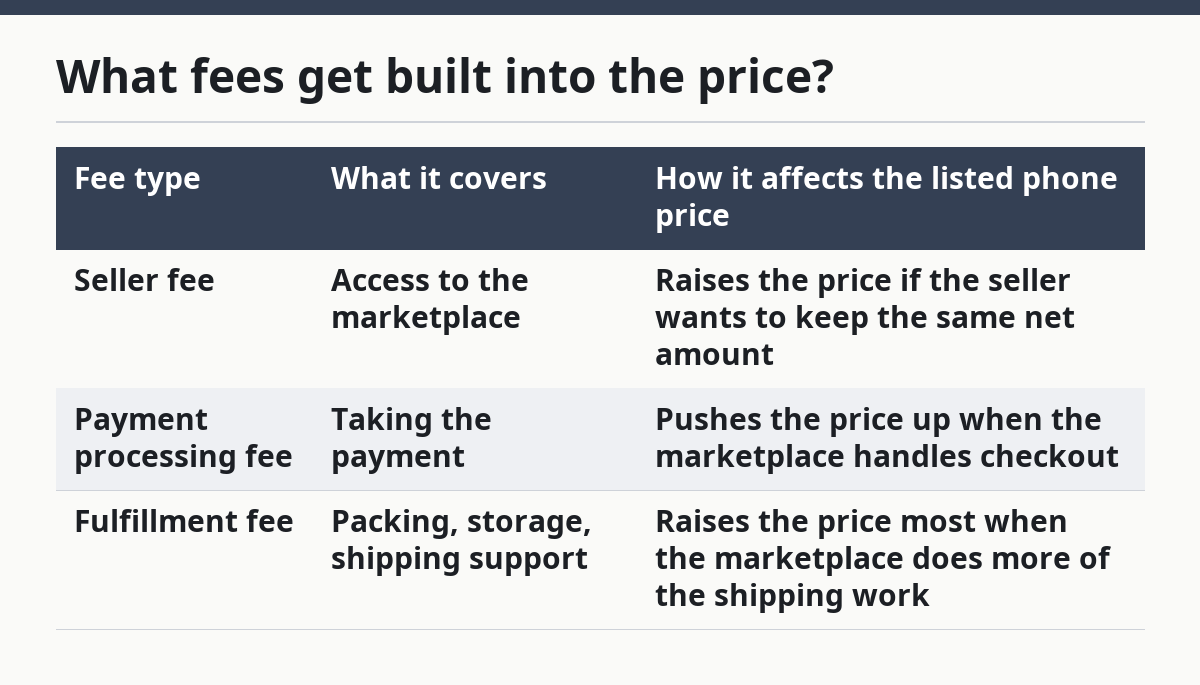
The listed phone price often absorbs three costs: seller fee, payment processing fee, and fulfillment fee. These costs can hit at different points, but the seller usually bundles them into one number because the buyer only sees one sticker price.
A seller fee is the platform’s charge for using the marketplace at all. Payment processing fees are the cost of collecting the money through the marketplace checkout flow. Fulfillment fees cover the work of storing, packing, and shipping the phone when the platform handles part of the delivery chain.
When a seller prices a phone, the fee stack matters more than any single charge. A low seller fee can still lead to a higher listed price if payment processing and fulfillment costs are also present. The reverse is true too: a listing with fewer platform services can stay lower because the seller has fewer costs to recover.
Here is the practical effect in plain terms:
| Fee type | What it covers | How it affects the listed phone price |
|---|---|---|
| Seller fee | Access to the marketplace | Raises the price if the seller wants to keep the same net amount |
| Payment processing fee | Taking the payment | Pushes the price up when the marketplace handles checkout |
| Fulfillment fee | Packing, storage, shipping support | Raises the price most when the marketplace does more of the shipping work |
A generic article often misses this point: the listed price is not always a sign of greed or premium positioning. Sometimes it is just the fee stack showing up in the only place the seller can control.
Why is a marketplace price higher than the store price?
A marketplace price is often higher than the store price because the seller is pricing for net proceeds, not just for the phone itself. A storefront may show a lower number if its fee structure is different, but this page is about the marketplace side, where the listed price can swell to cover platform charges.

That higher number can come from fee recovery, not from a better phone. A seller may list the same model, such as a Samsung Galaxy S24, at a higher marketplace price because the platform takes a cut from the sale, takes payment costs out of the payout, or charges for fulfillment. The listing has to make room for those costs somewhere.
A second reason is price padding. Some sellers add extra room to protect themselves from returns, shipping mistakes, or small price moves while the listing sits online. That does not mean every marketplace listing is padded, but it does mean the listed price can carry more than the phone’s visible value.
This is the part many readers get wrong: a higher marketplace price is not always a sign that the seller thinks the phone is better. It can simply mean the seller expects the platform to take more from the payout. If the same listing were moved to a lower-cost channel, the sticker price could come down without any change to the device.
How do marketplace fees affect final price?
Marketplace fees affect final price by changing what the seller needs to see after the sale clears. If the seller wants to net a certain amount, the listed price has to sit above that target by enough to cover the platform’s charges.
The simplest way to think about it is this: the buyer pays the listed price, but the seller keeps only what remains after the marketplace takes its fees. The more the platform takes, the more the listing has to rise to keep the seller whole.
For a phone listing, that matters in three common situations. First, a seller with a tight margin on an older model may increase the sticker price just to avoid losing money. Second, a seller using marketplace fulfillment may price higher because shipping support is part of the cost structure. Third, a seller may raise the price when the marketplace adds payment processing fees on top of the seller fee.
A seller who ignores this math can underprice the phone and lose money on the sale. A seller who overdoes it can make the listing look overpriced and slow the sale down. The right balance is the number that covers the fee stack without drifting so high that buyers skip the listing.
That is why the most useful pricing question is not “What does the phone cost?” It is “What will I keep after the marketplace fee stack comes out?”
How do I set a listing price that covers fees?
You set a listing price that covers fees by working backward from the net amount you want to keep. Start with the amount the seller wants after the sale, then add the seller fee, payment processing fee, and any fulfillment cost until the listing price leaves room for all of them.

- Write down the net target. Pick the amount the seller wants to keep after fees. For a phone like an iPhone 15 or Pixel 8, this is the number that matters most because it is the real goal of the listing.
- List every marketplace fee. Include seller fee, payment processing fee, and fulfillment fee if the marketplace handles shipping. Leaving out one fee is the fastest way to set the price too low.
- Add a cushion for small surprises. Returns, packaging, and a slight price move can eat into the payout. Even a small cushion helps keep the listing from breaking even on paper and losing money in practice.
- Check whether the phone needs a cleaner price point. A round number can help the listing look easier to understand, especially when buyers compare several Galaxy S24 or similar listings at once.
- Publish, then watch the net amount, not just the sale price. If the listing sells but the payout is too thin, the sticker price was too low for that fee stack.
The point of this process is not to chase the highest possible price. It is to stop the platform from taking a bigger bite than the seller planned for. A listing can look fair to a buyer and still be wrong for the seller if the fee math was skipped.
What mistakes make the price too high?
The most common mistake is adding fees twice, which makes the listed phone price climb faster than it should. Sellers sometimes build the seller fee into the price, then add the payment processing fee on top again in a separate bump, and the listing ends up higher than the real cost warrants.
Another mistake is using a high fee stack from one marketplace and applying it to every listing on every marketplace. That creates a stale price that may fit one platform but not another. A phone like a Pixel 8 may need one price on a fulfillment-heavy marketplace and a different one on a lighter platform with fewer charges.
A third mistake is padding the price to cover every possible problem. That can scare off buyers and slow the sale, especially if similar listings look cleaner. A listing that sits too long can cost more than the fee it was meant to avoid.
The trade-off is clear: a higher price can protect seller margin, but it can also make the phone harder to sell. If the listing is too aggressive, the seller may wait longer, lower the price later, or face more churn from buyers comparing similar devices. That is why fee recovery should be measured, not guessed.
Who should care most about fee-driven listing prices?
Sellers who care about net payout should care most about fee-driven listing prices. If the goal is to keep a certain amount from a marketplace sale, then the listed price has to reflect the seller fee, payment processing fee, and fulfillment cost from the start.
This matters most for sellers moving used phones, refurbished phones, or any model with thin margin room. A small fee change can turn a decent listing into a weak one. A phone like an older Galaxy or a midrange Pixel has less room for error than a newer model with stronger demand.
It matters less for sellers who are already pricing well above cost and do not need a tight net target. In that case, the platform fees still matter, but they are less likely to force a visible price jump. Even then, the seller still needs to know what the marketplace takes, because fee drag can quietly eat the return.
This is not the right page for a buyer trying to compare official store pricing, authorized seller pricing, or direct sales pricing. It is for the person trying to understand why one marketplace listing is higher than another and what the fee stack is doing to that number.
Where this fits in the bigger price picture
Marketplace fees are only one part of what affects mobile phone prices, but they are one of the easiest to miss. The fee stack can raise the listed phone price even when the phone model, storage, and condition stay the same.
That is why this topic belongs next to other price drivers, not separate from them. A marketplace listing for an iPhone 15 or Samsung Galaxy S24 reflects the device itself, the seller’s target payout, and the platform’s cost structure at the same time. If the fee side changes, the sticker price changes with it.
The simplest rule is this: a higher marketplace price often means the seller is trying to protect margin, not that the phone has magically become more valuable. If the listed price looks high, ask what fees are sitting inside it before assuming the seller overreached.
Drafted with AI; not yet reviewed by a person.