

Price Movement and Lifecycle: The Complete Guide
Last updated: November 27, 2026
Price movement in a phone’s lifecycle is simple: new models cost the most at launch, then prices usually ease as the next model gets close, and older models drop again when support and stock thin out. For a buyer, the right move is to pick the point in that cycle that matches the features needed, the support window wanted, and the budget on hand.
Key takeaways
- A phone’s price does not move at random; launch timing, new-model announcements, storage size, and support length all push it up or down.
- The biggest value shift usually happens when a newer model is announced, not when the old one is already years old.
- A phone with a lower sticker price can still be a poor buy if software support is nearly over.
- Refurbished and previous-generation phones often give the cleanest price-to-life balance.
- The right choice depends on how long the phone needs to stay in use, not just on the current tag.
What does price movement mean in a phone’s lifecycle?
Price movement means the phone gets cheaper or dearer as it moves through release, early demand, normal selling, discounting, and end-of-support stages. That cycle matters because a phone is not a flat-price product; the same model can sit at very different levels depending on age, stock, and the arrival of the next generation.
The cleanest way to think about it is by lifecycle stage. A new model, such as an iPhone 15 or Galaxy S24, usually starts at its launch price. A previous model, such as an iPhone 14 or Galaxy S23, often becomes the value pick once the newer phone is on shelves. Near the end of the support window, prices can fall again, but the buyer takes on a real risk: fewer updates, weaker resale value, and a shorter useful life.
This is why price movement is not only about finding the lowest number on the tag. A phone at a lower price can cost more over time if it needs replacing sooner. The better question is not “What is cheapest today?” but “How much usable life is left for the money?”
Why do phone prices change so much?
Phone prices change because the market rewards freshness, then punishes age. Launch day carries the highest attention, the strongest carrier push, and the least stock pressure. Once a new model arrives, the older one competes on value instead of novelty, and the price starts to bend.
Three forces drive most of the movement. First, new hardware resets the comparison. A phone with a newer chip, camera system, or USB-C port makes the older model look dated, even if the older model still works well. Second, retailer stock matters. When a color, storage size, or model line gets thin, the remaining units can hold price longer than expected. Third, software support changes the buyer’s view. A phone that still has years of updates left can hold a steadier price than a phone that is close to the end of support.
Carrier offers can blur the picture. A trade-in, installment plan, or bill credit can make a phone look cheaper than it really is, but the list price still matters when the buyer wants to compare phones across stores. The current price on a brand site, Amazon, Best Buy, or a carrier page may not tell the same story as the total cost over 24 months.
Which stage gives the best value?
The middle of the lifecycle usually gives the best value for most buyers. That is the point where the newest model has already reset the market, but the previous model still has enough support left to make the purchase sensible.
A phone in this stage often offers the best balance of price, features, and resale value. The buyer may miss the very latest camera tricks or chip revision, but often keeps the core benefits that matter most: strong battery life, modern display quality, current network support, and a still-useful update path. For many shoppers, that is the sweet spot.
The launch stage only wins if the buyer wants the newest model on day one, needs the newest camera or chip, or cares about the longest possible support window. The late stage only wins if the phone will be used as a temporary device, a backup phone, or a budget buy where lower cost matters more than long support. That is why “best value” is not a single point in time. It is a match between the phone’s remaining life and the buyer’s needs.
A useful rule: if a phone is still on the main sales page of the brand and also widely sold by major retailers, it is usually in the strongest part of its price-to-life curve. If the phone is mostly left to clearance stock or third-party sellers, the price may look tempting, but the trade-off gets sharper.
Launch phone or last year’s model?
The launch phone wins for buyers who want the full support window and the newest features. The last year’s model wins for buyers who want a lower current price without dropping into a weak support position. That is the cleanest split in phone buying.
| Criteria | Launch phone | Last year’s model | Winner for this condition |
|---|---|---|---|
| Upfront price | Usually highest at release | Usually lower after the new model lands | Last year’s model for budget control |
| Software support left | Longest remaining window | Shorter, but often still strong | Launch phone for long ownership |
| New features | Gets the newest chip, camera, and design | Misses the latest jump | Launch phone for feature-first buyers |
| Value per dollar | Weak at first, then improves slowly | Often stronger right away | Last year’s model for most buyers |
| Resale potential | Usually stronger early on | Often softer because it is one step older | Launch phone if resale matters |
| Risk of buying too early | Higher, because early price drops can sting | Lower, because the big drop already happened | Last year’s model for cautious buyers |
| Retail availability | Widest at launch | Can narrow as stock clears | Launch phone for easy color/storage choice |
| Best use case | Long ownership, top specs, latest standard | Smart savings, solid life left | Depends on support and budget |
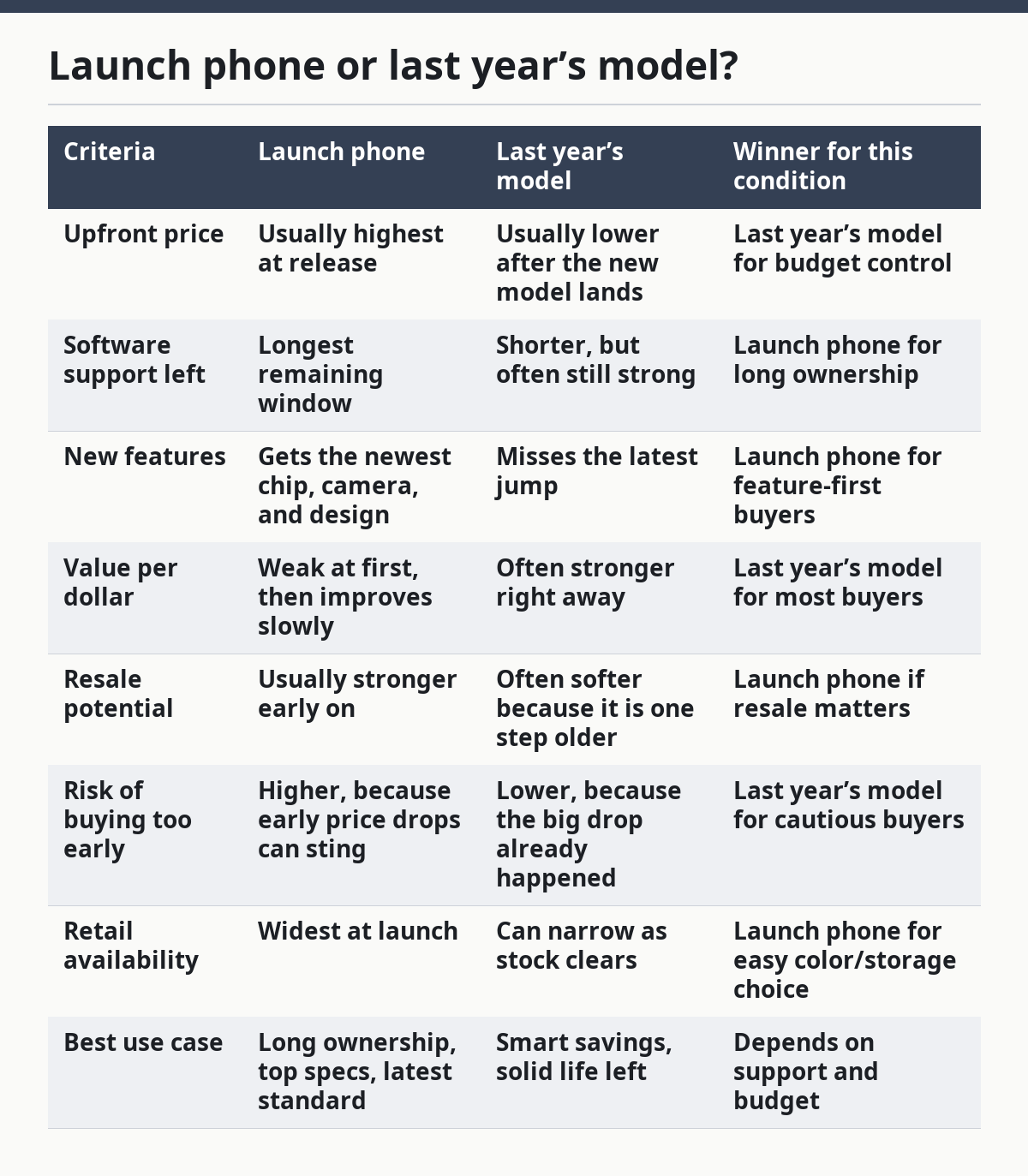
The launch phone is right when the buyer plans to keep the device for years and wants to stretch the useful life as far as possible. An iPhone 15 or Galaxy S24 type purchase makes sense if the buyer values the latest standard and does not want to wonder whether support will run out soon.
The weakness is obvious: the buyer pays for freshness. That premium is real, and it often shrinks faster than expected once the next model is announced. A launch buyer also faces more temptation to overbuy storage or features that will never be used.
The last year’s model is the sharper value play. An iPhone 14 or Galaxy S23 type phone often keeps the important parts of the experience while giving up the newest badge. The downside is also clear: the support window is shorter, the resale ceiling is lower, and some buyers will always feel they missed the “latest” model by one step.
For a buyer who cares about sensible spending, the older model usually makes more sense. For a buyer who wants the longest runway, the launch model wins.
When does the price drop hard?
The price usually drops hard when a new generation is announced and the market no longer needs to pay for the old one as if it were current. That is the moment when price movement becomes most visible.
The drop is often sharper than at any other point in the cycle because buyers suddenly have a direct substitute. A phone that looked premium yesterday becomes “last year’s model” overnight. That label matters. It changes the search results, the retailer placement, and the buyer’s willingness to pay.
Clearance, trade-in promos, and carrier credits can deepen the fall, but they do not affect every buyer equally. A trade-in offer only helps if the buyer already owns an eligible phone. A carrier bill credit only helps if the buyer is willing to stay in that plan. A straight cash buyer should look past the advertised discount and compare the final out-of-pocket cost.
This is also where storage size can distort the chart. A 128GB model can move differently from a 256GB version of the same phone. The base storage model usually gets the most attention and may sell down first, which can leave the larger version holding price longer. That does not mean it is better value; it means stock is uneven.
If the buyer wants the lowest realistic price for a current-generation phone, the best window is often after the next model is announced but before the older stock disappears. That window is not the same for every brand, but the pattern is consistent.
How long should support change the decision?
Support should change the decision the moment the phone’s likely remaining life is shorter than the buyer plans to keep it. A lower price means less if the device is near the end of updates, security patches, or parts support.
This is where many generic buying guides get it wrong. They focus on the sticker and ignore the calendar. A phone with a deep discount can still be poor value if the buyer wants three more years and the phone is already near the end of its support run. A phone that costs more today can be the cheaper choice over time if it stays safe and usable longer.
For buyers who keep phones until they fail, support matters more than almost anything else. For buyers who replace phones every one or two years, support matters less, but resale still matters. In both cases, the support window changes the math.
Apple and Samsung both show how support affects price. A recent iPhone model and a recent Galaxy model can both hold value better than a much older budget phone because the market trusts them to stay useful longer. A lower-cost phone that loses support sooner may be fine for a short-term user but weak for a long-term owner.
The buyer should check three things before making a final call: the current price, the model year, and the remaining support life. If any one of those is missing, the purchase decision is incomplete.
What is the honest side-by-side?
The best choice depends on whether the buyer is buying for today’s savings or tomorrow’s use. That is the real trade-off between a newer phone and an older one.
| Criteria | Newer phone | Older phone | Winner for this condition |
|---|---|---|---|
| Current price | Higher | Lower | Older phone for budget |
| Remaining support | Longer | Shorter | Newer phone for long use |
| Feature set | Newest chip, camera, and ports | One step behind | Newer phone for top specs |
| Risk of regret | Lower on specs, higher on price timing | Lower on price, higher on age | Depends on buyer patience |
| Resale later | Usually stronger | Usually weaker | Newer phone for resale |
| Best deal timing | Launch or near launch | After the next launch | Older phone after refresh |
| Retail choice | Usually broad | Can narrow in late life | Newer phone for easy buying |
| Who should skip | Short-budget buyers | Long-hold buyers | Different in each case |
The newer phone wins when the buyer wants the longest useful life from day one. That makes sense for someone who keeps phones for years and cares about current features. The downside is the premium, which can be hard to justify if the buyer mostly uses messaging, calls, maps, and streaming.
The older phone wins when the buyer wants the strongest value per dollar. That makes sense for someone who wants a strong phone without paying for the newest label. The downside is the shorter runway. If the buyer hates the idea of replacing a phone sooner, the lower price may be false economy.
A clean way to decide is this: if the phone must still feel current in several years, go newer. If the phone only needs to be good enough now, go older.
What does a smart buying step look like now?
A smart buying step is to compare one current model, one previous-generation model, and one refurbished option before paying. That three-way check usually reveals whether the price movement is actually good value or just a marketing discount.

The buyer should start with the exact model and storage size, not a vague family name. An iPhone 15 is not the same decision as an iPhone 15 Pro, and a Galaxy S24 is not the same as a Galaxy S24 Ultra. The storage size can change the result too. A 128GB version may be the sensible buy, while a larger version may sit too close to the next model’s price.
The next step is to compare the same phone across at least two retailers. Brand site, Amazon, Best Buy, and carrier stores often show different bundles, trade-in terms, or stock levels. None of that matters if the buyer only checks one page.
Then check the support window and the likely resale path. If the phone will be kept for a long time, support matters most. If the phone will be traded in quickly, resale matters more. If the phone is only a short-term stopgap, the lowest clean price may be enough.
FCC guidance on opening phones is useful for buyers who want flexibility across carriers, and the FTC’s guidance on mobile devices helps frame the questions buyers should ask before committing to a plan. Those are useful reference points, even when the final choice comes down to the specific phone in front of the buyer: FCC opening guidance and the Federal Trade Commission.
When should the verdict flip?
The verdict flips when the buyer’s use case breaks the normal price-to-life rule. A lower-priced older phone is not always the right answer, and a newer phone is not always worth the premium.
If the buyer needs the longest support window, the verdict flips toward the newer phone even when the old one looks cheaper. This is common for someone who keeps a phone until it fails or wants to avoid another upgrade for as long as possible. A current model such as an iPhone 15 or Galaxy S24 is the safer call here.
If the buyer is shopping for a backup phone, travel phone, or child’s first phone, the verdict flips toward the older model. In that case, the buyer is paying for utility, not status, and a previous-generation phone gives the right mix of price and capability.
If the buyer finds a refurbished phone with a clear return policy and a known condition grade, the verdict can flip again. Refurbished stock often sits in the best middle ground, especially when the model is only one generation old and still has meaningful support left. The catch is simple: the buyer must accept a device that may not be factory fresh.
If the buyer is choosing between a deeply discounted phone near end of support and a newer model with a higher price, the verdict flips to the newer model. That is the moment when the cheaper phone becomes the more expensive mistake.
The verdict
Choose the newer phone if the phone must last longer, keep support longer, and hold resale value better. Choose the previous-generation phone if the buyer wants the better price-to-life balance and can live without the newest feature set. Neither if the only reason to buy is a low sticker price on a phone with little support left.
A phone’s lifecycle is not a side note; it is the price curve itself. The buyer who treats it that way usually pays less for more useful time.
Drafted with AI; not yet reviewed by a person.