

Mobile Phone Pricing Mechanics: The Complete Guide
Last updated: November 27, 2026
Quick answer: for a typical buyer, the total mobile phone price can differ by hundreds of dollars across the same model once financing, storage, and trade-in credits are counted. Mobile Phone Pricing Mechanics — The Complete Guide shows how that total is built: handset retail price, carrier financing terms, trade-in credits, storage tier, and timing around launch cycles. The same phone can cost very different amounts depending on whether you buy it outright, finance it through a carrier, trade in an old device, or wait for a later sales window. I write on mobile device pricing, carrier billing, and consumer purchase terms, so this guide focuses on how the numbers are actually built.
Key takeaways
- The headline price is only one part of the bill; financing, trade-ins, and plan terms can change the real cost.
- Carrier deals often look bigger than they are because credits are spread out over many months.
- Higher storage tiers usually raise the phone price, but they also raise the resale value less predictably.
- Launch timing matters. New models are priced for early buyers first, not for bargain hunters.
- A practical choice depends on cash flow, upgrade habits, and whether the buyer wants carrier lock-in or flexibility.
What makes a phone’s price change?
A phone’s price changes because the listed price is only one layer of the transaction. The core factors are the brand, the model year, the storage tier, the sales channel, and whether the phone is sold opened or tied to a carrier finance plan.
A new flagship model usually enters at the top of its maker’s range, while older models move down when the next generation appears. Storage is the easiest visible step-up: the jump from one tier to the next can be large enough to alter the whole value case, especially if the buyer does not keep local photos or large games on the phone.
Channel matters too. A carrier may show a lower monthly payment than a retailer, but the real price can depend on bill credits, service eligibility, and whether the credit stops if the line is canceled early. Apple’s and Samsung’s own sales pages, as well as carrier storefronts and major retailers, can all show the same model with different purchase math. That is not a mistake; it is the market working through different business models.
Timing also matters. Launch periods are for early adopters, not value seekers. Older stock, renewed phones, and last-generation models usually become more attractive when the new model arrives, because the performance gap is smaller than the price gap. For a broader comparison of how buying route affects total cost, see Opened vs Carrier Phones and How Trade-In Credits Work.
For background on consumer pricing and contract terms, the Federal Trade Commission’s consumer pages and the FCC’s handset-opening guidance are useful reference points: FTC and FCC cell phone opening guide. The FCC has also published consumer guidance on opened phones and service choice: FCC opened phones.
How does carrier financing really work?
Carrier financing lowers the monthly bill on paper, but the phone is still paid for in full through the contract structure. The selling trick is simple: the device cost is split across many months, then often offset by promotional credits that only appear if the line stays active and in good standing.
That means the quoted monthly price is not the same thing as the device’s true price. If a carrier offers a phone for a low monthly amount with a trade-in bonus, the handset may be tied to a 24-month or similar billing schedule, with the credit arriving in parts. If the customer leaves early, the remaining phone balance may come due and the credits may stop. In practical terms, a 24-month promotion is a 24-month commitment.
This is the mechanic that most beginners miss. A plan that looks cheaper by a few dollars each month can become more expensive once a trade-in credit is lost or a required plan tier is added. The phone price and the service price are often blended on the same bill, which makes comparison harder than it should be.
Carrier financing works best for buyers who keep the same line for the full credit period and who value low upfront cost more than flexibility. It is weaker for anyone who changes carriers often, wants to switch plans freely, or dislikes hidden dependence on bill credits.
If the handset deal requires a long stream of credits, treat the advertised monthly number as a conditional discount, not as the price, and consider reviewing the contract with a qualified financial or consumer-rights professional if the terms are unclear. The FTC’s consumer guidance on phone plans and billing disputes is a useful starting point: FTC consumer guidance.
Why do storage tiers and model years matter so much?
Storage tiers and model years matter because they change both the retail price and the resale logic. A phone with more storage often starts at a noticeably higher price, but the buyer only gets value from that extra capacity if the phone actually fills up with apps, video, offline downloads, or large photo libraries.
The model year is just as important. A one-generation-old phone can keep much of the practical experience of the newer model while missing the newest chip, camera feature, or display tweak. That can make the older model a stronger buy if the buyer cares more about total cost than about having the newest badge. In pricing terms, a model-year gap of 1 generation often matters more than a storage bump.
This is where pricing mechanics become personal. A power user who records video, edits photos, or keeps large game files may need the higher tier. A light user who streams most content and stores little locally may pay for capacity they never use.
The resale side matters too. Higher storage sometimes helps resale, but the gain is not always enough to justify the original jump. The market often rewards the model year more consistently than extra capacity. A newer baseline model may hold value better than an older maxed-out version with a large storage tier.
If the goal is a lower-risk purchase, a mid-tier storage option in a last-generation model often gives a balanced result. That is not the flashiest choice, but it avoids paying launch premiums for capacity that may sit empty.
Which buying route changes the final cost most?
Opened retail usually gives the clearest price, while carrier-financed buying most often changes the final cost through credits and service requirements. The right route depends on whether the reader wants a simple cash price or is willing to trade flexibility for a staged discount.
Here is the direct comparison.
| Criteria | Opened retail | Carrier financing | Winner for this condition |
|---|---|---|---|
| Upfront cash needed | Higher at checkout | Lower at checkout | Carrier financing if cash flow is tight |
| Price clarity | Clearer, easier to compare | Harder, because credits and line terms matter | Opened retail if transparency matters |
| Early exit risk | Lower | Higher if credits stop or balance remains | Opened retail if plans may change |
| Monthly bill complexity | Lower | Higher | Opened retail for simple billing |
| Service lock-in | Less | More likely | Opened retail for flexibility |
| Upgrade path | Flexible | Often tied to a term | Opened retail for frequent switchers |
| Deal size on paper | Smaller-looking | Often larger-looking | Carrier financing for headline discount hunters |
| Resale and switching freedom | Better | Usually weaker | Opened retail for future resale |
| Need for trade-in to trigger savings | Rare | Common | Carrier financing if a strong trade-in is available |
| Best fit | Independent buyers | Carrier loyalists | Depends on the user type |
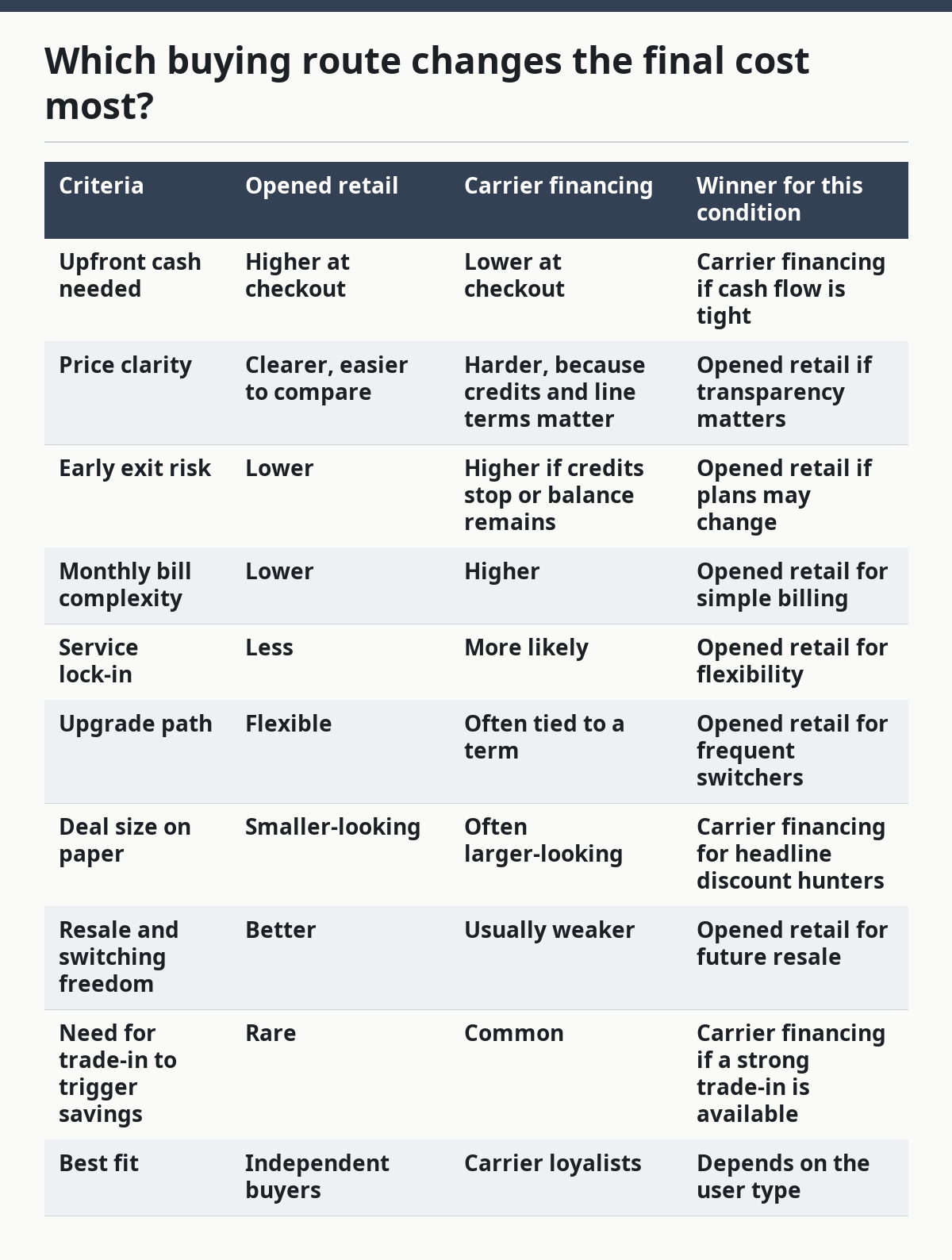
Opened retail wins for buyers who want the cleanest math. Carrier financing wins for buyers who will keep the line active long enough to earn all the credits and who are comfortable tying the device to a service plan. That is the whole trade: clarity versus staged savings.
The hidden cost of carrier financing is often attention rather than cash. The buyer has to track the billing term, the credit schedule, and the conditions that keep the deal alive. That is manageable, but it is not free.
When does a trade-in help, and when does it mislead?
A trade-in helps when the device being handed over still has strong market value and the credit is delivered in a form the buyer can actually keep. It misleads when the headline trade-in number is large but the credit depends on a long service term, a premium plan, or a condition grade that is stricter than the buyer expects.
Trade-in value is usually part math and part marketing. The phone’s condition, age, storage, and model tier all affect the offer. A recent flagship in clean condition will usually do better than an older midrange phone with screen wear or battery decline. The problem is that the buyer often sees only the final promotional number, not the plain market value of the old device.
The strongest trade-in deals usually make sense for loyal users who already planned to stay with the same carrier or ecosystem. In that case, the credit can genuinely reduce the net cost. The weakest deals are the ones that rely on a high monthly plan just to open the credit. If the plan costs more than the savings, the deal has merely moved money from one line to another.
Trade-ins are also where many buyers overestimate what the old phone is worth. A phone that feels “pretty good” in daily use may not command a strong credit if the battery health is poor, the frame is bent, or the storage is small. The market does not reward sentiment.
The best habit is to compare the trade-in offer with an opened sale price of the new device. If the credit only looks good when paired with a high-cost plan, the buyer should be skeptical.
What does launch timing do to price?
Launch timing pushes prices upward at release and downward as the model ages. The first wave of buyers pays for immediacy, while later buyers often benefit from promotions, older-model discounts, and better information about real-world trade-offs.
The launch window is expensive for a reason. Demand is strongest, supply is still settling, and the maker has no incentive to discount heavily right away. That is why the newest model often gets the cleanest display, the best camera headline, and the least forgiving price.
A few months later, the picture can shift. The previous generation may still offer most of the same basic experience, but at a lower price and with fewer conditions. That is where value buyers usually win. They are not buying yesterday’s phone by mistake; they are buying the version whose price has started to soften.
This also affects carrier promotions. Some of the biggest-looking deals are designed to move inventory tied to a new launch cycle or to clear last-generation stock. The discount is real, but so is the reason for it.
The buyer who cares most about price should usually avoid launch week unless a specific feature is worth paying for now. The buyer who cares most about having the newest model should accept that the first price is the least favorable price. For timing patterns and model turnover, the mechanics are closely related to how phone refresh cycles affect value.
What are the traps in the fine print?
The traps in the fine print are plan requirements, credit schedules, device lock rules, and conditions that make a deal vanish after the purchase. These are the details that turn a normal-looking offer into a much more expensive one.
Plan requirements are the most common trap. A device discount can require a premium plan, which may cost more each month than the device credit saves. That is how a phone can appear discounted while the total bill rises.
Credit schedules are the second trap. A promotion may be spread across many months, so the buyer does not get the value immediately. If the account changes, the credits can stop. That makes the deal conditional, not guaranteed in the casual sense many shoppers assume.
Lock rules are another issue. Some phones bought through carriers may stay tied to the network for a period before they can be fully opened. For buyers who travel, resell devices often, or switch carriers, that restriction matters a lot. The FCC’s consumer guidance on cell phone opening is useful here: FCC cell phone opening guide.
The last trap is the “free phone” label. A free phone is rarely free in a full sense. The buyer is usually paying through monthly service, a trade-in, or both. That does not make the offer bad, but it does mean the label is marketing language, not a financial summary.
The safe habit is to ask one question: what is the total cost over the full term, including plan changes and lost credits if the line ends early? If the answer is unclear, the deal is not simple enough yet.
What should a buyer do with all of this?
A buyer should choose the price structure that matches how long the phone will stay in use and how much billing complexity is acceptable. That is the cleanest way to avoid paying for features that do not matter or credits that will never fully arrive.
Choose opened retail if the buyer wants clear pricing, freedom to switch carriers, and the option to resell or replace the phone on a personal schedule. Choose carrier financing if the buyer will stay with one carrier long enough to collect every credit and values lower upfront cost more than flexibility.
Here is the honest verdict in plain terms:
Choose opened retail if the buyer wants transparent pricing, plans to switch carriers, or dislikes credit-based deals. Choose carrier financing if the buyer will stay on the same line for the full term and can keep the required plan without straining the monthly budget. Neither if the only way the deal looks good is a long term, a premium plan, and a trade-in that the buyer is not sure will qualify.
The right choice is not about which ad looks better. It is about whether the buyer wants a simple purchase or a financed relationship with the carrier.
What does a smart budget actually account for?
A smart budget accounts for the handset, the plan, the storage tier, the trade-in, and the likely holding period. A phone that looks affordable at checkout can still be the wrong choice if the service plan or financing term raises the total cost over 24 months or another billing period.

Budgeting starts with the device price alone, but it should not stop there. The buyer should add any activation fee, any required plan increase, and the risk that a trade-in credit will be spread out instead of applied all at once. A lower sticker price does not mean a lower total spend.
The holding period matters because phones age quickly in price terms. If the buyer upgrades every 12 months, paying for a premium tier that will be replaced early is hard to justify. If the buyer keeps a phone for several years, a stronger model or higher storage tier may be worth the extra cost because the price gets stretched over more use.
A smart budget also leaves room for accessories only when they matter. A case and screen protection can be sensible. Paying extra for a cosmetic color or a storage tier that never fills up is less sensible.
The simplest rule is to price the phone as a system, not a single object. Device, plan, credits, and exit risk all belong in the same decision.
What gets overlooked most often?
The most overlooked part of mobile phone pricing is that the “best deal” and the “lowest price” are not the same thing. A buyer can get a big promotional number and still spend more over time because of plan costs, delayed credits, or the wrong storage choice.
The second overlooked point is that price depends on use pattern. A heavy camera user and a basic caller should not shop the same way. One may need more storage and a newer processor; the other may get better value from an older model with a lower entry price.
The third overlooked point is resale. A buyer who cares about trading in later should think about demand for that model at the next upgrade cycle. A phone that is popular and easy to sell can reduce the true cost of ownership, even if the sticker price is not the lowest.
The final overlooked point is patience. Many buyers rush because launch ads are loud. The market rewards patience more often than it rewards haste.
FAQ
Why do two stores show different prices for the same phone?
Two stores show different prices because one may be selling the phone opened, while the other is bundling it with financing, plan credits, or a trade-in offer. The listed number can also change by storage tier, color, or whether the model is current or last generation.
Is a carrier deal always cheaper than buying opened?
A carrier deal is not always cheaper than buying opened. It can be cheaper if the buyer keeps the line for the full credit period and the required plan does not cost more than the discount saves. It can be more expensive if the buyer leaves early or has to buy a higher monthly plan.
Why does more storage cost so much more?
More storage costs more because the maker charges for a higher capacity tier, and that tier is often positioned as a premium option. The buyer should only pay for it if the phone will actually store large files, offline media, or many apps locally.
Do older phones become bad buys after a new release?
Older phones do not become bad buys just because a new model appears. In many cases they become better value, because the price drops while the day-to-day experience stays close to the newer phone for most basic users.
What is the safest way to compare phone prices?
The safest way to compare phone prices is to compare the total cost over the full term, not the headline monthly payment. That means adding the device price, the service plan, the trade-in conditions, and the risk of losing credits if the account changes.
Drafted with AI; not yet reviewed by a person.