
How AI Features and on-Device Processing Change Phone Prices
Last updated: November 27, 2026
Quick answer: 3 hardware parts usually drive the price up. How AI features and on-device processing change phone prices is mostly about special hardware, more memory, and extra software work; phones that run AI on the device usually cost more than models that send the work to the cloud. The next step is simple: check whether the phone’s AI runs on-device, which chip and NPU it uses, and whether those features are worth paying for.
Key takeaways
- Phones with AI features can cost more because the hardware has to do more work locally.
- The biggest price push usually comes from an NPU, more memory, and the higher chip tier that supports them.
- On-device processing matters because it keeps AI tasks fast without sending data away first.
- A phone can advertise “AI” and still rely on cloud processing, which may mean less hardware cost.
- If you do not use AI assistant tools, image edits, or live summaries, the premium may not be worth it. See also our phone pricing guide for the other major cost drivers.
What changes the price most?
The price changes most when AI features require stronger hardware, not when a phone just has a marketing label. A model with an NPU, more RAM, and a better chipset usually sits above a similar phone without those parts because the maker has to pay for more capable components and the engineering to tie them together.
The neural processing unit, or NPU, is the part that helps a phone handle machine learning features without making the main CPU do all the work. That matters for AI assistant features, photo cleanup, transcription, and other tasks that happen many times a day. If the phone can do those jobs locally, it needs silicon built for that load. For background, see Qualcomm’s overview of on-device AI processing and Google’s Gemini on-device AI materials.
Therefore, not every AI feature adds a large cost. Some features are mostly software, such as text suggestions or simple image filters, and those can ride on hardware the phone already has. The jump in price usually comes when the feature set depends on dedicated AI hardware, larger memory, or a chip positioned above the basic tier.
A simple way to think about it is this: cloud AI can keep the phone cheaper, while on-device AI often pushes the price up. The first option offloads work to a server. The second option asks the phone to do the job itself, which is harder for the hardware and usually more expensive to build.
Which hardware parts support AI features?
The main hardware parts are the NPU, the main processor, memory, storage, and sometimes a stronger cooling design. The NPU is one headline part, but it is not the only part that matters.
Because of that, a phone with on-device inference has to move data quickly between the camera, memory, and AI block. If the memory is too small or too slow, the phone can still run AI features, but the experience will feel less capable. That is why AI-ready phones often appear in higher trim levels with more RAM and better storage.
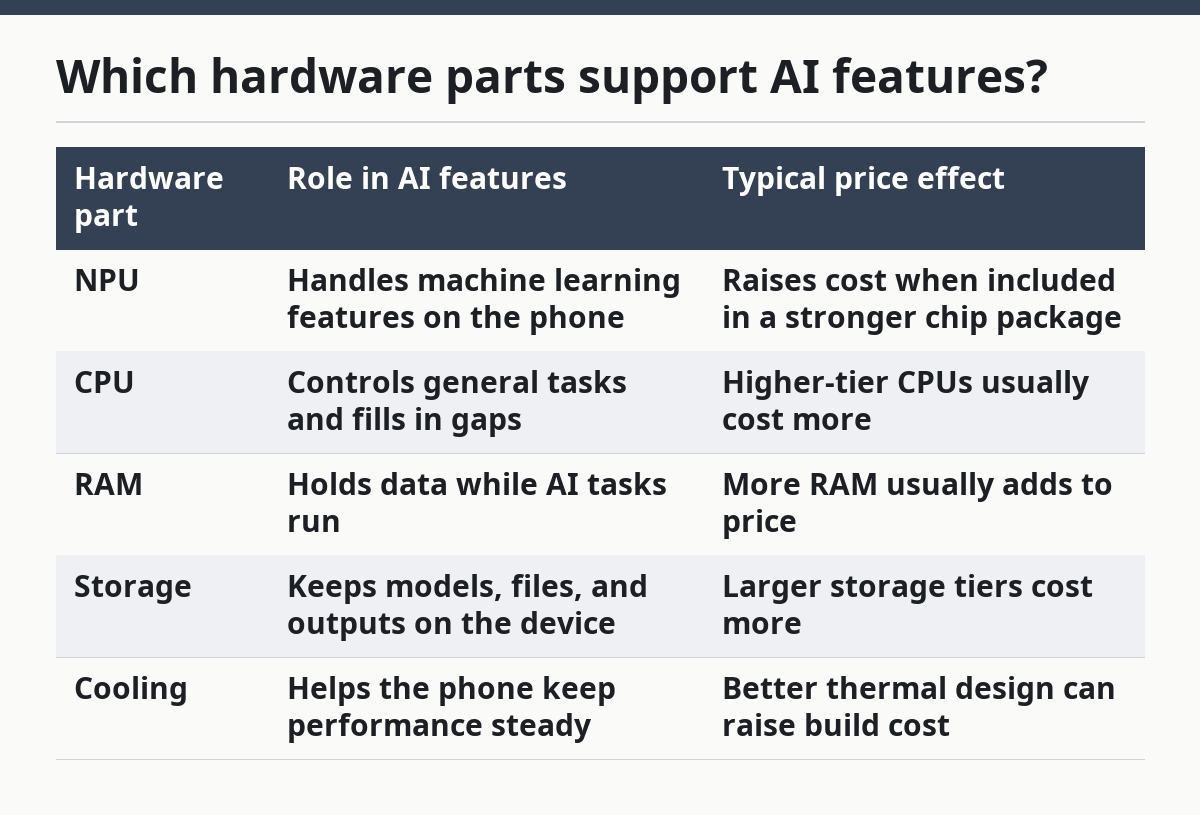
Here is the hardware comparison that usually drives the price difference:
| Hardware part | Role in AI features | Typical price effect |
|---|---|---|
| NPU | Handles machine learning features on the phone | Raises cost when included in a stronger chip package |
| CPU | Controls general tasks and fills in gaps | Higher-tier CPUs usually cost more |
| RAM | Holds data while AI tasks run | More RAM usually adds to price |
| Storage | Keeps models, files, and outputs on the device | Larger storage tiers cost more |
| Cooling | Helps the phone keep performance steady | Better thermal design can raise build cost |
This is where many buyers get misled. A phone can say it has AI, but if the hardware is modest, the AI may be limited to small tasks or cloud help. In that case the phone may look cheaper than a full AI model, because it is cheaper to make. The trade-off is less local speed and fewer advanced features.
One practical clue is whether the maker talks about on-device processing in plain terms. If the phone can summarize, edit, or generate content locally, that usually points to a stronger hardware set. If the phone mostly sends requests out to a server, the hardware burden is lighter and the price may stay lower.
How does on-device processing change the bill?
On-device processing changes the bill because the phone must carry enough silicon to do the work itself. That usually means a pricier chip, more memory, and more testing, all of which can push the retail price up.
There are three common paths. The first is cloud-based AI, where the phone sends data away and gets a result back. The second is hybrid AI, where the phone handles some steps locally and sends harder tasks to the cloud. The third is full on-device processing, where the phone does the job right there on the handset.
The third path is the most expensive to build. It can also be the most appealing to buyers who care about speed and privacy, because the phone does not have to wait for a server before it produces a result. That speed has a cost. It takes more capable hardware to keep the feature working well without making the phone feel slow.
This is also why the premium is not only about software pricing. The phone maker may bundle AI tools into the OS, but if the hardware cannot support them, the model has to move up a tier. That is why two phones from the same brand can look close on the surface and still land at different price points.
The best clue is the phrase “on-device inference.” If that phrase appears in the spec sheet or launch notes, the phone is doing real work locally. A phrase like that usually indicates hardware support, and that support tends to show up in the price.
Are AI phones priced higher because of software or hardware?
AI phones are usually priced higher because of hardware first and software second. The software adds value, but the hardware often creates the actual cost jump.
Software features can be packaged across several models without changing the bill much. A writer’s tool, a photo cleanup mode, or a voice assistant can be added in code. The hardware cost rises when those tools need a stronger NPU, extra RAM, or a chip that can keep up with repeated machine learning tasks.
The cost split works like this:
| Cost driver | What it affects | Why it matters for price |
|---|---|---|
| Software feature pricing | AI tools, apps, and bundled services | Can add value without huge hardware changes |
| AI hardware requirements | Chip, NPU, RAM, storage | Raises manufacturing cost |
| On-device processing | Local speed and privacy | Demands stronger components |
| Cloud processing | Offloaded AI tasks | Can keep hardware cheaper |
That table is the key to reading phone pricing honestly. A maker can charge more for a software suite, but the bigger premium usually appears when the phone has to be built like an AI device from the start. The hardware and software pieces work together, yet the hardware usually sets the floor.
This is also where buyers should be careful with vague labels. “AI phone” can mean anything from a phone with a few smart camera tricks to a device built around local inference. If the listing does not spell out the NPU, the AI assistant tools, or the on-device processing model, the premium may be more marketing than substance.
How should you compare AI phones before you pay more?
You should compare AI phones by the tasks you will actually use, then match those tasks to the hardware that supports them. Start with the feature list, then check whether the phone runs those features on-device or through the cloud.
Use this order:
- List the AI features you care about, such as an AI assistant, photo cleanup, live transcription, or summary tools. If you only want one feature, avoid paying for a bundle you will never open.
- Look for the term “on-device” or “on-device inference.” If it appears, the phone is doing more work locally, which usually means a higher price.
- Check whether the phone includes an NPU and whether the chipset is built for machine learning features. If the spec sheet hides these details, the AI claim may be thin.
- Compare RAM and storage tiers. A phone with more memory often handles AI tasks better, but that also raises the bill.
- Decide whether privacy and speed matter more than price. If they do, a local AI model may be worth the premium. If they do not, a cloud-heavy phone may be the better buy.
This is the cleanest way to avoid overpaying. A phone with AI features is not automatically overpriced, but the premium only makes sense when the hardware matches the promise. If you never plan to use the assistant, the photo tools, or the local summaries, the extra money can be hard to justify.
For broader context on phone pricing, this guide sits under the larger hub on what affects mobile phone prices. That hub helps place AI alongside the other big drivers, like build quality and storage, without mixing them into one blur.
Who should pay for AI features, and who should skip them?
You should pay for AI features if you use them often enough to justify the extra hardware cost. That is most sensible for people who edit photos, use voice tools, or want the phone to handle tasks locally without a constant cloud handoff.
Skip the premium if you mainly use the phone for calls, messages, streaming, and simple apps. In that case, the AI package may add cost without changing the day-to-day use of the phone. A cheaper model with weaker AI hardware can still be the smarter purchase.
This also matters for buyers who want a simple price-to-value rule. A phone with a strong NPU and full on-device processing is not a bad buy by default. It is just a different buy. The extra cost pays for local speed, fewer cloud round-trips, and a more capable AI assistant stack. If those are not part of the plan, the phone may be carrying features you will never notice.
Ultimately, AI pricing is still moving. Makers bundle features in different ways, and the label on the box does not always match the amount of local processing inside. That is why the spec sheet matters more than the ad copy. If the phone’s AI story is vague, treat the premium as optional until the hardware proves it. If you are unsure how much to spend, consider checking a buying guide for phone prices or speaking with a qualified retail specialist before you pay extra for AI features.
Drafted with AI; not yet reviewed by a person.