
How phone rumors move prices before launch
Last updated: November 27, 2026
Quick answer: phone rumors and leaks can move prelaunch prices by 1 to 2 weeks, mainly on the current model, not the unreleased one. In the topic How announcement rumors and leaks can move phone prices before launch, shoppers usually see small, uneven changes rather than a guaranteed drop.
Rumors and leaks can push prelaunch phone prices in two directions at once: some stores hold firm, while others trim prices on the current model to sell it before the new one arrives. If you are shopping for a phone now, the next step is simple: watch the current model’s price for 1 to 2 weeks after a leak cycle starts, then decide whether the discount is real or just a short-lived promo.
Key takeaways
- Leaks change buyer behavior first, and retailer pricing second.
- The biggest pressure usually falls on the outgoing model, not the unreleased phone.
- A rumor can create a small discount, but it can also freeze prices if stock is tight.
- If you need a phone in the next 7 days, buy for the current price, not the rumor.
- If you can wait, track one model and one retailer list; too many tabs create noise, not savings.
What changes when a leak starts?
A leak changes phone prices by changing expectations before launch. Once a model’s name, camera, chip, or color is widely discussed, buyers start waiting, and that makes sellers less certain about how much stock they can move at the old price.
According to Apple’s and Samsung’s own launch announcements, new phones are typically introduced on a defined event schedule, which is why the prelaunch window matters so much: Apple Newsroom and Samsung Newsroom. That pressure usually shows up first on the current version of the same phone line. If a new Galaxy S model or iPhone is expected, the older model can get a short promo, a bundle, or a quieter markdown as retailers try to clear shelf space before the announcement cycle closes. The unreleased phone itself usually does not get a real street price yet, because there is no normal retail stock to discount.
The key point is that rumors affect pricing through demand, not magic. A leak can make buyers pause for 2 weeks, and that pause is enough for a seller to change a listing, but only if the store thinks demand will soften. If the rumor points to a much better camera, a larger battery, or a major redesign, waiting behavior grows faster. If the leak sounds vague, price pressure is weaker. For background on how pricing changes are tracked across the market, see the hub on what affects mobile phone prices.
This is why rumor-driven price movement belongs in the same bucket as pre-announcement pricing. It is not the launch-day drop, and it is not the official release. It is the stretch when sellers test whether shoppers will pay full price for last year’s model or hold off for the next one. That is the same pricing story covered in the site’s hub on what affects mobile phone prices, but here the focus is the leak cycle itself.
Why do shoppers wait after rumors start?
Because shoppers think the next phone will make the current one look overpriced, they wait after rumors start. That waiting behavior can spread fast, even when the rumor is only a render, a chip leak, or a part list with no confirmed spec sheet.
This matters because phone pricing is partly driven by what buyers believe will happen next month, not just by what is on the shelf today. If a rumor suggests a model is 3 to 4 weeks from announcement, some buyers stop paying full price for the current version and start watching for markdowns. Retailers notice that hesitation through slower sales and may answer with temporary discounts, trade-in bumps, or accessory bundles. See also best phone deals and iPhone price guide for the kinds of price shifts shoppers compare during this window.
There is a catch. Rumors do not help every shopper. If you need a replacement phone now, waiting for a leak to “force” a better deal can cost more if the current stock sells out or if the model you want is no longer easy to find in the color or storage size you want. The rumor may lower one listing while raising stress everywhere else.
A simple way to think about it is this: the rumor has value only if it changes your buying window. If you were going to buy in 30 days anyway, the leak may help. If you need a phone this week, it mostly adds noise.
Can leaks affect retailer pricing?
Yes, leaks can affect retailer pricing, but usually in small, uneven moves rather than one clean price drop. A store with excess stock may cut a current model by a little, while another store keeps the same price and waits for a bigger event like the official announcement.
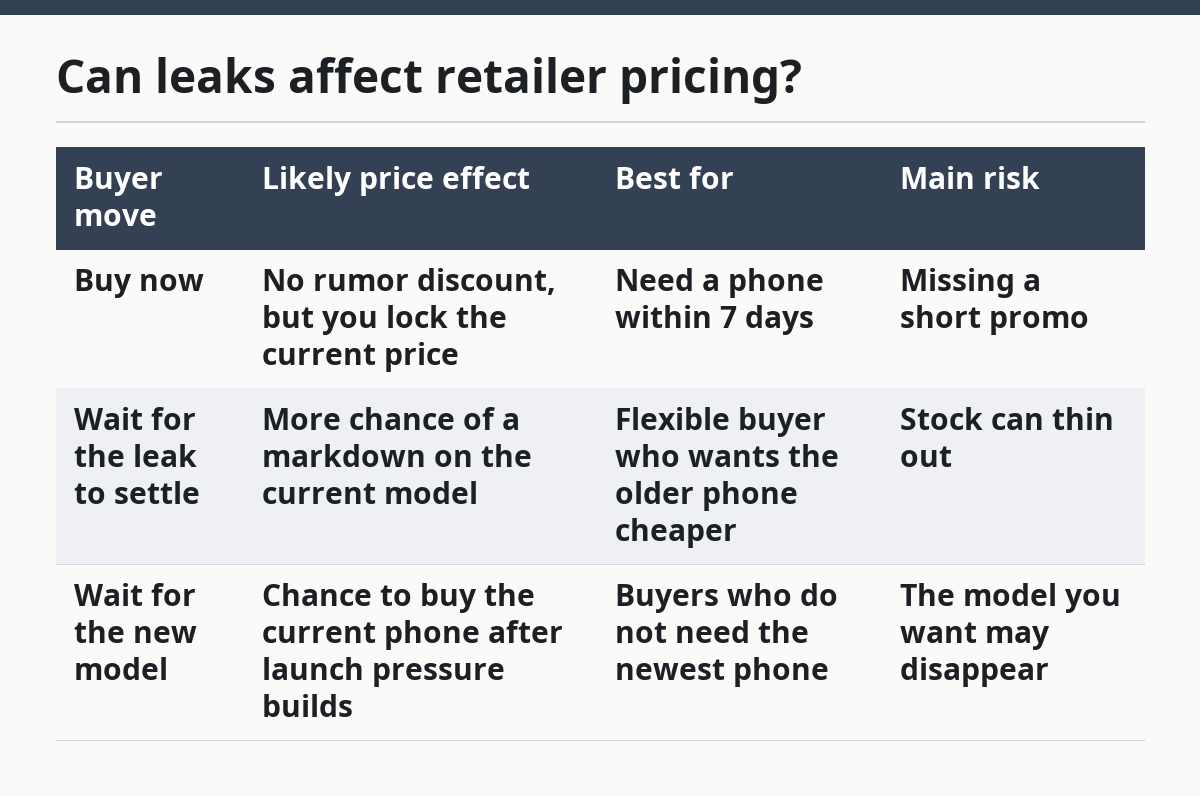
Here is the basic comparison:
| Buyer move | Likely price effect | Best for | Main risk |
|---|---|---|---|
| Buy now | No rumor discount, but you lock the current price | Need a phone within 7 days | Missing a short promo |
| Wait for the leak to settle | More chance of a markdown on the current model | Flexible buyer who wants the older phone cheaper | Stock can thin out |
| Wait for the new model | Chance to buy the current phone after launch pressure builds | Buyers who do not need the newest phone | The model you want may disappear |
Retailers usually react to three things: stock level, how loud the rumor is, and how close the announcement cycle feels. A quiet leak about one feature may do little. A full leak with images, colors, and model names can push stores to act faster because they expect a demand shift.
The mistake is assuming every leak creates the same discount. It does not. A rumor about a flagship phone can move price tags for a midrange sibling model if the buyer pool overlaps, but not always. If a retailer already has thin inventory, the leak can do the opposite and keep prices firm. For a related market view, see Samsung Galaxy prices and the guide to how to compare phone prices.
How do you read a rumor before you wait?
You read a rumor by checking whether it changes demand for the exact phone you want, not just whether it sounds exciting. A leak only matters if it hits the same model family, the same storage tier, or the same buyer group.
Use this 4-step check:
-
Identify the model line.
If the rumor is about an iPhone Pro model and you want the base model, the pricing effect may be smaller. The closer the leak is to your target model, the more likely the price moves. -
Check how complete the leak is.
A single photo or a part number is weaker than a full package of name, colors, and key specs. A complete leak usually creates more buyer hesitation. -
Watch the old model first.
The phone already on sale is the one most likely to shift. If the current model’s price stays flat for 7 to 14 days after the leak, the rumor may not be strong enough to matter. -
Compare one retailer to another.
If one store cuts price and another does not, the rumor is probably affecting local stock, not the whole market. That is a sign to look for the best current offer, not to assume a broad drop is coming.
This is the part most generic advice misses: a rumor is not a buying signal by itself. It is a pressure signal. You still need to see whether that pressure reaches the exact listing you care about.
What does speculation discounting look like in practice?
Speculation discounting is the price move that happens when sellers try to get ahead of a launch, a leak wave, or a wave of cautious buyers. It is not always labeled as a launch sale, and it often shows up as a cleaner price on the old model rather than a headline cut on the new one.
The most common forms are simple. You may see a lower listed price, a short coupon, a trade-in boost, or a bundle with a charger or case. The number on the page might stay close to the old price, but the real out-of-pocket cost falls by the value of the promo. That is why a buyer should look at the total price, not just the sticker.
There is a limit to this strategy. Speculation discounts can disappear quickly if the rumor turns out to be weak or if the old model starts selling faster than expected. A retailer can pull back after 24 hours or after a weekend, especially if only one color or storage size is moving.
The risk for buyers is chasing a “maybe” and missing a solid “now.” A small discount on a last-year model is helpful only if it is the exact phone, color, and storage level you want. A price cut on the wrong configuration is not a bargain. For a broader buying strategy, see how to compare phone prices.
How should a buyer act during the rumor window?
A buyer should match the rumor window to the urgency of the purchase. If the phone is needed now, buy on the best current price and do not wait on leak noise. If the phone can wait, use the rumor as a reason to watch the old model closely for a short period.

The easiest method is to keep one target model, one price threshold, and one time limit. For example, watch a Galaxy S or iPhone model for 7 days after a strong leak, then decide. That keeps the decision grounded in the current market instead of endless speculation. If the price does not move, you have your answer. If it drops, you can buy before the store clears the lowest stock.
There is also a case for not waiting at all. If you want a certain color, storage size, or carrier version, rumor-driven shopping can backfire. The exact SKU you want may vanish while you wait for a discount that never comes. That is why rumor watching is stronger for flexible buyers than for people who need a specific setup.
A practical rule: use rumors to time a purchase, not to predict a perfect bottom price. The phone market does not reward precision on every model, and it especially does not reward a buyer who waits too long for a headline leak to become a real deal.
Which rumor-driven move makes sense for you?
The right move depends on how much time you have, how attached you are to one model, and how much price risk you can tolerate. Rumors are most useful for buyers who can wait a short time and who are open to the current model if the next one is not dramatically better.
| Situation | Best move | Why it fits | Who should skip it |
|---|---|---|---|
| Need a phone in 7 days | Buy now | Avoid stock loss and price swings | Anyone chasing a rumored discount |
| Want the current model cheaper | Wait briefly | Leak pressure can help the outgoing model | Buyers who need a fixed color or storage size |
| Want the newest phone | Watch announcements, not old-model markdowns | The rumor matters more for timing than for savings | Buyers who need a budget cap right now |
| Shopping only for value | Compare current model deals during the leak cycle | Short promos often appear before launch | Anyone expecting a guaranteed drop |
The wrong move is waiting without a limit. Rumors keep coming, and a buyer can lose a good price while hoping for a better one. The better move is to set a short watch period, check the current model, and act when the price fits the need.
If the question is whether announcement rumors and leaks can move phone prices before launch, the answer is yes — but mostly through the old model, through shopper hesitation, and through short retailer promos rather than a clean, universal drop. That is useful for buyers who can wait a little and risky for buyers who need a phone now.
Drafted with AI; not yet reviewed by a person.