

Why phones get discounted when inventory ages
Last updated: November 27, 2026
Phones get discounted when inventory ages because slow-moving stock ties up cash, takes up shelf space, and becomes harder for a retailer to sell at full price. Once a handset sits long enough as warehouse stock or clearance stock, the retailer often lowers the price to move it before the next newer model, promotion, or stock write-down makes it even less attractive.
Key takeaways
- A phone does not usually get cheaper just because time passed; it gets cheaper because the retailer wants it gone.
- Inventory aging turns a regular item into slow-moving stock, and slow-moving stock gets pressure from shelf space, cash flow, and seasonal resets.
- Clearance pricing is a retailer decision, not a signal that the phone is broken or unusable.
- The same model can sit at full price in one store and be marked down in another if one retailer needs the space more urgently.
- Older inventory is not always discounted right away; some stores hold price until demand softens enough to justify a markdown.
What changes when phone stock sits too long?
Aging inventory becomes a cost before it becomes a sale, and that is why the price moves down. A retailer pays for the phone long before a customer buys it, so every extra week on the shelf makes that unit less useful to the business.
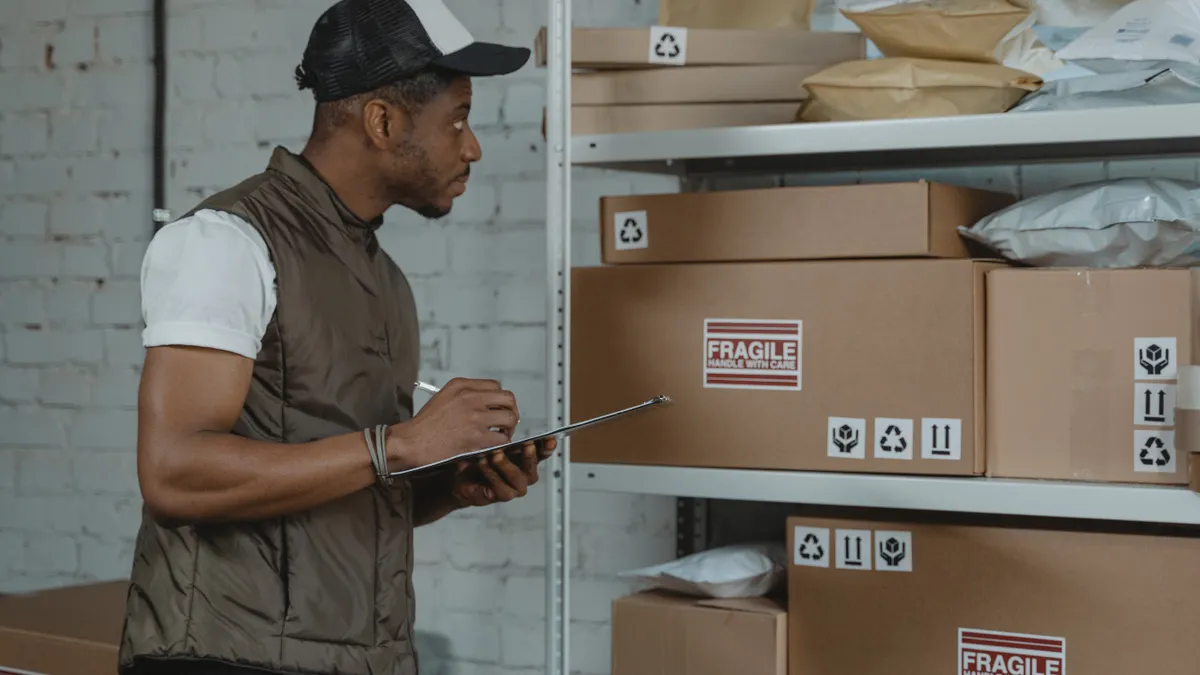
The problem is not the phone itself. The problem is that the phone has turned into slow-moving stock, which means it is occupying cash and shelf space without bringing money back. A store that has 20 units of one model and only 3 units of another cannot keep the same display space forever if the 20-unit model is not selling.
Retailers watch this in the stock room and on the shelf. If a model has been sitting for 30, 60, or 90 days longer than planned, the next step is often a markdown, a bundle, or a clearance tag. The exact timing varies by retailer, but the logic is the same: move the units before they become dead stock.
This is why the discount often appears before a phone is truly “old.” Inventory aging is about the retailer’s shelf life, not just the phone’s age in the market. A phone can be a current model and still get marked down if too many units are sitting in warehouse stock.
For the accounting side of inventory valuation, the inventory standards used in many businesses treat stock as an asset until it is sold, then push the business to measure whether that asset still has the value it once had. See IAS 2 Inventories and FASB Topic 330, Inventory.
Why does inventory aging force a markdown?
Inventory aging forces a markdown because the retailer is trying to turn a storage problem into cash. A phone that sits for months can still be perfectly fine, but the store still has to pay for the shelf space, insurance, handling, and the money tied up in unsold stock.
The first pressure is cash flow. A retailer that bought 50 phones at once has money stuck in those units until they sell. If only 10 sell quickly, the remaining 40 become a drag on the store’s cash, especially when a newer shipment arrives.
The second pressure is space. A wall display, end cap, or warehouse bin is limited. If an older model is not moving, the retailer loses the chance to use that spot for a newer phone with better demand. That matters even more during a launch window or a holiday reset.
The third pressure is risk. As inventory ages, the chance of a deeper markdown rises. If a store waits too long, it may have to cut the price harder than it wanted, or bundle the phone with accessories to clear the unit. That is why many markdowns happen in stages instead of one big cut.
A generic article often says “older stock is discounted because it is older.” That misses the real business logic. The retailer is not reacting to time alone. It is reacting to the gap between the phone’s current selling power and the cost of keeping it around. When that gap widens, the markdown starts to make sense.
How do retailers decide on the markdown?
Retailers decide on the markdown by weighing selling speed, shelf pressure, and the chance of a better sale later. The price does not usually drop at random; it moves when the store thinks a lower price will do more good than waiting.
Here is the basic process a retailer follows when mobile phone inventory ages:
- Track how long each model has sat in stock, often by week or month, so the store can spot slow-moving stock before it piles up.
- Compare sell-through with the original plan, because a model that should have moved in a few weeks but is still sitting after 60 or 90 days needs attention.
- Check the next shipment or launch schedule, since a newer model can make the current unit harder to sell at full price.
- Choose the least costly action: hold price, offer a small markdown, bundle with accessories, or move the unit into clearance stock.
- Watch the result on the shelf, because a markdown that still leaves the unit unsold may need a second cut rather than another month of waiting.
That process is why clearance stock often looks uneven from store to store. One retailer may cut a phone after a few slow weeks; another may wait longer because the same unit still has demand in that location or channel. A model that sells in one market can sit in another, and the markdown follows the local pace of sales.
Retailers also think about the sale price versus the original cost. If the gap is already small, a slight markdown may be enough. If the unit has been sitting for a long time, the store may need a deeper cut just to free space. That is why a phone can move from full price to a modest discount to a clearance tag without any change in the handset itself.
What is the difference between slow-moving stock and clearance stock?
Slow-moving stock is inventory that is selling more slowly than planned, while clearance stock is inventory the retailer is actively trying to remove. The first is a warning sign; the second is the action taken after the warning sign stays unresolved.
| Type of stock | What it means | Typical retailer response | What the shopper sees |
|---|---|---|---|
| Slow-moving stock | Units are not selling at the expected pace | Watch it closely, adjust display space, consider a small markdown | A phone may still show at full price |
| Clearance stock | The retailer wants the units gone | Lower the price, bundle items, or move to final-sale style promotion | A visible discount or clearance tag |
| Warehouse stock | Units are stored off the floor and not moving | Reallocate, return, or discount if shelf pressure rises | The phone may not appear in the main display |
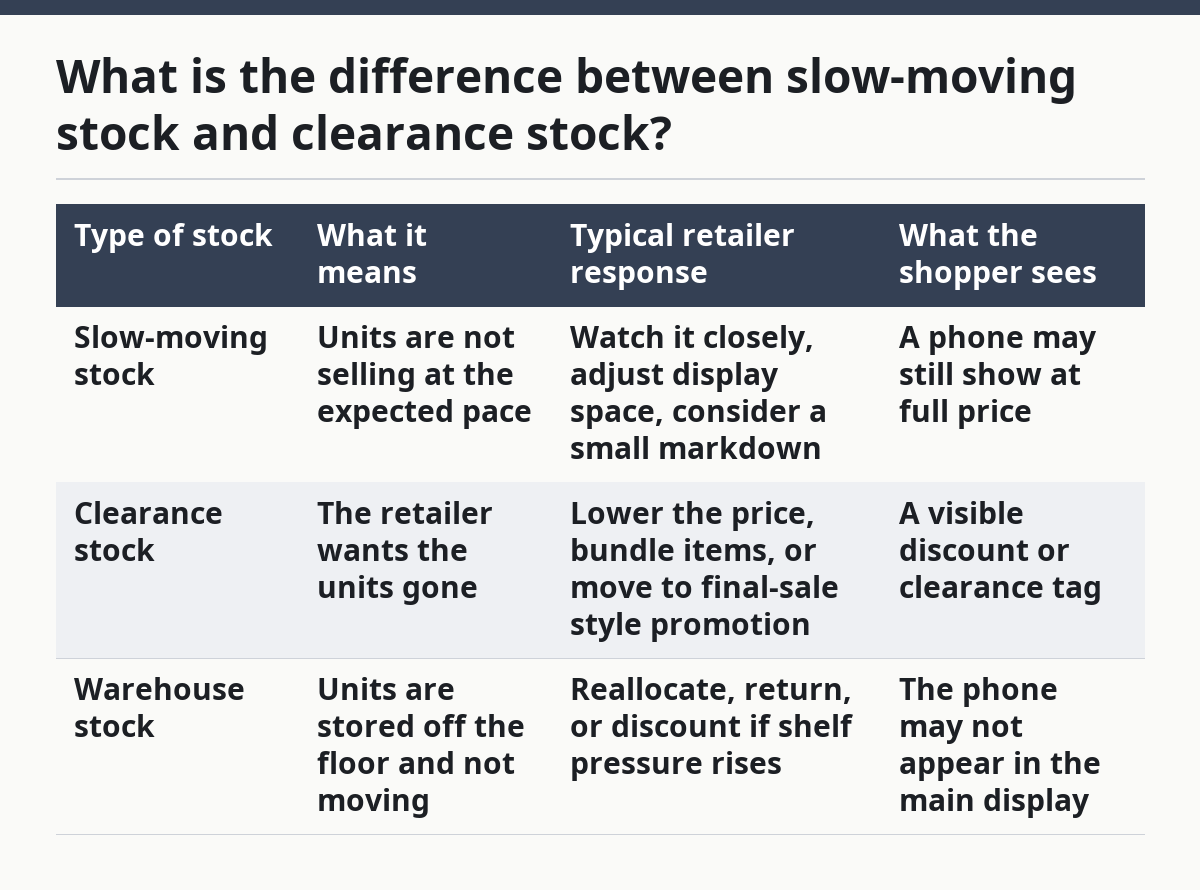
A slow-moving phone is not always discounted right away. A store can have a model sit for 2 months and still hold the line if demand is weak but not dead. Once the item is moved into clearance stock, the retailer is usually more serious about clearing it out.
This distinction matters because shoppers often assume every discount means a phone is nearing the end of its life. That is not always true. Sometimes it just means the retailer has too many units, or the model is taking longer to sell in that channel than the buyer expected.
The practical clue is placement. If the phone is moved from regular display to a clearance shelf, or if the retailer starts bundling it with a case or charger, the store is signaling that the item has become a stock problem, not just a product listing.
Why do some stores discount faster than others?
Some stores discount faster because their inventory cost is different, their space is tighter, or their sales pace is slower. A large chain and a small retailer can look at the same phone and make opposite choices on the same day.
A store with limited shelf space may cut prices sooner because every square foot matters. A retailer with more room may wait longer and hope the next customer pays full price. The same model can also age differently in different locations if one store sells phones quickly and another has weak foot traffic.
Channel matters too. Online stock can move on different timing than in-store stock, even when the handset is the same. A phone sitting in warehouse stock may be discounted before it ever reaches the shelf if the retailer sees that demand is soft. Another retailer might hold it for a week or a month longer and use a promo instead of a straight markdown.
This is also why clearance pressure looks uneven. A store that bought too many units for a local market may need to discount faster than a store that ordered carefully. The markdown is not only about the phone’s age; it is about the retailer’s mistake, the retailer’s space, and the retailer’s urgency to free cash.
A common mistake is reading a discount as proof that the phone has a defect. That is not what most aging-inventory markdowns mean. The price change usually reflects the store’s stock position, not the handset’s condition. If the phone is sold through regular retail channels, the real question is often, “How long has this unit sat here?” rather than, “What is wrong with it?”
When should a shopper read a discount as clearance pressure?
A shopper should read a discount as clearance pressure when the lower price comes with signs that the retailer wants the unit out fast. Those signs include a clearance label, limited stock, a moved display location, or a price cut that appears without a broader model-wide promotion.
A simple way to think about it is this: if the store is selling the phone because it wants to sell that phone, the discount may be promotional. If the store is selling the phone because it wants the space back, the discount is more likely tied to inventory aging. The difference shows up in how the unit is presented.
Clearance pressure often shows up in specific patterns:
- a single model is marked down while nearby models stay put;
- the phone is placed in a clearance section;
- the store says stock is limited, but the model is still listed as available;
- the unit is bundled or discounted to clear warehouse stock.
That does not make the phone a bad buy. It does mean the price is being driven by retailer inventory logic, not just by demand for the model. For a shopper, that can be useful because a marked-down phone may offer decent value if the model still fits the need. The trade-off is that the choice may be narrower, colors may be limited, and the retailer may not restock the same unit.
This page sits under the larger guide to what affects mobile phone prices, and inventory aging is one of the clearest examples of how retailer behavior changes the tag you see.
What gets missed when people talk about “old phones”?
People often miss that the discount is about stock age, not only product age. A phone can be a recent model and still get discounted if it sits too long. A phone can also be older in the market and still hold price if the retailer has little stock and steady demand.
That matters because “old” gets used as a catch-all word. In practice, there are at least two different clocks running. One clock is the market clock: how long the model has existed. The other is the inventory clock: how long that specific unit has been sitting on a shelf or in a warehouse. The price can react to either one, but this page is about the second.
Another thing people miss is that markdowns are often a retailer defense, not a customer reward. The store is trying to avoid a bigger loss later. If a handset sits too long, the retailer may have to take a deeper cut or carry it through another sales cycle. The earlier markdown is meant to keep that from happening.
That is why a discount on aging stock can feel sudden. The store has likely been watching the unit for weeks or months before the tag changes. The customer only sees the final step, not the slow buildup of inventory aging behind it.
Why do older phone stock prices fall?
Older phone stock prices fall because the retailer’s cost of holding the unit rises while the chance of selling it at full price falls. A phone that has sat through 30, 60, or 90 days of weak movement starts to look like a space problem, not a sales asset. The markdown is the store’s way of turning a stuck item into cash.
Does slow inventory always get discounted?
No, slow inventory does not always get discounted right away. A retailer may wait if the phone still has some demand, if the store has space, or if the next sale window is close. Some units sit at the same price for weeks before the store decides the markdown is worth it.
How do retailers price aging stock?
Retailers price aging stock by checking how fast it is selling, how much shelf space it uses, and whether a lower price is likely to move it. They may start with a small markdown, then step down again if the phone remains in clearance stock. The exact move depends on the retailer, the channel, and the amount of warehouse stock still sitting there.
Drafted with AI; not yet reviewed by a person.