

How to Compare Mobile Phone Insurance Plans for Theft and Loss
Last updated: November 19, 2026
Quick answer: compare 5 things in this order — theft cover, loss cover, deductible, claim limit, and coverage area. That is usually the clearest way to compare mobile phone insurance plans for theft and loss before you look at the premium. It helps you see whether a plan is likely to work if a phone is stolen or missing, or whether it only looks good on the sales page.
I read policy wording for a living, and this kind of comparison comes down to exclusions, not slogans. This article is information, not personal advice; if you are unsure, consult a qualified adviser or the insurer before you buy.
Key takeaways
- Theft cover and loss cover are not the same thing, and some plans include one without the other.
- The deductible matters because it is the amount you still pay when a claim is approved.
- Claim limits can cap what you get back even if the phone cost more.
- Coverage area matters if you travel, commute, or use the phone outside your home country.
- A plan can look broad on the sales page but still fail if your device is too old, too new, or not on the insurer’s list.
What should I check first?

Start with the policy wording, because that is where mobile phone insurance says what it really covers. The sales page may use broad phrases like “theft and loss protection,” but the policy booklet is where you find the rules that decide a claim.
Use the deductible as your first filter. If the deductible is high, a small claim may not feel worth filing. Then check whether theft and loss are both covered, because many people assume they come as a pair when they do not.
- Open the policy booklet and find the theft and loss sections before anything else.
- Read the deductible line and note how much you would still owe on a claim.
- Check the claim limit so you know the maximum payout for one phone.
- Look for the coverage area to see whether the plan applies only at home or also abroad.
- Verify device eligibility so you do not pay for a plan your phone cannot use.
- Compare the exclusions to see what kinds of “missing” or “stolen” claims are rejected.
If a plan is hard to understand in the first 2 pages, that is a warning sign, not a challenge. A policy that buries the rules is often the one most likely to surprise you later. Consumer groups and regulators such as the UK’s Financial Conduct Authority and the U.S. Federal Trade Commission both warn consumers to read the terms, not the headline.
Theft cover or loss cover?
Theft cover and loss cover are different, and the difference changes the value of the plan. Theft cover usually deals with a phone taken by force, stealth, or other defined criminal taking. Loss cover is about a phone that is misplaced, dropped somewhere unknown, or simply cannot be found, depending on how the insurer defines “loss.”
Theft cover is usually the cleaner benefit because insurers can ask for a police report, proof of ownership, and a timeline. Loss cover is often tighter because a missing phone is harder to verify. That means a plan with loss cover can still deny a claim if the policy says the phone was left unattended, lost in a public place under certain conditions, or not reported fast enough.
The right comparison question is not “Does it say theft and loss?” It is “What counts as theft, what counts as loss, and what proof does the insurer require for each?” A policy that names both may still treat them very differently, so it is sensible to check the wording carefully and, if needed, ask the insurer or a qualified adviser to explain it. If you travel often or use the phone outside the home, that distinction matters more than a glossy product name.
What does the deductible change?

The deductible changes how much a claim is worth in real life. It is the amount you pay before the insurer pays the rest, so a plan with a lower premium can still cost more after a claim if the deductible is high.
This is the part many buyers miss when they compare plans by monthly cost alone. Two plans can both say “theft and loss,” yet one may require a larger out-of-pocket payment before any replacement or cash value is approved. If the phone is older, that gap can become the whole story, because the claim limit and deductible may leave very little value left.
A good way to compare is to look at the likely claim amount, then subtract the deductible and check what remains against the claim limit. If the numbers leave a tiny payout, the policy may not fit a midrange phone or a phone you could replace yourself without strain. A plan is not automatically better because it is cheaper each month; the deductible can move the real cost in the other direction.
How do claim limits and coverage area work?
Claim limits and coverage area decide where the protection applies and how much the insurer will pay. A claim limit is the top amount the insurer will cover for a device, while the coverage area tells you whether the policy works only in one country, across a region, or worldwide.
This matters if you travel, move between countries, or buy a phone in one market and use it in another. A policy that looks generous at home can shrink fast if the rules say the claim must be filed in a specific country or within a certain time after the theft or loss. The same is true for replacement rules: some plans replace the device, while others pay cash up to the limit or provide a refurbished unit.
For example, the coverage area can change the value of the same plan by country. The claim limit can do the same by device price. A phone user who travels frequently should care more about coverage area and claim limits than about the smallest premium line. A person who rarely leaves one city may care more about deductible and proof rules.
Here is the comparison that usually changes the choice:
| Criteria | Theft cover-focused plan | Loss cover-focused plan | Winner for [condition] |
|---|---|---|---|
| Main risk covered | Stolen phone events | Misplaced or missing phone events | Theft cover if you worry about crime |
| Proof needed | Often stronger proof, such as a report | Often stricter proof, because loss is harder to verify | Theft cover if you can document incidents |
| Deductible impact | Can still make small claims feel thin | Can erase much of the value on lower-cost phones | Lower deductible if you expect to claim |
| Claim limit | Caps payout after theft | Caps payout after loss | Higher limit for expensive phones |
| Coverage area | May be limited by country or region | May be limited by country or region | Broader coverage if you travel |
| Device eligibility | Old, new, or imported phones may be excluded | Same eligibility limits often apply | Plan with wider device list |
| Claim frequency rules | May limit repeat theft claims | May limit repeat loss claims | Stricter claim rule if you have many devices |
| Replacement method | Replacement or cash can differ | Replacement or cash can differ | Method that matches your preference |
| Exclusions | Opened, unattended, or unreported phones may be excluded | Missing-after-delay cases may be excluded | The plan with fewer exclusions |
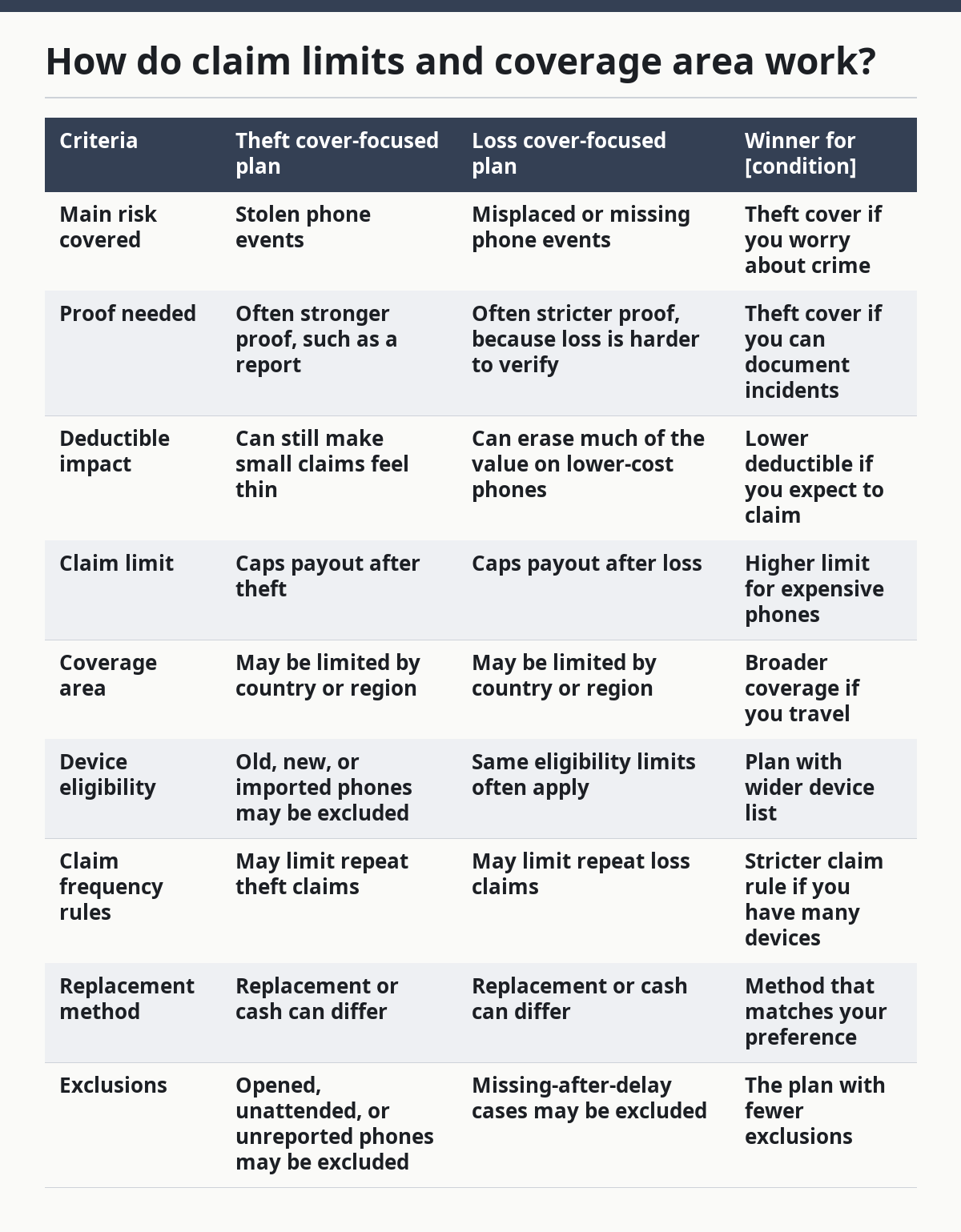
The table is not about which label sounds better. It is about which clause is easier for you to live with. For a broader comparison of protection choices, see the hub on mobile phone warranty and protection choices and the page on accidental damage cover, because those options solve different problems.
Which plan fits your phone and habits?
The better plan is the one that matches how you use the phone, not the one with the longest list of covered events. A commuter with a newer device and frequent public transit use may value theft cover more. A person who misplaces items often may look harder at loss cover, but only if the policy’s proof rules are realistic.
Device eligibility is a common reason people get caught out. Some insurers limit plans to phones bought within a certain age window, specific models, or devices in good working order. Others may require the phone to be registered quickly after purchase or to be free of pre-existing damage.
The warning sign is simple: if your phone sits near the edge of the insurer’s rules, read the policy before paying anything. That includes opened devices, imported handsets, and older models. If the wording does not clearly include your phone, assume it does not until the insurer says otherwise in writing. If you want to compare mobile phone insurance plans for theft and loss properly, this is the point where eligibility often decides the answer.
When does mobile phone insurance make less sense?
Mobile phone insurance makes less sense when the deductible, exclusions, and claim limits leave too little value after a claim. If a policy covers theft and loss but the deductible is high enough to wipe out most of the payout, the protection may not help much when you need it.
It also makes less sense if your main concern is accidental damage rather than theft or loss. This page is not about accidental damage cover, and those terms belong on a separate decision page. A plan can be fine for theft and loss and still be the wrong fit for cracked screens or liquid damage.
Another weak fit is a phone that falls outside eligibility rules. If the device is too old, too new, or not on the insurer’s approved list, the comparison stops being about value and becomes about whether you can join the plan at all. If that happens, keep comparing mobile phone insurance plans for theft and loss until you find one that actually accepts your device.
What is the verdict?
Choose theft-cover-led mobile phone insurance if your biggest risk is a stolen phone and you can live with proof requirements, claim limits, and a deductible. Choose loss-cover-led mobile phone insurance if you are more likely to misplace a phone and the policy explains that loss clearly, with rules you can actually meet. Neither if the plan’s exclusions, eligibility rules, or deductible leave you with too little protection to matter.
That verdict changes if one of four things is true. First, if you travel often, coverage area may matter more than the theft-versus-loss label. Second, if your phone is expensive, the claim limit can matter more than the premium. Third, if your phone is old or unusual, device eligibility can rule a plan out before price does. Fourth, if you mainly fear screen cracks or water damage, this comparison is the wrong one and another protection choice should handle that risk.
For a broader view of protection options around a handset, this sits alongside the hub on mobile phone warranty and protection choices, but it does not replace the policy wording for theft and loss.
How do I compare mobile phone insurance plans step by step?
Compare mobile phone insurance plans by working from the policy wording, not the advert. The shortest route is to check the claim rule, then the deductible, then the claim limit, then the coverage area, and finally the device eligibility.
Before you compare prices, compare rules. A 5-step check is enough for most buyers: theft definition, loss definition, deductible, claim limit, and eligibility.
First, use the policy booklet to find the exact theft and loss definitions. Second, use the deductible line to see what you would pay if a claim is approved. Third, use the claim limit to see how much the insurer will ever pay for one device. Fourth, use the coverage area to see where the protection applies. Fifth, use the device eligibility rule to make sure the phone qualifies before you pay for the plan.
A useful comparison also includes the exclusions page, because that is where many denied claims start. If the wording is vague about unattended phones, delayed reporting, or proof of ownership, check the wording carefully and ask the insurer or a qualified adviser for clarification before you buy. Insurance plans for theft and loss are only worth comparing if the claim rules are readable enough to use under stress.
For consumer guidance on reading policy terms, the Financial Conduct Authority and the Federal Trade Commission both publish plain-language material on comparing insurance and spotting misleading claims. Those pages do not choose a plan for you, but they help you ask the right questions before you pay.
Drafted with AI; not yet reviewed by a person.