

Why Phone Prices Differ Between Regions
Last updated: November 27, 2026
Quick Answer: phone prices differ between regions for 4 main reasons: launch strategy, channel costs, regional pricing tiers, and model-code differences. Why phone prices differ between regions even when the model is the same comes down to how manufacturers price a device by market, not by a single global number. They split the market into regions, set separate pricing tiers, and adjust for launch strategy, channel margin, local competition, and product differences tied to a model code. The result is that the “same” phone can carry a different sticker price even before taxes or exchange rates enter the picture.
Key takeaways
- A phone’s price is often set by region first, country second.
- The model number can hide real differences in bands, chargers, storage, or warranty support.
- Distribution channel matters because carrier shelves, retail shelves, and direct sales do not cost the manufacturer the same thing.
- The launch market often gets one price structure, then later regions get another.
- The cheapest-looking listing may not be the same product, even if the name on the box matches.
What is regional mobile phone pricing?
Regional mobile phone pricing is the practice of giving the same phone different list prices in different markets. The price is usually set by the manufacturer, then filtered through the local distribution channel, so a launch model in one region may start at one figure while the same name in another region starts higher or lower.

That is not a bug in the system. It is the system. A phone maker may treat North America, Europe, and parts of Asia as separate pricing zones, and readers should check the local market terms or ask a professional source if they need help comparing them. Each zone can reflect a different demand pattern, channel cost, and competitive pressure. A flagship name such as Galaxy S24 or iPhone 15 can appear identical on paper while still sitting inside a different regional pricing plan.
The key point is that “same model” does not always mean “same commercial product.” The box can carry the same family name, yet the model code, packaging, bundle, software loadout, or supported network bands can shift by region. For a reader comparing listings, that is why one country’s price looks out of line until the local version is checked against the exact model code.
This is also why price comparison gets messy. A headline price is only one layer; the phone may move through a carrier, a reseller, or the manufacturer’s own store before it reaches the shelf. The guide to what affects mobile phone prices starts here, because region is often the first filter that changes the final number. For related reading, see our guide to phone model numbers, carrier vs opened phones, and how to compare phone specs.
Why does the same model have a different price?
The same model has a different price because the manufacturer is pricing the market, not just the device. A phone maker is not guessing at one universal number; it is aiming at a specific launch region, a specific channel, and a specific competitor set, then using those inputs to choose the starting price.
The most common reason is launch region strategy. Some regions are used as early launch markets, and early launches often carry a higher opening price because supply is tight and demand is strongest in the first weeks. Other regions get a later release or a different introductory tier, which can make the “same” model look cheaper even when nothing inside the phone has changed.
Regional pricing tiers matter too. A company can put the same phone into a premium tier in one market and a more aggressive tier in another. That choice is not random. It reflects how much local buyers already pay for rival phones, how sensitive the market is to a small price jump, and how much margin the distributor needs to stay in the channel.
Local market position also matters. In one region, the model may be treated as a halo device meant to support the brand, but buyers who need to verify that positioning should consult the local launch page or an expert source. In another, it may be priced to fight a crowded shelf full of similar phones. The price then becomes part of the competitive stance, not just a reflection of the hardware.
How do model codes change the price?
Model codes change the price because they often mark a regional variant, and a regional variant can cost more or less to produce, support, and sell. The code tells the buyer, retailer, and service chain which version is in the box, and that version may not be identical across borders.
A good way to check this is to compare the model code before comparing the price. If two listings share the same marketing name but carry different codes, they may differ in supported bands, SIM setup, storage options, or bundled accessories. Apple, for example, uses model identifiers that can be checked through its support pages such as Identify your iPhone model. That kind of lookup matters because the box name alone is not enough. Samsung also maintains regional support and product information on its support site.
The practical effect is simple: a cheaper phone from one region may not be a clean substitute for a pricier one from another region. The lower price can reflect a stripped bundle, a different charger standard, a different eSIM or SIM layout, or a network variant built for that market. The model code is often the clearest clue that the two listings are not fully interchangeable.
Here is the comparison most buyers need to see:
| What changes by region | What the buyer sees | Why the price can move |
|---|---|---|
| Model code | Same family name, different identifier | Different regional hardware or support package |
| Band support | Fewer or different network bands | Different production and certification path |
| Bundle contents | Charger, cable, or adapter changes | Different packaging and channel cost |
| Warranty scope | Local support only or limited cross-region support | Different service cost for the seller |
| Storage tier | 128 GB vs 256 GB, for example | Different base price at launch |
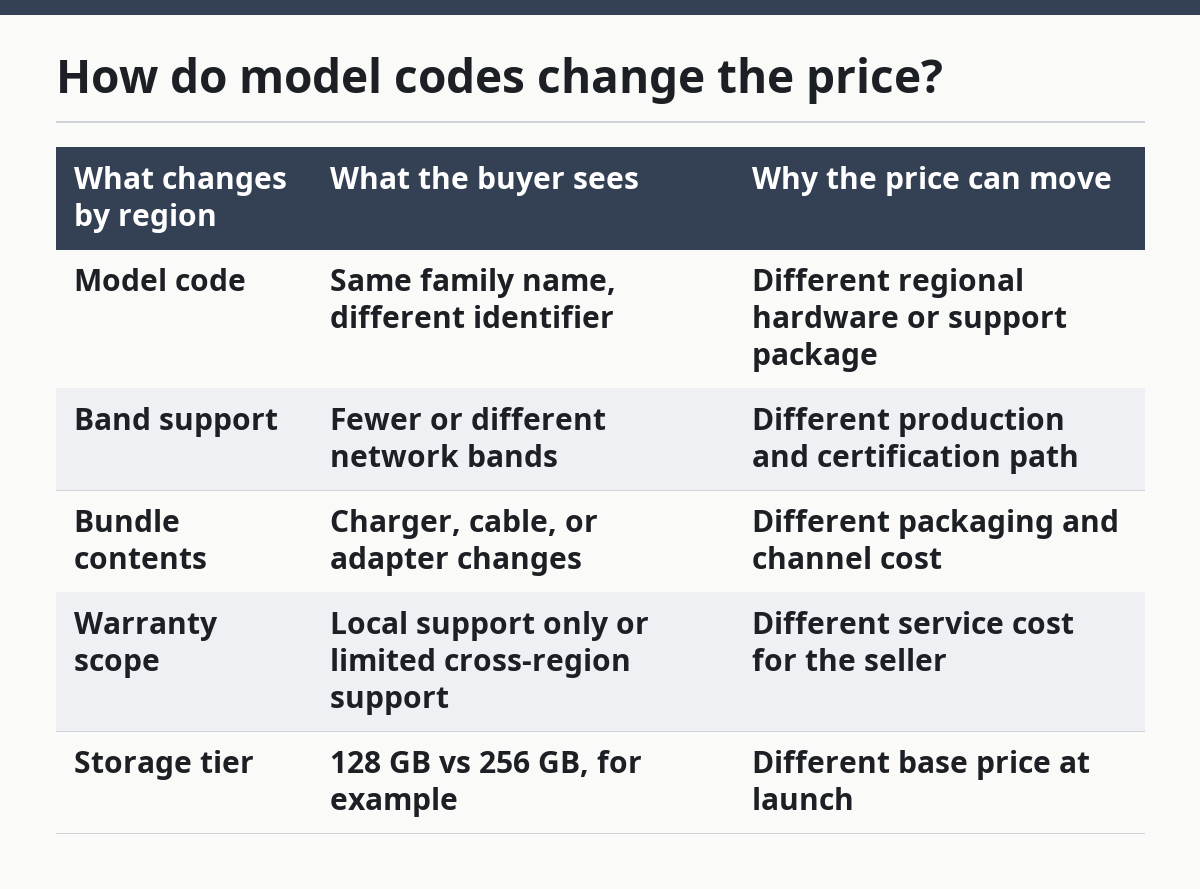
The trap is assuming the name on the front of the box is the whole product. It often is not. A model code is the cleaner comparison point, especially when the buyer plans to use the phone outside the launch region.
Why does the distribution channel matter?
The distribution channel matters because the manufacturer does not sell every phone the same way in every region. A direct-to-consumer store, a carrier bundle, and an independent retailer each create a different cost and margin chain, so the regional sticker price can change even when the hardware does not.
Carrier channels often look cheaper at first glance, but the price can be tied to a contract, an installment plan, or a subsidy model that changes the real cost over time. Retail channels may show a higher upfront price but fewer restrictions. Manufacturer stores may use their own pricing tier, which can sit above or below the channel market depending on whether the brand wants to protect margin or push volume.
This is why price normalization across countries is so hard. A like-for-like comparison only works when the channel is the same, the model code is the same, the storage is the same, and the comparison ignores differences such as financing structure. A buyer who compares a direct store price in one region against a carrier-subsidized price in another is not comparing equal offers.
The distribution channel can also change how quickly a price moves after launch. A retailer might discount earlier to clear stock, while a manufacturer keeps the list price stable for a longer period. The same phone can then appear in two price bands inside the same country, let alone across two regions. That is one reason regional pricing pages and product pages can mislead when they are read as a single number instead of a channel-specific offer. For more context, our phone buying guide and network compatibility guide explain how channel and support affect value.
How do launch regions shape the first price?
Launch regions shape the first price because they set the opening tone for the rest of the market. The first countries to get the phone often receive the first official pricing, and that price becomes the reference point for later regions, even when the later regions are served through a different distribution channel.
The manufacturer usually chooses launch regions where demand is predictable, supply can be controlled, and the brand wants a strong early signal. That early signal can mean a premium starting price. Later regions may receive a lower or higher local figure depending on how the brand wants to position the phone in that market.
A beginner often expects the launch price to be a single worldwide number that just gets translated into local currency. That is not how it works. The opening price is part of a market entry plan. The manufacturer can set one tier for the launch market, another for a market where the same phone must compete against cheaper rivals, and another where the product is sold mainly through carrier shelves.
The price can also change after launch without any change to the model name. That is normal. Once the first wave of demand passes, the regional pricing tier may shift, stock may be rebundled, or the channel may discount to move volume. A phone’s price in month 1 is often a poor guide to its price in month 6.
What should a buyer check before comparing prices?
A buyer should compare the model code, storage size, channel, and region before treating two prices as the same offer. That four-part check catches most false comparisons and keeps a buyer from chasing a listing that only looks cheaper.
Use this order:
- Match the exact model code, not just the marketing name, so the comparison starts with the same regional variant.
- Check the storage tier, such as 128 GB or 256 GB, because storage changes the base price fast.
- Identify the distribution channel, since a carrier offer is not the same as a direct store offer.
- Check the launch region or market label, because the same device name can sit in different regional pricing tiers.
- Compare the price only after those four items match, so the result reflects real regional pricing rather than a mixed bundle of differences.
A common mistake is to stop at the brand and model name. That mistake can cost a buyer a bad comparison, a wrong accessory bundle, or a phone that does not match the local network setup they expected. Another mistake is to assume the cheaper region is always the better deal. It is not if the model code points to a variant that is harder to support in the buyer’s own market.
The cleanest habit is to treat the price as the last thing to compare, not the first. The right question is not “Which country is cheapest?” It is “Which exact version of this phone is being sold, through which channel, in which region, and on what pricing tier?”
When is a price difference normal, and when is it a warning sign?
A price difference is normal when the model code, region, and channel are different. It becomes a warning sign when a listing uses the same marketing name but hides a different regional variant, a different channel structure, or a bundle that changes the real value of the phone.
Normal differences often come from launch strategy and regional pricing tiers. A phone can be more expensive in one region because that market is being used as an early launch anchor, or because the manufacturer expects stronger demand there. It can be cheaper elsewhere because the brand wants volume, because the channel is more competitive, or because the region is being treated as a different pricing class.
The warning sign is a listing that looks like a straight bargain but does not explain the model code or the market version. If the seller avoids that detail, the buyer may be looking at a phone that is not the same product in practical terms. That does not make the listing bad by itself. It does mean the comparison is incomplete.
This page is not the place to sort out taxes, duties, or customs delays. Those affect the final bill, but they are a separate issue. The job here is narrower: why manufacturers and markets create different phone prices before those other costs are added.
FAQ
Why are phones cheaper in some countries?
Phones are cheaper in some countries because manufacturers set different regional prices for the same model. The lower price can reflect a different launch strategy, a more competitive market, or a different distribution channel. It does not automatically mean the phone is inferior, but the model code should still be checked.
Does the same phone have different MSRP in different regions?
Yes, the same phone can have different MSRP in different regions. That happens when the manufacturer uses separate pricing tiers for different markets instead of one global list price. The marketing name may stay the same, but the regional price structure can still change.
Are regional price differences caused by taxes or strategy?
Regional price differences are often caused by manufacturer strategy, not just outside costs. Taxes and fees can affect the final bill, but this page is about the pricing decision made before those add-ons. A phone can start at a different regional price because the brand set a different market plan for that region.
Drafted with AI; not yet reviewed by a person.