

How carrier contract cycles change phone prices
Last updated: November 27, 2026
Quick answer: carrier contract cycles can lower a phone’s upfront price by spreading the cost over 24 months, but the out-of-pocket phone price is only lower if you keep the line active long enough to earn all the bill credits. In this article, carrier contract pricing changes your out-of-pocket phone price by moving part of the cost from the store counter to your monthly bill. The phone can look cheaper on day one because the carrier spreads the price across a 24-month or similar term, then pays you back in bill credits if you keep the line active and meet the contract terms.
Key takeaways
- A lower upfront price on contract usually means part of the phone cost is delayed, not erased.
- Monthly bill credits can reduce the real cost, but only if you keep the required line and payment plan active long enough.
- Contract length changes both the sticker price and the risk of losing credits if you leave early.
- Device financing and monthly installment plans are part of the same price setup, but they do not work like a simple cash discount.
- The best deal depends on how long you expect to stay with one carrier, not just the price shown at checkout.
What changes the phone price on contract?
Carrier contract pricing changes the phone price because the carrier ties the phone discount to a service term and a payment schedule. The number you see at checkout is often the first payment, the tax, or the remaining balance after a promotional credit has been promised over time.
That is why the same phone can show two very different prices: one for a phone sold with a carrier contract and one for a phone sold without it. On contract, the carrier may use a monthly installment of 24 months, then apply bill credits each month if you keep the line active and the account in good standing. The price looks lower up front because the carrier is counting on future service revenue.
The key point is that the listed price is not always the full price. If a phone is advertised at a low out-of-pocket amount but the rest is covered by 24 monthly bill credits, the real question is whether you will stay long enough to collect all 24 credits. If you leave after 8 months, you may lose the rest.
This is why contract pricing is useful for some buyers and bad for others. It helps the buyer who plans to keep the same carrier for the full term. It is a poor fit for someone who changes carriers often, upgrades early, or wants to pay the whole phone cost at once and be done.
Why is the upfront phone price lower on contract?
The upfront phone price is lower on contract because the carrier spreads the phone’s cost across the contract cycle instead of asking for full payment on day one. That lower number is usually tied to device financing, bill credits, or both.

A carrier contract can work in a few ways. The phone may be sold with a monthly installment plan, such as 24 equal payments. The carrier then lowers your effective cost by applying bill credits to your bill each month. In other cases, the carrier reduces the amount you pay at checkout and recovers that difference through the contract term. Either way, the discount is usually conditional.
Here is the practical effect. A phone that would feel expensive at full price can look manageable when the carrier breaks it into monthly installments. That helps with cash flow.
It also makes the phone feel less expensive than it really is if you stop reading after the first payment line.
The trade-off is timing. A lower upfront price is not the same thing as a lower total cost. If the bill credits depend on a full 24-month term, then leaving at month 10 changes the math fast. You may still owe the device balance, and you may also lose the remaining credits.
This setup is not ideal for buyers who want freedom to switch carriers, because the discount is tied to staying put. It is also not ideal for someone who values a clean break between phone cost and service cost. The price may look friendlier, but the commitment is the hidden part of the deal.
How do carrier credits change the real cost?
Carrier credits reduce the real cost only if you keep receiving them for the full promised term. According to the FTC and FCC, carrier promotions and device financing are often conditional, so the monthly credit is the part that turns a high sticker price into a lower effective price, but the credit usually comes with conditions.

The usual pattern is straightforward. You sign up for device financing, pay the monthly installment, and then the carrier applies a separate bill credit to offset that installment. If the credit is large enough and lasts the full term, your net phone cost can be much lower than the advertised list price. If the credits stop, the monthly payment stays, and the phone gets more expensive again.
This is the part many buyers miss. The credit is not a rebate sitting in your hand. It is a promise to lower future bills. That means the real price depends on behavior after the purchase, not just the checkout screen.
For example, use this simple check before you agree to a contract cycle:
- Find the phone’s full financed amount. This is the number the monthly installment is based on.
- Find the length of the credit term. Many carrier offers are built around a 24-month cycle.
- Check whether the credit starts right away or after the first bill.
- Ask what happens if you upgrade early, cancel service, or move the line to a different plan.
- Compare the total out-of-pocket amount you expect to pay over the full term, not just the first month.
If you want the phone to be cheap in the long run, the credit terms matter more than the headline offer. A phone with a larger bill credit can still cost more if the contract is long, restrictive, or easy to break. The real cost is the amount you will actually pay after all credits, fees, and missed credits are counted.
How do contract terms change phone pricing?
Contract terms change phone pricing by deciding how long the discount lasts, when the credits arrive, and what happens if you leave early. The most important term is the length of the cycle, because it controls how long the carrier has to spread the discount across your bill.
A 24-month term usually lowers the monthly payment more than a shorter term, but it also locks the discount in for longer. That can make the phone seem affordable at first while creating a longer commitment. A shorter cycle can make the monthly hit feel larger, but it may reduce the time you are tied to the carrier.
Early upgrade terms matter too.
If the carrier lets you upgrade before the device is fully paid off, you may need to pay off the remaining balance, return the phone, or give up pending bill credits. That is where a good-looking contract can turn into a bad deal for anyone who wants to upgrade every year.
| Contract feature | What it does to price | Best for | Risk |
|---|---|---|---|
| Longer cycle, such as 24 months | Lowers the monthly installment and stretches the discount | Buyer staying with one carrier | Higher chance of lost credits if plans change |
| Shorter cycle | Raises the monthly payment but ends sooner | Buyer who wants less commitment | Less room for a large promotional discount |
| Bill credits | Lowers the effective phone cost over time | Buyer who will keep service active | Credits can stop if the account changes |
| Early upgrade option | Lets the buyer switch phones sooner | Buyer who upgrades often | Remaining balance or lost credits |
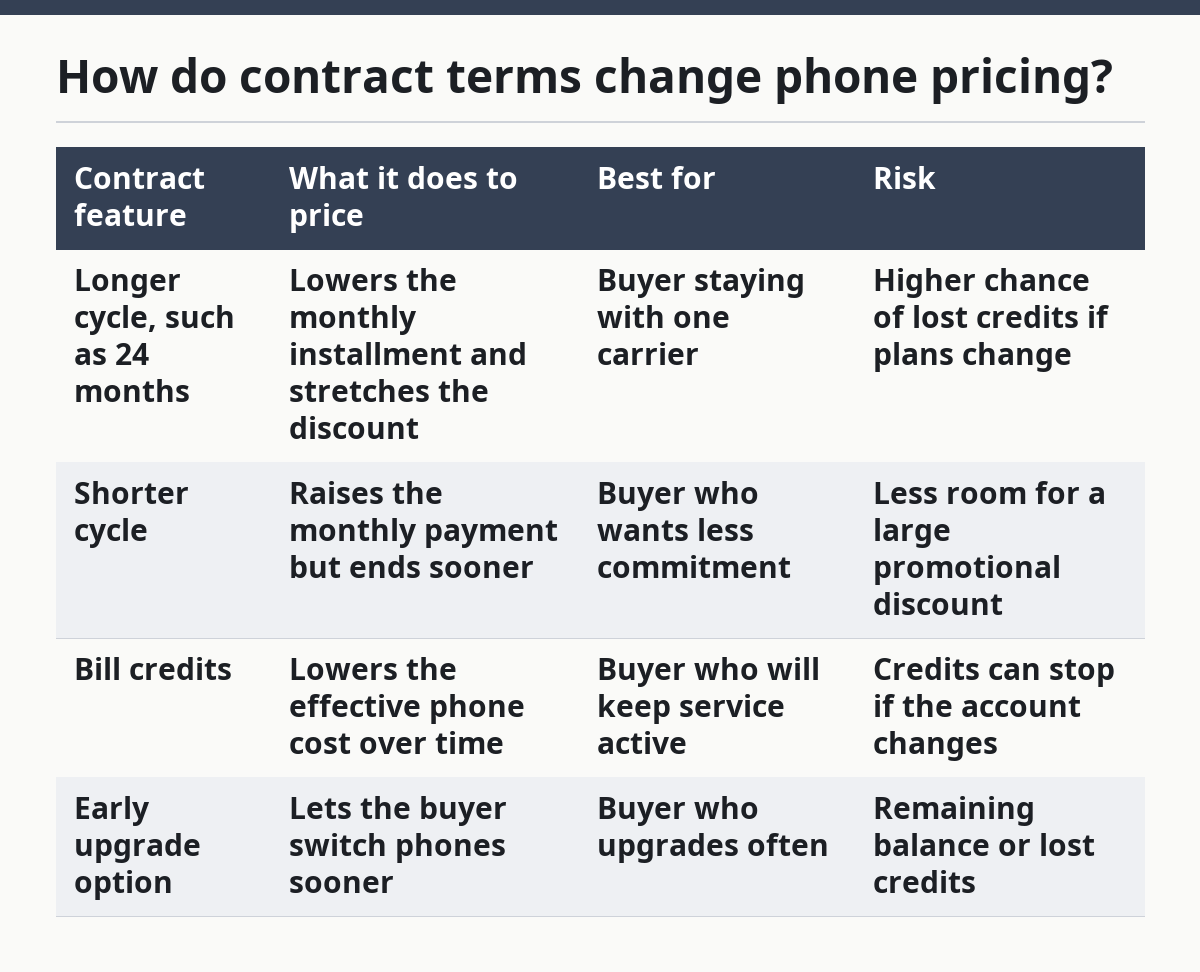
The reason contract terms matter so much is that the phone price is not isolated from the service plan. The carrier uses the contract cycle to shape the true cost. If the buyer does not read the term length and the credit rules, the deal can look cheaper than it really is.
What should I check before I sign?
You should check the full device-financing math before you sign, because the checkout price alone does not tell you what the phone will cost by the end of the contract. The right next step is to match the monthly installment, the bill credit, and the contract length on the same page.
Start with the device financing structure. Look for the financed amount, the number of monthly payments, and whether the carrier is using bill credits to reduce the effective cost. If the plan says 24 monthly installments, count the months as part of the price, not as fine print. A deal that looks small at checkout can be much larger once those 24 months are added up.
Then check the service rule attached to the credit. Ask whether the credit requires a specific plan, one active line, or continued service for the full term. If the answer changes when you upgrade, cancel, or suspend the line, the advertised price is only half the story.
Finally, compare the total cash you will part with over the cycle. Do not look only at the phone’s price tag. Look at the monthly bill, the line fee, the installment, and the credit together. That is the number that matters if you want to know whether the contract is actually cheaper.
For a wider view of pricing factors, this sits under the broader hub on what affects mobile phone prices. The carrier contract cycle is one of the biggest reasons the same model can feel cheaper in one checkout flow and more expensive in another, and phone financing explains the payment side in more detail.
When is a carrier contract the wrong choice?
A carrier contract is the wrong choice when you want freedom more than a lower first bill. If you expect to switch carriers, upgrade early, or pay off the phone on your own schedule, the contract cycle can make the phone more expensive than it first appears.

It is also the wrong choice if you hate conditional discounts. A bill credit that depends on 24 months of service is not the same as a plain markdown. Miss a payment, move the line, or end service early, and the math changes. That is a real drawback, not a minor detail.
The contract model can also be a poor fit if you are shopping only by the advertised upfront price. That number often hides the rest of the cost in future installments. If you are trying to judge the true phone price, the better question is not “What do I pay today?” but “What do I pay over the whole term, and what breaks the deal?”
There is one clear advantage: for a buyer who will stay with one carrier for the full term, the contract cycle can make a high-priced phone easier to manage. The downside is that the savings are conditional. If that condition does not fit your habits, the contract is not a bargain. For comparison, it can help to review how to compare mobile plans before you sign.
Drafted with AI; not yet reviewed by a person.