
How Regulatory Compliance Costs Raise Phone Prices
Last updated: November 28, 2026
Regulatory compliance and certification costs raise phone prices by adding fixed costs before a phone can be sold at all. A maker has to pay for testing, approvals, paperwork, and product changes for rules such as FCC, CE marking, SIM certification, RoHS, and EMC testing, and those costs get spread across each unit.
Key takeaways
- Compliance costs usually do not show up as one line on the box; they are folded into the phone’s price.
- The biggest pressure comes from fixed fees, lab testing, and redesign work, not from one simple certificate.
- FCC, CE marking, SIM certification, RoHS, and EMC testing each add a different kind of cost.
- Small production runs feel these costs more because there are fewer phones to spread them across.
- Phones made for stricter or more complex markets often carry more compliance overhead.
What does regulatory compliance cost a phone maker?
Regulatory compliance costs a phone maker money in three places: testing, certification, and product changes. A handset has to pass radio checks, emissions checks, and environmental rules before it can be sold in a market that requires them, and each step can mean lab time, filing fees, and engineering work.
The key point is that these are mostly fixed costs. If a company spends on EMC testing, FCC authorization, or CE-related work, that cost exists whether it sells 1,000 phones or 1,000,000. That is why compliance weighs more on smaller brands, niche models, and short product runs than on mass-market flagships.
The phone itself may also need design changes to pass. A radio module may need shielding, an antenna may need retuning, or a board layout may need another revision after a failed test. Each redesign adds time and payroll cost before the first unit ships.
This is why compliance is not just a legal box to tick. It is part of product development, and it can delay launch even when no law is broken. A phone that needs one more EMC test pass can spend weeks in the lab instead of on shelves.
If you want the wider pricing picture, this topic sits inside the larger Mobile Phone Pricing Factors hub, but compliance is its own cost bucket and should be treated that way.
Which certifications usually matter most?
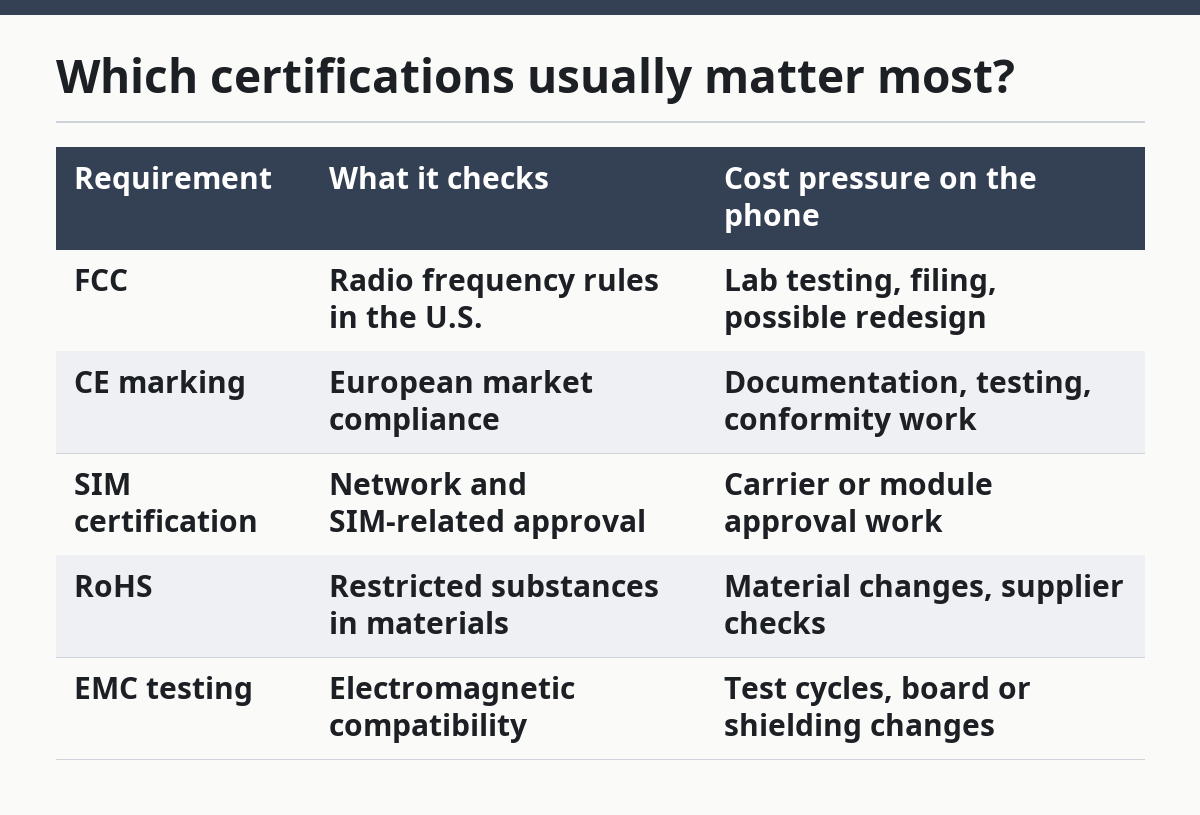
The most common compliance items that affect phone pricing are FCC, CE marking, SIM certification, RoHS, and EMC testing. Each one covers a different risk, and each one adds cost in a different way.
| Requirement | What it checks | Cost pressure on the phone |
|---|---|---|
| FCC | Radio frequency rules in the U.S. | Lab testing, filing, possible redesign |
| CE marking | European market compliance | Documentation, testing, conformity work |
| SIM certification | Network and SIM-related approval | Carrier or module approval work |
| RoHS | Restricted substances in materials | Material changes, supplier checks |
| EMC testing | Electromagnetic compatibility | Test cycles, board or shielding changes |
FCC approval matters because a phone is a radio device, not just a screen and battery. It has to transmit without causing harmful interference, so the radio chain, antenna, and software settings may be tested and documented.
CE marking matters because it signals that a phone meets the relevant European requirements. It is not a single test, but a package of conformity work that can include radio, safety, and environmental checks depending on the device and market.
RoHS matters because it limits certain hazardous substances in electronics. That can force a maker to change materials, ask more questions of suppliers, and keep records for every part that touches the phone’s bill of materials.
SIM certification matters when a device must work cleanly on a carrier’s network or with a specific module. That can mean extra approval paths beyond the base phone design, especially when the phone is sold through carriers rather than only opened retail channels.
EMC testing matters because a phone must not radiate or receive unwanted electrical noise in ways that break rules or hurt performance. Fail an EMC test and the maker may need another board revision, a new shield, or a new test run.
For the official frameworks, the FCC and European Commission both publish compliance material. The FCC equipment authorization pages and the European Commission’s RoHS guidance are the kinds of source pages that set the rules behind the cost.
How do those costs show up in retail price?
Those costs show up in retail price as overhead spread across every unit. A phone’s sticker price usually reflects materials, assembly, software, shipping, margin, and then the compliance burden buried inside the company’s cost stack.
A simple way to think about it is this: if a model needs more lab work, more documentation, and more revisions, the company has to recover that spending somewhere. The easiest place is the selling price. Even when the final markup is not visible, compliance can push the phone into a higher price tier.
This effect is strongest in three cases. First, low-volume phones, because fixed certification fees get divided across fewer units. Second, phones with many radios or market variants, because each variant can need separate testing or paperwork. Third, phones sold into strict markets, because the rule set itself can be broader.
A large brand may hide some of the burden better than a small one, but it does not make the cost vanish. It can spread the expense across a wider lineup, while a smaller maker may have to recover more of it from one model’s price. That is one reason niche phones often look expensive for their specs.
The consumer does not usually see a line item called “FCC fee” or “RoHS compliance” on the box. The price just comes out higher than it would be if the phone could be sold with no approval work at all.
Why do some phones need more testing than others?
Some phones need more testing because they use more radios, more bands, or a more complex design. A basic handset with fewer features can face a simpler approval path than a premium phone packed with 5G radios, Wi‑Fi, Bluetooth, NFC, and multiple regional variants.
The number of tests matters because each radio path and each market rule can create another round in the lab. A phone that must satisfy EMC testing, radio approvals, safety checks, and RoHS documentation will usually cost more to bring to market than a simpler device with fewer compliance touchpoints.
Here is the usual order of work when compliance is handled properly:
-
Map the target market rules. The maker checks whether the phone needs FCC authorization, CE marking work, SIM certification, RoHS documentation, or another approval path. That defines the test plan before hardware is frozen.
-
Build the compliance prototype. Engineers prepare a near-final sample with the right antenna, shield, firmware, and materials. The result should be a unit that reflects the shipping design, not a rough mock-up.
-
Run EMC and radio testing. The phone goes into a lab for emissions and immunity checks, along with radio performance tests tied to the target standard. A failure here often means a hardware or firmware change.
-
Fix problems and retest. If shielding, layout, or software settings are wrong, the team changes the design and repeats the test. That adds time and another lab charge.
-
Submit the paperwork. The company files the needed conformity documents and records. Once that is complete, the phone can move toward sale in the approved market.
-
Carry the cost into launch pricing. The company recovers the compliance spend across the units it expects to sell. The smaller the run, the more each unit has to carry.
The cost of a failed test is not just the retest fee. It can also mean a delayed launch, missed carrier windows, and a product that arrives after competitors have already taken shelf space. That is why compliance work is often done early, not after the phone is finished.
When does compliance matter most to the buyer?
Compliance matters most to the buyer when the phone is sold in a tightly regulated market or when the model is low volume. In those cases, the compliance cost is more likely to be visible in the final price, even if the buyer never sees the paperwork.
This is also where some readers make a bad assumption: they think a higher phone price is always about better parts. Sometimes it is, but sometimes the extra money is paying for approvals, lab time, and engineering work that never shows up in the spec sheet. A phone with an ordinary chip can still cost more if it was expensive to certify.
The trade-off is real. Stronger compliance raises consumer protection, radio reliability, and environmental discipline, but it also makes entry harder for small brands. That can reduce price competition. A strict approval path can keep bad products out, yet it can also make it harder for a lean company to launch a cheap phone.
This is where compliance costs are not good for the buyer: if the only reason a phone is expensive is that a maker had to spend heavily on paperwork for a tiny run, the buyer pays for overhead without getting better hardware. It is also not good for the market when repeated retests or slow approvals delay lower-cost models.
Still, the answer is not “skip compliance.” A phone without the right approvals can be illegal to sell, unsafe to use on networks, or poor at meeting emissions rules. The buyer’s real choice is not compliance versus no compliance. It is whether the compliance burden is being spread efficiently or passed through at a higher price than necessary.
How can a shopper tell if compliance is part of the price?
A shopper can tell compliance is part of the price by looking for signs of market-specific approval work, not by expecting a label that names the cost. The box rarely says “this price includes FCC testing,” so the clue is usually in the model’s market scope, carrier ties, and feature complexity.
A carrier-sold phone often carries more approval work than a simple opened model, especially when SIM certification or network acceptance is involved. A phone released in several regions may also cost more because the maker had to support more rule sets and more paperwork. A premium model with many radios almost always carries a larger compliance burden than a basic voice phone.
One practical sign is a phone that ships in a narrow set of regions or through one carrier first. That can mean the maker is still working through approvals or has chosen a more controlled launch path to limit compliance risk. Another sign is a brand that keeps hardware variants tightly separated by market. That often reflects the cost of meeting different standards.
The buyer should not assume compliance is the biggest driver of price. It is one layer in a stack that also includes materials, assembly, software support, branding, and channel margin. Still, when a phone seems expensive for what it includes, compliance is often part of the explanation, especially in markets where FCC, CE marking, RoHS, and EMC testing all matter.
Do certification fees change retail price?
Yes, certification fees can change retail price because they raise the cost a maker has to recover somewhere. The fee itself may be only one part of the bill, but it usually sits beside lab time, filing work, and possible redesigns. Those costs are spread across the units, so the final price tends to rise when the volume is low or the approval path is complex.
Why do phones cost more in some regulated markets?
Phones cost more in some regulated markets because the maker may face more testing, more documentation, or more approval steps before sale. FCC, CE marking, SIM certification, RoHS, and EMC testing can all add overhead depending on the market and the device design. That overhead is often folded into the shelf price rather than shown separately.
What compliance costs are built into smartphone pricing?
Smartphone pricing usually includes the cost of radio approvals, EMC testing, certification fees, environmental compliance work, and engineering changes made to pass those checks. It can also include the time cost of delays and retesting. These costs are often fixed, so they hit small runs harder than large-volume phones.
Drafted with AI; not yet reviewed by a person.