

How Imported Phones Get Priced by Seller Markups and Local Handling
Last updated: November 29, 2026
Quick answer: imported phones are often priced in 3 layers, and the topic of how imported phones get priced by seller markups and local handling is usually clearer when you compare the full landed price, not just the shelf label. Importers, distributors, and local resellers add their own margin, then local handling covers storage, testing, warranty support, and the risk of units that do not move fast.
Key takeaways
- The sticker price on an imported phone is usually built in layers, not one jump from factory cost to retail.
- Seller markup is not the same as local handling. One pays for profit; the other pays for work, risk, and support.
- Parallel imports can look cheaper at first, but the missing local warranty often shows up in the final price trade-off.
- A phone with a cleaner local support path can cost more than the same model sold through an importer with thin after-sales service.
- The best comparison is often the full landed price to the buyer, not just the first number on the shelf.
What makes the price higher?
However, the price goes up because every seller in the chain adds a layer before the phone reaches the buyer. An imported smartphone may pass from an importer to a distributor, then to a local reseller, and each one may keep a margin of its own.
A simple way to think about it is this: the factory price is not the retail price, and the gap is not one fee. It is several smaller charges that pile up. A reseller who holds the phone for 30 days, answers setup questions, and accepts returns needs room in the price for that work.
Therefore, two phones with the same model name can sit at different prices in the same market. One may be a parallel import with little after-sale support. The other may have passed through a local distributor that handles stock, paperwork, and warranty claims for the reseller.
The buyer may not see those layers listed out. The visible number may be the final sticker price, but that number reflects three things: the seller’s profit, the cost of handling the phone locally, and the risk that the seller may need to fix or replace a unit later.
How does a seller build the final price?
Because of that, a seller builds the final price by adding markup on top of the phone’s base cost and then folding in local handling costs. That process is not mysterious, but it is easy to misread if a buyer only compares two shelf prices side by side.
Here is the usual path, step by step:
- The seller starts with the phone’s purchase cost from an importer or distributor. That base cost is the floor, not the final number a buyer pays.
- The seller adds gross margin. This is the seller’s room for profit after rent, staff time, payment fees, and returns.
- The seller adds local handling costs such as inspection, software setup, packaging checks, and storage. These costs may be small per unit, but they matter on slower-selling models.
- The seller adds warranty risk. If the phone is sold with local warranty support, the price needs to cover repair labor, swap stock, and the chance that some units come back. The FTC notes that warranty terms can affect how a buyer should compare offers, and the same is true in imported-phone pricing. FTC: Warranties
- The seller rounds the result into a market-friendly price point. A phone may end up priced just below a clean threshold because buyers react to the final figure, not the formula.
In particular, this is the part most generic explainers miss: markup is not one flat number. A low-volume importer may use a bigger margin on a niche model because the phone ties up cash longer. A fast-moving local reseller may accept a smaller margin on a popular model if the phone sells in a few days.
The result is not always a higher price for imported phones. Sometimes a parallel import is cheaper because it skips one or more layers. The trade-off is that the missing layers do not disappear; the buyer just takes on more of the risk.
What counts as local handling?
Meanwhile, local handling is the work the seller does after the phone arrives in the country but before it reaches the buyer. It covers the practical jobs that make an imported phone ready for sale, and those jobs cost money even when they are not itemized on the receipt.
Typical local handling includes checking the phone’s condition, confirming it powers on, preparing the software for local use, and packing it for sale. Some sellers also pay for serial number tracking, basic quality checks, and return processing. A small shop may do this on a few units at a time; a distributor may do it across hundreds of phones.
The local handling cost becomes more visible when a seller offers local warranty support. A warranty provider or service partner needs staff, spare parts, and a process for claims. That support is part of the price, even when the seller does not label it separately. For context on how warranty terms change the buyer’s risk, the FCC and FTC both advise checking service details before purchase. FCC consumer guide to wireless phones
A phone sold as a parallel import often has lower handling cost because the seller does less after it lands. The downside is plain: if the phone fails later, the buyer may have fewer local repair options, and the seller may be less willing to absorb the cost.
Imported phones and local warranty gaps
However, imported phones can cost less up front when the seller does not include a strong local warranty, but that lower price often comes with a gap in support. That gap is one of the biggest reasons imported phones are priced differently from stock that is fully backed by a local reseller.
The gap shows up in three places. First, the seller may only offer a short store warranty instead of broader local service. Second, repair parts may not be stocked locally. Third, the buyer may have to deal with a warranty provider that only covers certain faults or only handles the phone if it was sold through an approved channel.
That is why a phone with a cheaper sticker price can still be the more expensive choice if it fails. The buyer may have to pay for postage, repair delays, or a replacement unit outside the seller’s warranty terms. The risk is not theoretical; warranty coverage and repair access are practical cost items, not adjectives.
This is the main reason imported phones are not ideal for someone who wants simple support. A buyer who values low friction, quick repair, and a clean claim path may prefer to pay for those things in the price. A buyer who only wants the lowest entry number may accept the risk and buy the parallel import.
Why do importers, distributors, and resellers each add margin?
Since each seller carries a different part of the cost and risk, they each add margin. The importer brings in the stock, the distributor moves it into the local market, and the reseller makes the final sale to the buyer.
The importer’s margin covers sourcing work, financing, and the risk of holding stock that may not sell quickly. The distributor’s margin covers warehousing, allocation to retailers, and the cost of moving mixed stock across channels. The local reseller’s margin covers the shop floor, sales staff, returns, and customer support.
A clean way to compare those roles is below:
| Seller role | Main job | Typical cost pressure | What the buyer sees |
|---|---|---|---|
| Importer | Brings in the phone | Cash tied up in stock | Lower price than retail, no buyer contact |
| Distributor | Spreads stock to sellers | Warehousing and allocation | Middle price, often invisible to buyer |
| Local reseller | Sells to the buyer | Rent, staff, support, returns | Final shelf price and warranty promise |
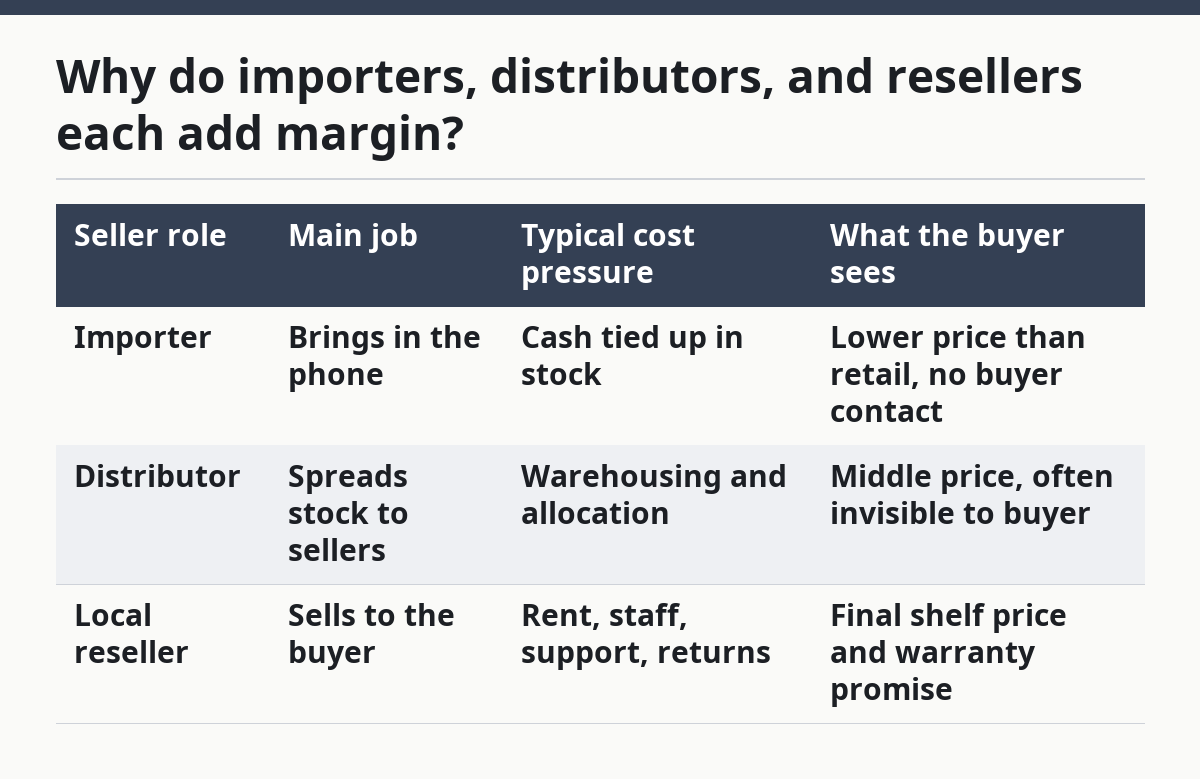
In contrast, no one in the chain works for free. If a seller price looks unusually low, one of two things is usually true: the seller accepted a thin margin, or the seller trimmed handling and support.
How should a buyer read the price tag?
Therefore, a buyer should read the price tag as a bundle of cost, service, and risk, not just as a number. The right question is not “Why is this imported phone higher?” but “What is included in this price that the cheaper one leaves out?”

The fastest check is to compare four things before buying: who sold the phone, whether local warranty is included, what the return window looks like, and whether the phone is a parallel import. A seller that names all four clearly is usually easier to compare than one that hides them behind a single number.
If two phones have the same model and storage size, the cheaper one is not always the better deal. A lower price can mean fewer handling steps, less support, or a warranty that is hard to use. A higher price can reflect a local stock path with better service and less hassle later.
This page sits under the Mobile Phone Purchase Channels hub because pricing only makes sense when the channel is clear. Mobile Phone Purchase Channels A phone that moves through official local stock will usually be priced differently from one that arrives through a parallel import path, even if the model name on the box is the same. For related guidance, see phone warranty guide and buying a used phone.
Where do sellers make the biggest mistakes?
Ultimately, sellers make the biggest mistake when they price imported phones as if handling and support were free. That mistake usually shows up as a thin early price and a weak after-sales promise, and it can damage trust fast.
One common error is underpricing local warranty work. If a seller promises support for 12 months but sets the price as if there will be no claims, the first repair can erase the margin on several sales. Another error is overpricing slow-moving stock just because it came through a longer chain. If the market sees the same model at a lower number from another channel, the overpriced unit sits.
However, buyers make mistakes too. They often compare only the sticker price and ignore the service terms. That can cost them later if the phone needs a repair board, a screen swap, or a return that the seller will not accept without the right paperwork.
The practical fix is simple: compare the whole channel, not just the phone. A local reseller with a higher tag may still be the cheaper choice if the handling, warranty, and return process are built into that price.
FAQ
Why are imported phones priced differently from local stock?
Imported phones are priced differently from local stock because the seller chain is not the same. An importer, distributor, or local reseller may each add margin, and local handling can add more cost through inspection, storage, and warranty support. The final number reflects both profit and the work needed to sell the phone locally.
What costs get added to imported phone prices?
The main costs are seller markup, local handling, and support risk. Handling can include checking the phone, preparing it for sale, storing it, and dealing with returns or warranty claims. If the seller offers local service, that support has to be built into the price somehow.
Do imported phones usually include a markup?
Yes, imported phones usually include a markup because each seller in the chain needs room to make money and cover costs. The markup may be small on fast-moving stock or larger on units that sit longer. A lower price does not mean no markup; it usually means a thinner one or less support attached to the sale.
How do I tell if a cheaper imported phone is worth it?
A cheaper imported phone is worth it only if the support trade-off is acceptable. Check the warranty terms, the return window, and who handles repairs locally. If the price gap is mostly coming from skipped support, the lower sticker price can turn into a higher total cost later.
Drafted with AI; not yet reviewed by a person.