
Why Preorders and Launch-Day Availability Change Mobile Phone Prices
Last updated: November 29, 2026
Quick Answer: In the first week, a phone can still be sold at the same sticker price, yet a preorder may include $50 or $100 of extra value while launch-day stock can be thinner or bundled differently.
Why preorders and launch-day availability change mobile phone prices comes down to tight supply, high first-wave demand, and launch stock allocations that shape how many phones reach shelves at the list price. That is why a phone can look “the same” on paper and still be harder to buy, bundled with preorder bonuses, or pushed into higher-priced reseller listings during launch week.
Mobile Phone Pricing Mechanics puts the launch price in context, while phone preorder guide and launch-week buying tips explain how timing changes the offer you see.
For background on pricing and launch timing, see the Apple iPhone launch store and Samsung’s smartphone lineup, which show how preorder and launch offers are presented in practice.
Key takeaways
- A preorder does not always mean a lower price; it often means earlier access, not a discount.
- Launch day is price-sensitive because the first batch of phones can be small and many buyers want the same model at once.
- Retailers and carriers can shape the first price you see by deciding how many units to release and whether to attach perks.
- Short supply does not automatically raise the official list price, but it can raise the price you actually pay if the cheapest stock disappears.
- If you wait, you may miss preorder bonuses, yet you may also avoid launch-day scarcity and inflated resale listings.
According to the Federal Trade Commission, buyers should compare the full offer, not just the headline price, because add-ons and conditions can change the real cost.
What makes smartphone preorder pricing different?
Smartphone preorder pricing is different because the buyer is reserving a phone before normal shelf stock is full, not shopping in a steady market. A preorder price can stay at the manufacturer’s list price, shift with a trade-in offer, or include a bonus like earbuds, storage upgrades, or account credit.

The key point is that the preorder window is not just about timing. It is a sales tool. Manufacturers want early commitment, and retailers want early orders they can count before the phone is widely available. That is why the offer may look better than a plain in-store purchase, even when the base price of the phone has not changed.
A preorder can also hide the real comparison. A phone listed at the same price as launch day may still be cheaper in practice if the preorder includes a $50 or $100 accessory bundle, free shipping, or a storage step-up. A phone may also look more expensive if the preorder requires a carrier plan, activation fee, or a higher storage tier than the model in the store.
The trap for readers is assuming preorder equals bargain. It often does not. The better question is whether the preorder includes value that launch-day buyers will not get once stock is open to everyone.
Why launch day changes the price you see
Launch day changes the price you see because the first stock can be limited and the first buyers are the most eager. That makes the market less calm than it looks on a product page.
Manufacturers usually split launch units across retailers, carriers, and regions through launch stock allocations. One store may get enough units to sell at list price for a while, while another may run out in hours and push customers toward a different color, storage size, or bundle. A shortage does not need to change the official MSRP to change the real market price.
Launch-day demand also brings out two price patterns. The cheapest listings can disappear fast, so the remaining offers may look higher. Some sellers may hold stock back and ask more from buyers who want the phone immediately. That is not the same as a manufacturer raising the price, but the result can feel the same to the buyer at checkout.
This is why launch day is hard for shoppers who want the lowest price right away. If the phone is hot, the launch crowd can make the list price feel theoretical. If the phone is cool, the price may stay steady because stock is easy to find and there is no rush.
How do retailers and manufacturers set the first price?
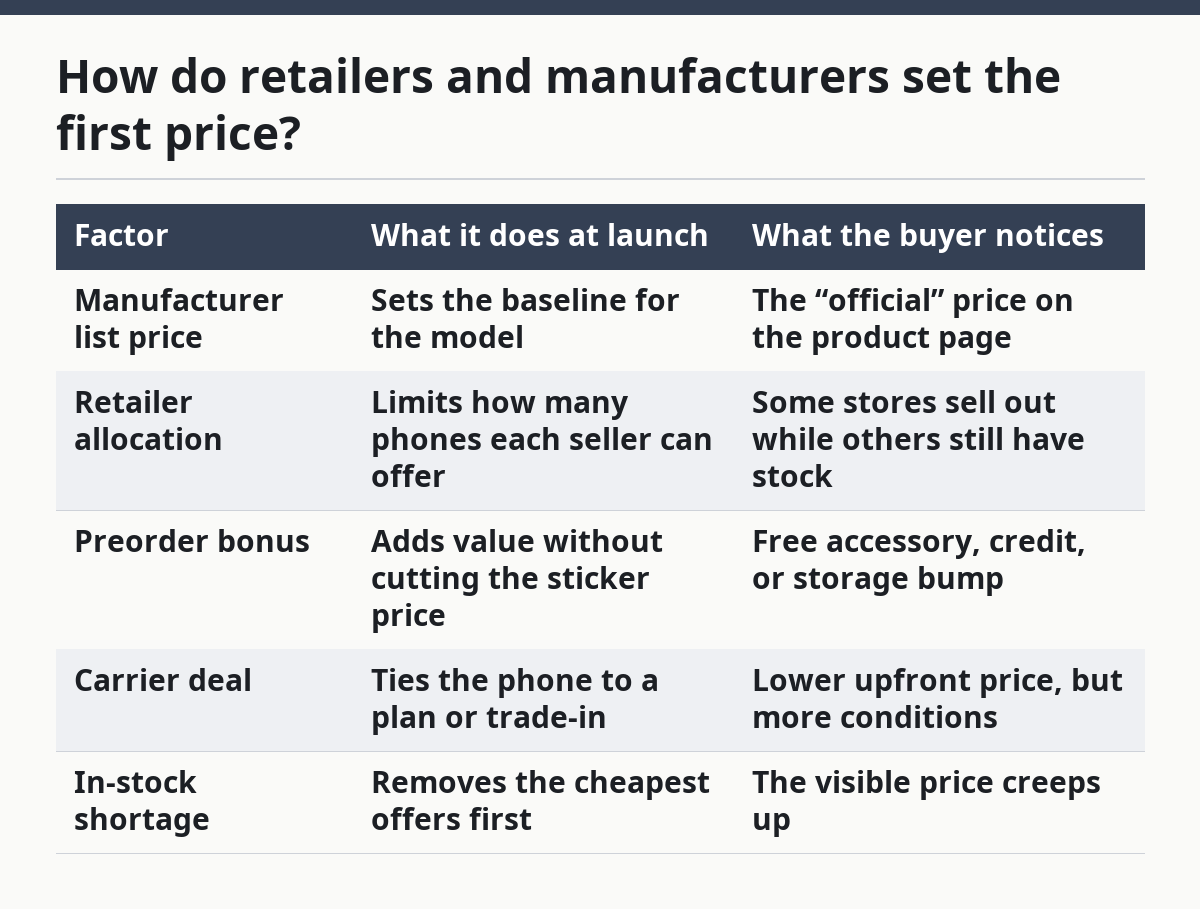
Retailers and manufacturers set the first price by balancing list price, stock allocation, and launch bonuses. The sticker price may be fixed, but the offer around it can change from one seller to another.
| Factor | What it does at launch | What the buyer notices |
|---|---|---|
| Manufacturer list price | Sets the baseline for the model | The “official” price on the product page |
| Retailer allocation | Limits how many phones each seller can offer | Some stores sell out while others still have stock |
| Preorder bonus | Adds value without cutting the sticker price | Free accessory, credit, or storage bump |
| Carrier deal | Ties the phone to a plan or trade-in | Lower upfront price, but more conditions |
| In-stock shortage | Removes the cheapest offers first | The visible price creeps up |
A retailer can keep the base price steady and still change the deal by trimming bonuses after launch. A preorder might include an accessory credit, while the same phone a week later comes without it. The buyer sees a higher total cost even though the headline price never moved.
Manufacturers also use launch stock allocations to steer demand. If one color or storage tier is scarce, that version can become the price anchor in shoppers’ minds. Then the next available version looks “normal” even if it is a different model with a different margin.
What actually happens when stock is short?
When stock is short, the cheapest phones often sell first and the remaining offers can become more expensive. That is the simplest way to think about it.
Here is the usual chain:
- The manufacturer ships a small first batch to retailers and carriers.
- The most visible listings sell out or switch to waitlists within the launch window.
- Shoppers who still want the phone at once move to the few sellers with units left.
- Those sellers may keep the list price, remove preorder bonuses, or show only higher-storage versions.
- Buyers who want immediate delivery may end up paying more in total, even if the base MSRP has not changed.
This process matters most during the first days after release, when launch-day demand is strongest and release allocations are still thin. A model that looks easy to buy in reviews can become hard to find at list price once the first wave of interest hits.
The cost of short stock is not only higher prices. It also means worse choice. Color options disappear, storage tiers narrow, and the buyer may have to choose between waiting and paying more. That is why launch-day shortages affect price and convenience at the same time.
Which matters more: preorder bonuses or launch-day urgency?
Preorder bonuses matter more if you care about total value, while launch-day urgency matters more if you care about getting the phone immediately. That is the real split.
If a preorder includes a meaningful bonus, the buyer may get more for the same list price. If the phone launches with weak stock and no bonus, launch day can become a worse deal even if the sticker price looks identical. On the other hand, if a buyer only wants the phone in hand on day one, the preorder bonus may not matter much.
| Situation | Best fit | Why |
|---|---|---|
| Preorder with bonus | Value-focused buyer | More extras at the same base price |
| Launch-day buy with strong stock | Patient buyer who still wants the first wave | Stable price and normal choice |
| Launch-day buy with weak stock | Urgent buyer only | Faster access, but fewer choices |
| Waiting after launch | Bargain hunter | Better chance of settled supply and fewer launch premiums |
The wrong move is to treat every preorder as a deal. Some are, but some just swap a normal sale for a sales pitch with a countdown timer. The other wrong move is to assume launch day always costs more. If a retailer has enough inventory and the model is not in huge demand, the price may stay close to list.
How should a buyer read launch pricing without getting fooled?
A buyer should compare the base price, the bonus, and the stock level before deciding. That sounds simple, but launch pages make it easy to miss one of those three things.
Start with the base price. Check the sticker for the exact storage tier, because a 128 GB model and a 256 GB model are not the same product. Then look for preorder bonuses, since a free accessory or credit can change the real value without changing the headline number. After that, look at availability language such as “limited stock,” “backorder,” or “ships in 2–3 weeks,” because that tells you whether scarcity is already affecting the offer.
Use this quick order of operations:
- Compare the same model and storage size first. A 128 GB launch price tells you little about the 256 GB version.
- Check whether the preorder includes a bonus. The deal may be better than the launch listing even if the sticker is the same.
- Look at delivery timing. If one seller ships immediately and another says 2–3 weeks, the cheaper-looking offer may not be real for your schedule.
- Watch for bundle pressure. A launch seller may replace the base model with a case, charger, or plan requirement.
- Decide whether first-day ownership is worth paying for. If not, waiting can avoid launch-week scarcity pricing.
This step-by-step check is useful because it separates the phone price from the launch story around it. The story changes fast; the math is slower.
For a broader view of how phone prices are built, the Mobile Phone Pricing Mechanics hub ties these pieces together without turning launch timing into the whole answer.
What does this mean for the first buyer and the patient buyer?
The first buyer pays for certainty, while the patient buyer often pays less for the same phone later. That is the basic trade-off.
The first buyer gets the earliest delivery, the widest preorder-bonus window, and the most direct path to launch-day ownership. The price risk is that scarcity can remove the cheapest stock and leave only thinner offers or bundles. That makes launch week best for buyers who value timing more than savings.
The patient buyer gives up the launch bonus and the first-day bragging rights, but avoids the scramble. Once launch stock allocations relax and retailers refill shelves, the price often becomes easier to read because the cheapest model is visible again. This page is not for someone trying to time the exact cheapest day after release; another guide covers that separately. It is for the buyer who wants to know why the first week looks different in the first place.
One honest limit: launch pricing does not move the same way for every phone. A mainstream model with broad supply behaves differently from a highly anticipated flagship with tight allocations. That is why the same launch rules can produce very different price patterns.
Do preorder phones cost more than phones bought later?
Not always. A preorder can cost the same as a later purchase, or it can look cheaper because it includes a bonus such as credit, accessories, or a storage upgrade. The difference is often in the package, not the base price.
Why are launch-day phones sometimes harder to buy at list price?
Launch-day phones are sometimes harder to buy at list price because the first stock is limited and many buyers want the same model at once. Once the cheapest units sell out, the remaining offers may be bundled, delayed, or listed by sellers who know demand is still high.
Does limited launch stock raise phone prices?
Limited launch stock can raise the price you actually pay, even if the official list price stays the same. The shortage removes the cheapest offers first, narrows choice, and can push buyers toward higher-priced sellers or bundle-only listings.
Drafted with AI; not yet reviewed by a person.