
How to Compare Mobile Phone Charger and Cable Bundles
Last updated: November 19, 2026
Quick answer: choose the charger and cable bundle with the highest wattage that your phone actually supports, a USB-C cable that fits your bag or bedside table, and a clear fast-charging label. That is the cleanest way to compare these bundles, because the box can look complete while still being too slow, too short, or missing the power adapter you need. For How to Compare Mobile Phone Charger and Cable Bundles, the numbers on the box matter more than the marketing on the front. If the bundle lists 18W, 20W, or 30W, that is more useful than adjectives alone.
Key takeaways
- The bundle is only useful if the wall charger, power adapter, and cable all match your phone’s charging needs.
- Wattage matters because a fast charger that is too weak will charge slowly even if the cable is fine.
- USB-C cable length changes daily use more than most buyers expect, especially at a desk, sofa, or bed.
- A bundle with no clear fast charging support is a weak pick for newer phones that expect higher power.
- The right bundle for one phone can be the wrong bundle for another if the phone’s port or charging standard differs.
What should I compare first?
Compare the charger wattage first, because that is the biggest clue to whether the bundle will feel fast or sluggish. After that, check whether the listing includes a wall charger or only a cable, and confirm the cable type is USB-C if your phone uses USB-C charging.
A bundle can look like a good value and still fail the daily-use test. If the power adapter is low wattage, the phone may charge slowly. If the cable is very short, the charger may be usable only beside an outlet. If the listing does not say fast charging support, assume nothing and read the spec line carefully.
Therefore, a good way to judge the bundle is to ask one question: does the phone get the power it can use, in a length that fits the places you charge? That question matters more than the box art. USB-C and fast charging are not decoration; they are the parts that decide whether the bundle works in practice. For standards background, the USB Implementers Forum’s USB Type-C materials are a useful reference: USB-IF USB Type-C. For broader charging guidance, Apple’s support pages also show how charger wattage affects device charging behavior: Apple support on power adapters and charging.
The honest side-by-side
A higher-wattage fast charger with a USB-C cable wins for most buyers, because it is the safer choice for daily charging and future use. A low-wattage bundle only makes sense when the phone is modest, the cable is just for backup, or the buyer does not care about charging speed.
| Criteria | Higher-wattage charger + USB-C cable bundle | Basic charger + cable bundle | Winner for which condition |
|---|---|---|---|
| Charging speed | Better fit for phones that support fast charging | May charge, but can feel slow on newer phones | Higher-wattage bundle when speed matters |
| Included wall charger | More likely to cover the full setup in one box | May leave out the power adapter or use a weaker one | Higher-wattage bundle for convenience |
| USB-C cable length | Often better if the cable is long enough for bed, couch, or desk use | Short cables can feel cramped | Longer cable for flexible charging spots |
| Fast charging support | Usually clearer on the listing | May be vague or omitted | Clear-label bundle for buyers who want fewer surprises |
| Compatibility with modern phones | Better fit for USB-C phones that expect more power | Can work, but may not use the phone’s full charging ability | Higher-wattage bundle for newer models |
| Use at a desk | More likely to reach from outlet to table | Shorter reach can make the setup awkward | Long-cable bundle for desk charging |
| Travel use | One bundle can reduce the need for separate purchases | May still need a second cable or adapter | Complete bundle for travel packing |
| Upgrade room | Better if the phone may be replaced soon | Less useful if the next phone needs more power | Higher-wattage bundle for longer ownership |
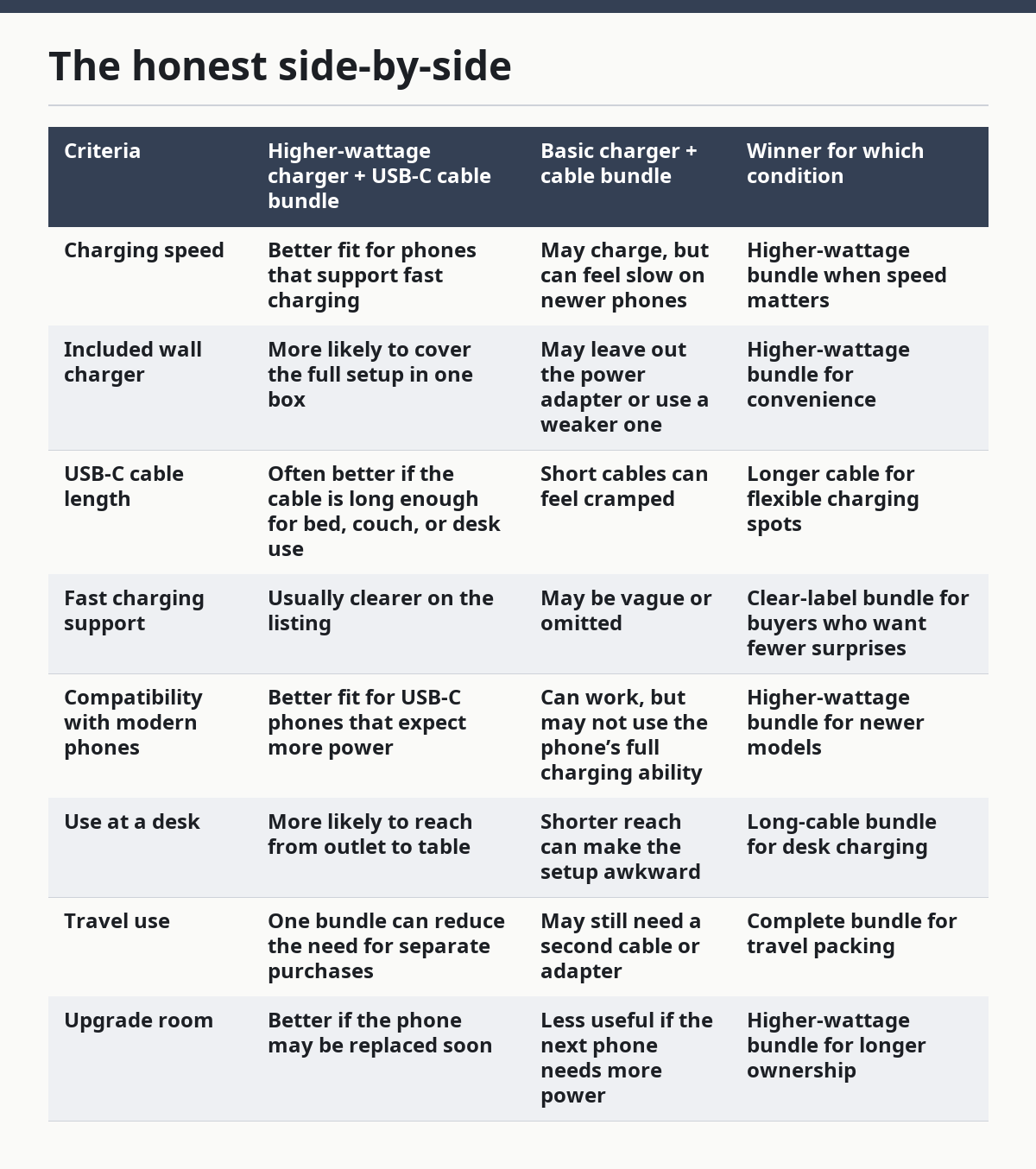
The table points to the same result: the bundle with the clearer wattage, the better USB-C cable length, and the stated fast charging support is the stronger choice. The weaker bundle is not useless, but it is easier to outgrow.
Which charger and cable bundle suits daily use?
The better daily-use bundle is the one with a wall charger rated high enough for the phone and a USB-C cable long enough to reach the places you charge most. Daily use is where tiny differences matter. A 1-meter cable may be fine at a nightstand and annoying on a sofa. A weak power adapter may be acceptable overnight and frustrating before you leave the house.
Pros of the stronger bundle:
- It is more likely to support fast charging on phones that can take it.
- The included power adapter reduces the chance of buying the wrong charger separately.
- A longer USB-C cable is easier to route around furniture and cases.
Cons of the stronger bundle:
- It may cost more than a basic bundle.
- It can be unnecessary for a simple backup charger.
- Some listings use “fast” loosely, so the buyer still has to check the wattage.
So this bundle is for the person who charges a phone every day, uses the same charger in more than one place, or wants fewer replacement buys later. It is not for someone who only needs a spare cable for emergencies. It is also the wrong call if the listing hides the wattage or fails to say whether the wall charger is included at all.
When is a basic bundle enough?
A basic bundle is enough when the phone charges slowly anyway, the cable is only a backup, or the buyer already owns a suitable power adapter. That is the narrow case where simplicity beats speed. If the phone’s charging needs are modest and the bundle is meant for a drawer, a glove box, or a travel bag, a basic kit can still do the job.
Pros of the basic bundle:
- It can be enough for light use or a spare set.
- It may be less cluttered if the buyer already has a charger brick.
- It avoids paying for power the phone does not need.
Cons of the basic bundle:
- It can leave the user with a weak wall charger.
- It often gives less useful information about fast charging support.
- It may not be the best fit for newer USB-C phones that benefit from higher wattage.
This bundle is for the person who already has a reliable charger at home and only needs a second cable. It is not a strong pick for a main bedroom charger, a desk setup, or anyone trying to charge faster than their current setup allows. If the box says USB-C but says nothing about wattage, that is a reason to pause and check the listing, and if needed consult a qualified retailer or technician before buying.
How does the cable itself change the choice?
The USB-C cable changes the choice because cable length and type affect where the phone can charge and how well the setup fits the room. A bundle with the right adapter but a short cable can still fail in daily use. A longer cable makes a bedside outlet or desk outlet far easier to use, while the wrong connector type can make the whole bundle pointless.
The main things to check are simple:
- USB-C cable type
- Cable length
- Whether the listing says fast charging support
- Whether the wall charger is included
- Whether the power adapter is part of the bundle or sold separately
Because the cable is the part the user touches every day, it matters more than many buyers expect. It determines whether the phone can sit on a table while charging or has to perch next to the outlet. That is why a bundle with a stronger charger but a poor cable can still be the wrong buy. The cable is the part the user touches every day.
For standards context, the USB-IF pages on USB Type-C are useful because they explain the connector family and the naming buyers keep seeing on listings: USB-IF USB Type-C. If a seller mentions a charging standard but leaves out the cable details, the missing detail is usually the one that affects daily use most. A 1-meter cable and a 2-meter cable can feel very different in a bedroom or office.
When should the verdict flip?
The overall verdict flips in a few specific situations. In those cases, the bundle that looks weaker on paper can become the smarter buy.
First, choose the basic bundle if the phone is old, slow to charge, and already comes with a charger you trust. In that case, the extra wattage in a stronger bundle brings little value.
Second, choose the stronger bundle if the phone supports fast charging and the current charger is too weak. The difference shows up every day, not just on paper.
Third, choose the bundle with the longer USB-C cable if the outlet is awkwardly placed. A short cable can turn an otherwise good charger into a nuisance.
Fourth, skip both if the listing does not clearly say whether the wall charger is included, what wattage it delivers, or whether the cable is USB-C. A bundle with unclear specs is a bad choice when the whole point is to avoid buying parts twice.
What is the safest recommendation?
The safest recommendation is to choose the higher-wattage charger and USB-C cable bundle if your phone supports fast charging, you need the wall charger included, and you want one setup that works at home and on the go. Choose the basic bundle if you only need a spare cable or your current power adapter already does the job. Avoid either bundle if the listing hides the wattage, omits the charger details, or gives no clear fast charging support.
That is the plain answer for this comparison. The stronger bundle is usually the safer buy for most people because it reduces the odds of a slow charger, a short cable, or a missing adapter. The basic bundle only wins when the buyer already owns the missing part or does not care about charging speed.
Ultimately, if the goal is to keep mobile phone ownership costs under control, the best bundle is the one that prevents a second purchase later. That does not mean buying the flashiest box. It means buying the bundle with the right power adapter, the right USB-C cable length, and the right charging wattage for the phone already in your pocket.
Drafted with AI; not yet reviewed by a person.