
How product positioning changes phone price within a brand lineup
Last updated: November 27, 2026
Quick answer: product positioning can create a $100 to $200 gap, or more, between phones in the same brand lineup, even when the hardware difference looks small. How product positioning changes phone price within a brand lineup is really about which model is framed as basic, which one is framed as premium, and which features are held back so the top model can justify a higher MSRP. In the same brand lineup, a value model, a mid-tier phone, and a flagship can sit close on hardware but far apart on price because the brand is selling status, margin, and range—not just parts.
Key takeaways
- The same brand can charge more for a phone even when the hardware gap looks small.
- Price changes with the role each model plays in the lineup: entry, mainstream, premium sub-brand, or flagship.
- A premium sub-brand is often priced above a plain model on purpose, not by accident.
- When a brand uses a tiered lineup, it trims features from the cheaper phone to protect the higher-priced one.
- The right move is to judge whether the position fits your needs, not whether the box looks “better.”
What does product positioning do to phone price?
Product positioning sets the price band before the spec sheet does. A brand decides whether a model should read as a value model, a mainstream phone, a premium sub-brand, or the top flagship, then prices it to match that role.

That is why two phones from the same brand can have similar screens, 128 GB storage, or the same size class and still land at very different MSRP levels. The more premium the position, the more the brand can charge for design cues, launch status, camera branding, and the feeling that the model sits at the top of the ladder.
For example, a tiered lineup can keep one phone as the “starter” choice, another as the “best balance,” and a third as the aspirational model. The higher phone price is not only paying for extra hardware. It is paying for where the phone sits in the lineup.
This is the reason a generic “same-brand comparison” can mislead buyers. A phone can look overpriced if you compare only chips or display size, yet be priced exactly as the lineup strategy intends. That does not make the gap fake; it makes the gap deliberate.
How does brand positioning affect MSRP?
Brand positioning affects MSRP by setting the ceiling a model can reach before the spec sheet is even finished. MSRP is not just a cost-plus number; it is a signal of how the brand wants the market to read the phone.

A flagship branding strategy usually allows the highest MSRP because the phone is meant to anchor the whole lineup. It is the model reviewers compare first, the one with the strongest launch push, and the one that makes the rest of the lineup look more affordable by contrast. A premium sub-brand can also sit high in the range even when it is not the absolute top model, because the sub-brand itself carries status.
Here is the simplest way to think about it: positioning decides what the brand protects, and price follows that choice. If the brand protects the camera tier, battery life tier, or materials tier for the top model, the lower models lose those parts and also lose pricing power. If the brand wants a clear ladder, it may leave a feature out of the cheaper phone even when adding it would not change cost by much.
The same logic works in reverse. A value model is priced to pull in price-sensitive buyers and keep them inside the brand. Its job is not to be the strongest phone in the lineup. Its job is to make the ladder look broad enough that the buyer can step up to a more expensive model.
For readers comparing phone price at the brand level, the key question is not “Is this phone expensive?” It is “What role does the brand want this phone to play?” That question explains much more of the MSRP than the spec list alone.
Why do similar phones in the same brand have different prices?
Similar phones in the same brand have different prices because the brand uses feature gaps, naming, and launch order to sort buyers into tiers. A phone that looks close on paper can still sit in a different price band if the brand gives it a different job.

The most common reason is feature protection. A brand may reserve the brighter display, better camera lens, larger battery, faster charging, or stronger materials for the upper model. Even when the cheaper phone is already “good enough,” the brand keeps a few visible wins for the higher tier so the gap feels real.
Specifically, naming also matters. A model with a “Pro” or premium sub-brand label can cost more because the name tells buyers to expect more. That label changes what a buyer accepts as normal. The brand can charge a premium not just for parts, but for the promise attached to the name.
Meanwhile, launch timing matters too. A newer model often sits higher in the ladder even if an older sibling still shares the same brand. That helps the brand keep a clear premium path while still offering a lower entry point through last year’s phone.
The trade-off is plain: a tighter ladder gives buyers more choice, but it can also make the line harder to read. If the differences are too small, the cheaper phone can look like a compromise and the expensive one can look bloated. If the differences are too wide, the lineup starts to feel like a sales funnel.
Which price ladder does a brand usually build?
A brand usually builds a three-step ladder: value model, mainstream model, and flagship, with a premium sub-brand sometimes sitting beside the flagship or just below it. That ladder is the backbone of brand pricing strategy.
| Lineup role | What the brand is trying to signal | Typical pricing effect | What the buyer usually gets |
|---|---|---|---|
| Value model | Lowest cost entry into the brand | Lowest MSRP in the lineup | Fewer premium extras, simpler materials, trimmed feature set |
| Mainstream model | Balanced choice for most buyers | Mid-range MSRP | Enough features to sell on practicality and comfort |
| Premium sub-brand | More status without full flagship cost | Higher than the mainstream model | Better materials, stronger brand pull, more premium cues |
| Flagship branding | Top of the ladder | Highest MSRP in the lineup | Best feature set, strongest launch status, most visible prestige |
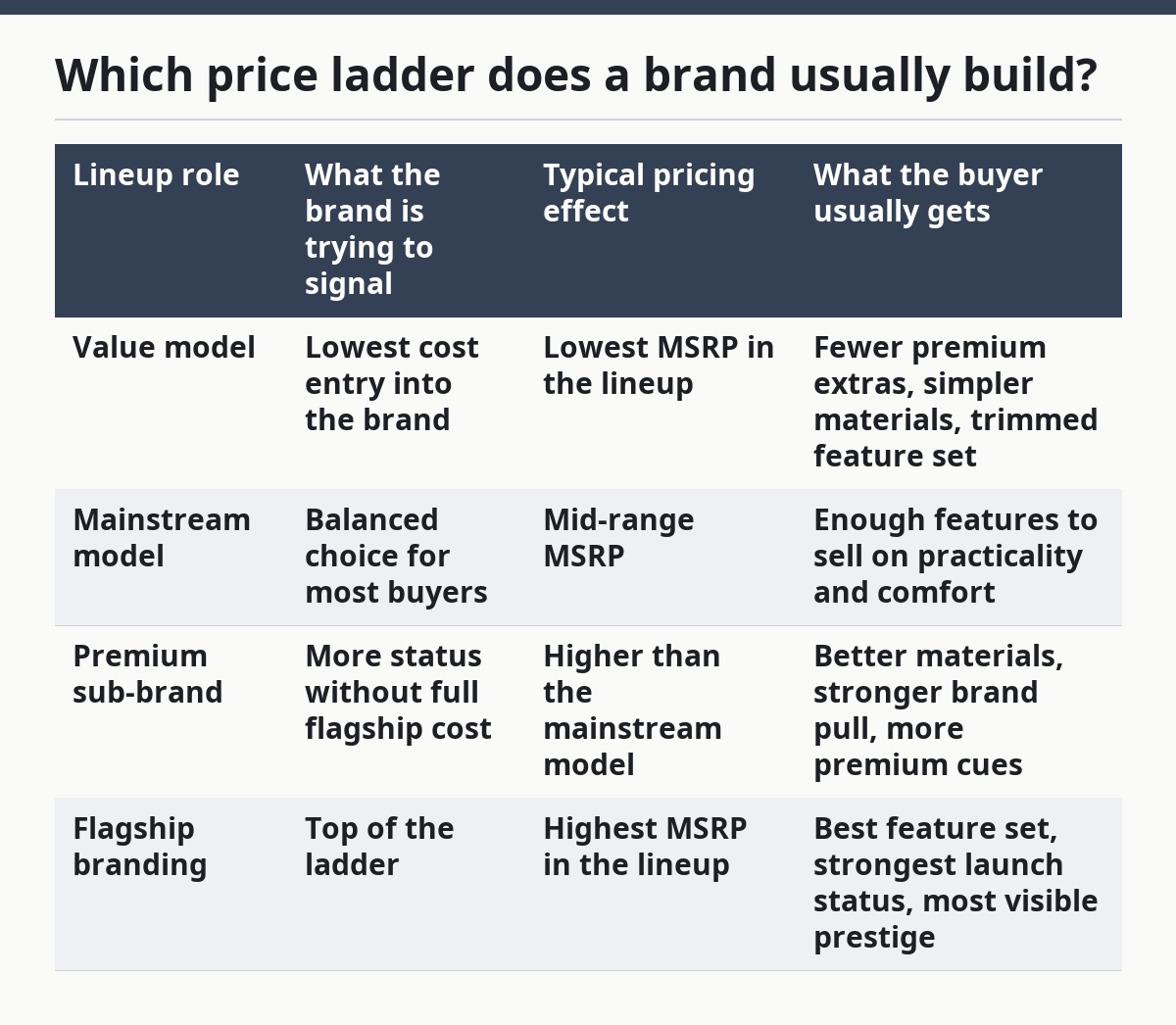
That ladder is not random. It lets the brand answer three different buyers at once: the buyer who wants the cheapest way in, the buyer who wants the safest middle, and the buyer who wants the top badge. The price gaps between those rungs can be large enough to make the cheaper model look like a deal and the flagship look justified.
The trick is that not every brand uses the same ladder shape. Some brands put the premium sub-brand very close to the flagship. Others leave a wider gap so the flagship stays exclusive. That is why two brand lineups can look similar and still price very differently.
How do premium sub-brands cost more by design?
Premium sub-brands cost more by design because they are built to collect higher margins while keeping the main brand ladder intact. A premium sub-brand is not just a nicer model name; it is a pricing tool.
The sub-brand gives the company a second way to sell prestige. It can set a higher price than the value model without making the top flagship feel ordinary. That makes the middle of the lineup more profitable and gives the buyer a step up that feels simpler than jumping straight to the flagship.
This strategy also helps a brand sort the market. Some buyers want the prestige cues of the premium sub-brand but do not want the full cost of the flagship. Others want a cheaper phone but are willing to pay extra for a name that sounds more serious than the basic model. The sub-brand captures both groups.
The drawback is that premium branding can hide the real value gap. A sub-brand may look “almost flagship” on the shelf, yet still carry missing features, slower charging, or less capable cameras. The price is high because the brand wants it to feel raised, not because every part inside is top tier.
That is why premium sub-brands are useful but easy to overbuy. They are the right choice when the buyer wants a better brand signal without paying for every flagship feature. They are the wrong choice when the buyer is only chasing specs and does not care about the badge.
What should you check before paying the premium?
You should check the lineup role, the missing features, and the size of the price gap before paying the premium. The goal is to tell whether the extra money buys a real step up or only a better name.
Use this simple procedure:
- Identify the phone’s position in the lineup. Decide whether it is the value model, mainstream model, premium sub-brand, or flagship. If the box and product page keep pointing to “Pro,” “Ultra,” or another premium label, the brand is telling you where the phone sits.
- List the features the cheaper model lacks. Check for the exact differences that matter to you: display quality, camera tier, charging speed, materials, or battery class. A small gap in one area can be worth it; a small gap in a badge usually is not.
- Compare the price gap against the feature gap. If the higher model is only adding cosmetic changes, the premium may be hard to justify. If it is adding the one feature you care about, the higher MSRP can make sense.
- Look at launch timing. A newer model often holds a higher price because it is still the front of the line. An older sibling may give you more value if you do not need the latest badge.
- Choose the role, not the status. Pick the model that matches how you use the phone. A flagship is useful when you want the top of the range. A value model is better when you want the lowest entry into the brand.
This is the part many buyers skip. They compare only one spec at a time and miss the reason the lineup exists. Product positioning changes price because the brand wants each model to feel like a separate answer to a separate buyer.
When is the higher-priced model worth it?
The higher-priced model is worth it when the brand has put the features you care about in the more expensive tier, not just the nicer name. If the premium phone gives you a better display, stronger camera setup, or the one design detail you will notice every day, the higher MSRP can be rational.
It is usually not worth it when the extra money mostly buys branding, a shinier finish, or a title that sounds important. A $100 or $200 gap can be fair if the upper model changes the experience in a way you will feel for the full life of the phone. A much larger gap is harder to justify if the phone is just another step in a sales ladder.
This is where product positioning can help or hurt you. If you want status, the premium sub-brand does its job. If you want value, the same positioning can push you into paying for signal instead of substance.
The cleanest decision is to ask one question: if the brand removed the badge, would I still pay the gap for the hardware? If the answer is no, the lineup is doing its job on the brand side, but not on yours.
For a broader view of the other forces behind handset cost, the hub on what affects mobile phone prices belongs next in the reading path. It adds the wider price picture; this page stays on how the lineup itself shifts price inside one brand.
Which buyers should ignore positioning?
Buyers who only want the lowest useful price should often ignore positioning after they confirm the basics. If the value model already covers the screen size, battery life, and camera level you need, the premium story is mostly noise.
The same goes for buyers who buy phones for function, not status. A flagship branding push can make a model look like the obvious choice, but the best choice may sit one or two tiers down. The price ladder is designed to make the upper rung look natural. That does not mean it is right for every budget.
Positioning matters most when the buyer cares about feel, badge, and a clear step up inside the same brand. It matters less when the buyer already knows the features needed and only wants the cheapest model that has them.
The honest limit is simple: product positioning explains why the price changes, but it does not prove the higher price is worth it. That judgment still belongs to the buyer, not the brand.
Drafted with AI; not yet reviewed by a person.