

How Competition Between Brands Can Push Phone Prices Up or Down
Last updated: November 27, 2026
Competition between brands can push phone prices both ways: it can drive prices down when brands fight for buyers, or hold them up when brands try to signal quality, protect margins, or avoid a race to the bottom. The same mobile phone market competition can make a midrange class phone cheaper in one year and make a flagship class phone more expensive in another.
Key takeaways
- Brand rivalry does not always mean lower prices. It can also lead to higher launch prices, bigger gaps between tiers, or fewer real discounts.
- Price cuts are most likely when two or more competitor brand names are chasing the same buyer at the same time.
- In the flagship class, brands often compete on features and status, not just price, so MSRP can move up even when the market is crowded.
- In the midrange class, competition usually bites harder, because buyers compare a shorter list of specs and can switch brands more easily.
- A phone price is shaped by positioning, tiering, and launch rivalry, not just by one seller trying to win a sale.
If you want the wider pricing picture, this sits under the larger guide to what affects mobile phone prices.
How does brand competition change phone prices?
Brand competition changes phone prices by changing how much room each brand has to charge, discount, or defend its image. When several brands target the same market segment, one brand’s move can force another to respond within days or weeks.
A simple way to think about it is this: if a competitor brand cuts a similar phone’s price, the other brand may match it, add storage, bundle accessories, or keep MSRP steady but allow sharper retailer discounts. If the rival pushes a premium story instead, the first brand may also hold price and sell on camera quality, chip set, or design instead of on a lower ticket.
That is why competition does not point in only one direction. A crowded market can mean lower street prices, but it can also mean higher list prices if brands keep adding features to justify their place in the line-up. The result is a tug of war between price and perceived value.
What the market is really fighting over
The fight is rarely only about the number on the box. Brands compete over screen size, camera count, battery life, software support, and whether the phone looks like a flagship class model or a midrange class model.
That matters because phones are compared side by side. If two models sit in the same bracket, one price move can feel large even when the difference is small. A $50 shift on a midrange class phone can change the whole value story, while the same shift on a flagship class model may be used to preserve status rather than to start a bargain.
When do brands cut prices?
Brands cut prices when the rival’s offer looks too close, too cheap, or too visible to ignore. That is most common in the midrange class, where buyers compare features quickly and move to the lower price if the spec list looks close enough.

The pressure usually rises when a competitor brand launches a phone with the same core features, similar storage, and a cleaner headline price. It also rises when a brand has two or more phones competing for the same buyer inside its own line, because outside pressure and inside pressure arrive together.
A useful pattern is this:
- A rival phone appears in the same segment. A brand sees a competitor with similar memory, display size, or camera setup.
- The first brand narrows the gap. It may cut the MSRP, add a bigger storage tier, or let channel pricing fall.
- Retailers react. Sellers often trim listed prices to keep attention on the better-known model.
- The market settles for a while. Price stability returns until the next launch or feature bump.
This is not only about cheap phones. Even a strong brand can trim price to protect share if a competitor makes the same feature set look ordinary.
When do brands push prices up?
Brands push prices up when competition shifts from “who is cheapest?” to “who looks most worth it?” That happens a lot in the flagship class, where brands care about image, margin, and the message their top phone sends about the rest of the range.
A phone can become dearer in a competitive market if the brand adds features that raise the cost of the device and then prices the phone to match the new positioning. A rival brand may do the same, especially if both want to look like the premium choice rather than the bargain choice. In that case, competition does not pull prices down; it raises the level of what counts as a normal flagship price.
Competition can also keep prices high when brands fear that a lower number would make the phone seem less capable. If a company wants its top model to sit above a competitor’s top model, it may hold the line on MSRP even with strong rival pressure. That is common when the real battle is for status, not for the lowest sticker.
Why higher prices can still be competitive
A higher price can still be a competitive move if the brand thinks buyers use price as a signal. In a crowded flagship class, a low price can damage the premium story. A higher price can say “this is the top tier,” even if the gap in hardware is not huge.
That is one reason competition does not always create a bargain. It can create a ladder. Each brand wants its phone to look slightly better, slightly more premium, or slightly more complete than the next one. The ladder can lift prices across the whole segment.
How does mobile phone market competition work in the midrange class?
Mobile phone market competition is usually toughest in the midrange class because buyers have more choice and fewer reasons to stay loyal. This is where prices tend to move fastest.
The midrange class often has clearer comparisons than the flagship class. Buyers can line up a few competitor brands, check the screen, battery, storage, and camera, and decide quickly. That makes price matching powerful. If one brand drops its price or improves the spec sheet, the others often have to respond.
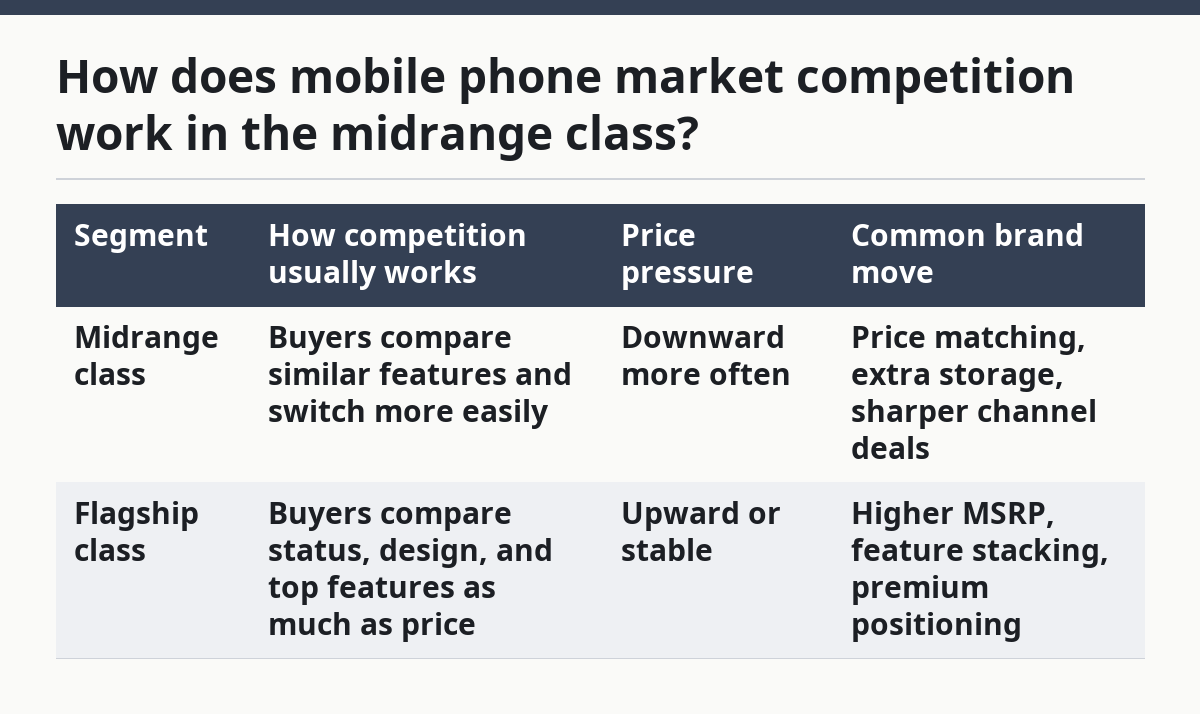
The table below shows the main difference between the two segments.
| Segment | How competition usually works | Price pressure | Common brand move |
|---|---|---|---|
| Midrange class | Buyers compare similar features and switch more easily | Downward more often | Price matching, extra storage, sharper channel deals |
| Flagship class | Buyers compare status, design, and top features as much as price | Upward or stable | Higher MSRP, feature stacking, premium positioning |
Midrange competition can still create higher prices if brands keep stacking features. A better camera system, larger battery, or faster chip can move the whole bracket upward. That is not the same as a cheap phone becoming expensive for no reason; it is a market where the “normal” phone keeps getting more capable and more costly.
How do brands match each other without cutting prices hard?
Brands match each other without slashing price by changing the shape of the offer instead of the headline number. That is a common response in mobile phone pricing mechanics because it protects the brand while still answering the rival.

The core procedure usually looks like this:
- Identify the direct rival. Find the competitor brand and the exact market segment it is targeting, such as midrange class or flagship class.
- Compare the visible specs. Look at storage, display, battery, and camera count, not just the name.
- Check the price gap. If the gap is too small or too large for the segment, the brand may respond with a storage step-up or a bundle rather than a full cut.
- Adjust the offer shape. A brand may keep MSRP steady, lower channel pricing, or add a stronger base model.
- Watch the result. The expected outcome is less direct price pressure and a better fit with the rival’s positioning.
This is where many readers get the story wrong. They expect competition to mean a lower sticker on every phone. In practice, the brand may choose a different weapon. It might keep the same MSRP and let the market see a better spec-to-price balance instead.
That makes the phone look more competitive without admitting defeat on price. It is a common move in both the flagship class and the midrange class, especially when the brand wants to defend long-term positioning.
What makes competition push prices in the wrong direction?
Competition pushes prices in the wrong direction when brands compete on image, not on cost. That usually means the brands are not trying to be cheapest; they are trying to look best at the top of the range.
Three things can do that.
First, brands may use expensive parts to separate themselves from rivals. Better screens, stronger cameras, and more premium materials can lift the base cost of the phone.
Second, brands may keep a price floor in place so the device does not look discounted too early. That is especially common when a brand wants the model to sit beside a competitor brand’s premium phone without looking weaker.
Third, rivalry can spread upward through the line. If one brand makes its flagship class phone pricier and more loaded with features, the rival may feel pressure to answer at the same level. The effect can ripple into the whole range, including the midrange class.
This is why a crowded market does not always make phones cheap. Sometimes it makes them more polished, more packed, and more expensive.
What should you watch first if you want to understand a phone’s price?
You should watch the rival set, the segment, and the brand’s position before you blame competition for a price change. Those three details tell you whether a brand is likely to cut, hold, or raise price.
Start with the competitor brand. If the rival is aiming at the same buyer, the pressure is real. Then check the market segment. A midrange class phone usually has more direct price pressure than a flagship class phone. Then look at brand tiering. A brand near the top of the market often guards its image more carefully than one trying to gain share.
That is the cleanest way to read mobile phone pricing mechanics. A phone does not get cheaper or dearer just because more brands exist. It changes because those brands are trying to win the same buyer with different tools.
For readers who want a broader frame, the hub on what affects mobile phone prices covers the other forces that sit beside competition.
Which mistakes make competition look simpler than it is?
The biggest mistake is assuming more brands always means lower prices. That ignores launch rivalry, brand tiering, and the fact that premium phones often use competition to raise the ceiling, not lower the floor.
Another mistake is comparing only the sticker price. A phone with a higher MSRP can still be the sharper buy if the rival model needs add-ons, while a lower-priced model can look cheap only because it gives up storage or camera quality.
A third mistake is treating all segments the same. The midrange class reacts fast to price matching, while the flagship class often reacts through positioning and feature stacking. If you miss that split, you miss why one phone gets cheaper and another gets pricier in the same month.
FAQ
Do competing brands lower phone prices?
Competing brands often lower phone prices, but not always. They are most likely to do that in the midrange class, where buyers compare similar models and can switch quickly. In the flagship class, competition can also raise prices if brands focus on status, feature depth, or premium positioning instead of the lowest sticker.
Can lack of competition keep prices high?
Yes. When few brands are fighting for the same buyer, there is less reason to trim price or improve value quickly. A weaker competitive field can leave more room for high MSRP, slower discounts, and less pressure to match a rival’s better offer. That is one reason market competition matters so much in phone pricing.
How does flagship rivalry affect MSRP?
Flagship rivalry can push MSRP up when brands compete on premium features and image. If each brand wants its top phone to look more advanced than the other, the list price can rise as a signal of status and quality. In that setting, competition changes the shape of the price ladder instead of simply pulling prices down.
Drafted with AI; not yet reviewed by a person.