
How Supply Chain Disruptions Change Phone Prices
Last updated: November 27, 2026
Supply chain disruptions usually push phone prices up in stages, not all at once. First, a manufacturing plant slows or stops, then logistics network delays spread the shock, and after that component suppliers and phone brands pass higher costs into retail prices over weeks or months.
Key takeaways
- Phone prices often rise in layers: factory output first, shipping next, retail pricing last.
- The biggest pressure usually shows up when a disruption hits more than one part of the mobile phone supply chain at once.
- Price changes are often delayed, so a phone on sale today may still reflect an older cost structure.
- Not every disruption makes every model more expensive; brands may protect flagship phones first and adjust lower-tier models later.
- The slowest part of the change is often the retail shelf, where old stock can hide the shock for a while.
The mobile phone supply chain is built to be fast, but it is not built to ignore shocks. A delay in one place can change the cost of a phone long before a shopper sees a new sticker price.
What changes first in the mobile phone supply chain?
The first change is usually a factory or parts delay, and it can begin within days of a disruption. A manufacturing plant that misses parts, labor, power, or transport slots produces fewer phones, which changes how many units reach distributors in the next 1 to 3 weeks.

That matters because phone pricing does not move only on the final assembly cost. A phone depends on component suppliers, packing materials, freight space, and scheduling across a logistics network. When one link slips, the brand may have to rebook transport, switch suppliers, or hold inventory longer than planned.
A generic article often stops at “shortage equals higher prices,” but the real sequence is more useful. Here is the usual chain of events:
-
A disruption starts at one point in the supply chain.
This can be a factory shutdown, port delay, power loss, or transport bottleneck. The effect is fewer finished phones or slower movement of parts. -
Production schedules change.
A manufacturing plant may cut output on one model and keep another model running. That can shift stock toward phones with higher margins. -
Inventory at distributors gets thinner.
Once channel stock falls, retailers lose the buffer that normally keeps prices steady for a few weeks. -
Retail prices begin to move.
The first visible change may be fewer promotions, not a big list-price jump. Discounts disappear before the sticker changes. -
The new cost structure settles in.
After several weeks or months, the market often accepts the higher cost base until supply improves.
That sequence is why timing matters. A shopper who sees a phone price rise in month 2 of a disruption is often seeing the pass-through, not the original shock.
Why do phone prices rise during supply chain disruptions?
Phone prices rise during supply chain disruptions because brands lose volume, pay more to move goods, or both. When a logistics network becomes slower or less predictable, the cost of getting each phone to market can increase even if the phone itself has not changed.
There are two kinds of pressure here. The first is direct cost: more expensive freight, rerouted shipments, and extra handling. The second is scarcity pressure: if a model arrives in smaller numbers, the seller may reduce discounts or raise prices because demand is still there.
The biggest mistake is assuming every model moves the same way. A flagship phone can sometimes stay closer to its usual price because brands defend their premium line first. Lower-priced models can be more sensitive because they leave less room for margin after transport and retail costs.
A simple way to think about it is this:
| Disruption point | What changes first | Likely price effect | Typical time lag |
|---|---|---|---|
| Manufacturing plant slowdown | Fewer finished phones | Fewer discounts, then higher prices | Days to weeks |
| Component supplier delay | Sparser production runs | Select models become pricier | Weeks |
| Shipping delay in the logistics network | Higher landed cost | Retailers trim promotions | 2 to 8 weeks |
| Long disruption across several links | Lower stock and higher cost | Broad price increases | Weeks to months |
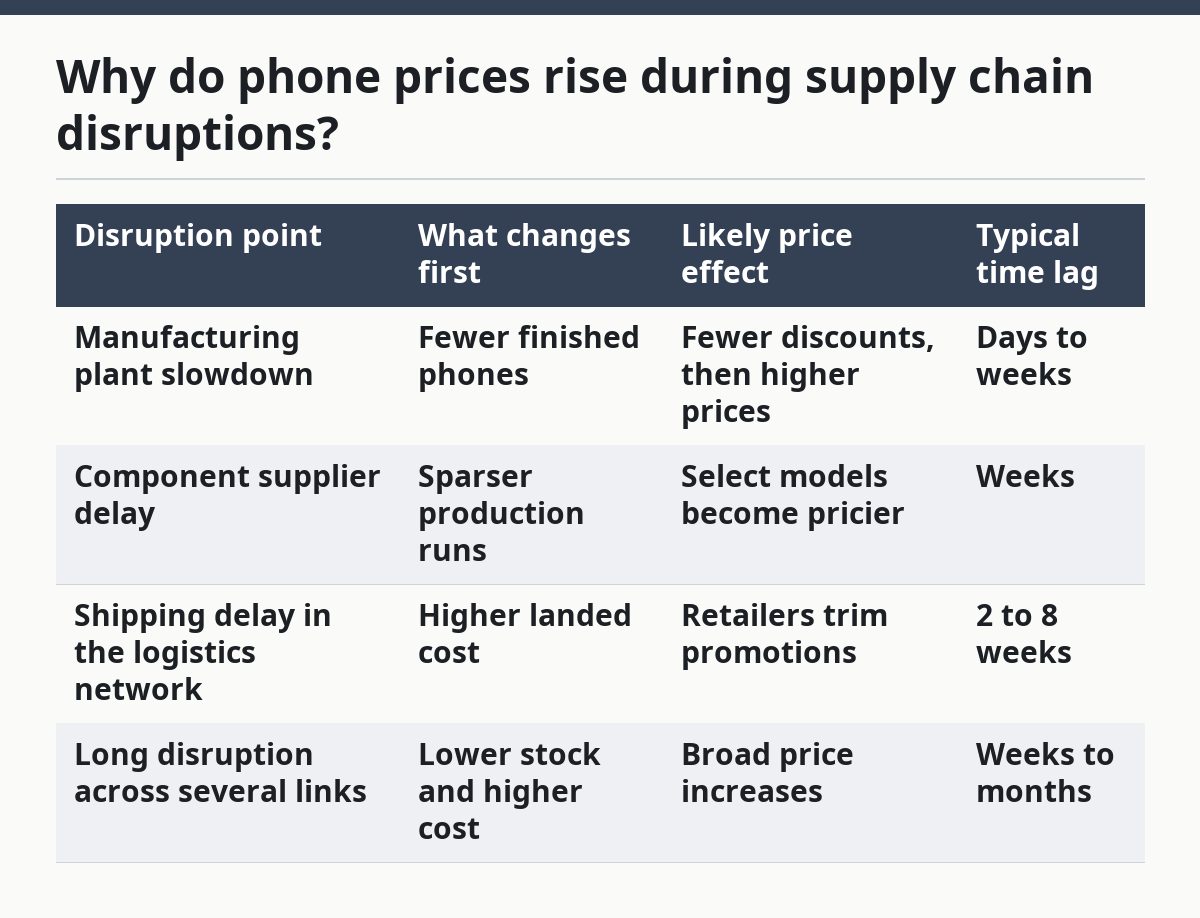
This is why a phone can still sell at the old price for a while after a disruption starts. Retailers often work through stock they already paid for before they change the shelf price. The jump shows up later, when replacement inventory arrives with a higher cost base.
For a broader view of the forces that shape pricing, this page sits under the hub on what affects mobile phone prices, which helps place supply chain shocks alongside other drivers.
How do shipping delays affect pricing?
Shipping delays affect pricing by adding cost and by stretching the time before new stock reaches stores. A delay of even a few weeks can force a retailer to sell through older inventory, then reorder at a higher landed cost once the logistics network clears.
The price effect is not always immediate. If a retailer has 2 to 4 weeks of stock on hand, shoppers may not see a change until that buffer is gone. After that, the next shipment can arrive more expensive because shipping space is tighter, routes are longer, or carriers are charging more to move goods on time.
This is also where price pass-through becomes visible. A brand may absorb some of the extra freight cost on a high-end model, then recover it elsewhere through a lower discount or a higher price on a mid-range model. The move is often quiet. The phone stays on the shelf, but the sale price stops being as generous.
There is a second effect that is easy to miss. Delays can shift the mix of phones in stores. If one color, storage size, or model arrives late, the seller may push the versions that are in stock. That can make one configuration look overpriced compared with another, even when the base phone has not changed much.
A shipping delay page would focus on delivery estimates, but this one is about pricing, not arrival time. The price impact comes from cost, stock, and timing together. A delay that lasts only a few days may not change much. A delay that lasts several weeks can change how the whole market prices a model.
Which phones get hit hardest?
Phones with thin margins and weak supply buffers get hit hardest, especially when the disruption lasts more than one order cycle. That often means budget and mid-range models feel the squeeze first, while premium phones may hold steady longer because brands have more room to adjust.
This is not a fixed rule, though. A model with strong demand and tight stock can rise quickly even if it sits in the premium tier. A model with slow sales can stay on sale longer, because retailers want to move inventory they already hold.
The key question is not only “what phone is it?” but “how deep is the buffer?” If a retailer has 6 weeks of stock, prices may look calm even during a disruption. If the buffer is 1 week, the next shipment can reset the price much sooner.
There is also a brand strategy angle. Some brands protect the launch price of a new model because they want a clean market message for the first 30 to 60 days. Others adjust promotions instead of the sticker price. A buyer may think the price is stable when the real change is that the discount has vanished.
Phones are not affected equally, and that is the point many generic explanations miss. The same disruption can raise one model, flatten another, and barely touch a third.
How long do price changes usually last?
Price changes usually last until the disrupted part of the supply chain recovers and the old stock mix returns, which can take weeks or months. If the problem is brief, the market may only show temporary price firmness, with discounts returning once inventory normalizes.
The time path usually has three phases. In the first phase, the effect is hidden by existing stock. In the second, retailers run low and promotions shrink. In the third, replacement stock arrives at the new cost base and prices settle at a higher level until supply improves.
Here is a practical way to read the market:
- 0 to 2 weeks: little visible change if shelves are still full.
- 2 to 8 weeks: the first pricing shift often appears as fewer promotions.
- Several months: repeated disruptions can make higher prices feel normal.
A short disruption can leave no lasting mark if the market had enough inventory. A longer one can change the baseline for a season or longer. That is why 2020 is remembered not just for shortage stories, but for how long some cost changes stayed in place after the first shock.
The honest downside for buyers is that timing is hard to judge from a storefront alone. A phone that looks overpriced this week may normalize next month. A phone that looks fairly priced may rise after the next restock. There is no clean signal unless the wider supply chain is easing.
What should a buyer watch for?
A buyer should watch discounts, stock depth, and model mix, because those three signs show price pressure before the sticker price changes. When a retailer stops discounting a phone that used to be on sale, that is often the first clue that replacement inventory is more expensive.
Here is a plain checklist that helps:
-
Compare the sale price with the regular price.
If the discount shrinks on a model for 2 or 3 weeks in a row, supply pressure may be building. -
Look at multiple configurations.
A 128 GB version may move differently from a 256 GB version, because stock and demand are not the same. -
Check whether the phone is still widely listed.
If several sellers still show it but stock is thin, the next restock can come in at a higher price. -
Watch for bundle changes.
Accessories may disappear before the phone price changes, which is another sign that margins are tightening. -
Track the pattern, not one listing.
One outlier price means little. A price shift across several sellers is more meaningful.
The wrong move is to assume that every increase is permanent. Some price bumps are temporary reactions to a short disruption. The better move is to wait for supply to normalize when the phone is not urgent. If the model is needed now, the real decision is whether the current price is acceptable, not whether the market is “fair.”
Why do phone prices rise during supply chain disruptions?
Phone prices rise during supply chain disruptions because the cost of making and moving each unit rises, and because tighter stock weakens discounting. A disrupted supply chain can hit a manufacturing plant, a logistics network, or component suppliers first, then the higher cost shows up in retail prices after inventory turns over.
The delay matters. A phone can stay at the old price for 2 to 8 weeks while sellers work through stock they already have. Once replacement stock arrives, the new cost often becomes visible through smaller discounts or a higher regular price.
How do shipping delays affect pricing?
Shipping delays affect pricing by raising landed cost and by forcing retailers to wait longer for new stock. If a delay lasts only a few days, the price may not change much. If it lasts several weeks, the next shipment can arrive with higher transport cost and a weaker promotion.
Can shortages increase prices for months?
Yes, shortages can keep prices higher for months if the disruption lasts across several reorder cycles. The effect usually fades only when factory output, shipping, and stock levels all recover. Until then, the market may hold onto the higher price, even after the first shock is over.

When do supply chain disruptions stop mattering?
They stop mattering when inventory is healthy again and replacement stock is flowing normally through the mobile phone supply chain. At that point, retailers can restore discounts and price competition. Until then, the disruption can keep shaping phone prices even if the original problem has moved on.
Drafted with AI; not yet reviewed by a person.